Astronauts Mike Massimino and Don Pettit in the science garage discuss how fresh brewed coffee will soon be available aboard the ISS.
Astronauts Mike Massimino and Don Pettit in the science garage discuss how fresh brewed coffee will soon be available aboard the ISS.
More images from Rosetta of comet 67P/C-G : Comet Churyumov-Gerasimenko in 3D – The Planetary Society

A 3D view of the comet composed from images taken by the OSIRIS camera
and NavCam. The resolution of the two cameras is quite different, so it took
some processing to make it work as a stereo pair. The left-eye image is the
original OSIRIS photo; the right-eye image is a synthetic one made by
warping the OSIRIS photo to the shapes of features visible in the NavCam photo.
ESA / Rosetta / NavCam / MPS for OSIRIS Team MPS / UPD / LAM /
IAA / SSO / INTA / UPM / DASP / IDA / Daniel Macháček
 Close-up detail of comet 67P/Churyumov-Gerasimenko. The image
was taken by Rosetta’s OSIRIS narrow-angle camera and downloaded
today, 6 August. The image shows the comet’s ‘head’ at the left of the
frame, which is casting shadow onto the ‘neck’ and ‘body’ to the right.
The image was taken from a distance of 120 km and the image
resolution is 2.2 metres per pixel.
===
Here’s an introduction to comets and Rosetta:
The European Space Agency’s Rosetta spacecraft after ten years has finally made its rendezvous this morning with Comet 67P/Churyumov–Gerasimenko. Below is the official announcement. (Note that unlike NASA, ESA has a policy of not releasing images in real time for its science missions. This is apparently to insure analysis of them by its researchers is not scooped by scientists elsewhere. So some of the images released this morning are not necessarily the latest from the spacecraft.)
Latest updates and imagery :
—–
Rosetta arrives at comet destination
6 August 2014 After a decade-long journey chasing its target, ESA’s Rosetta has today become the first spacecraft to rendezvous with a comet, opening a new chapter in Solar System exploration.
Comet 67P/Churyumov–Gerasimenko and Rosetta now lie 405 million kilometres from Earth, about half way between the orbits of Jupiter and Mars, rushing towards the inner Solar System at nearly 55 000 kilometres per hour.
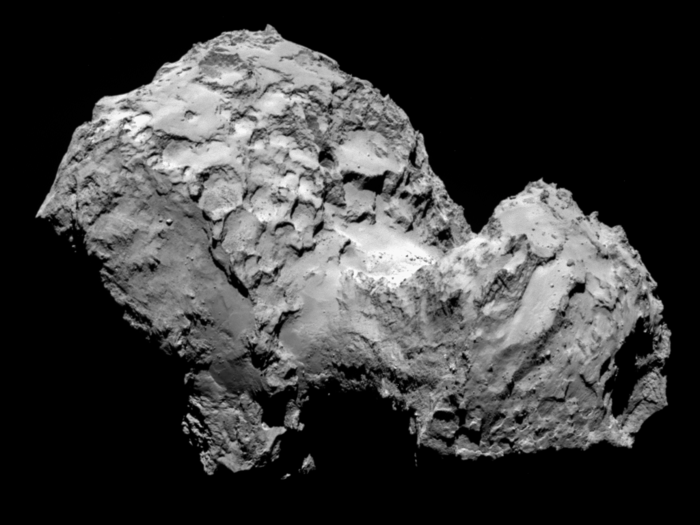 Comet 67P/Churyumov–Gerasimenko as it appeared on August 3.
The comet is in an elliptical 6.5-year orbit that takes it from beyond Jupiter at its furthest point, to between the orbits of Mars and Earth at its closest to the Sun. Rosetta will accompany it for over a year as they swing around the Sun and back out towards Jupiter again.
Comets are considered to be primitive building blocks of the Solar System and may have helped to ‘seed’ Earth with water, perhaps even the ingredients for life. But many fundamental questions about these enigmatic objects remain, and through a comprehensive,in situstudy of the comet, Rosetta aims to unlock the secrets within.
The journey to the comet was not straightforward, however. Since its launch in 2004, Rosetta had to make three gravity-assist flybys of Earth and one of Mars to help it on course to its rendezvous with the comet. This complex course also allowed Rosetta to pass by asteroids Šteins and Lutetia, obtaining unprecedented views and scientific data on these two objects.
 Sequence of images as Rosetta approached the comet.
“After ten years, five months and four days travelling towards our destination, looping around the Sun five times and clocking up 6.4 billion kilometres, we are delighted to announce finally ‘we are here’,” says Jean-Jacques Dordain, ESA’s Director General.
“Europe’s Rosetta is now the first spacecraft in history to rendezvous with a comet, a major highlight in exploring our origins. Discoveries can start.”
Today saw the last of a series of ten rendezvous manoeuvres that began in May to adjust Rosetta’s speed and trajectory gradually to match those of the comet. If any of these manoeuvres had failed, the mission would have been lost, and the spacecraft would simply have flown by the comet.
“Today’s achievement is a result of a huge international endeavour spanning several decades,” says Alvaro Giménez, ESA’s Director of Science and Robotic Exploration.
“We have come an extraordinarily long way since the mission concept was first discussed in the late 1970s and approved in 1993, and now we are ready to open a treasure chest of scientific discovery that is destined to rewrite the textbooks on comets for even more decades to come.”
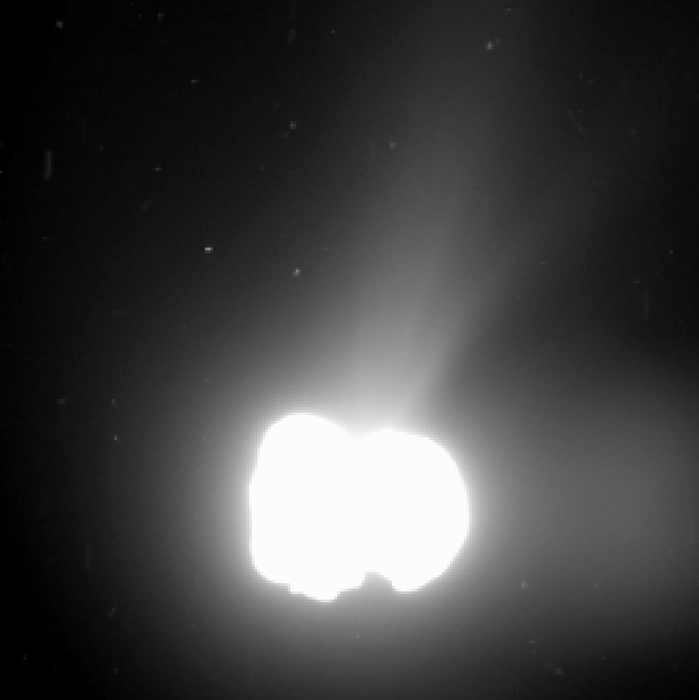
Comet 67P/Churyumov-Gerasimenko activity on 2 August 2014. The image
was taken by Rosetta’s OSIRIS wide-angle camera from a distance of 550 km.
The exposure time of the image was 330 seconds and the comet nucleus is
saturated to bring out the detail of the comet activity. Note there is a
ghost image to the right. The image resolution is 55 metres per pixel.
The comet began to reveal its personality while Rosetta was on its approach. Images taken by the OSIRIS camera between late April and early June showed that its activity was variable. The comet’s ‘coma’ – an extended envelope of gas and dust – became rapidly brighter and then died down again over the course of those six weeks.
In the same period, first measurements from the Microwave Instrument for the Rosetta Orbiter, MIRO, suggested that the comet was emitting water vapour into space at about 300 millilitres per second.
Meanwhile, the Visible and Infrared Thermal Imaging Spectrometer, VIRTIS, measured the comet’s average temperature to be about –70ºC, indicating that the surface is predominantly dark and dusty rather than clean and icy.
Then, stunning images taken from a distance of about 12 000 km began to reveal that the nucleus comprises two distinct segments joined by a ‘neck’, giving it a duck-like appearance. Subsequent images showed more and more detail – the most recent, highest-resolution image was downloaded from the spacecraft earlier today and will be available this afternoon.
“Our first clear views of the comet have given us plenty to think about,” says Matt Taylor, ESA’s Rosetta project scientist.
“Is this double-lobed structure built from two separate comets that came together in the Solar System’s history, or is it one comet that has eroded dramatically and asymmetrically over time? Rosetta, by design, is in the best place to study one of these unique objects.”
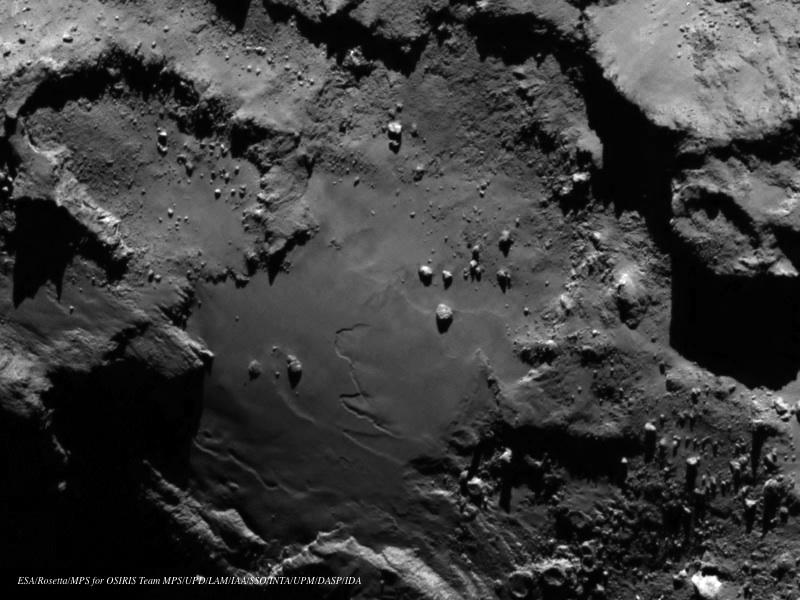
Twitter / esascience: LATEST! Stunning close up from @ESA_Rosetta
of comet #67P shows boulders, craters & cliffs http://ow.ly/A116s
Today, Rosetta is just 100 km from the comet’s surface, but it will edge closer still. Over the next six weeks, it will describe two triangular-shaped trajectories in front of the comet, first at a distance of 100 km and then at 50 km.
At the same time, more of the suite of instruments will provide a detailed scientific study of the comet, scrutinising the surface for a target site for the Philae lander.
Eventually, Rosetta will attempt a close, near-circular orbit at 30 km and, depending on the activity of the comet, perhaps come even closer.
“Arriving at the comet is really only just the beginning of an even bigger adventure, with greater challenges still to come as we learn how to operate in this unchartered environment, start to orbit and, eventually, land,” says Sylvain Lodiot, ESA’s Rosetta spacecraft operations manager.
As many as five possible landing sites will be identified by late August, before the primary site is identified in mid-September. The final timeline for the sequence of events for deploying Philae – currently expected for 11 November – will be confirmed by the middle of October.
“Over the next few months, in addition to characterising the comet nucleus and setting the bar for the rest of the mission, we will begin final preparations for another space history first: landing on a comet,” says Matt.
“After landing, Rosetta will continue to accompany the comet until its closest approach to the Sun in August 2015 and beyond, watching its behaviour from close quarters to give us a unique insight and realtime experience of how a comet works as it hurtles around the Sun.”
===
Rosetta will release a separate spacecraft called Philae to land on the comet:
From the caption;
Extended version of Philae touchdown animation to include visualisations of some of the science experiments on the lander.
The animation begins with the deployment of Philae from Rosetta at comet 67P/Churyumov–Gerasimenko in November 2014. Rosetta will come to within about 10 km of the nucleus to deploy Philae, which will take several hours to reach the surface. Because of the comet’s extremely low gravity, landing gear will absorb the small forces of landing while ice screws in the probe’s feet and a harpoon system will lock the probe to the surface. At the same time a thruster on top of the lander will push it down to counteract the impulse of the harpoon imparted in the opposite direction. Once it is anchored to the comet, the lander will begin its primary science mission, based on its 64-hour initial battery lifetime. The animation then shows five of Philae’s 10 instruments in action: CIVA, ROLIS, SD2, MUPUS and APXS.
Rosetta’s Philae lander is provided by a consortium led by DLR, MPS, CNES and ASI.
Here’s an animation showing the release and landing:
An announcement from the European Southern Observatory (ESO):
Triangulum Galaxy Snapped by VST
The VLT Survey Telescope (VST) at ESO’s Paranal Observatory in Chile has captured a beautifully detailed image of the galaxy Messier 33. This nearby spiral, the second closest large galaxy to our own galaxy, the Milky Way, is packed with bright star clusters, and clouds of gas and dust. The new picture is amongst the most detailed wide-field views of this object ever taken and shows the many glowing red gas clouds in the spiral arms with particular clarity.

Messier 33, otherwise known as NGC 598, is located about three million light-years away in the small northern constellation of Triangulum (The Triangle). Often known as the Triangulum Galaxy it was observed by the French comet hunter Charles Messier in August 1764, who listed it as number 33 in his famous list of prominent nebulae and star clusters. However, he was not the first to record the spiral galaxy; it was probably first documented by the Sicilian astronomer Giovanni Battista Hodierna around 100 years earlier.
Although the Triangulum Galaxy lies in the northern sky, it is just visible from the southern vantage point of ESO’s Paranal Observatory in Chile. However, it does not rise very high in the sky. This image was taken by the VLT Survey Telescope (VST), a state-of-the-art 2.6-metre survey telescope with a field of view that is twice as broad as the full Moon. This picture was created from many individual exposures, including some taken through a filter passing just the light from glowing hydrogen, which make the red gas clouds in the galaxies spiral arms especially prominent.
Among the many star formation regions in Messier 33’s spiral arms, the giant nebula NGC 604 stands out. With a diameter of nearly 1500 light-years, this is one of the largest nearby emission nebulae known. It stretches over an area 40 times the size of the visible portion of the much more famous — and much closer — Orion Nebula.
The Triangulum Galaxy is the third-largest member of the Local Group of galaxies, which includes the Milky Way, theAndromeda Galaxy, and about 50 other smaller galaxies. On an extremely clear, dark night, this galaxy is just visible with the unaided eye, and is considered to be the most distant celestial object visible without any optical help. Viewing conditions for the very patient are only set to improve in the long-term: the galaxy is approaching our own at a speed of about 100 000 kilometres per hour.
A closer look at this beautiful new picture not only allows a very detailed inspection of the star-forming spiral arms of the galaxy, but also reveals the very rich scenery of the more distant galaxies scattered behind the myriad stars and glowing clouds of NGC 598.
Here’s a brief video from NASA JPL about the status of the Curiosity Rover two years after it landing on Mars: Curiosity Rover Report (Aug. 5, 2014): A Softer Trek to Mount Sharp
On the second anniversary of landing, NASA’s Curiosity rover on Mars is preparing to navigate through a series of sandy valleys on its way to Mount Sharp. The base of Mount Sharp sits 3 kilometers (1.8 miles) from the rover’s current position.
And here is a release from NASA about the anniversary:
NASA Mars Curiosity Rover: Two Years and Counting on Red Planet
NASA’s most advanced roving laboratory on Mars celebrates its second anniversary since landing inside the Red Planet’s Gale Crater on Aug. 5, 2012, PDT (Aug. 6, 2012, EDT).
During its first year of operations, the Curiosity rover fulfilled its major science goal of determining whether Mars ever offered environmental conditions favorable for microbial life. Clay-bearing sedimentary rocks on the crater floor in an area called Yellowknife Bay yielded evidence of a lakebed environment billions of years ago that offered fresh water, all of the key elemental ingredients for life, and a chemical source of energy for microbes, if any existed there.
 This image from the Navigation Camera on NASA’s Curiosity Mars rover
shows wheel tracks printed by the rover as it drove on the sandy floor
of a lowland called “Hidden Valley” on the route toward Mount Sharp.
The image was taken on Aug. 4, 2014.› Full image and caption
“Before landing, we expected that we would need to drive much farther before answering that habitability question,” said Curiosity Project Scientist John Grotzinger of the California Institute of Technology, Pasadena. “We were able to take advantage of landing very close to an ancient streambed and lake. Now we want to learn more about how environmental conditions on Mars evolved, and we know where to go to do that.”
During its second year, Curiosity has been driving toward long-term science destinations on lower slopes of Mount Sharp. Those destinations are in an area beginning about 2 miles (3 kilometers) southwest of the rover’s current location, but an appetizer outcrop of a base layer of the mountain lies much closer — less than one-third of a mile (500 meters) from Curiosity. The rover team is calling the outcrop “Pahrump Hills.”
For about half of July, the rover team at NASA’s Jet Propulsion Laboratory in Pasadena, California, drove Curiosity across an area of hazardous sharp rocks on Mars called “Zabriskie Plateau.” Damage to Curiosity’s aluminum wheels from driving across similar terrain last year prompted a change in route, with the plan of skirting such rock-studded terrain wherever feasible. The one-eighth mile (200 meters) across Zabriskie Plateau was one of the longest stretches without a suitable detour on the redesigned route toward the long-term science destination.
Another recent challenge appeared last week in the form of unexpected behavior by an onboard computer currently serving as backup. Curiosity carries duplicate main computers. It has been operating on its B-side computer since a problem with the A-side computer prompted the team to command a side swap in February 2013. Work in subsequent weeks of 2013 restored availability of the A-side as a backup in case of B-side trouble. In July, fresh commanding of the rover was suspended for two days while engineers confirmed that the A-side computer remains reliable as a backup.
To help prepare for future human missions to Mars, Curiosity incudes a radiation detector to measure the environment astronauts will encounter on a round-trip between Earth and the Martian surface. The data are consistent with earlier predictions and will help NASA scientists and engineers develop new technologies to protect astronauts in deep space.
In 2016, a Mars lander mission called InSight will launch to take the first look into the deep interior of Mars. The agency also is participating in the European Space Agency’s (ESA’s) 2016 and 2018 ExoMars missions, including providing “Electra” telecommunication radios to ESA’s 2016 orbiter and a critical element of the astrobiology instrument on the 2018 ExoMars rover.
Additionally, NASA recently announced that its next rover going to Mars in 2020 will carry seven carefully selected instruments to conduct unprecedented investigations in science and technology, as well as capabilities needed for humans to pioneer the Red Planet.
Based on the design of the highly successful Mars Science Laboratory rover, Curiosity, the new rover will carry more sophisticated, upgraded hardware and new instruments to conduct geological assessments of the rover’s landing site, determine the potential habitability of the environment, and directly search for signs of ancient Martian life.
Scientists will use the Mars 2020 rover to identify and select a collection of rock and soil samples that will be stored for potential return to Earth by a future mission. The Mars 2020 mission is responsive to the science objectives recommended by the National Research Council’s 2011 Planetary Science Decadal Survey.
The Mars 2020 rover will help further advance our knowledge of how future human explorers could use natural resources available on the surface of the Red Planet. An ability to live off the Martian land would transform future exploration of the planet. Designers of future human expeditions can use this mission to understand the hazards posed by Martian dust and demonstrate technology to process carbon dioxide from the atmosphere to produce oxygen. These experiments will help engineers learn how to use Martian resources to produce oxygen for human respiration and potentially as an oxidizer for rocket fuel.
The Mars 2020 rover is part of the agency’s Mars Exploration Program, which includes the Opportunity and Curiosity rovers, the Odyssey and Mars Reconnaissance Orbiter spacecraft currently orbiting the planet, and the MAVEN orbiter, which is set to arrive at the Red Planet in September and will study the Martian upper atmosphere.
NASA’s Mars Exploration Program seeks to characterize and understand Mars as a dynamic system, including its present and past environment, climate cycles, geology and biological potential. In parallel, NASA is developing the human spaceflight capabilities needed for future round-trip missions to Mars.
Follow our progress on NASA’s Journey to Mars at:
For more information about Curiosity, visit: