The latest finding from the European Southern Observatory (ESO):
Planet-forming Lifeline Discovered in a Binary Star System
ALMA Examines Ezekiel-like “Wheel in a Wheel” of Dust and Gas
For the first time, researchers using ALMA have detected a streamer of gas flowing from a massive outer disc toward the inner reaches of a binary star system. This never-before-seen feature may be responsible for sustaining a second, smaller disc of planet-forming material that otherwise would have disappeared long ago. Half of Sun-like stars are born in binary systems, meaning that these findings will have major consequences for the hunt for exoplanets. The results are published in the journal Nature on 30 October 2014.
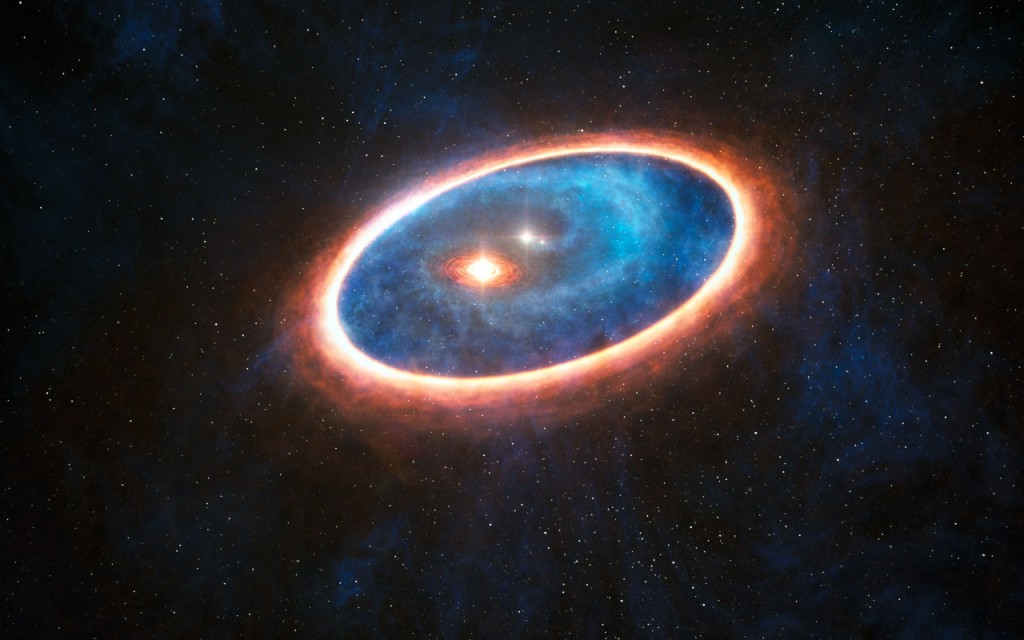
This artist’s impression shows the dust and gas around the double star system GG Tauri-A. Researchers using ALMA have detected gas in the region between two discs in this binary system. This may allow planets to form in the gravitationally perturbed environment of the binary. Half of Sun-like stars are born in binary systems, meaning that these findings will have major consequences for the hunt for exoplanets.
A research group led by Anne Dutrey from the Laboratory of Astrophysics of Bordeaux, France and CNRS used theAtacama Large Millimeter/submillimeter Array (ALMA) to observe the distribution of dust and gas in a multiple-star system called GG Tau-A [1]. This object is only a few million years old and lies about 450 light-years from Earth in the constellation of Taurus (The Bull).
Like a wheel in a wheel, GG Tau-A contains a large, outer disc encircling the entire system as well as an inner disc around the main central star. This second inner disc has a mass roughly equivalent to that of Jupiter. Its presence has been an intriguing mystery for astronomers since it is losing material to its central star at a rate that should have depleted it long ago.
While observing these structures with ALMA, the team made the exciting discovery of gas clumps in the region between the two discs. The new observations suggest that material is being transferred from the outer to the inner disc, creating a sustaining lifeline between the two [2].
“Material flowing through the cavity was predicted by computer simulations but has not been imaged before. Detecting these clumps indicates that material is moving between the discs, allowing one to feed off the other,” explains Dutrey. “These observations demonstrate that material from the outer disc can sustain the inner disc for a long time. This has major consequences for potential planet formation.”
Planets are born from the material left over from star birth. This is a slow process, meaning that an enduring disc is a prerequisite for planet formation. If the feeding process into the inner disc now seen with ALMA occurs in other multiple-star systems the findings introduce a vast number of new potential locations to find exoplanets in the future.
The first phase of exoplanet searches was directed at single-host stars like the Sun [3]. More recently it has been shown that a large fraction of giant planets orbit binary-star systems. Now, researchers have begun to take an even closer look and investigate the possibility of planets orbiting the individual stars of multiple-star systems. The new discovery supports the possible existence of such planets, giving exoplanet discoverers new happy hunting grounds.
Emmanuel Di Folco, co-author of the paper, concludes:
“Almost half the Sun-like stars were born in binary systems. This means that we have found a mechanism to sustain planet formation that applies to a significant number of stars in the Milky Way. Our observations are a big step forward in truly understanding planet formation.”
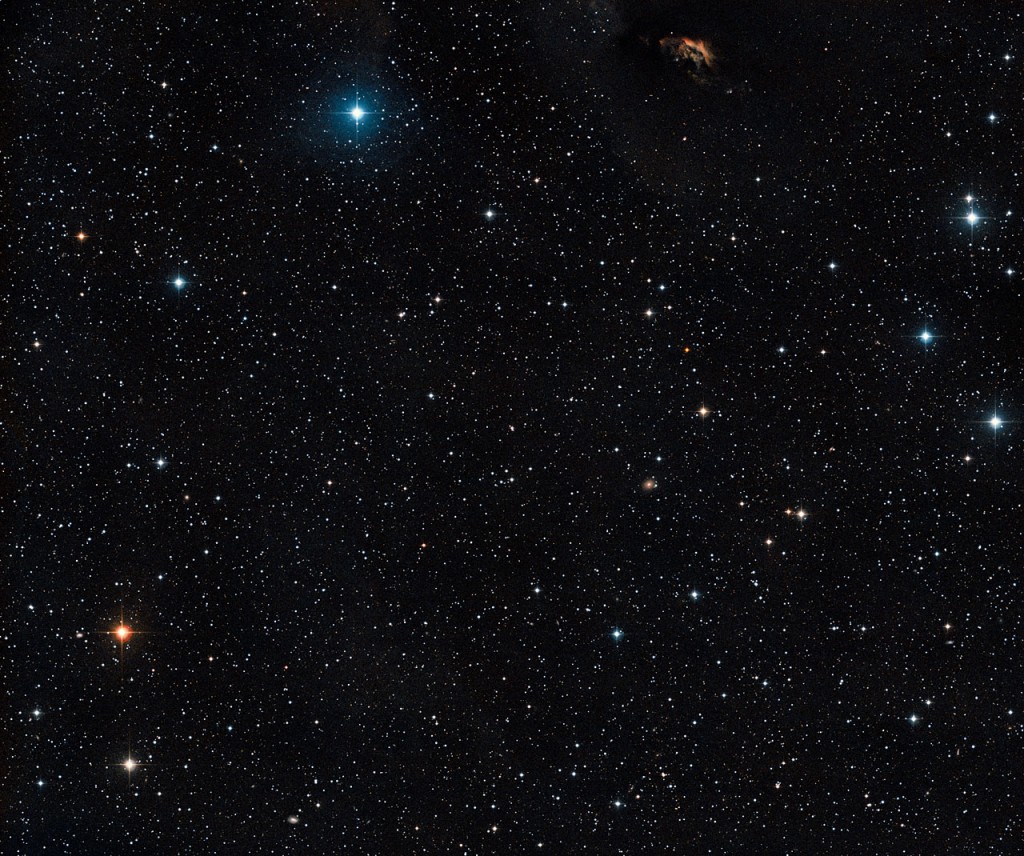
This wide-field view shows the sky around the young multiple star system GG Tauri, which appears very close to the centre of this picture. This view also shows a dust cloud and evidence of star formation near the top of the picture. This, like GG Tauri itself, is part of the Taurus Dark Cloud complex, one of the closest star-forming regions to Earth. Credit: ESO/Digitized Sky Survey 2. Acknowledgement: Davide De Martin