The latest NASA Space to Ground report on activities in the past week related to the Int. Space Station:
The latest NASA Space to Ground report on activities in the past week related to the Int. Space Station:
An announcement from the Heinlein Prize Trust:
The Heinlein Prize Trust
HEINLEIN AWARD
recognizes innovative solar sail propulsion used
in the MESSENGER mission to Mercury
The Robert A. and Virginia Heinlein Prize Trust’s new Heinlein Award honors
space-tested technology that can benefit commercial space activities.
The inaugural winner of the Heinlein Award for technology is Daniel J. O’Shaughnessy, the first to employ solar panels as sails to control the path of a spacecraft without using its rocket propulsion system.
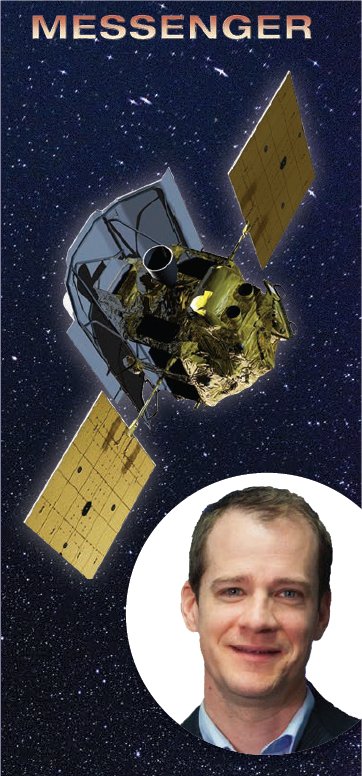
O’Shaughnessy is lead mission systems engineer for the MESSENGER spacecraft, built and operated by the Johns Hopkins University Applied Physics Laboratory, which manages this Discovery-class mission for NASA.
His technique was first used when the APL team accurately aimed MESSENGER for its first flyby of Mercury in 2008.
“This was the most critical part of the mission,” O’Shaughnessy says. “Performance was key, and I wanted to keep the risk low.”
The technology uses the force generated by sunlight to guide the craft, allowing for more precise — and less risky — course adjustment. It also conserves propellant, helping extend the life of the spacecraft and the mission.
Cost-efficient technology that is designed and implemented quickly is a hallmark of APL.
“Whenever we can reduce difficulty and cost, it helps accomplish our goals,” O’Shaughnessy says.
MESSENGER (MErcury Surface, Space ENvironment, GEochemistry, and Ranging) is a NASA-sponsored scientific investigation of Mercury and the first mission to orbit the planet closest to the Sun.
MESSENGER was launched August 3, 2004, and entered orbit on March 17, 2011. It’s on its second extended mission, scheduled to conclude in Spring 2015. Dr. Sean C. Solomon, director of Columbia University’s Lamont-Doherty Earth Observatory, leads the mission as principal investigator.
[MESSENGER Sails on Sun’s Fire for Second Flyby of Mercury – NASA – Sept.5.08]
• THE ROBERT A. & VIRGINIA HEINLEIN PRIZE TRUST •
Robert A. Heinlein™ was an American writer of speculative fiction who published more than 150 novels, short stories and articles.
The Heinlein Prize Trust is a nonprofit foundation that maintains the legacy of the late author and his wife, Virginia, by promoting the commercial uses of space.
The Heinlein Prize for Advances in Space Commercialization, founded in 1988, recognizes accomplishments which advance the couple’s dream of humanity’s future in space.
The Heinlein Award, introduced in 2014, recognizes the use of new technologies in space that can benefit commercial space activities.
Gerald W. Driggers, author of the Earth-Mar Chronicles book series, was interviewed on the Space Show this week: Gerald Driggers, Monday, 11-3-14 | Thespaceshow’s Blog,
They talked about the books and about Mars settlement in general.
A portion of the payment for the books goes to the Mars One project. Popular Science has an interesting extended article about the Mars One project and the motivations of those who want to sign up for it : Why Thousands Of People Are Willing To Die On Mars – Popular Science “More than 200,000 aspiring space explorers have volunteered for a one-way trip to Mars. Are they insane?”
The astronauts on the Int. Space Station have fun with a large ball of water and a GoPro camera: ISS Astronauts Encase GoPro In Orb Of Floating Water – Popular Science
Here is the 3D version:
An announcement from the European Southern Observatory (ESO):
Revolutionary ALMA Image Reveals Planetary Genesis
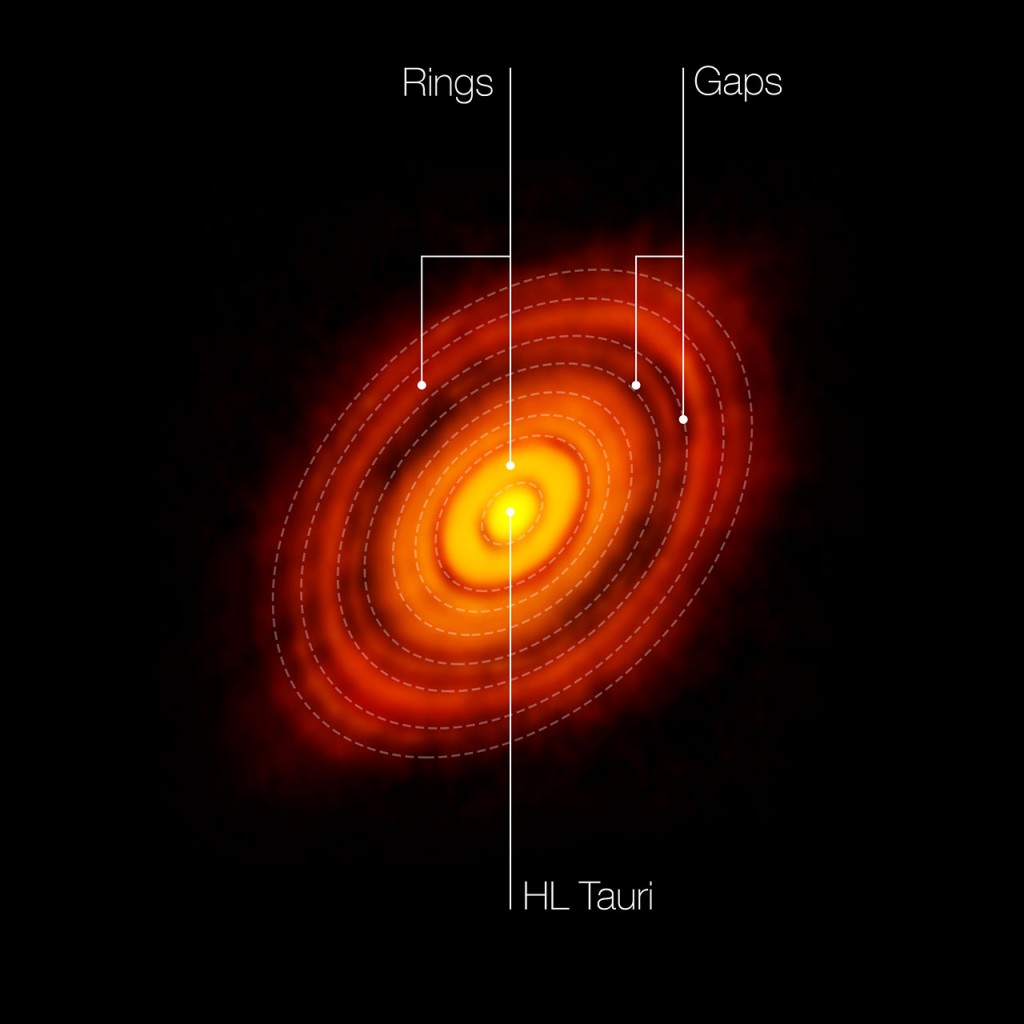
This new image from ALMA, the Atacama Large Millimeter/submillimeter Array, reveals extraordinarily fine detail that has never been seen before in the planet-forming disc around a young star. These are the first observations that have used ALMA in its near-final configuration and the sharpest pictures ever made at submillimetre wavelengths. The new results are an enormous step forward in the observation of how protoplanetary discs develop and how planets form.
For ALMA’s first observations in its new and most powerful mode, researchers pointed the antennas at HL Tauri — a young star, about 450 light-years away, which is surrounded by a dusty disc [1]. The resulting image exceeds all expectations and reveals unexpectedly fine detail in the disc of material left over from star birth. It shows a series of concentric bright rings, separated by gaps [2].
“These features are almost certainly the result of young planet-like bodies that are being formed in the disc. This is surprising since such young stars are not expected to have large planetary bodies capable of producing the structures we see in this image,” said Stuartt Corder, ALMA Deputy Director.
“When we first saw this image we were astounded at the spectacular level of detail. HL Tauri is no more than a million years old, yet already its disc appears to be full of forming planets. This one image alone will revolutionise theories of planet formation,” explained Catherine Vlahakis, ALMA Deputy Program Scientist and Lead Program Scientist for the ALMA Long Baseline Campaign.
HL Tauri’s disc appears much more developed than would be expected from the age of the system. Thus, the ALMA image also suggests that the planet-formation process may be faster than previously thought.
Such high resolution can only be achieved with the long baseline capabilities of ALMA and provides astronomers with new information that is impossible to collect with any other facility, even the NASA/ESA Hubble Space Telescope. “The logistics and infrastructure required to place antennas at such distant locations required an unprecedented coordinated effort by an expert international team of engineers and scientists,” said ALMA Director, Pierre Cox. “These long baselines fulfill one of ALMA’s major objectives and mark an impressive technological, scientific and engineering milestone.”
Young stars like HL Tauri are born in clouds of gas and fine dust, in regions which have collapsed under the effects of gravitation, forming dense hot cores that eventually ignite to become young stars. These young stars are initially cocooned in the remaining gas and dust, which eventually settles into a disc, known as a protoplanetary disc.
Through many collisions the dust particles will stick together, growing into clumps the size of sand grains and pebbles. Ultimately, asteroids, comets and even planets can form in the disc. Young planets will disrupt the disc and create rings, gaps and holes such as those seen in the structures now observed by ALMA [3].
The investigation of these protoplanetary discs is essential to our understanding of how Earth formed in the Solar System. Observing the first stages of planet formation around HL Tauri may show us how our own planetary system may have looked more than four billion years ago, when it formed.
“Most of what we know about planet formation today is based on theory. Images with this level of detail have up to now been relegated to computer simulations or artist’s impressions. This high resolution image of HL Tauri demonstrates what ALMA can achieve when it operates in its largest configuration and starts a new era in our exploration of the formation of stars and planets,” says Tim de Zeeuw, Director General of ESO.