Musicians Davide Cairo and Giacomo Muzzacato at The Creators Project have taken samples from NASA’s sound collection and created original music :
“It’s Pluto eve!” – Update on the New Horizons mission
Alan Stern, principle investigator for the New Horizons fly-by of Pluto mission, gives this update as they wait for next July’s encounter with the distant planet:
It’s Pluto Eve!
December 31, 2014: As 2014 ends and 2015 begins, I’m reminded of something senior planetary scientist and New Horizons science team member Rick Binzel said a while back: “It’s Pluto Eve!”
New Horizons has been awake from hibernation since mid-day on Dec. 6, having completed its almost nine-year-long cruise phase from Earth to “Pluto space.” We’re currently in the very earliest stages of Pluto approach.
Since waking New Horizons, we’ve been checking out spacecraft systems and some of the instruments, calibrating gyroscopes, collecting trajectory tracking information, and undertaking many other spacecraft preparations before the Pluto encounter starts on Jan. 15. At the same time, our science, engineering and operations teams have been planning and testing spacecraft command loads (detailed flight plans) for the first parts of encounter operations in early 2015. Needless to say, it’s been a busy time.
When the encounter begins we’ll still be very far from Pluto, about 135 million miles (220 million kilometers). We won’t get close enough to be at our “BTH” — Better than Hubble —imaging point until mid-May, but there is still a lot to do before then.
Throughout January to early-May, we’ll be taking essentially continuous data on the interplanetary environment where the Pluto system orbits. We’ll do that daily using our charged particle sensors (called PEPSSI and SWAP) to measure both solar wind and high-energy particles, and we’ll use the Venetia Burney Student Dust Counter to measure dust-particle concentrations in the inner reaches of the Kuiper Belt.
We’ll also do a great deal of radio tracking of New Horizons using NASA’s Deep Space Network to refine our knowledge of the approach trajectory, and we’ll use our Long-Range Reconnaissance Imager (LORRI) to take hundreds of pictures of Pluto against star fields to better refine the spacecraft’s distance to Pluto. Our navigation teams will use that information to compute burn solutions for midcourse maneuvers we may want to make using New Horizons’ rocket engines in mid-March and mid-May. We should know whether the March burn will be needed by early February and we’ll keep you posted.
Some other data we’ll be planning to take before May include:
- January, February and April: A series of better and better approach movies of Pluto and its satellites orbiting around it.
- April: Distant color imaging of Pluto and its large moon Charon, and brightness-variation measurements of smaller moons Nix and Hydra as they rotate on their axes.
The gap in imaging observations in March has been timed to give our ground teams a bit of a break before the sprint to Pluto encounter from April to July.
In all the images we’ll take through April, Pluto will just be a few pixels across at most, so the imagery will look like the Hubble images you may be familiar with. Nonetheless, these datasets will provide important science information because they will be taken from angles that can’t be observed from Earth, and taken more frequently than observations we typically make from the ground. We plan to release results from these approach observations one to several times each month, at a pace that quickens with time.
 Pluto as seen by the Hubble Space Telescope.
Back on Earth, from January to April, we’ll inspect all these datasets and determine what they can teach us about Pluto and its environment from afar. We’ll also be planning encounter command loads for both this period and for May and June, during which the pace of Pluto observations will increase dramatically (as will our resolution of Pluto). And our ground team will also further refine our trajectory information and range-to-Pluto measurements, conduct a final set of instrument checkouts, complete final training simulations for encounter, and build and test some of the software we’ll use to analyze the detailed Pluto-system data that begins flowing home in the later stage of approach in early summer.
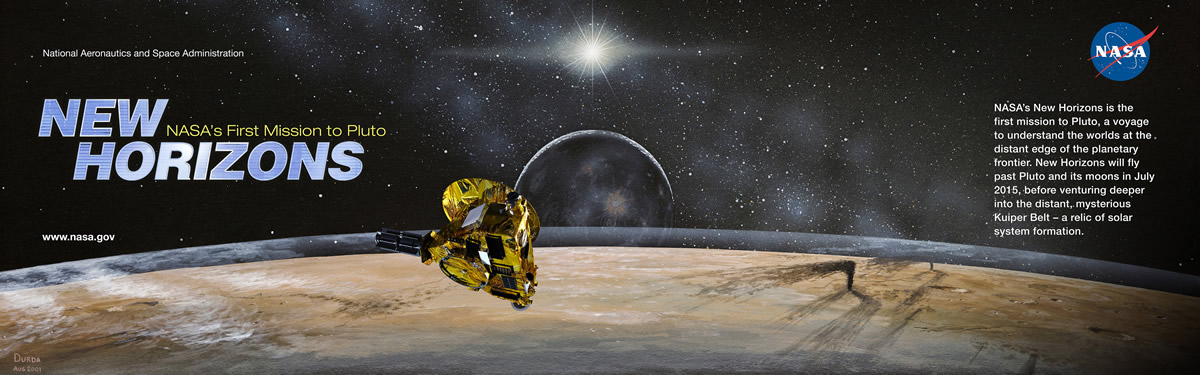 New Horizons: NASA’s First mission to the Pluto system (based
on an artist’s conception of Pluto by planetary scientist Dan Durda).
In early 2015 we also plan to celebrate the 85th anniversary of the discovery of Pluto — made in 1930. More on that soon, too.
We’ve been waiting for 2015 for so long, so I hope you have a safe and joyous New Year’s celebration. And until I write again, I hope you’ll keep exploring—just as we do!
– Alan Stern
The SETI record so far
Here’s a quick summary of SETI efforts over the past few decades : The search for ET: how close are we? – New Scientist.
Fire destroys GreenHab facility at Mars Desert Research Station
An announcement from the Mars Society:
MDRS GreenHab Destroyed by Fire
The Mars Society regrets to announce the loss of the Mars Desert Research Station’s Fisher GreenHab to an accidental fire yesterday afternoon (Dec. 29th). There were no injuries to Crew 146, the four-person team currently using the MDRS facility outside Hanksville, Utah.
According to a Mars Society spokesperson, the Habitat, which includes crew work stations and living quarters, did not sustain any damage, with the fire being limited to the GreenHab. Following MDRS emergency guidelines, crew members were able to safely put out the fire.
The Fisher GreenHab was the second GreenHab built at the Utah station. An earlier prototype structure was lost during the first MDRS field season due to heavy winds. It served as a model for the second generation GreenHab, a larger and more permanent unit built by Gary Fisher in 2003.

Interior of MDRS GreenHab prior to fire
For five seasons, the facility functioned as an experimental closed loop water recycling system, but testing ceased when it was concluded that the system was too small to maintain the Habitat with six full-time crew members.
In 2009 the GreenHab was refitted for use as a greenhouse. Under the direction of GreenHab Coordinator Nick Orenstein, it was successfully utilized for three seasons to grow crops for the MDRS crews. A variety of important experiments were scheduled to be carried out in the GreenHab during the current 2014-15 field season.
“We will work to erect a new GreenHab as soon as possible in order to conduct these critical research projects. With the help of our friends and supporters, I’m confident the Mars Society will be able to raise the necessary funds to replace the GreenHab in the very near future,” said MDRS Director Shannon Rupert.
To contribute to the Mars Society’s “Rebuild the GreenHab” Fund, please click here.
Sci-Tech: Focus fusion project update from LPPFusion, Inc.
LPPFusion, Inc., formerly Lawrenceville Plasma Physics, Inc, offers some updates on recent developments in their focus fusion program:
* Tungsten Cathode Nears Completion after Long Delays
The long-awaited tungsten cathode is finally nearing completion in a Chinese factory. According to the latest reports by California-based Tungsten Heavy Powder(THP), which is performing the work in China, machining will be complete within a few weeks and delivery to LPPFusion should occur by mid-February. The 99.95% pure tungsten piece has been in the machining process for nearly two months. Because pure tungsten is as brittle as ceramic and liable to cracking, the part must be removed from machining frequently and heat-treated to relieve internal stress.

Given the extreme difficult of making the tungsten cathode, why does LPPFusion not go directly to the final beryllium electrodes? The answer is that tungsten, with its extreme resistance to heat, is the lowest risk material for the next step of our experiment. We need to eliminate evaporation of the electrode and the resulting impurities to get a jump in the density of our plasmoid, and in the resulting fusion energy output or yield. We have firm experimental evidence that tungsten does not erode under the condition FF-1 is currently running. While we have developed and published well-founded theories of how pre-ionization can stop erosion of much less heat-resistant materials like beryllium, we still need to test those theories experimentally. That we can do safely with tungsten, with risking damage to the electrodes or disappointing fusion results. In this way we will confirm or refine the theories and technique, paving the way for the beryllium electrodes.
Those beryllium electrodes will be ready when we need them. We expect to order them in January, with delivery in the first half of 2015.
* LPPF Releases Processed Data to Researchers and the Public
LPPFusion, Inc. has made available on our website the data in ourProcessed Data Base to all researchers, both professional and amateur. This data provides the key observations for each shot from the start of operation of Focus Fusion-1 in 2009 through the end of 2013 for four instruments: the Main Rogowski coil (MRC), High Voltage Probe (HVP), the Near Time of Flight (NTF) and Far Time of Flight (FTF) detectors. This gives data on the current and voltage produced during a shot and the neutrons and x-rays emitted. We are making this data publically available in the expectation that other researchers will be able to use the data to provide new insights into the functioning of the Dense Plasma Focus device and advance the field generally.
* Physics of Plasmas Publishes LPPFusion’s Runaway Electron Theory
Physics of Plasmas, the leading journal in the field of plasma physics, has published LPPFusion’s new paper on “Runaway electrons as a source of impurity and reduced fusion yield in the dense plasma focus”. The paper, by Chief Scientist Eric J. Lerner and Chief Research Officer Hamid R. Yousefi, was published online October 22, 2014 less than a month after it was submitted for peer-review. Physics of Plasmas had published a previous LPPFusion paper on record-breaking ion energies in 2012.
The new paper describes the evidence that runaway electrons are a key cause of vaporization of electrodes in the dense plasma focus device, an idea first reported on LPPFusion’s website in April of this year. Runaway electrons occur when very strong electric fields, such as in lightning bolts, accelerate electrons moving through a mainly neutral gas. If the field is strong enough the electrons gain more energy between each collision with an atom than they lose in the collision, thus speeding up to high energy.