Dawn probe moves closer to dwarf planet Ceres

NASA’s Dawn is getting closer to Ceres, the largest asteroid and now classified as a dwarf planet. Ceres is particularly interesting because it has a thick layer of water ice.

Dawn Spacecraft Begins Approach to Dwarf Planet Ceres

• Dawn has entered its approach phase toward Ceres
• The spacecraft will arrive at Ceres on March 6, 2015

NASA’s Dawn spacecraft has entered an approach phase in which it will continue to close in on Ceres, a Texas-sized dwarf planet never before visited by a spacecraft. Dawn launched in 2007 and is scheduled to enter Ceres orbit in March 2015.
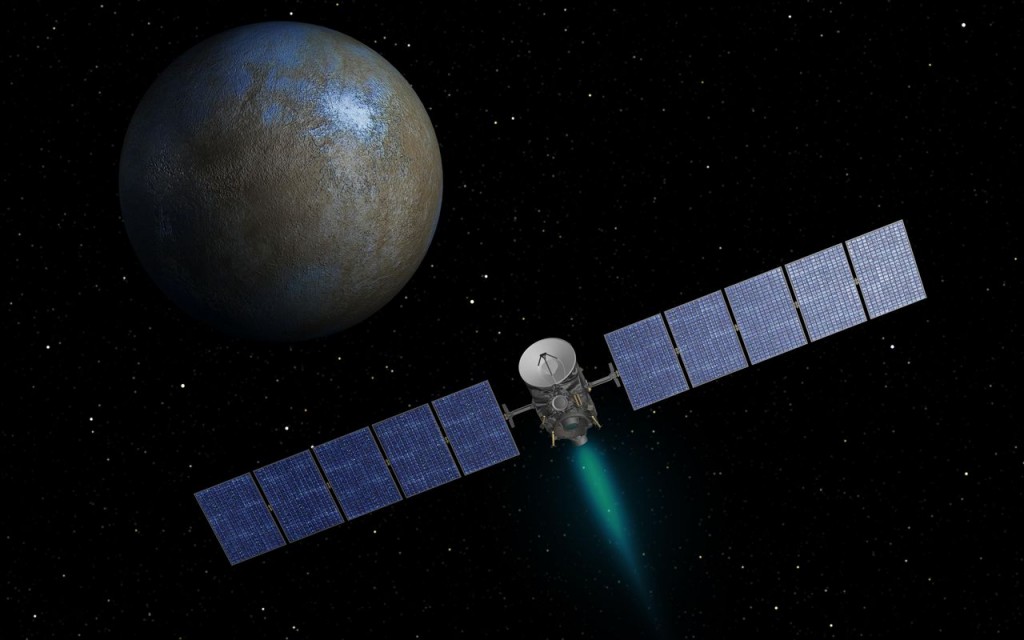
PIA17650-1280x800[1]This artist’s concept shows NASA’s Dawn spacecraft heading
toward the dwarf planet Ceres. Image credit: NASA/JPL-Caltech

Dawn recently emerged from solar conjunction, in which the spacecraft is on the opposite side of the sun, limiting communication with antennas on Earth. Now that Dawn can reliably communicate with Earth again, mission controllers have programmed the maneuvers necessary for the next stage of the rendezvous, which they label the Ceres approach phase. Dawn is currently 400,000 miles (640,000 kilometers) from Ceres, approaching it at around 450 miles per hour (725 kilometers per hour).

The spacecraft’s arrival at Ceres will mark the first time that a spacecraft has ever orbited two solar system targets. Dawn previously explored the protoplanet Vesta for 14 months, from 2011 to 2012, capturing detailed images and data about that body.

“Ceres is almost a complete mystery to us,” said Christopher Russell, principal investigator for the Dawn mission, based at the University of California, Los Angeles. “Ceres, unlike Vesta, has no meteorites linked to it to help reveal its secrets. All we can predict with confidence is that we will be surprised.”

fulltraj[1]The trajectory of the Dawn spacecraft has it moves from
Vesta to Ceres. (Larger image)

The two planetary bodies are thought to be different in a few important ways. Ceres may have formed later than Vesta, and with a cooler interior. Current evidence suggests that Vesta only retained a small amount of water because it formed earlier, when radioactive material was more abundant, which would have produced more heat. Ceres, in contrast, has a thick ice mantle and may even have an ocean beneath its icy crust.

Ceres, with an average diameter of 590 miles (950 kilometers), is also the largest body in the asteroid belt, the strip of solar system real estate between Mars and Jupiter. By comparison, Vesta has an average diameter of 326 miles (525 kilometers), and is the second most massive body in the belt.

The spacecraft uses ion propulsion to traverse space far more efficiently than if it used chemical propulsion. In an ion propulsion engine, an electrical charge is applied to xenon gas, and charged metal grids accelerate the xenon particles out of the thruster. These particles push back on the thruster as they exit, creating a reaction force that propels the spacecraft. Dawn has now completed five years of accumulated thrust time, far more than any other spacecraft.

“Orbiting both Vesta and Ceres would be truly impossible with conventional propulsion. Thanks to ion propulsion, we’re about to make history as the first spaceship ever to orbit two unexplored alien worlds,” said Marc Rayman, Dawn’s chief engineer and mission director, based at NASA’s Jet Propulsion Laboratory in Pasadena, California.

The next couple of months promise continually improving views of Ceres, prior to Dawn’s arrival. By the end of January, the spacecraft’s images and other data will be the best ever taken of the dwarf planet.

The Dawn mission to Vesta and Ceres is managed by JPL, a division of the California Institute of Technology in Pasadena, for NASA’s Science Mission Directorate, Washington. UCLA is responsible for overall Dawn mission science.

More information about Dawn: dawn.jpl.nasa.gov.

—

Here’s a video showing Dawn’s images of Vesta in a manner that provides a 3D like view of the asteroid:

‘To The Stars International Quarterly’ – January 2015 issue now available

The Moon Society and the National Space Society (NSS) offer the tenth issue of the To The Stars International Quarterly (pdf). The 170 page file is “loaded with space news, color photos, and interesting articles”.

In addition to the Moon Society and the NSS, contributing organizations include Space Renaissance Initiative,  The Mars Foundation,  Open Luna Foundation, and the Students for the Exploration and Development of Space (SEDS).

Here is the Table of Contents:

2 Co-sponsoring Organizations
NEWS SECTION pp. 3-119
3-26 Earth Orbit and Mission to Planet Earth
27-29 Space Tourism
30-48 Cislunar Space and the Moon
49-75 Mars
76-89 Asteroids & Comets
90-107 Other Planets & their moons
108-119 Starbound
ARTICLES, ESSAYS pp 120-160
120 Are we ever going to Settle the Moon? – Peter Kokh
A fresh look at the idea of “Spinning-up” Industries Needed on the Moon – Peter Kokh
122 Exports to Earth need to be greater in value than imports from Earth; The “MUS/cle.” Equation
123 Biospheric Technologies needed on the Moon – and on Earth – Peter Kokh
124 We Need More Good & Realistic Moon & Mars Outpost & Settlement Art – Peter Kokh
125 SHIELDING: “The Good, the Bad, the Ugly” > ”The Drab, the Nice, the Beautiful“- Peter Kokh
127 Fun Time About Names: “Sun” “Earth” “Moon” – Peter Kokh
128 Meeting the Threat of Orbital Debris Authors – Al Anzaldua and David Dunlop
151 From Power Beaming at the International Space Station to Tethered Balloons, Proposed Cubesats and a Growing Network of First Nations° Connected Organizations – Dave Dunlop,
158 The Emerging Lunar Reconvergence – Dave Dunlop
162 Online Op-Ed Articles from other writers worth reading
STUDENTS & TEACHERS pp 161-164
165 NASA Launches Student Contest for 3D-Printed Astronaut Tools
166 Contestant gets to name new ISS “Droid”;
167 PISCES to host winning mooniest team; The “Cities at Night Project” is asking for your help.
167 NASA Selects student teams for High Powered Rocket Challenge
169 Feature Articles and Essays in our sister publications: Ad Astra and Moon Miners’ Manifesto
ATTSIQ #10 page 1 JANUARY 2015

Previous TTSIQ issues are available at: www.moonsociety.org/international/ttsiq/ and at: www.nss.org/tothestars/.

UV telescope on China’s Chang’e 3 lander images a galaxy from the Moon

As noted here  back in March (see First images from the UV telescope on Chang’e-3 lander), the International Lunar Observatory Association (ILOA) based in Hawaii is collaborating with the National Astronomical Observatories -Chinese Academy of Sciences (NAOC) and the China National Space Administration (CNSA) in the use of the Lunar Ultraviolet Telescope (LUT) on the Chang’e 3 spacecraft that landed on the lunar surface in December 2013.

It has long been proposed that the Moon could provide an excellent location on which to do astronomical observations. It provides a stable platform for telescopes and has no atmosphere to blur images or to block UV light. Though the LUT is  is a very small telescope, it sets a precedent for lunar astronomy.

Galaxy observation is a key goal of the LUT and the ILOA yesterday posted the following in the Lunar Enterprise Daily:

Moon-Based Telescope Observation Of M101 Spiral
Is First Galaxy Imaged From The Moon

m101GalaxyFromMoon1214[1]

Great Astronomy From The Moon Potential Confirmed By China Chang’e-3 Lunar Ultraviolet Telescope LUT Observations On 2 December At Beginning Of Lunar Day 13;

Iconic 2014 Photo To Be Refined Further By NAOC Astronomers In Beijing, In Collaboration With ILOA And UHH, CFHT Lunar Astronomy Team On Hawai`i Island USA, Introducing Bright, Robust New Year 2015

Image Credit: National Astronomical Observatories of China & International Lunar Observatory Association; University of Hawaii Hilo, Canada France Hawaii Telescope

Video: Aurora Borealis as seen from northern Sweden

Chad & Linnea Blakley of  Lights Over Lapland assist

people from all reaches of the globe see and photograph the magical aurora borealis in Abisko National Park, Sweden. We offer a full range of photo adventures including five-day all inclusive Aurora Photo Expeditions, nightly aurora photo trips with all camera gear provided and virtually any customizable aurora holiday that you can imagine. We are proud of the fact that we were the first aurora photo tour in the area and that our Nightly aurora phot tour is the highest ranked activity in Abisko National Park on Tripadvisor. 

They provide a collection of northern lights videos at Lights Over Lapland on Vimeo. Here are two recent additions:

See the HobbySpace Aurora page for news and resources.


Everyone can participate in space