Videos: “Space to Ground” & other space habitat reports – Dec.3.2021

Here is the latest episode in NASA’s Space to Ground weekly report on activities related to the International Space Station:

** Expedition 66 Spacewalk 78 Animation – November 29, 2021 – NASA

This animation discusses U.S. Spacewalk 78 in which NASA Astronauts Thomas Marshburn and Kayla Barron will replace a faulty S-band Antenna Subassembly, or SASA, with a spare antenna system already attached to the space station’s exterior. Marshburn and Barron will work at the Port 1 (P1) truss structure, where the antenna is mounted. The antenna recently lost its ability send signals to Earth via NASA’s Tracking and Data Relay Satellite System in mid-September, but because of several redundancies on station, did not make a significant impact to station operations. This is the first spacewalk to replace a SASA since Joe Tanner and Heidi Stefanyshyn-Piper replaced a SASA on the S1 truss during STS-115 on Sept. 16, 2006.

** NASA Spacewalk to Replace Space Station Antenna – NASA

Watch NASA astronauts Kayla Barron and Thomas Marshburn venture outside the International Space Station on Dec. 2 to replace a faulty antenna system. The antenna recently lost its ability to transmit low-rate voice communications and data to flight controllers in mission control, although it has had a limited impact on operations. The two astronauts will replace it with a spare.

The spacewalkers are expected to turn their spacesuits on to battery power at about 7:10 a.m. EST for an excursion slated to last about 6.5 hours. Marshburn will serve as extravehicular crew member 1 (EV 1), wearing a spacesuit with red stripes, and Barron will be extravehicular crew member 2 (EV 2), wearing a spacesuit with no stripes. European Space Agency astronaut Matthias Maurer will provide support from inside the orbiting laboratory, maneuvering the Canadarm2 robotic arm that will carry Marshburn. This will be the fifth spacewalk for Marshburn, and the first for Barron.

** ISSRDC 2021: The Next Decade of ISS Research – ISS National Lab – YouTube

The National Academies of Sciences, Engineering, and Medicine (NASEM) will be developing the next Decadal Survey on Biological and Physical Sciences Research in Space 2023-2032, which will serve as a critical framework to shape the upcoming vision and strategic plan for research efforts in the areas of biological and physical sciences in space. In this session, representatives from NASEM, NASA, the ISS National Lab, and the European Space Agency will discuss the future of space-based research on the ISS that can expand scientific knowledge while benefiting both space exploration and life on Earth.

Moderator: Jeff Foust: Senior Space Writer, Space News

Panelists: Krystyn J. Van Vliet, Ph.D.: Michael and Sonja Koerner Professor of Materials Science and Engineering, MIT and co-chair of the Decadal Survey on Biological and Physical Sciences Research in Space Doug Matson, Ph.D.: Associate Professor, Mechanical Engineering, Tufts and ISSNL User Advisory Committee, Chair Tara Ruttley, Ph.D.: Associate Chief Scientist for Microgravity Research, NASA Thomas Driebe, Ph.D.: Head of Physical and Material Sciences Group in the Research & Exploration Department, DLR Space Agency, (German Aerospace Center) Richard Hughson, Ph.D.: Schlegel Research Chair in Vascular Aging and Brain Health, Schlegel-University of Waterloo Research Institute for Aging, and Fellow, Canadian Academy of Health Sciences.

** ISSRDC 2021: In Space Production Applications in the Low Earth Orbit Economy (Part 1) – ISS National Lab – YouTube

To build a vibrant economy in space, it is critical that we identify products and services, advance technology development, and prove manufacturing processes for a sustainable and scalable market. The ISS is the only crewed orbital laboratory to be leveraged as a proving ground for in-space production leading to the future space-based economy. How might we best leverage the ISS toward that future? In the first session, we will discuss why this area is important to the nation and to the future of spaceflight.

Moderator: Alex MacDonald: Chief Economist, NASA and ISS National Lab Program Executive Panelists: Olivier de Weck, Ph.D.: Professor of Aeronautics and Astronautics and Engineering Systems, MIT Ken Savin, Ph.D.: Senior Program Director of In-Space Production, CASIS (manager of the ISS National Lab) Christian Maender: Director, In-Space Manufacturing & Research, Axiom Space Ryan Prouty: Manager, Research Integration Office, International Space Station Program, NASA

** ISSRDC 2021: In Space Production Applications in the Low Earth Orbit Economy (Part 2) – ISS National Lab – YouTube

To build a vibrant economy in space, it is critical that we identify products and services, advance technology development, and prove manufacturing processes for a sustainable and scalable market. The ISS is the only crewed orbital laboratory to be leveraged as a proving ground for in-space production leading to the future space-based economy. How might we best leverage the ISS toward that future? In the second session, we will dive into the perspectives from trailblazers in this area. What has to happen for more people to join the effort in shaping a robust and sustainable economy in low Earth orbit?

Moderator: Meagan Crawford: Managing Partner, SpaceFund Panelists: Rich Boling: Vice President of Corporate Advancement, Techshot, Kevin DiMarzio: Vice President, Business Development, Redwire Space Yusuf Erkul, M.D., CEO Co-Founder, Kernal Biologics

** Chinese space station living! Exercise, puzzle games & an Earth time-lapse – VideoFromSpace / CCTV Video News Agency

Chinese taikonauts Zhai Zhigang, Wang Yaping and Ye Guangfu are currently serving aboard the Tiangong space station in low-Earth orbit. Along with their space station duties they find time for exercise and puzzle games. Full Story: https://www.space.com/china-shenzhou-…

** Tiangong space station flies over china in amazing real-time & time-lapsed footage – VideoFromSpace / CCTV Video News Agency

See the China’s Tiangong space station fly over several locations in China in these views captured in October 2021.

** NASA Selects Companies to Develop Commercial Destinations in Space | NASA

====
=== Amazon Ads ===

LEGO Ideas International Space Station Building Kit,
Adult Set for Display,
Makes a Great Birthday Present
(864 Pieces)

====

Outpost in Orbit:
A Pictorial & Verbal History of the Space Station

Night sky highlights for December 2021

** What’s Up: December 2021 Skywatching Tips from NASA – NASA JPL

What are some skywatching highlights in December 2021? See three planets after sunset, but say goodbye to Venus as the “Evening Star” at the end of the month. Then have a hunt for newly discovered Comet Leonard in the early morning through mid-month. Finally, get up early on Dec. 14 to watch for Geminid meteors after local moonset, around 2 a.m. Additional information about topics covered in this episode of What’s Up, along with still images from the video, and the video transcript, are available at https://solarsystem.nasa.gov/whats-up….

** Tonight’s Sky: December– Space Telescope Science Institute – Tonight’s Sky

Step outside on a cold December night when the stars shine bright to find the Big Dipper, Cassiopeia, and Cepheus. They will help you locate a binary star system, a fan-shaped open star cluster, and a variable star. Stay tuned for space-based views of a ragged spiral galaxy, an open star cluster, and an edge-on galaxy.

** What to see in the night sky: December 2021 – BBC Sky at Night Magazine

What can you see in the night sky tonight? Pete Lawrence and Paul Abel December 2021’s night-sky highlights.

** What’s in the Night Sky December 2021 #WITNS | Comet Leonard | Geminid Meteor Shower | Solar Eclipse – Alyn Wallace

** Night Sky Notebook December 2021 – Peter Detterline

** See also:

=== Amazon Ad ===

Stellaris: People of the Stars

===

Envisioning Exoplanets:
Searching for Life in the Galaxy

ESO: VLT uncovers closest pair of supermassive black holes yet found

The latest report from  ESO (European Southern Observatory):

ESO telescope uncovers closest pair of supermassive black holes yet

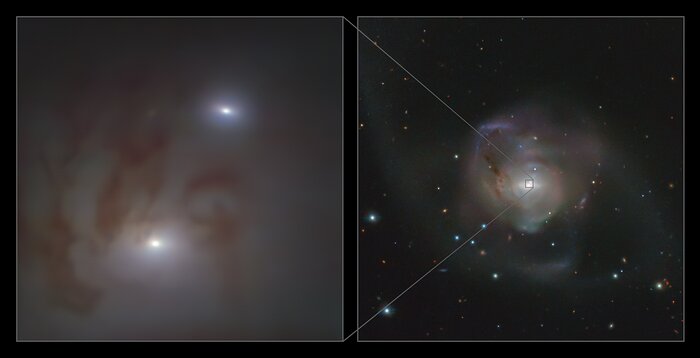
This image shows close-up (left) and wide (right) views of the two bright galactic nuclei, each housing a supermassive black hole, in NGC 7727, a galaxy located 89 million light-years away from Earth in the constellation Aquarius. Each nucleus consists of a dense group of stars with a supermassive black hole at its centre. The two black holes are on a collision course and form the closest pair of supermassive black holes found to date. It is also the pair with the smallest separation between two supermassive black holes found to date — observed to be just 1600 light-years apart in the sky.   The image on the left was taken with the MUSE instrument on ESO’s Very Large Telescope (VLT) at the Paranal Observatory in Chile while the one on the right was taken with ESO’s VLT Survey Telescope.

Using the European Southern Observatory’s Very Large Telescope (ESO’s VLT), astronomers have revealed the closest pair of supermassive black holes to Earth ever observed. The two objects also have a much smaller separation than any other previously spotted pair of supermassive black holes and will eventually merge into one giant black hole.

Located in the galaxy NGC 7727 in the constellation Aquarius, the supermassive black hole pair is about 89 million light-years away from Earth. Although this may seem distant, it beats the previous record of 470 million light-years by quite some margin, making the newfound supermassive black hole pair the closest to us yet.

Supermassive black holes lurk at the centre of massive galaxies and when two such galaxies merge, the black holes end up on a collision course. The pair in NGC 7727 beat the record for the smallest separation between two supermassive black holes, as they are observed to be just 1600 light-years apart in the sky.

“It is the first time we find two supermassive black holes that are this close to each other, less than half the separation of the previous record holder,”

says Karina Voggel, an astronomer at the Strasbourg Observatory in France and lead author of the study published online today in Astronomy & Astrophysics.

“The small separation and velocity of the two black holes indicate that they will merge into one monster black hole, probably within the next 250 million years,”

adds co-author Holger Baumgardt, a professor at the University of Queensland, Australia. The merging of black holes like these could explain how the most massive black holes in the Universe come to be.

Voggel and her team were able to determine the masses of the two objects by looking at how the gravitational pull of the black holes influences the motion of the stars around them. The bigger black hole, located right at the core of NGC 7727, was found to have a mass almost 154 million times that of the Sun, while its companion is 6.3 million solar masses.

Just as people at a busy crossroad may accidentally bump into each other, so too can galaxies in the Universe! But in this case, the outcome is more dramatic than a small nudge. When two galaxies clash, they merge into each other, giving birth to a new, bigger one. One example is the NGC 7727 galaxy, shown in this image from ESO’s VLT Survey Telescope (VST) in Chile. Located 89 million light-years away from Earth in the constellation Aquarius, NGC 7727 is believed to be the result of a clash between two galaxies that occurred about one billion years ago. The consequences of this tremendous cosmic bump are still evident in the peculiar, irregular shape of NGC 7727 and the streams of stars in its outer regions.  The image was taken in visible light as part of the VST-ATLAS survey. The goal of the survey is to map a vast region of the Southern Sky — so large you could fit about 19,000 full moons in it! By studying the galaxies in this region, astronomers aim to shed new light on the nature of dark energy, the mysterious force permeating the Universe and causing its accelerating expansion.

It is the first time the masses have been measured in this way for a supermassive black hole pair. This feat was made possible thanks to the close proximity of the system to Earth and the detailed observations the team obtained at the Paranal Observatory in Chile using the Multi-Unit Spectroscopic Explorer (MUSE) on ESO’s VLT, an instrument Voggel learnt to work with during her time as a student at ESO. Measuring the masses with MUSE, and using additional data from the NASA/ESA Hubble Space Telescope, allowed the team to confirm that the objects in NGC 7727 were indeed supermassive black holes.

Astronomers suspected that the galaxy hosted the two black holes, but they had not been able to confirm their presence until now since we do not see large amounts of high-energy radiation coming from their immediate surroundings, which would otherwise give them away.

“Our finding implies that there might be many more of these relics of galaxy mergers out there and they may contain many hidden massive black holes that still wait to be found,” says Voggel. “It could increase the total number of supermassive black holes known in the local Universe by 30 percent.”

The search for similarly hidden supermassive black hole pairs is expected to make a great leap forward with ESO’s Extremely Large Telescope (ELT), set to start operating later this decade in Chile’s Atacama Desert.

“This detection of a supermassive black hole pair is just the beginning,” says co-author Steffen Mieske, an astronomer at ESO in Chile and Head of ESO Paranal Science Operations. “With the HARMONI instrument on the ELT we will be able to make detections like this considerably further than currently possible. ESO’s ELT will be integral to understanding these objects.”

Links

=== Amazon Ads ===

Stellaris: People of the Stars

===

More Things in the Heavens:
How Infrared Astronomy Is Expanding
Our View of the Universe

The Space Show this week – Nov.29.2021

The guests and topics of discussion on The Space Show this week:

1. Tuesday, Nov. 30, 2021; 7 pm PST (9 pm CST, 10 pm EST): We welcome Dr. Brian Weeden to discuss the recent Russian ASAT test plus more on space policy for the year.

2. Hotel Mars – Wednesday, Dec.1.2021: TBD. See the Space Show Newsletter for updates.

3. Friday, Dec.3, 2021; 9:30-11 am PST (11:30 am-1 pm CST, 12:30-2 pm EST): No Friday show this week.

4. Sunday, Dec.5, 2021; 12-1:30 pm PST (2-3:30 pm CST, 3-4:30 pm EST): We welcome back Michael Listner, Atty, for a 2021 review of space law and policy.

Some recent shows:

** Sunday, Nov.28.2021 – Ryan Reynolds “joined us [transitioning] from being an Open Lines first time caller to a Space Guest. We talked [about] getting more people interested in space, Ryan had some new ideas that got lots of discussion, we [also] talked settlement and more.”

** Tuesday, Nov.23.2021 – Dr. Wendell Mendell discussed “current developments with NASA, NewSpace, lunar return and much more“.

** Sunday, Nov.21.2021 – Charles Miller gave an update on Lynk Global, the company he co-founded to provide mobile phone broadband services with a low earth orbit constellation of satellites.

** Friday, Nov.19.2021 – Kasper Kubica discussed “his idea for $10 million luxury condos in free space as a way to kick off space settlement. His proposed structure which you will hear discussed was very much like a typical condominium structure and project here on Earth other than our guest modeled his condos on high end luxury units being sold in NYC“.

** See also:
* The Space Show Archives
* The Space Show Newsletter
* The Space Show Shop

The Space Show is a project of the One Giant Leap Foundation.

The Space Show - David Livingston
The Space Show – Dr. David Livingston

=== Amazon Ads ===

Liftoff: Elon Musk and the Desperate Early Days
That Launched SpaceX

===

Envisioning Exoplanets:
Searching for Life in the Galaxy

Videos: “Space to Ground” & other space habitat reports – Nov.26.2021

Here is the latest episode in NASA’s Space to Ground weekly report on activities related to the International Space Station:

** Thanksgiving Message from the International Space Station – NASA

Aboard the International Space Station, NASA astronauts Mark Vande Hei, Raja Chari, Tom Marshburn and Kayla Barron and ESA (European Space Agency) astronaut Matthias Maurer shared their thoughts about spending Thanksgiving in orbit and the foods they plan to enjoy. Vande Hei is in the midst of a year-long mission, while Chari, Marshburn, Barron and Maurer arrived on the space station Nov. 11 for a planned six-month mission. Together, they’re living and working aboard the microgravity laboratory to advance scientific knowledge and demonstrate new technologies for future human spaceflight missions

** STEMonstrations: Moment of Inertia – NASA

NASA Astronauts Megan McArthur and Shane Kimbrough discuss moment of inertia and its effects on rotating objects. Watch as Megan demonstrates what happens to her angular speed as she alters her moment of inertia in microgravity aboard the International Space Station. Be sure to check out https://www.nasa.gov/stemonstrations for more videos like this, along with their corresponding classroom connection lesson plans.

** New Space Station Module Docks to the International Complex – NASA

The Russian “Prichal” Node Module and the attached Progress M-UM docked to the “Nauka” Multipurpose Laboratory (MLM) of the International Space Station November 26 following a launch from the Baikonur Cosmondrome in Kazakhstan on November 24. The node module will serve as a multi-hatch docking port for Russian visiting vehicles to the complex.

** Expedition 66 ESA Education Event – November 24, 2021 – NASA Video

Aboard the International Space Station, Expedition 66 flight engineer Mattias Maurer of ESA (European Space Agency) discussed living and working in space during an in-flight downlink November 24 with students from Germany, the Czech Republic, and Ireland. Maurer launched in November on the SpaceX Crew Dragon Endurance for a planned six-month science mission to advance scientific knowledge and demonstrate new technologies for future human and robotic exploration missions.

** Expedition 66 – Northrup Grumman Cygnus 16 Release – November 202, 2021 – NASA Video

More than three months after arriving at the International Space Station to deliver more than three tons of food, supplies and scientific experiments, the unpiloted Northrop Grumman “SS Ellison Onizuka” Cygnus cargo craft departed the complex, headed for destructive entry back into the Earth’s atmosphere in December. Ground controllers at Mission Control, Houston sent commands to release Cygnus from the grasp of the Canadarm 2 robotic arm after it was detached from the Earth-facing port of the station’s Unity module. Cygnus launched on Aug. 10 atop a Northrop Grumman Antares rocket from the Wallops Flight Facility, Virginia.

** Video Shows Beautiful Images of Earth Shot from China’s Tiangong Space Station – CCTV Video News Agency

China Manned Space Agency (CMSA) on Tuesday released a video of Earth shot from China’s Tiangong (Heavenly Palace) space station.

** A Glimpse into How Chinese Astronaut Works Out in Space – CCTV Video News Agency

A footage released by the China Manned Space Agency (CMSA) on Wednesday has given people a glimpse into Chinese astronauts’ life at the country’s space station, showing how the crew member Ye Guangfu works out hard to stay fit for better performing the crew’s tasks in space.

====

=== Amazon Ads ===

LEGO Ideas International Space Station Building Kit,
Adult Set for Display,
Makes a Great Birthday Present
(864 Pieces)

====

Outpost in Orbit:
A Pictorial & Verbal History of the Space Station

Everyone can participate in space