NASA’s Dawn spacecraft is using its ion propulsion system to descend to its third mapping orbit at Ceres, and all systems are operating well. The spiral maneuvering over the next five weeks will take the spacecraft to an altitude of about 900 miles (less than 1,500 kilometers) above the dwarf planet.
Dawn survey orbit 29, July 17, 2015 (Larger image).
The spacecraft experienced a discrepancy in its expected orientation on June 30, triggering a safe mode. Engineers traced this anomaly to the mechanical gimbal system that swivels ion engine #3 to help control the spacecraft’s orientation during ion-thrusting. Dawn has three ion engines and uses only one at a time.
Dawn’s engineering team switched to ion engine #2, which is mounted on a different gimbal, and conducted tests with it from July 14 to 16. They have confirmed that the spacecraft is ready to continue with the exploration of Ceres.
By the end of the day on July 17, Dawn will have descended to an altitude of about 2,400 miles (3,900 kilometers). After arrival at its next mapping orbit — called the High-Altitude Mapping Orbit, or HAMO — in August, Dawn will begin taking images and other data at unprecedented resolution.
More information on the Dawn mission is online at:
In this live epicsode we ask, what are the missing links needed for human exploration of the cosmos?
TMRO Live is a funded show. If you like this episode consider contributing to help us to continue to improve. Head over to http://www.patreon.com/tmro for information, goals and reward levels. Don’t forget to check out our Space Pod campaign as well over at http://www.patreon.com/spacepod
Lauren Oliver is making a 30 minute film with a story about a fictional seventh Mercury mission. He has assembled a first rate crew and cast for it and has a Kickstarter campaign is underway to complete the funding of the film.
Project Mercury Reborn
Like space? T-minus is a space movie set during NASA’s golden age. It’s 1963 at the culmination of Project Mercury. One (fictional) astronaut has to make an extraordinary choice. Life, nature, and NASA itself will align against him: but in the end, he will succeed.
The era is to be painstakingly recreated through practical special effects and physical sets. Most of this will take place in an 8,000 sq. ft. “garage” not far from where director L.M. Oliver grew up in Greensboro, North Carolina.
“The movie is my entire life,” he says. “The sum of my passions—storytelling, space, traditional special effects. And the struggle to accomplish something despite distractions and intrusions of reality. To turn the corner sometimes you have to make decisions that endanger your immediate survival. So it’s a film about courage and making your own reality and the perils of trying to join the very small club of dreamers who also do. And we have a ’63 Sting Ray,” he grins. “It’s insane.”
To make the movie feel like an artifact of its time, it will be shot on 35mm film with absolutely no CGI or green screen. Veterans of practical, in-camera techniques–Bob Keen (Return of the Jedi) and Jim Belohovek (Buckaroo Banzai)–are overseeing the special effects. One key sequence will utilize a rare “Oxberry” animation stand, specially restored for this film.
Production designer Kiel Bryant:
“I’m privileged to help bring this world to life. It’s a thrilling challenge and I hope people leave the theater full of inspiration, wanting to be an astronaut.”
T-minus will star Cameron Anderson (The Bank Job) as astronaut Benjamin Fletcher, Stella Stocker (Mission: Impossible – Rogue Nation) as his wife Victoria, and Tom Virtue (Iron Man 3) as Flight.
Peering closely at the “heart of Pluto,” in the western half of what mission scientists have informally named Tombaugh Regio (Tombaugh Region), New Horizons’ Ralph instrument revealed evidence of carbon monoxide ice. The contours indicate that the concentration of frozen carbon monoxide increases towards the center of the “bull’s eye.” These data were acquired by the spacecraft on July 14 and transmitted to Earth on July 16. Image Credit: NASA/JHUAPL/SWRI
—-
New Horizon sends the first measurements of Pluto’s atmosphere:
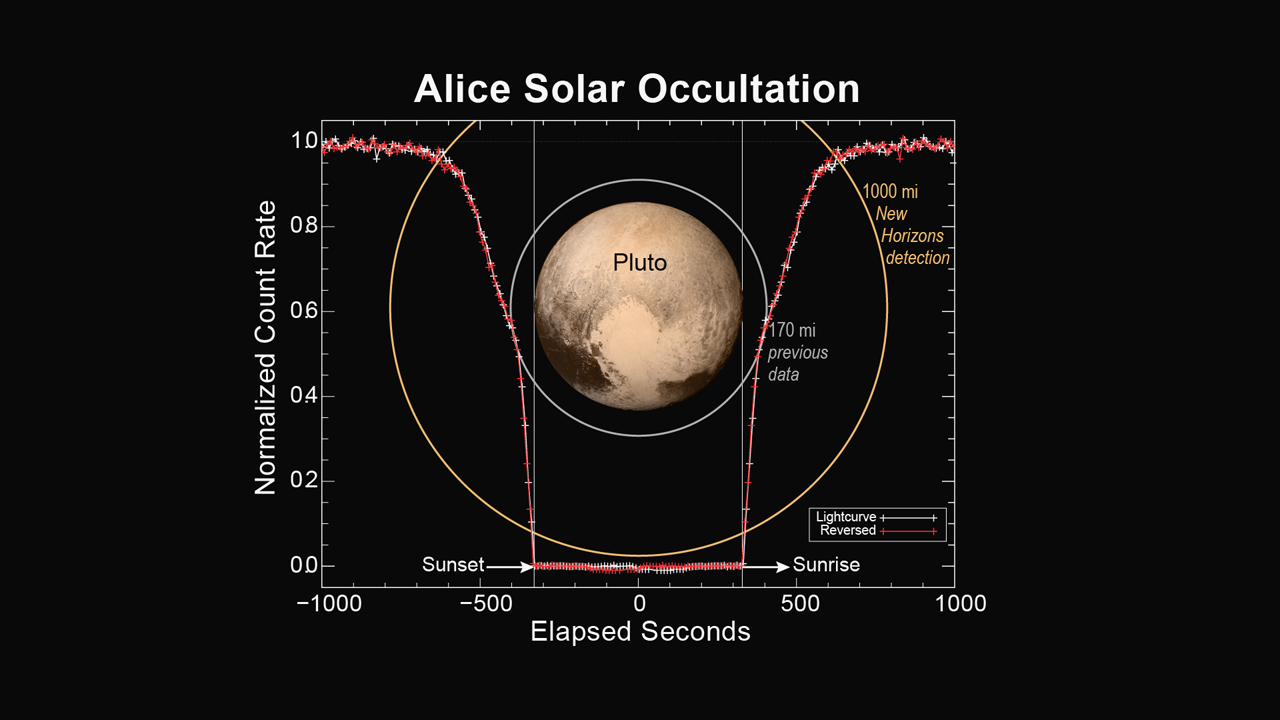
Scientists working with NASA’s New Horizons spacecraft have observed Pluto’s atmosphere as far as 1,000 miles (1,600 kilometers) above the surface of the planet, demonstrating that Pluto’s nitrogen-rich atmosphere is quite extended. This is the first observation of Pluto’s atmosphere at altitudes higher than 170 miles above the planet’s surface (270 kilometers).
The new information was gathered by New Horizon’s Alice imaging spectrograph during a carefully designed alignment of the sun, Pluto, and the spacecraft starting about an hour after the craft’s closest approach to the planet on July 14. During the event known as a solar occultation, New Horizons passed through Pluto’s shadow while the sun backlit Pluto’s atmosphere.
“This is only the beginning for Pluto atmospheric science” says New Horizons scientist Andrew Steffl of the Southwest Research Institute in Boulder, Colorado. “Next month, the full Alice occultation dataset will be sent to Earth for analysis. Even so, the data we have now show that Pluto’s atmosphere rises higher above its surface, in relative terms, than does the Earth’s.”
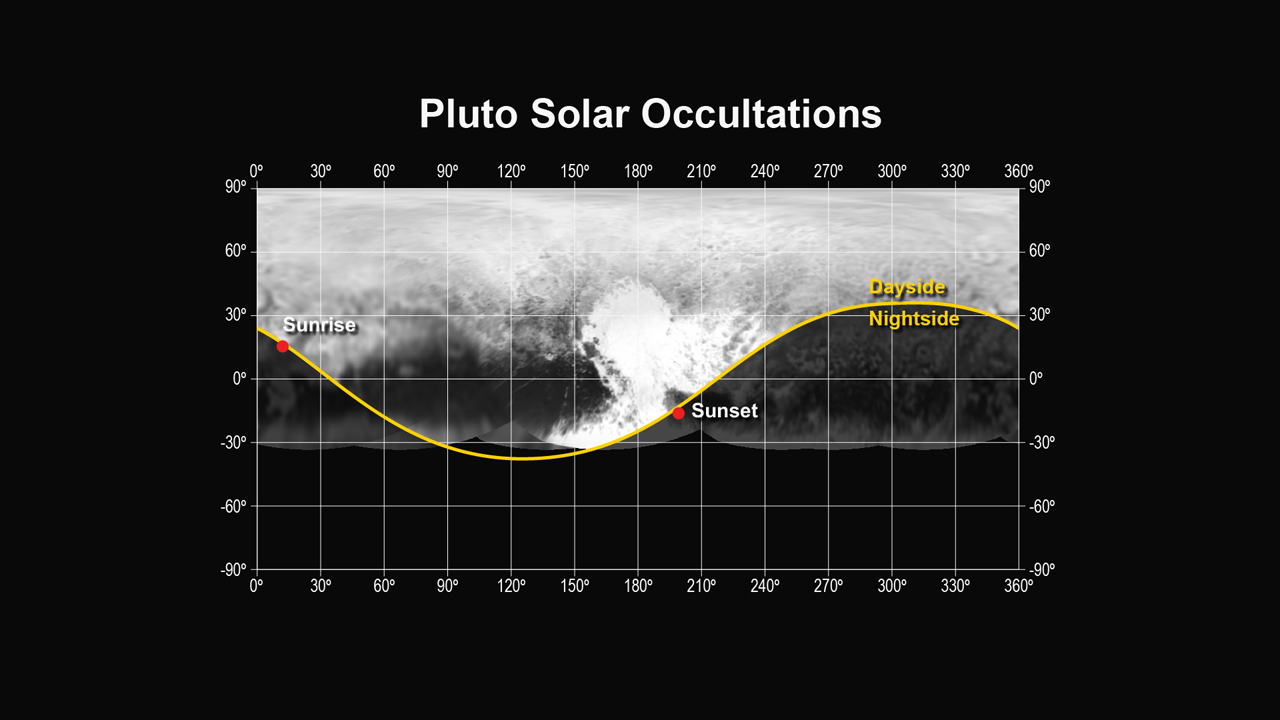
Pluto Solar Occultations – July 17, 2015: This figure shows the locations of the sunset and sunrise solar occultations observed by the Alice instrument on the New Horizons spacecraft. The sunset occultation occurred just south of the “heart” region of Pluto, from a range of 30,120 miles (48,200 km), while the sunrise occurred just north of the “whale tail”, from a range of 35,650 miles (57,000 km). Click for large image.
Alice Solar Occultation – July 17, 2015: This figure shows how the Alice instrument count rate changed over time during the sunset and sunrise observations. The count rate is largest when the line of sight to the sun is outside of the atmosphere at the start and end times. Molecular nitrogen (N2) starts absorbing sunlight in the upper reaches of Pluto’s atmosphere, decreasing as the spacecraft approaches the planet’s shadow. As the occultation progresses, atmospheric methane and hydrocarbons can also absorb the sunlight and further decrease the count rate. When the spacecraft is totally in Pluto’s shadow the count rate goes to zero. As the spacecraft emerges from Pluto’s shadow into sunrise, the process is reversed. By plotting the observed count rate in the reverse time direction, it is seen that the atmospheres on opposite sides of Pluto are nearly identical. Click for larger image.
This animation shows how the count rate observed by New Horizons’ Alice instrument decreases as Pluto’s atmosphere passes in front of the sun. The decreasing count rate is due to the ultraviolet sunlight having to pass through progressively larger amounts of the atmosphere as the spacecraft line of sight gets closer to Pluto. The observed count rates are compared with predictions based on two plausible models of Pluto’s atmosphere: a “turbulent” case, where the expected count rate is relatively large, due to small amounts of sunlight-absorbing hydrocarbons in the lower atmosphere, and a “stagnant” case, where much larger hydrocarbon abundances are predicted. The preliminary count rate data from Alice are matched by neither model, but are closer to the stagnant case. Image credit: NASA/JHUAPL/SwRI
New Horizons has discovered a region of cold, dense ionized gas tens of thousands of miles beyond Pluto — the planet’s atmosphere being stripped away by the solar wind and lost to space. Beginning an hour and half after closest approach, the Solar Wind Around Pluto (SWAP) instrument observed a cavity in the solar wind — the outflow of electrically charged particles from the Sun — between 48,000 miles (77,000 km) and 68,000 miles (109,000 km) downstream of Pluto. SWAP data revealed this cavity to be populated with nitrogen ions forming a “plasma tail” of undetermined structure and length extending behind the planet.
Artist’s concept of the interaction of the solar wind (the supersonic outflow of electrically charged particles from the Sun) with Pluto’s predominantly nitrogen atmosphere. Some of the molecules that form the atmosphere have enough energy to overcome Pluto’s weak gravity and escape into space, where they are ionized by solar ultraviolet radiation.
As the solar wind encounters the obstacle formed by the ions, it is slowed and diverted (depicted in the red region), possibly forming a shock wave upstream of Pluto. The ions are “picked up” by the solar wind and carried in its flow past the dwarf planet to form an ion or plasma tail (blue region). The Solar Wind around Pluto (SWAP) instrument on the New Horizons spacecraft made the first measurements of this region of low-energy atmospheric ions shortly after closest approach on July 14.
Such measurements will enable the SWAP team to determine the rate at which Pluto loses its atmosphere and, in turn, will yield insight into the evolution of the Pluto’s atmosphere and surface. Also illustrated are the orbits of Pluto’s five moons and the trajectory of the spacecraft. Click for larger image.
Similar plasma tails are observed at planets like Venus and Mars. In the case of Pluto’s predominantly nitrogen atmosphere, escaping molecules are ionized by solar ultraviolet light, “picked up” by the solar wind, and carried past Pluto to form the plasma tail discovered by New Horizons. Prior to closest approach, nitrogen ions were detected far upstream of Pluto by the Pluto Energetic Particle Spectrometer Science Investigation (PEPSSI) instrument, providing a foretaste of Pluto’s escaping atmosphere.
Plasma tail formation is but one fundamental aspect of Pluto’s solar wind interaction, the nature of which is determined by several yet poorly constrained factors. Of these, perhaps the most important is the atmospheric loss rate. “This is just a first tantalizing look at Pluto’s plasma environment,” says co-investigator Fran Bagenal, University of Colorado, Boulder, who leads the New Horizons Particles and Plasma team. “We’ll be getting more data in August, which we can combine with the Alice and Rex atmospheric measurements to pin down the rate at which Pluto is losing its atmosphere. Once we know that, we’ll be able to answer outstanding questions about the evolution of Pluto’s atmosphere and surface and determine to what extent Pluto’s solar wind interaction is like that of Mars.”
 Dawn survey orbit 29, July 17, 2015 (Larger image).