Constellation Supply Co. brings space themes to its ceramic products

Evan Dohrmann is a ceramics expert, an astronomy buff, and founder of the new startup Constellation Supply Co. He contacted me about his company’s first product: The Little Dripper Coffee Brewer, whose launch is backed by a successful Kickstarter soon to end.

The pledge rewards include a badge “inspired by the mission patches worn by intrepid space explorers” –

6d7a520364b170becef868462efead4e_original

– and a limited edition glow in the dark star chart constellation star chart –

Constellation_Poster_crop

Evan describes the poster to me as follows:

1. Innovative Design – The poster is inspired by the works of astrophysicist Donald H. Menzel and author H.A. Rey, and is designed and printed in the U.S.A. (Portland, Oregon).
2. Glow In the Dark – A glow in the dark poster is appealing to kids and adults alike.
3. Celebrate Science and Astronomy – Constellation Supply Co. is a ceramics business first and foremost, however we’ve chosen to celebrate our love of astronomy in everything we do. We believe this is something your followers will appreciate.

Nice to see Evan finding ways to combine his ceramics business with his interest in space and astronomy.


Video: SETI Institute Hangout discussion of Kepler 452b

Seth Shostak talks with SETI Institute scientists Douglas Caldwell, Jeffrey Coughlin, Joseph Twicken about the latest Kepler findings:

Kepler spots first earth-size planet in habitable zone of its star system

Here is the Kepler announcement:

NASA’s Kepler Mission Discovers Bigger, Older Cousin to Earth

NASA’s Kepler mission has confirmed the first near-Earth-size planet in the “habitable zone” around a sun-like star. This discovery and the introduction of 11 other new small habitable zone candidate planets mark another milestone in the journey to finding another “Earth.”
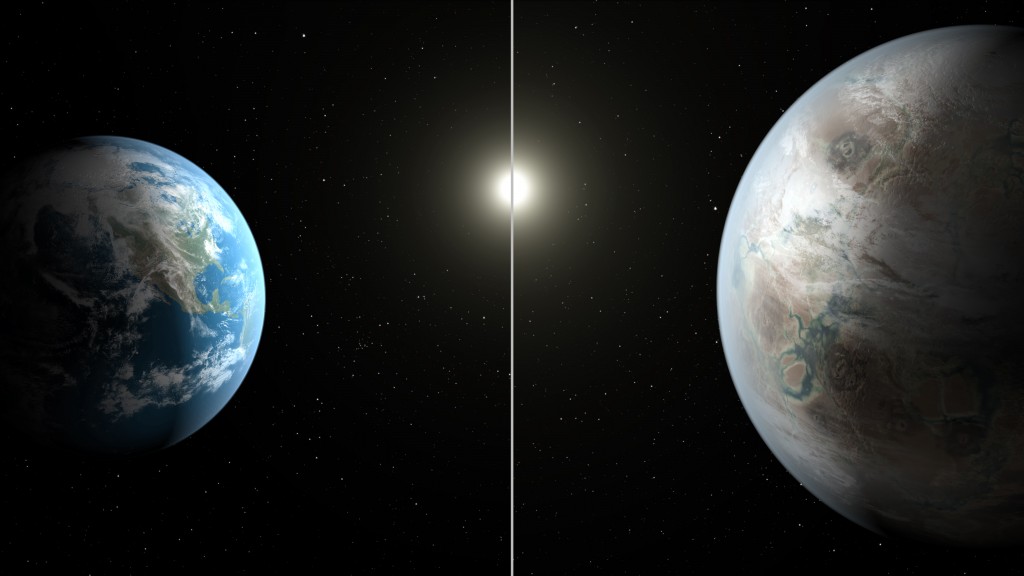
452b_artistconcept_comparisonwithearth[1]Click for larger image

This artist’s concept compares Earth (left) to the new planet, called Kepler-452b, which is about 60 percent larger in diameter.
Credits: NASA/JPL-Caltech/T. Pyle

The newly discovered Kepler-452b is the smallest planet to date discovered orbiting in the habitable zone — the area around a star where liquid water could pool on the surface of an orbiting planet — of a G2-type star, like our sun. The confirmation of Kepler-452b brings the total number of confirmed planets to 1,030.

“On the 20th anniversary year of the discovery that proved other suns host planets, the Kepler exoplanet explorer has discovered a planet and star which most closely resemble the Earth and our Sun,” said John Grunsfeld, associate administrator of NASA’s Science Mission Directorate at the agency’s headquarters in Washington. “This exciting result brings us one step closer to finding an Earth 2.0.”
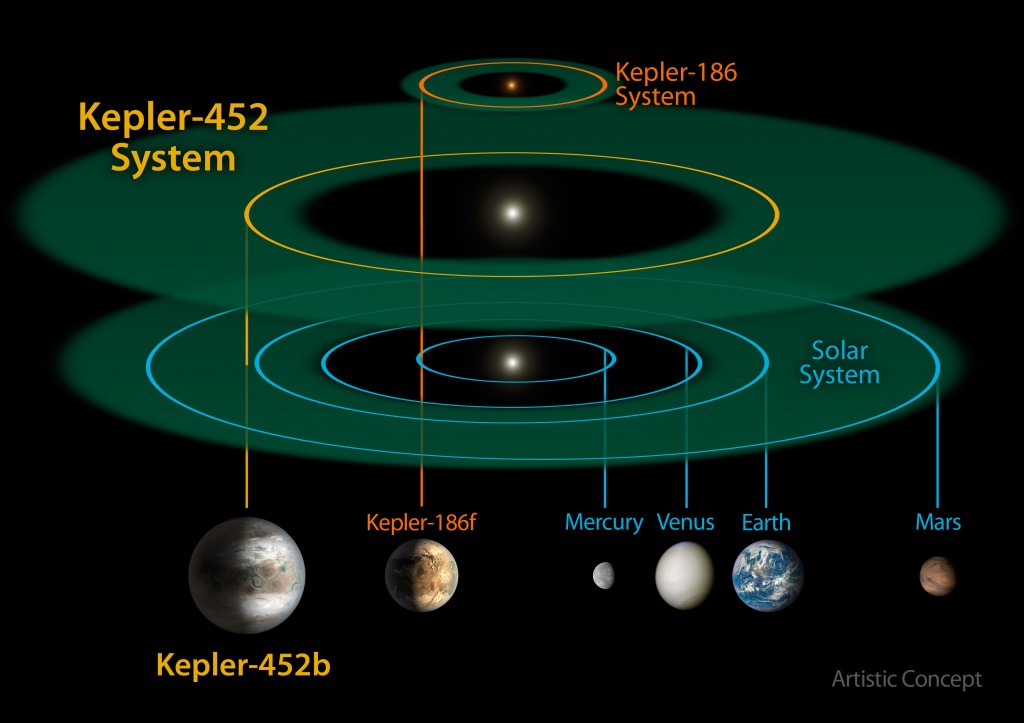
452b_system_comparison[1]Click for larger image.

This size and scale of the Kepler-452 system compared alongside the Kepler-186 system and the solar system. Kepler-186 is a miniature solar system that would fit entirely inside the orbit of Mercury. Credits: NASA/JPL-CalTech/R. Hurt

Kepler-452b is 60 percent larger in diameter than Earth and is considered a super-Earth-size planet. While its mass and composition are not yet determined, previous research suggests that planets the size of Kepler-452b have a good chance of being rocky.

While Kepler-452b is larger than Earth, its 385-day orbit is only 5 percent longer. The planet is 5 percent farther from its parent star Kepler-452 than Earth is from the Sun. Kepler-452 is 6 billion years old, 1.5 billion years older than our sun, has the same temperature, and is 20 percent brighter and has a diameter 10 percent larger.
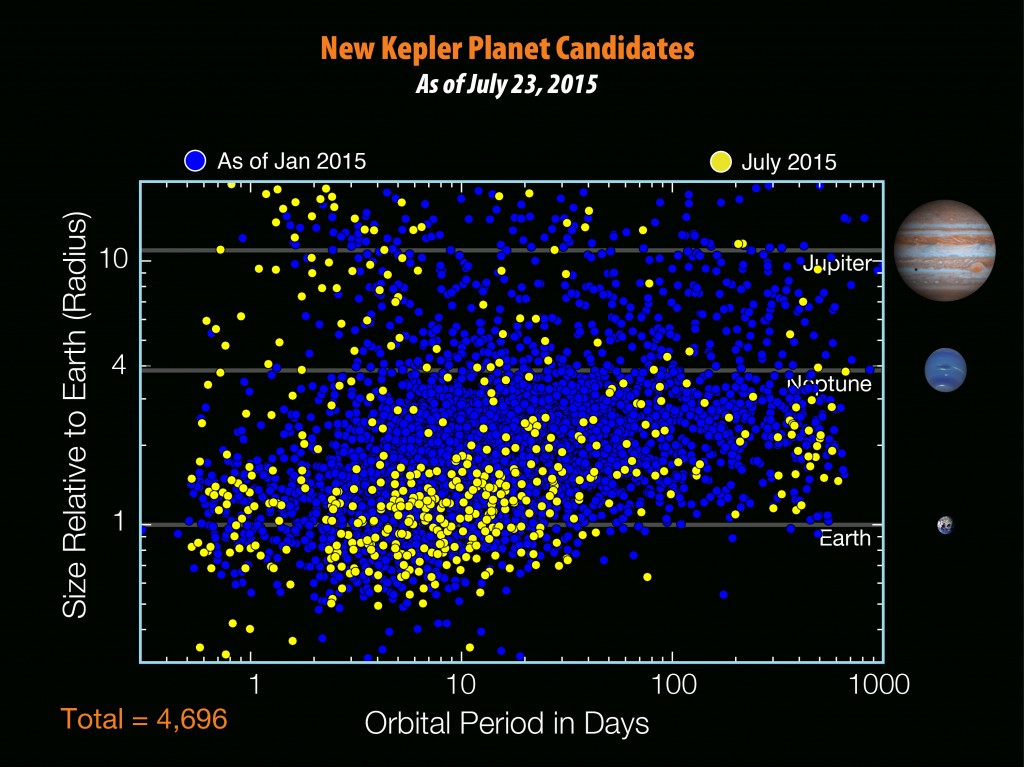
fig10-new_kepler_planet_cand[1]Click for larger image.

There are 4,696 planet candidates now known with the release of the seventh Kepler planet candidate catalog – an increase of 521 since the release of the previous catalog in January 2015. Credits: NASA/W. Stenzel

“We can think of Kepler-452b as an older, bigger cousin to Earth, providing an opportunity to understand and reflect upon Earth’s evolving environment,” said Jon Jenkins, Kepler data analysis lead at NASA’s Ames Research Center in Moffett Field, California, who led the team that discovered Kepler-452b. “It’s awe-inspiring to consider that this planet has spent 6 billion years in the habitable zone of its star; longer than Earth. That’s substantial opportunity for life to arise, should all the necessary ingredients and conditions for life exist on this planet.”

To help confirm the finding and better determine the properties of the Kepler-452 system, the team conducted ground-based observations at the University of Texas at Austin’s McDonald Observatory, the Fred Lawrence Whipple Observatory on Mt. Hopkins, Arizona, and the W. M. Keck Observatory atop Mauna Kea in Hawaii. These measurements were key for the researchers to confirm the planetary nature of Kepler-452b, to refine the size and brightness of its host star and to better pin down the size of the planet and its orbit.
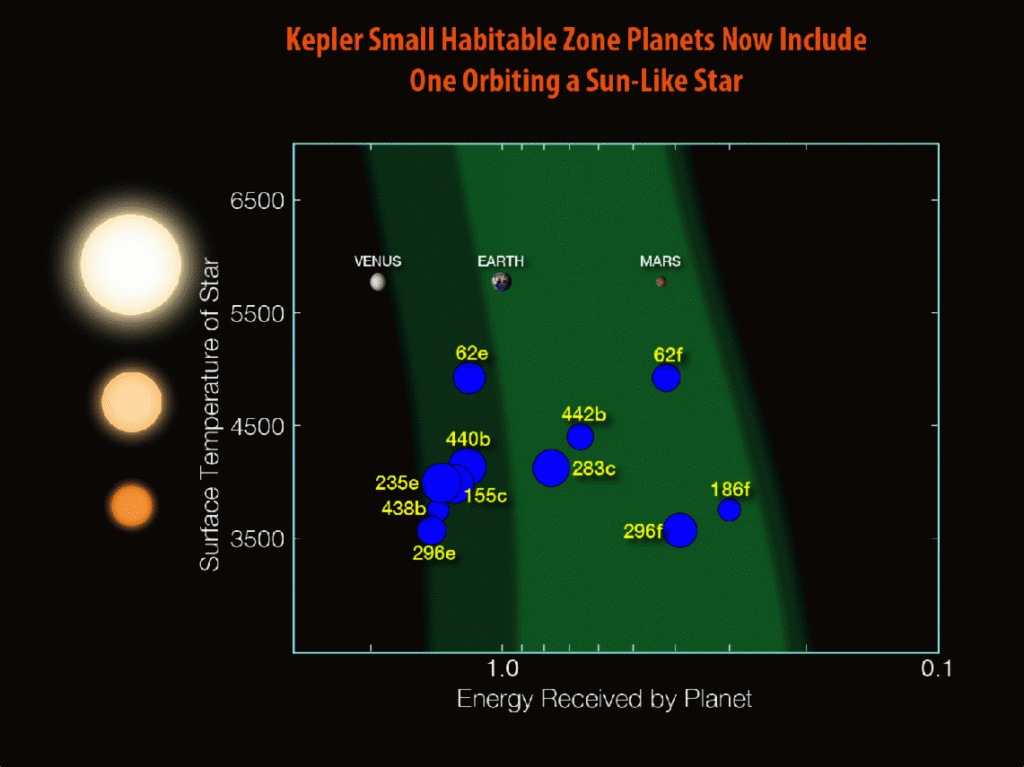
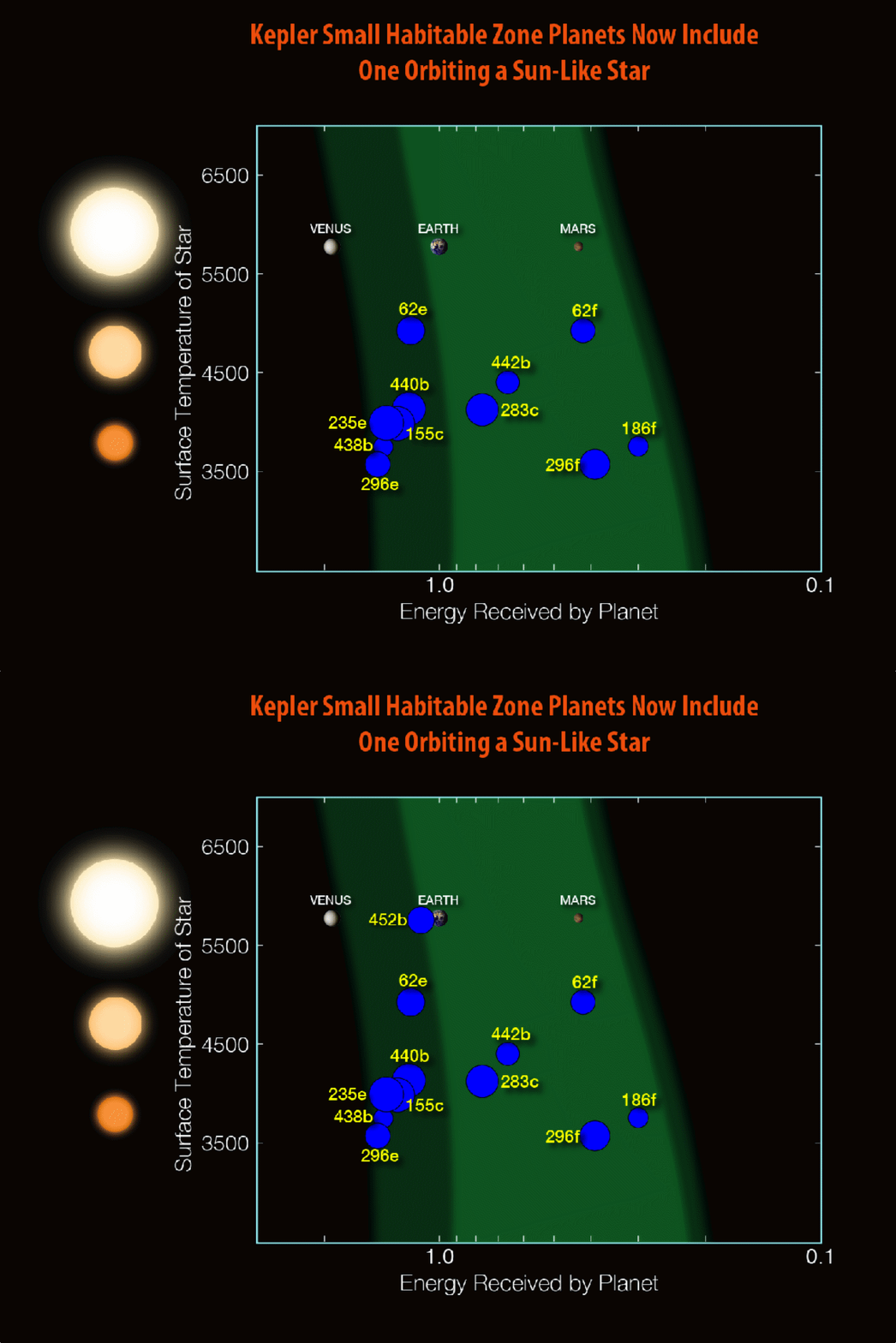
fig6-surfacetemperaturevsenergy[1]Click for a larger image.

Since Kepler launched in 2009, twelve planets less than twice the size of Earth have been discovered in the habitable zones of their stars. Credits: NASA/N. Batalha and W. Stenzel

The Kepler-452 system is located 1,400 light-years away in the constellation Cygnus. The research paper reporting this finding has been accepted for publication in The Astronomical Journal.

In addition to confirming Kepler-452b, the Kepler team has increased the number of new exoplanet candidates by 521 from their analysis of observations conducted from May 2009 to May 2013, raising the number of planet candidates detected by the Kepler mission to 4,696. Candidates require follow-up observations and analysis to verify they are actual planets.

Twelve of the new planet candidates have diameters between one to two times that of Earth, and orbit in their star’s habitable zone. Of these, nine orbit stars that are similar to our sun in size and temperature.
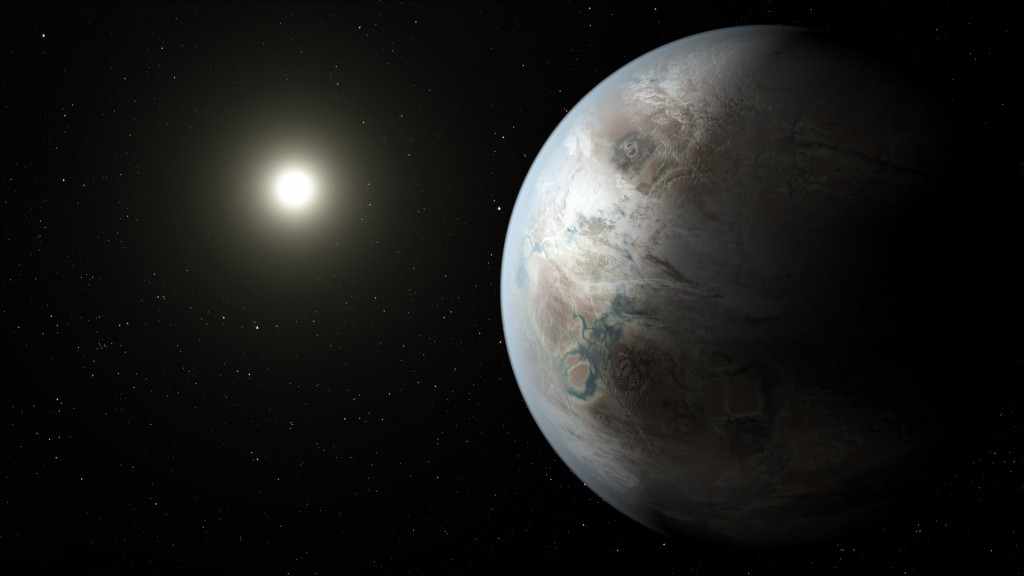
452b_artistconcept_beautyshot[1]Click for the image.

This artist’s concept depicts one possible appearance of the planet Kepler-452b, the first near-Earth-size world to be found in the habitable zone of star that is similar to our sun. Credits: NASA/JPL-Caltech/T. Pyle

“We’ve been able to fully automate our process of identifying planet candidates, which means we can finally assess every transit signal in the entire Kepler dataset quickly and uniformly,” said Jeff Coughlin, Kepler scientist at the SETI Institute in Mountain View, California, who led the analysis of a new candidate catalog. “This gives astronomers a statistically sound population of planet candidates to accurately determine the number of small, possibly rocky planets like Earth in our Milky Way galaxy.”

These findings, presented in the seventh Kepler Candidate Catalog, will be submitted for publication in the Astrophysical Journal. These findings are derived from data publically available on the NASA Exoplanet Archive.

Scientists now are producing the last catalog based on the original Kepler mission’s four-year data set. The final analysis will be conducted using sophisticated software that is increasingly sensitive to the tiny telltale signatures of Earth-size planets.

Ames manages the Kepler and K2 missions for NASA’s Science Mission Directorate. NASA’s Jet Propulsion Laboratory in Pasadena, California, managed Kepler mission development. Ball Aerospace & Technologies Corporation operates the flight system with support from the Laboratory for Atmospheric and Space Physics at the University of Colorado in Boulder.

For more information about the Kepler mission, visit: www.nasa.gov/kepler

Latest Kepler exoplanet finding to be announced

NASA is going to make an announcement today at 12:00 noon EDT about the latest discovery by the Kepler  space observatory:

NASA News Audio

The first exoplanet orbiting another star like our sun was discovered in 1995. Exoplanets, especially small Earth-size worlds, belonged within the realm of science fiction just 21 years ago. Today, and thousands of discoveries later, astronomers are on the cusp of finding something people have dreamed about for thousands of years — another Earth.

The briefing participants are:

  • John Grunsfeld, associate administrator for NASA’s Science Mission Directorate in Washington
  • Jon Jenkins, Kepler data analysis lead at NASA’s Ames Research Center in Moffett Field, California
  • Jeff Coughlin, Kepler research scientist at SETI Institute in Mountain View, California
  • Didier Queloz, professor of astrophysics at Cambridge University, United Kingdom

Broadcast live streaming video on Ustream

ESO: ALMA detects galaxies forming in early universe for the first time

A new report form ESO (European Space Observatory):

ALMA Witnesses Assembly of Galaxies
in the Early Universe for the First Time

The Atacama Large Millimeter/submillimeter Array (ALMA) has been used to detect the most distant clouds of star-forming gas yet found in normal galaxies in the early Universe. The new observations allow astronomers to start to see how the first galaxies were built up and how they cleared the cosmic fog during the era of reionisation. This is the first time that such galaxies are seen as more than just faint blobs.

This view is a combination of images from ALMA and the Very Large Telescope. The central object is a very distant galaxy, labelled BDF 3299, which is seen when the Universe was less than 800 million years old. The bright red cloud just to the lower left is the ALMA detection of a vast cloud of material that is in the process of assembling the very young galaxy.

When the first galaxies started to form a few hundred million years after the Big Bang, the Universe was full of a fog of hydrogen gas. But as more and more brilliant sources — both stars and quasars powered by huge black holes — started to shine they cleared away the mist and made the Universe transparent to ultraviolet light [1]. Astronomers call this the epoch of reionisation, but little is known about these first galaxies, and up to now they have just been seen as very faint blobs. But now new observations using the power of ALMA are starting to change this.

A team of astronomers led by Roberto Maiolino (Cavendish Laboratory and Kavli Institute for Cosmology, University of Cambridge, United Kingdom) trained ALMA on galaxies that were known to be seen only about 800 million years after the Big Bang [2]. The astronomers were not looking for the light from stars, but instead for the faint glow of ionised carbon [3]coming from the clouds of gas from which the stars were forming. They wanted to study the interaction between a young generation of stars and the cold clumps that were assembling into these first galaxies.

They were also not looking for the extremely brilliant rare objects — such as quasars and galaxies with very high rates of star formation — that had been seen up to now. Instead they concentrated on rather less dramatic, but much more common, galaxies that reionised the Universe and went on to turn into the bulk of the galaxies that we see around us now.

From one of the galaxies — given the label BDF 3299 — ALMA could pick up a faint but clear signal from the glowing carbon. However, this glow wasn’t coming from the centre of the galaxy, but rather from one side.

Co-author Andrea Ferrara (Scuola Normale Superiore, Pisa, Italy) explains the significance of the new findings:

“This is the most distant detection ever of this kind of emission from a ‘normal’ galaxy, seen less than one billion years after the Big Bang. It gives us the opportunity to watch the build-up of the first galaxies. For the first time we are seeing early galaxies not merely as tiny blobs, but as objects with internal structure!”

The astronomers think that the off-centre location of the glow is because the central clouds are being disrupted by the harsh environment created by the newly formed stars — both their intense radiation and the effects of supernova explosions — while the carbon glow is tracing fresh cold gas that is being accreted from the intergalactic medium.

By combining the new ALMA observations with computer simulations, it has been possible to understand in detail key processes occurring within the first galaxies. The effects of the radiation from stars, the survival of molecular clouds, the escape of ionising radiation and the complex structure of the interstellar medium can now be calculated and compared with observation. BDF 3299 is likely to be a typical example of the galaxies responsible for reionisation.

“We have been trying to understand the interstellar medium and the formation of the reionisation sources for many years. Finally to be able to test predictions and hypotheses on real data from ALMA is an exciting moment and opens up a new set of questions.This type of observation will clarify many of the thorny problems we have with the formation of the first stars and galaxies in the Universe,” adds Andrea Ferrara.

Roberto Maiolino concludes:

“This study would have simply been impossible without ALMA, as no other instrument could reach the sensitivity and spatial resolution required. Although this is one of the deepest ALMA observations so far it is still far from achieving its ultimate capabilities. In future ALMA will image the fine structure of primordial galaxies and trace in detail the build-up of the very first galaxies.”

Notes
[1] Neutral hydrogen gas very efficiently absorbs all the high-energy ultraviolet light emitted by young hot stars. Consequently, these stars are almost impossible to observe in the early Universe. At the same time, the absorbed ultraviolet light ionises the hydrogen, making it fully transparent. The hot stars are therefore carving transparent bubbles in the gas. Once all these bubbles merge to fill all of space, reionisation is complete and the Universe becomes transparent.

[2] They had redshifts ranging from 6.8 to 7.1.

[3] Astronomers are particularly interested in ionised carbon as this particular spectral line carries away most of the energy injected by stars and allows astronomers to trace the cold gas out of which stars form. Specifically, the team were looking for the emission from singly ionised carbon (known as [C II]). This radiation is emitted at a wavelength of 158 micrometres, and by the time it is stretched by the expansion of the Universe arrives at ALMA at just the right wavelength for it to be detected at a wavelength of about 1.3 millimetres.

Everyone can participate in space