Video: ESA Euronews report – update on the Rosetta mission

This ESA Euronews video reports on various Euro space news and then focuses on Rosetta mission to Comet 67P/Churyumov-Gerasimenko, , including the study of organic molecules:

The Rosetta Mission has been writing a new chapter in what we know about the formation of life. The ESA teams involved are now preparing for the last part of this amazing journey.

Comet Churyumov-Gerasimenko has recently reached the perihelion – that’s the closest point to the Sun in its six and a half year orbit. It’s an important scientific step – as increasing solar energy warms the comet’s frozen ices, turning them to gas and dust. To stay safe, Rosetta has been forced to move further from the comet.

The Rosetta mission has been extended by nine months – until September next year. It’s hoped this will further boost the enormous amount of data that’s already been collected.

===

This image released on August 22, shows

a dramatic outburst from Comet 67P/Churyumov-Gerasimenko, [it] was taken by Rosetta’s NAVCAM on 22 August 2015, about 336 km from the nucleus.

Comet_on_22_August_2015_NavCam_node_full_image_2[1]
This single frame Rosetta navigation camera image of Comet 67P/Churyumov-Gerasimenko was taken on 22 August 2015 from a distance of 336 km from the comet centre. The image has a resolution of 28.6 m/pixel and measures 29.3 km across. The comet reached the closest point to the Sun along its 6.5-year orbit, or perihelion, on 13 August 2015. The comet’s activity, at its peak intensity around perihelion and in the weeks that follow, is clearly visible in the image, including a significant outburst. Larger image
More about the image:

The image scale is 28.6 m/pixel and the image measures 29.3 km across. Although the activity is extraordinarily bright even in the original (below), the image above has been lightly enhanced to give a better view of the outline of the nucleus in the lower part of the image, as well as to show the full extent of the activity.

In this view, the comet is oriented with the large lobe up, revealing the Imhotep region as well as parts of Ash to the left, Aten at the centre (close to the edge and partly in shade), and Khepry to the right. The outburst seems to originate from a patch of the comet’s surface between Imhotep and Khepry.

The smaller lobe can be seen in the lower right part of the image, where indications of the ongoing activity over much of the comet can also be seen.

Comet 67P/C-G made its closest approach to the Sun, or perihelion, on 13 August 2015, just nine days before this image was taken. Based on observations made during previous passages of the comet through the inner solar system, scientists expect the activity to remain high for several weeks after perihelion, and the comet is likely to produce more of these sudden outbursts and peaks of activity.

The science instruments on Rosetta have also observed these outbursts and the teams are busy analysing the data to understand the nature of these events. These in-situ measurements are being complemented by astronomical observations from ground-based and near-Earth telescopes to try and understand the global impact of these events on the much larger coma of 67P/C-G

Mars Society not quite to crowdfunding target for GreenHab + 1 year Mars habitat sim starts in Hawaii with 6 volunteers

With three days left, Mars Society is near but not yet over its crowdfunding target for the funding of a new “GreenHab” greenhouse facility at the Mars Desert Research Station in Utah: Veggies on Mars – Help Rebuild the MDRS GreenHab – Indiegogo. The previous greenhouse was destroyed by fire.

yygnoujrtvqbmsew5ih5[1]

===

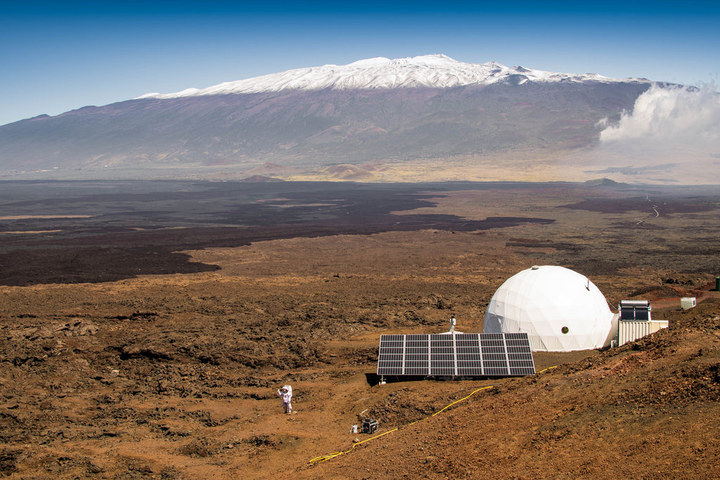
At another Mars sim facility, six people recently entered an habitat in Hawaii where they will simulate a Mars mission for the next year. This will be the fourth mission of the HI-SEAS (Hawaii Space Exploration Analog and Simulation) program.

Sians-sunset-photo-of-the-Hab[1]

Here is a blog from the habitat residents: Live From Mars – We are the Martians! | 12 months, 6 scientists, 1 Hab. Welcome to “Mars”.

Updates also available at #hiseas hashtag on Twitter.

enhanced-mid-17222-1440814819-1[1]


Video: Update on the Kepler exoplanet search

The Kepler space observatory was thought to be out of the exoplanet finding business for good due to a failure in the guidance hardware.  However, the system was returned to action using a clever technique with solar light pressure to maintain the telescope’s pointing stability. The K2 Mission, as this new phase of operation is called, has been underway for sometime now. This SETI Institute seminar gives an update

The NASA K2 mission makes use of the Kepler spacecraft to expand upon Kepler’s groundbreaking discoveries in the fields of exoplanets and astrophysics through new and exciting observations. K2 uses an innovative way of operating the spacecraft by carefully balancing the pressure of photons coming from the Sun. The K2 mission offers long-term, simultaneous optical observation of thousands of objects at high precision. Ecliptic fields are observed for approximately 75-days enabling a unique exoplanet survey which fills the gaps in duration and sensitivity between the Kepler and TESS missions, and offers exoplanet target identification for JWST transit spectroscopy. Astrophysics observations with K2 include studies of young open clusters such as the Pleiades and Hyades, galaxies, supernovae, and galactic archeology.

See the Kepler Science Center for more about the K2 mission.

Video: ‘Space to Ground’ report about the ISS – Aug.28.15

Here’s the latest report from NASA on activities related to the Int. Space Station:

Sci-Tech: New venture aims to develop vertical takeoff and landing biz-plane

The XTI Aircraft Company includes an aviation industry A-list group of founders and engineers who intend to develop a vertical take-off and landing aircraft called the Trifan 600. As seen below, the vehicle has three ducted fans to provide vertical lift. During horizontal flight the center fan is covered while the other two fans tilt and drive the vehicle forward at up to 400 mph (640 kmh). 

campaign_image%209[1]


TriFanInFlight

Image_35[1]


Here is a video about the vehicle:

To guage interest in the project, they have opened an equity crowdfunding campaign at StartEngine Crowdfunding. This involves eventual purchase of shares in the company, not contributing money for a perk as with Kickstarter or Indiegogo projects.

Here is an article about the project: The Transforming Vertical-Takeoff Plane That’s Better Than a Flying Car – Popular Mechanics.

campaign_image%2032_v2[1]

Everyone can participate in space