‘Hedgehog’ robot may someday hop, tumble, and flip to explore a comet or asteroid

A hopping cube may be the best way to explore a small asteroid or comet:

‘Hedgehog’ Robots Hop, Tumble in Microgravity

Hopping, tumbling and flipping over are not typical maneuvers you would expect from a spacecraft exploring other worlds. Traditional Mars rovers, for example, roll around on wheels, and they can’t operate upside-down. But on a small body, such as an asteroid or a comet, the low-gravity conditions and rough surfaces make traditional driving all the more hazardous.

Enter Hedgehog: a new concept for a robot that is specifically designed to overcome the challenges of traversing small bodies. The project is being jointly developed by researchers at NASA’s Jet Propulsion Laboratory in Pasadena, California; Stanford University in Stanford, California; and the Massachusetts Institute of Technology in Cambridge.

tech2015090[1]
While a Mars rover can’t operate upside down, the Hedgehog robot can function regardless of which side lands up. Credit: NASA/JPL-Caltech/Stanford
“Hedgehog is a different kind of robot that would hop and tumble on the surface instead of rolling on wheels. It is shaped like a cube and can operate no matter which side it lands on,” said Issa Nesnas, leader of the JPL team.

The basic concept is a cube with spikes that moves by spinning and braking internal flywheels. The spikes protect the robot’s body from the terrain and act as feet while hopping and tumbling.

“The spikes could also house instruments such as thermal probes to take the temperature of the surface as the robot tumbles,” Nesnas said.

Two Hedgehog prototypes — one from Stanford and one from JPL — were tested aboard NASA’s C-9 aircraft for microgravity research in June 2015. During 180 parabolas, over the course of four flights, these robots demonstrated several types of maneuvers that would be useful for getting around on small bodies with reduced gravity. Researchers tested these maneuvers on different materials that mimic a wide range of surfaces: sandy, rough and rocky, slippery and icy, and soft and crumbly.

“We demonstrated for the first time our Hedgehog prototypes performing controlled hopping and tumbling in comet-like environments,” said Robert Reid, lead engineer on the project at JPL.

Hedgehog’s simplest maneuver is a “yaw,” or a turn in place. After pointing itself in the right direction, Hedgehog can either hop long distances using one or two spikes or tumble short distances by rotating from one face to another. Hedgehog typically takes large hops toward a target of interest, followed by smaller tumbles as it gets closer.

tech20150903b-16[1]
‘Hedgehog’ Robots Hop, Tumble in Microgravity The Hedgehog robot, designed to explore the surfaces of comets and asteroids While a Mars rover can’t operate upside down, the Hedgehog robot can function regardless of which side lands up.NASA’s C-9 aircraft for microgravity research gave two Hedgehog prototypes The Hedgehog robot, designed to explore the surfaces of comets and asteroids, can perform a “tornado” maneuver to spin and launch itself from the surface. Credit: NASA/JPL-Caltech/Stanford
During one of the experiments on the parabolic flights, the researchers confirmed that Hedgehog can also perform a “tornado” maneuver, in which the robot aggressively spins to launch itself from the surface. This maneuver could be used to escape from a sandy sinkhole or other situations in which the robot would otherwise be stuck.

The JPL Hedgehog prototype has eight spikes and three flywheels. It weighs about 11 pounds (5 kilograms) by itself, but the researchers envision that it could weigh more than 20 pounds (9 kilograms) with instruments such as cameras and spectrometers. The Stanford prototype is slightly smaller and lighter, and it has shorter spikes.

Both prototypes maneuver by spinning and stopping three internal flywheels using motors and brakes. The braking mechanisms differ between the two prototypes. JPL’s version uses disc brakes, and Stanford’s prototype uses friction belts to stop the flywheels abruptly.

“By controlling how you brake the flywheels, you can adjust Hedgehog’s hopping angle. The idea was to test the two braking systems and understand their advantages and disadvantages,” said Marco Pavone, leader of the Stanford team, who originally proposed Hedgehog with Nesnas in 2011.

“The geometry of the Hedgehog spikes has a great influence on its hopping trajectory. We have experimented with several spike configurations and found that a cube shape provides the best hopping performance. The cube structure is also easier to manufacture and package within a spacecraft,” said Benjamin Hockman, lead engineer on the project at Stanford.

The researchers are currently working on Hedgehog’s autonomy, trying to increase how much the robots can do by themselves without instructions from Earth. Their idea is that an orbiting mothership would relay signals to and from the robot, similar to how NASA’s Mars rovers Curiosity and Opportunity communicate via satellites orbiting Mars. The mothership would also help the robots navigate and determine their positions.

The construction of a Hedgehog robot is relatively low-cost compared to a traditional rover, and several could be packaged together for flight, the researchers say. The mothership could release many robots at once or in stages, letting them spread out to make discoveries on a world never traversed before.

Hedgehog is currently in Phase II development through the NASA Innovative Advanced Concepts (NIAC) Program, and is led by Pavone. The flight development and testing were supported by NASA’s Center Innovation Fund (CIF) and NASA’s Flight Opportunities Program (FOP), which were led by Nesnas. NIAC, CIF and FOP are programs in NASA’s Space Technology Mission Directorate, located at the agency’s headquarters in Washington. JPL is managed by the California Institute of Technology for NASA. Stanford University, MIT and JPL collaborate on the project.

For a complete list of the selected proposals and more information about NIAC, visit: www.nasa.gov/niac

For more information about the Space Technology Mission Directorate, visit: www.nasa.gov/spacetech
Starship Congress 2015: Interstellar Hackathon – live feed available

The Starship Congress 2015: Interstellar Hackathon is underway today and tomorrow at Drexel University. Videos from the event, including a live feed,  are available at the Icarus Interstellar YouTube channel. See the presentation schedule here.

Organized by the Icarus Interstellar group, the event is described as follows:

Starship Congress is the not-for-profit science organization’s biennial international assemblage of recognized interstellar-and-deep space scientists and proponents. The 2nd Starship Congress will be hosted at Drexel University this September 4-5.

With a nod to this year’s University setting and a Hollywood and video game-driven surge in popularity of deep space exploration (“Interstellar”, “Guardians of the Galaxy”, “EVE: Valkyrie”, “Kerbal Space Program 1.0”), Starship Congress 2015 is being subtitled Interstellar Hackathon—featuring talks and presentations centered on hacking the paradigm of interstellar space exploration. Events leading up to the September summit include academic paper submission, poster contest and crowdfunded Kickstarter campaign. Drexel University is home to the first collegiate chapter of Icarus Interstellar.

Starship Congress 2015: Interstellar Hackathon will be built around workshops and punctuated by speakers from the deep space science community over the two-day event. Icarus Interstellar welcomes paper presentation by representatives of aerospace, aeronautics, advanced materials, fission and fusion research fields. Registration for Starship Congress 2015 will open later this week on Icarus Interstellar’s website. A call-for-papers will also be made in May. (Preliminary schedule for the 2-day event is included here below.)

“Two personal reasons for being involved in interstellar studies: Its the most fun and the most significant achievement humanity has undertaken”, notes Dr. Andreas Tziolas, president of Icarus Interstellar. “Icarus’ role is to keep up the pressure by coordinating cutting edge research in a way which is approachable and understandable to everyone seeking to participate. This first ever, Interstellar Hackathon will be as fun as it will be productive, as we challenge participants to think fast and hard about exploring our place in the universe.”

As before, Starship Congress aims to bring the interstellar and deep space science community together in order to foster discussion and generate tangible action. Distinct from the first Starship Congress, the 2015 edition is being structured to quickly break-down status quo approaches in anticipation of reaping new results from looking at old challenges with fresh outlooks.

“Just pulling off Starship Congress 2013 with so many important scientists and thinkers working together was an incredible experience,” says Starship Congress strategic director Mike Mongo, “and one that reaped qualifiable advances in thinking about interstellar space exploration. I am boggling just imagining how that effect will be furthered by Starship Congress 2015’s being staged on a notable university campus like Drexel. We are hacking Starship Congress itself by introducing the benefits and influences of an acclaimed academic setting.”

…

Starship Congress is the premier assemblage of international interstellar proponents and advocacy groups united in the common goal of deep space and interstellar accomplishment. By combining presentation, discussion, and decision, Starship Congress aims to engender and reach consensus of actionable items throughout the interstellar community.

Icarus Interstellar is dedicated to promoting the dream of interstellar flight, a dream springing from the same kernel of Boldness found in the original vision of humans taking flight. Founded as an organization in 2009, Icarus Interstellar became a 501c3 non-for-profit registered in the state of Alaska in 2011.


Video: Latest on occurrence rates of earth-like exoplanets

Here’s a SETI Institute seminar on using the Kepler space observatory data to determine how often earth-like exoplanets will be found around other stars: Planet Occurrence Rates with Kepler: Reaching Towards the Habitable Zone – SETI Institute

Dr. [Christopher Burke discusses the] latest results in measuring terrestrial planet occurrence rates using the planet candidates discovered by the Kepler pipeline.

For the first time an accurate model for the Kepler pipeline sensitivity to transiting planets is publicly available. Dr. Burke’s new analysis finds higher planet occurrence rates and a steeper increase in planet occurrence rates toward small planets than previously believed.

In addition, Dr. Burke will identify the leading sources of systematics that remain impacting Kepler planet occurrence rate determinations and approaches for minimizing their impact in future studies.

This work also sharpens our understanding on the dependence of planet occurrence rates on stellar effective temperature with potential implications for understanding the planet formation process.

Video: ‘Space to Ground’ report on the ISS – Sept.4.15

Here is the latest report from NASA on activities related to the Int. Space Station:

Saturn: One of the rings is not like the others + An update on the Cassini mission

A report from the Cassini mission at Saturn:

PIA11667_500[1]

Cassini Solstice Mission: At Saturn, One of These Rings is not like the Others

At Saturn, One of These Rings is not like the Others

Fast Facts:
— A study suggests the particles in one section of Saturn’s rings are denser than elsewhere, possibly due to solid, icy cores.

— The findings could mean that particular ring is much younger than the rest.

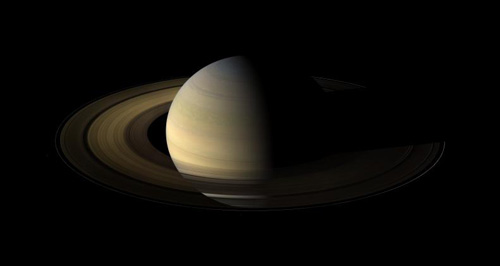
When the sun set on Saturn’s rings in August 2009, scientists on NASA’s Cassini mission were watching closely. It was the equinox — one of two times in the Saturnian year when the sun illuminates the planet’s enormous ring system edge-on. The event provided an extraordinary opportunity for the orbiting Cassini spacecraft to observe short-lived changes in the rings that reveal details about their nature.

Like Earth, Saturn is tilted on its axis. Over the course of its 29-year-long orbit, the sun’s rays move from north to south over the planet and its rings, and back again. The changing sunlight causes the temperature of the rings — which are made of trillions of icy particles — to vary from season to season. During equinox, which lasted only a few days, unusual shadows and wavy structures appeared and, as they sat in twilight for this brief period, the rings began to cool.

In a recent study published in the journal Icarus, a team of Cassini scientists reported that one section of the rings appears to have been running a slight fever during equinox. The higher-than-expected temperature provided a unique window into the interior structure of ring particles not usually available to scientists.

“For the most part, we can’t learn much about what Saturn’s ring particles are like deeper than 1 millimeter below the surface. But the fact that one part of the rings didn’t cool as expected allowed us to model what they might be like on the inside,” said Ryuji Morishima of NASA’s Jet Propulsion Laboratory, Pasadena, California, who led the study.

The researchers examined data collected by Cassini’s Composite Infrared Spectrometer during the year around equinox. The instrument essentially took the rings’ temperature as they cooled. The scientists then compared the temperature data with computer models that attempt to describe the properties of ring particles on an individual scale.

What they found was puzzling. For most of the giant expanse of Saturn’s rings, the models correctly predicted how the rings cooled as they fell into darkness. But one large section — the outermost of the large, main rings, called the A ring — was much warmer than the models predicted. The temperature spike was especially prominent in the middle of the A ring.

To address this curiosity, Morishima and colleagues performed a detailed investigation of how ring particles with different structures would warm up and cool down during Saturn’s seasons. Previous studies based on Cassini data have shown Saturn’s icy ring particles are fluffy on the outside, like fresh snow. This outer material, called regolith, is created over time, as tiny impacts pulverize the surface of each particle. The team’s analysis suggested the best explanation for the A ring’s equinox temperatures was for the ring to be composed largely of particles roughly 3 feet (1 meter) wide made of mostly solid ice, with only a thin coating of regolith.

“A high concentration of dense, solid ice chunks in this one region of Saturn’s rings is unexpected,” said Morishima. “Ring particles usually spread out and become evenly distributed on a timescale of about 100 million years.”

The accumulation of dense ring particles in one place suggests that some process either placed the particles there in the recent geologic past or the particles are somehow being confined there. The researchers suggest a couple of possibilities to explain how this aggregation came to be. A moon may have existed at that location within the past hundred million years or so and was destroyed, perhaps by a giant impact. If so, debris from the breakup might not have had time to diffuse evenly throughout the ring. Alternatively, they posit that small, rubble-pile moonlets could be transporting the dense, icy particles as they migrate within the ring. The moonlets could disperse the icy chunks in the middle A ring as they break up there under the gravitational influence of Saturn and its larger moons.

“This particular result is fascinating because it suggests that the middle of Saturn’s A ring may be much younger than the rest of the rings,” said Linda Spilker, Cassini project scientist at JPL and a co-author of the study. “Other parts of the rings may be as old as Saturn itself.”

During its final series of close orbits to Saturn, Cassini will directly measure the mass of the planet’s main rings for the first time, using gravity science. Scientists will use the mass of the rings to place constraints on their age.

The Cassini-Huygens mission is a cooperative project of NASA, ESA and the Italian Space Agency. JPL, a division of the California Institute of Technology in Pasadena, manages the mission for NASA’s Science Mission Directorate in Washington.

For more information about Cassini, visit:

===

Check out also the recent discussion with Dr. Curt Niebur of NASA about Saturn and the Cassini mission: John Batchelor Hotel Mars, Wednesday, 8-26-15 | Thespaceshow’s Blog

Everyone can participate in space