Everyday Spacer hosts the latest Carnival of Space.
Carnival of Space #466 – Everyday Spacer
Everyday Spacer hosts the latest Carnival of Space.
Everyday Spacer hosts the latest Carnival of Space.
Here is the latest weekly Space to Ground report from NASA on activities related to the Int. Space Station:
A new report from ESO (European Southern Observatory):
A Surprising Planet with Three Suns
A team of astronomers have used the SPHERE instrument on ESO’s Very Large Telescope to image the first planet ever found in a wide orbit inside a triple-star system. The orbit of such a planet had been expected to be unstable, probably resulting in the planet being quickly ejected from the system. But somehow this one survives. This unexpected observation suggests that such systems may actually be more common than previously thought. The results will be published online in the journal Science on 7 July 2016.
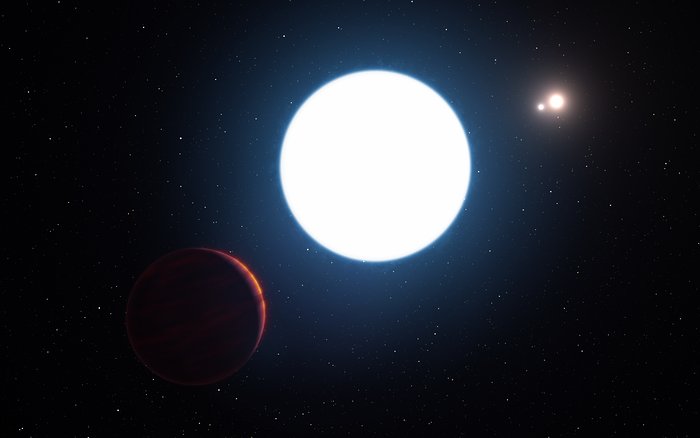
This artists impression shows the orbit of the planet in the triple-star system HD 131399. Two of the stars are close together and the third, brighter component is orbited by a gas giant planet named HD 131399Ab.
Luke Skywalker‘s home planet, Tatooine, in the Star Wars saga, was a strange world with two suns in the sky, but astronomers have now found a planet in an even more exotic system, where an observer would either experience constant daylight or enjoy triple sunrises and sunsets each day, depending on the seasons, which last longer than human lifetimes.
This world has been discovered by a team of astronomers led by the University of Arizona, USA, using direct imaging at ESO’s Very Large Telescope (VLT) in Chile. The planet, HD 131399Ab [1], is unlike any other known world — its orbit around the brightest of the three stars is by far the widest known within a multi-star system. Such orbits are often unstable, because of the complex and changing gravitational attraction from the other two stars in the system, and planets in stable orbits were thought to be very unlikely.

“HD 131399Ab is one of the few exoplanets that have been directly imaged, and it’s the first one in such an interesting dynamical configuration,”
said Daniel Apai, from the University of Arizona, USA, and one of the co-authors of the new paper.
“For about half of the planet’s orbit, which lasts 550 Earth-years, three stars are visible in the sky; the fainter two are always much closer together, and change in apparent separation from the brightest star throughout the year,”
adds Kevin Wagner, the paper’s first author and discoverer of HD 131399Ab [2].
Kevin Wagner, who is a PhD student at the University of Arizona, identified the planet among hundreds of candidate planets and led the follow-up observations to verify its nature.

Although repeated and long-term observations will be needed to precisely determine the planet’s trajectory among its host stars, observations and simulations seem to suggest the following scenario: the brightest star is estimated to be eighty percent more massive than the Sun and dubbed HD 131399A, which itself is orbited by the less massive stars, B and C, at about 300 au (one au, or astronomical unit, equals the average distance between the Earth and the Sun). All the while, B and C twirl around each other like a spinning dumbbell, separated by a distance roughly equal to that between the Sun and Saturn (10 au).
In this scenario, planet HD 131399Ab travels around the star A in an orbit with a radius of about 80 au, about twice as large as Pluto’s in the Solar System, and brings the planet to about one third of the separation between star A and the B/C star pair. The authors point out that a range of orbital scenarios is possible, and the verdict on the long-term stability of the system will have to wait for planned follow-up observations that will better constrain the planet’s orbit.
“If the planet was further away from the most massive star in the system, it would be kicked out of the system,” Apai explained. “Our computer simulations have shown that this type of orbit can be stable, but if you change things around just a little bit, it can become unstable very quickly.”
Planets in multi-star systems are of special interest to astronomers and planetary scientists because they provide an example of how the mechanism of planetary formation functions in these more extreme scenarios. While multi-star systems seem exotic to us in our orbit around our solitary star, multi-star systems are in fact just as common as single stars.
“It is not clear how this planet ended up on its wide orbit in this extreme system, and we can’t say yet what this means for our broader understanding of the types of planetary systems, but it shows that there is more variety out there than many would have deemed possible,” concludes Kevin Wagner. “What we do know is that planets in multi-star systems have been studied far less often, but are potentially just as numerous as planets in single-star systems.”
Notes
[1] The three components of the triple star are named HD 131399A, HD 131399B and HD 131399C respectively, in decreasing order of brightness. The planet orbits the brightest star and hence is named HD 131399Ab.
[2] For much of the planet’s year the stars would appear close together in the sky, giving it a familiar night-side and day-side with a unique triple sunset and sunrise each day. As the planet moves along its orbit the stars grow further apart each day, until they reach a point where the setting of one coincides with the rising of the other — at which point the planet is in near-constant daytime for about one-quarter of its orbit, or roughly 140 Earth-years.
This sequence takes the viewer deep into the constellation of Centaurus in the southern skies. We settle on the unremarkable-looking star called HD 131399, which is a triple star whose brightest component is orbited by a unique exoplanet called HD 131399Ab.
[ Update: Here is a video of the jubilant briefing held shortly after it was confirmed that the spacecraft was in orbit around Jupiter:
]
NASA’s Juno spacecraft successfully fired its engine and went into orbit around Jupiter:
NASA’s Juno Spacecraft in Orbit Around Mighty Jupiter

After an almost five-year journey to the solar system’s largest planet, NASA’s Juno spacecraft successfully entered Jupiter’s orbit during a 35-minute engine burn. Confirmation that the burn had completed was received on Earth at 8:53 p.m. PDT (11:53 p.m. EDT) Monday, July 4.
“Independence Day always is something to celebrate, but today we can add to America’s birthday another reason to cheer — Juno is at Jupiter,” said NASA administrator Charlie Bolden. “And what is more American than a NASA mission going boldly where no spacecraft has gone before? With Juno, we will investigate the unknowns of Jupiter’s massive radiation belts to delve deep into not only the planet’s interior, but into how Jupiter was born and how our entire solar system evolved.”
Confirmation of a successful orbit insertion was received from Juno tracking data monitored at the navigation facility at NASA’s Jet Propulsion Laboratory (JPL) in Pasadena, California, as well as at the Lockheed Martin Juno operations center in Littleton, Colorado. The telemetry and tracking data were received by NASA’s Deep Space Network antennas in Goldstone, California, and Canberra, Australia.
“This is the one time I don’t mind being stuck in a windowless room on the night of the 4th of July,” said Scott Bolton, principal investigator of Juno from Southwest Research Institute in San Antonio. “The mission team did great. The spacecraft did great. We are looking great. It’s a great day.”
Preplanned events leading up to the orbital insertion engine burn included changing the spacecraft’s attitude to point the main engine in the desired direction and then increasing the spacecraft’s rotation rate from 2 to 5 revolutions per minute (RPM) to help stabilize it..
The burn of Juno’s 645-Newton Leros-1b main engine began on time at 8:18 p.m. PDT (11:18 p.m. EDT), decreasing the spacecraft’s velocity by 1,212 miles per hour (542 meters per second) and allowing Juno to be captured in orbit around Jupiter. Soon after the burn was completed, Juno turned so that the sun’s rays could once again reach the 18,698 individual solar cells that give Juno its energy.
“The spacecraft worked perfectly, which is always nice when you’re driving a vehicle with 1.7 billion miles on the odometer,” said Rick Nybakken, Juno project manager from JPL. “Jupiter orbit insertion was a big step and the most challenging remaining in our mission plan, but there are others that have to occur before we can give the science team the mission they are looking for.”
Over the next few months, Juno’s mission and science teams will perform final testing on the spacecraft’s subsystems, final calibration of science instruments and some science collection.
“Our official science collection phase begins in October, but we’ve figured out a way to collect data a lot earlier than that,” said Bolton. “Which when you’re talking about the single biggest planetary body in the solar system is a really good thing. There is a lot to see and do here.”
Juno’s principal goal is to understand the origin and evolution of Jupiter. With its suite of nine science instruments, Juno will investigate the existence of a solid planetary core, map Jupiter’s intense magnetic field, measure the amount of water and ammonia in the deep atmosphere, and observe the planet’s auroras. The mission also will let us take a giant step forward in our understanding of how giant planets form and the role these titans played in putting together the rest of the solar system. As our primary example of a giant planet, Jupiter also can provide critical knowledge for understanding the planetary systems being discovered around other stars.
The Juno spacecraft launched on Aug. 5, 2011 from Cape Canaveral Air Force Station in Florida. JPL manages the Juno mission for NASA. Juno is part of NASA’s New Frontiers Program, managed at NASA’s Marshall Space Flight Center in Huntsville, Alabama, for the agency’s Science Mission Directorate. Lockheed Martin Space Systems in Denver built the spacecraft. The California Institute of Technology in Pasadena manages JPL for NASA.
More information on the Juno mission is available at: http://www.nasa.gov/juno
Follow the mission on Facebook and Twitter at:
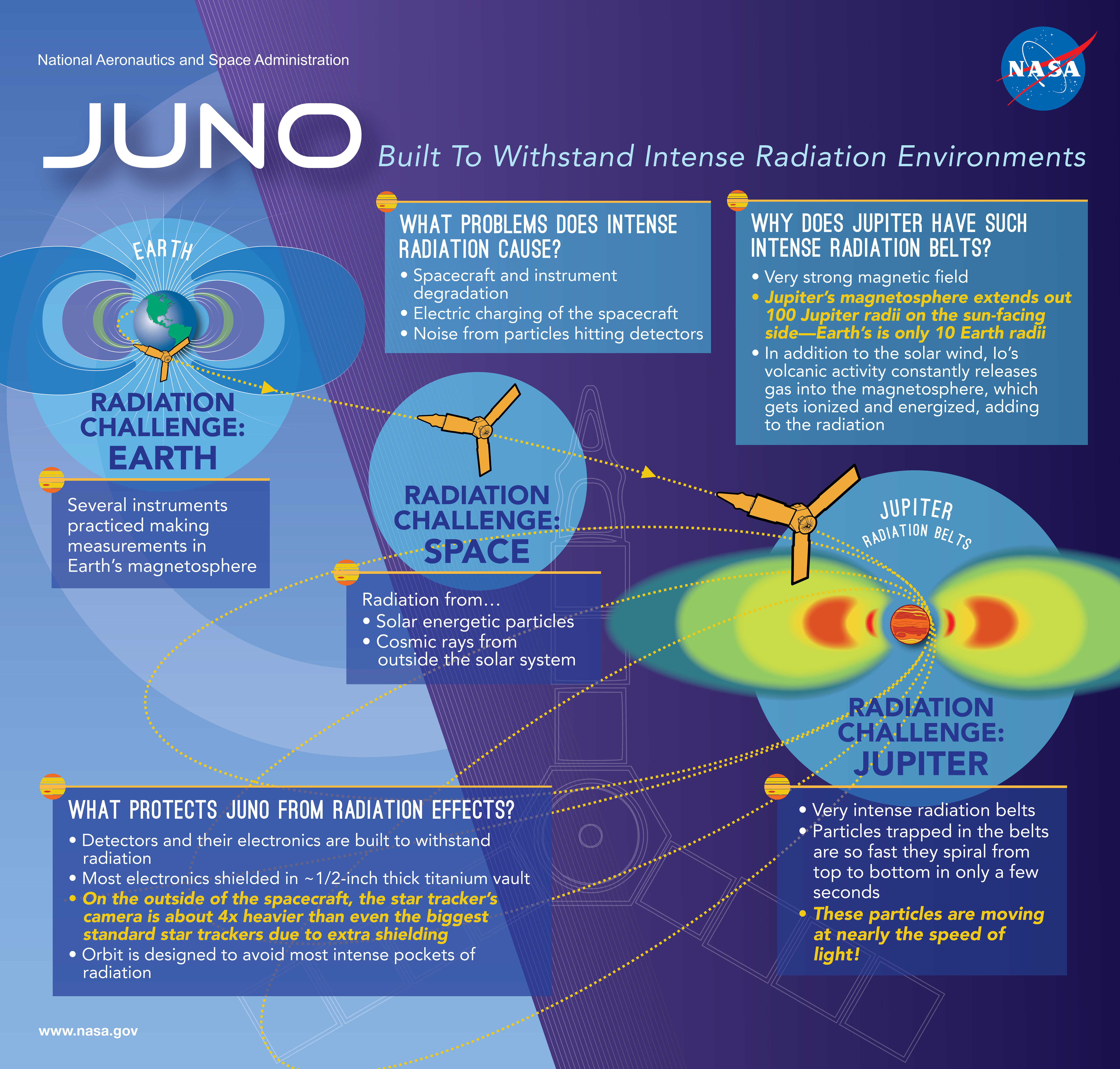
Here is an infographic (full size) about the harsh radiation environment that Juno will endure during its mission at the largest gas giant in our solar system:
NASA’s Juno spacecraft will fire its engine to go into orbit around Jupiter this evening: Live coverage: Juno spacecraft hours away from arriving at Jupiter – Spaceflight Now
By the time engineers on Earth receive confirmation of the start of Juno’s one-shot Jupiter Orbit Insertion burn at 11:18 p.m. EDT (0318 GMT), it will all be over.
If the firing goes according to plan, Juno will already be in orbit around Jupiter at that time, ground controllers won’t know for sure until 11:53 p.m. EDT (0353 GMT), when a tone sent by the spacecraft at the conclusion of the burn will be received by NASA’s Deep Space Network.
At Jupiter’s distance a half-billion miles away, it takes 48 minutes and 19 seconds for a radio signal to travel at the speed of light between Juno and Earth.
Here is a timeline of major events in the mission
This video from Juno shows the moons of Jupiter rotating around the planet as the spacecraft approached the Jupiter system: