2. Tuesday, August 9, 2016: 7-8:30 PM PDT (10-11:30 PM EDT, 9-10:30 PM CDT) We welcome back DR. ETHAN SIEGEL, a theoretical astrophysicist & author of the very popular blog, Starts With A Bang.
4. Sunday, August 14, 2016: 12-1:30 PM PDT (3-4:30 PM EDT, 2-3:30 PM CDT): OPEN LINES. First time callers welcome as are all calls regarding space and STEM topics.
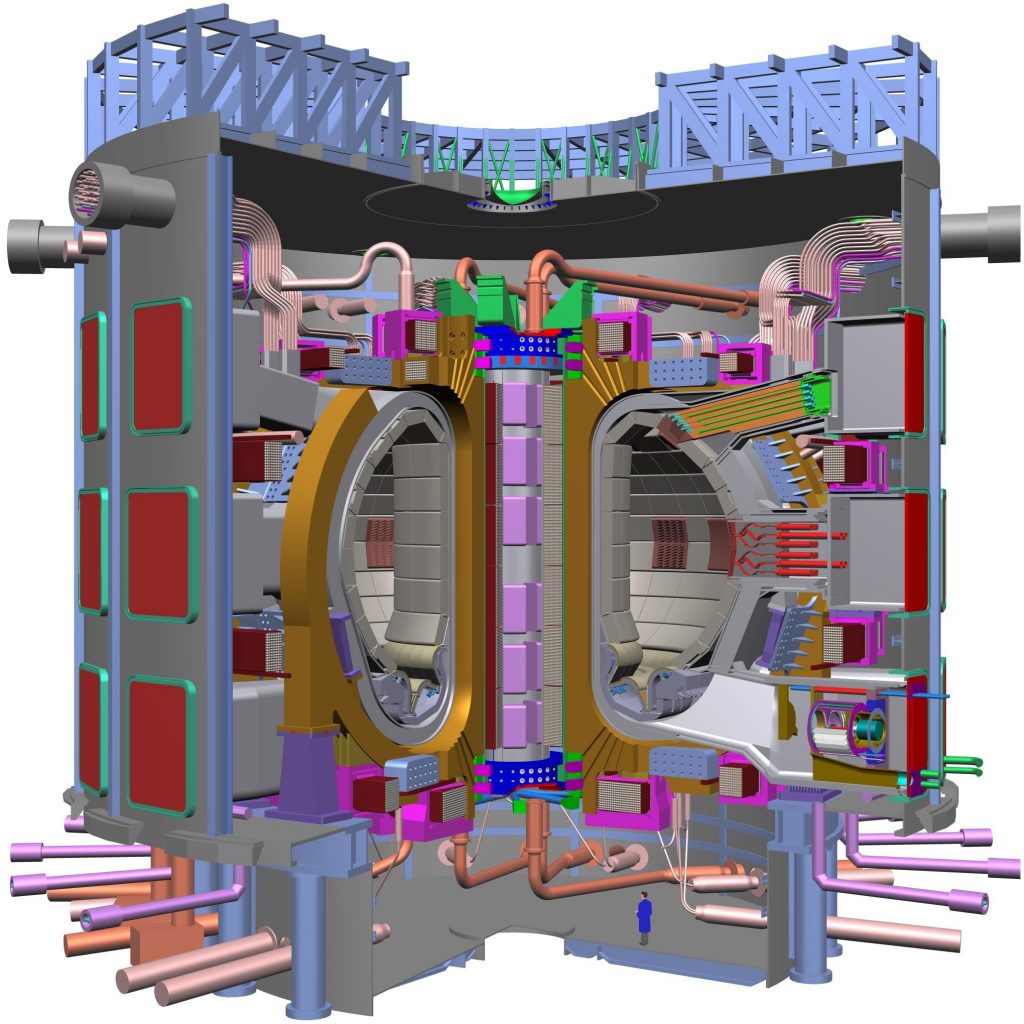
Over the years I’ve posted a number of times about innovative fusion power projects that are underway in various places (e.g. see Tri-Alpha Energy, General Fusion, Lockheed Compact Fusion, EMC2 polywell, Helion Energy, and LPP focus fusion) each aims for a much smaller and practical power plant than the giant ITER tokomak and NIF laser inertial confinement projects that consume most all of the government funding for fusion power. (Similar to the way SLS/Orion eat huge chunks of NASA funding that should go instead for development of technologies that would actually benefit and accelerate the exploration and development of space.) So most of these are using private funding with perhaps a trickle of government funding.
The ITER design. Note the person for scale.
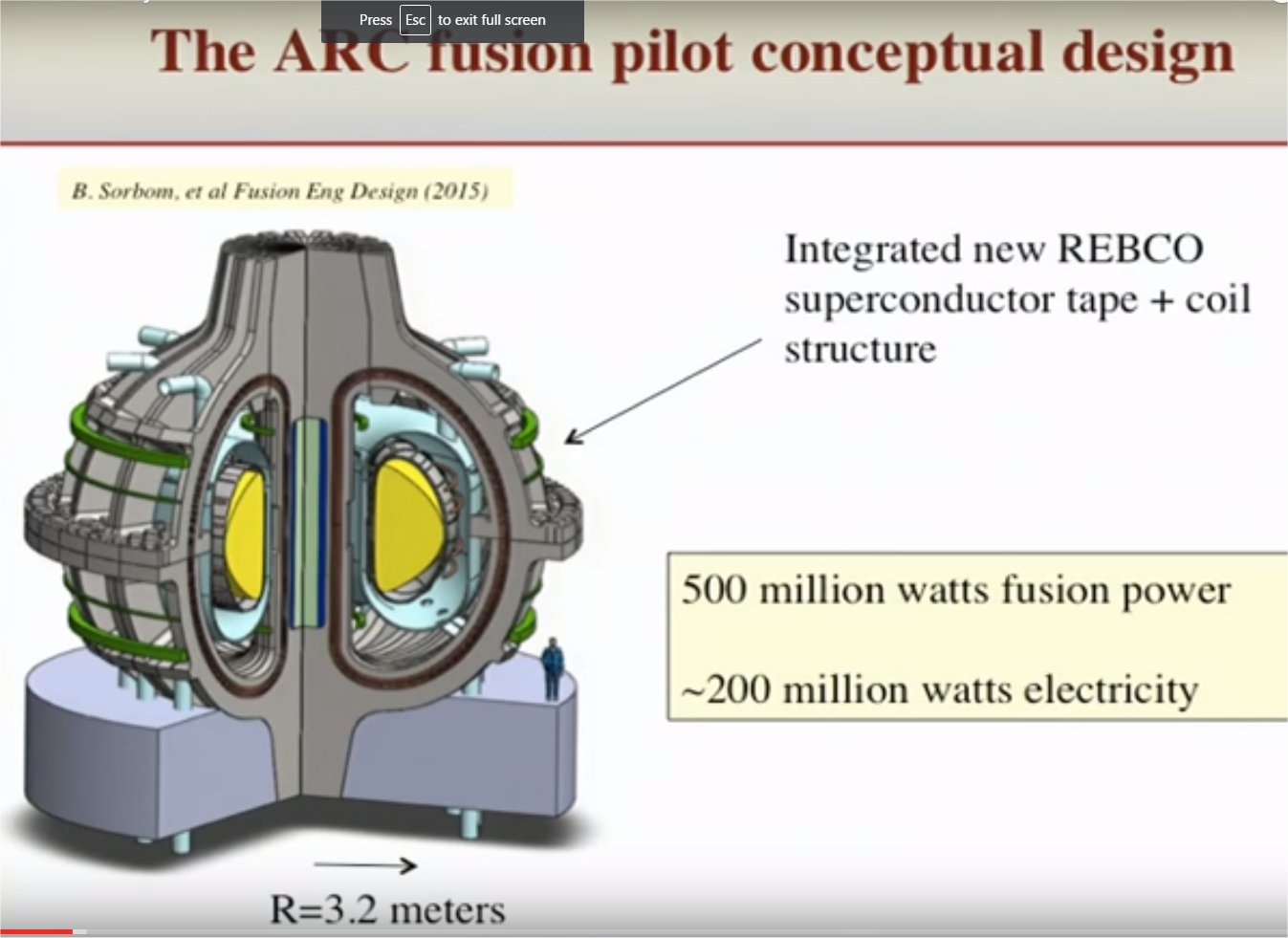
The MIT Affordable Robust Compact (ARC) fusion reactor looks like a conventional toroidal (i.e. doughnut shaped) design approach like a tokamak but it is drastically smaller and less complex than ITER. It accomplishes this by employing super high magnetic fields now possible with coils made from rare-earth barium copper oxide (REBCO) superconducting tapes that are proven and commercially available. Such high fields allow for a much smaller containment vessel for the 100 million degree plasma of deuterium and tritium ions and in turn the volume (and cost) of the reactor shrinks dramatically.
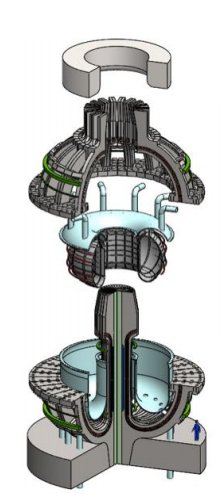
MIT ARC fusion pilot plant concept design.
The heat would be extracted via a blanket of liquid FLiBe molten salt that surrounds the containment vessel. Neutrons from the D-T reaction heat up this liquid, which will in turn heat up water for a conventional steam generator to produce electricity.
Furthermore, ARC uses a modular design that allows for relatively easy removal and replacement of the containment vessel, which will be damaged over time by the neuron bombardment.
The molten salt blanket approach is much simpler than the complex mechanical piping structure planned for ITER, which will require long shutdowns to disassemble the reactor and replace the damaged components.
ITER will cost $40 billion, take decades to complete, and is only a science experiment. It will produce 500W of thermal energy but no electricity. Development of an ARC reactor that would provide 500W thermal and 200MW of actual electricity for the grid and would cost less than a tenth of ITER.
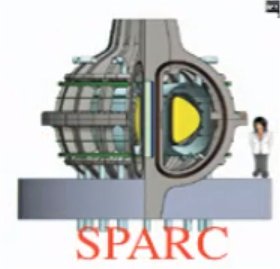
The MIT group has designed a small demonstration reactor called SPARC, Soonest/Smallest Private-Funded Affordable Robust Compact, that they estimate will cost in the $300M range. And, as the name says, they believe they can fund it with non-government money. Some money may come from a new MIT fund that is backing various leading edge technologies.
Prof. Dennis Whyte, head of the MIT Nuclear Science & Engineering Dept, gives a very interesting review of the ARC and SPARC projects, at a general audience level, in this video:
The projects mentioned at the top promise advantages over ARC. For example, some plan to use aneutronic reactions like Proton–Boron that do not produce neutrons and instead allow for direct extraction of electricity from charge particles emitted from the reactions. Most would be even more compact than ARC. However, none of these concepts are proven yet and so it is best if as many of them are pursued as possible to have the best chance of finding at least one that produces useful power from nuclear fusion.
A star displaying peculiar light patterns was first noticed in Kepler space telescope data by a group of citizen scientists working in the Planet Hunters program. Their work convinced astronomer Tabetha Boyajian to investigate star KIC 8462852, which is also known as Tabby’s Star or the WTF star (‘Where’s the Flux?’), in more detail. The investigation by her group found the star to be quite an oddity. Boyajian is interviewed about it in this article: How Astronomers Plan to Solve the Mystery of the “Alien Megastructure Star” – Out There/Discover Magazine
Tabby’s Star is so unusual that a few scientists, including Boyajian’s colleague Jason Wright, raised the possibility that its flickering is not natural but is due to the presence of an enormous artificial construct. That speculation quickly lent KIC 8462852 another nickname, the “alien megastructure star,” and prompted a flood of breathless news stories; it even got a shout out on Saturday Night Live. Boyajian’s subsequent TED lecture drew even more attention to her star.
The plan is to observe the star through a full calendar year at the [private] Las Cumbres Observatory Global Telescope Network (LCOGT). We have the funds to cover that, and a little bit more. We’re observing now, running off time LCOGT has gifted us, 200 hours there. At the end of the summer, when the Kickstarter funds get transferred, we’ll be able to set up the process through August and probably through December of 2017.
We want to see the star’s brightness dip again—it’s as simple as that. When it dips, how long the dips are, if there are many dips, all of the stuff relevant to any theory that’s on the table. Also, we’ll be able to get more detailed observations of whatever stuff is passing in front of the star, because we have a system to notify us when it’s not at its normal brightness. LCOGT is set up so we can get a spectrum as soon as that trigger happens, and also more intense observations.
These two videos from the Kickstarter campaign describe the star and their research plan: