This month, we’re on the floor at San Diego Comic-Con 2016 to celebrate the 50th anniversary of Star Trek’s first televised episode.
In this episode, Robert Picardo gives Star Trek fans a pop quiz to test their space science knowledge. And, for fairness, he asks space science experts to boldly go and test their Star Trek trivia knowledge. Robert also hosts a panel discussion about the relationship between Star Trek and NASA with some of the greatest minds at NASA.
More about the show:
This is the 8th installment of The Planetary Post, our monthly newsletter from Robert Picardo featuring the most notable space science happenings. To sign up go to http://www.planetary.org/connect
Starring Robert Picardo • Music by Jim McKeever
Featuring: Amber Straughn, Astrophysicist, NASA Goddard Space Flight Center Bobak Ferdowsi, Systems Engineer, NASA Jet Propulsion Laboratory Jay Falker, Early Stage Portfolio Executive, NASA Headquarters Dr. Kjell Lindgren, NASA Astronaut
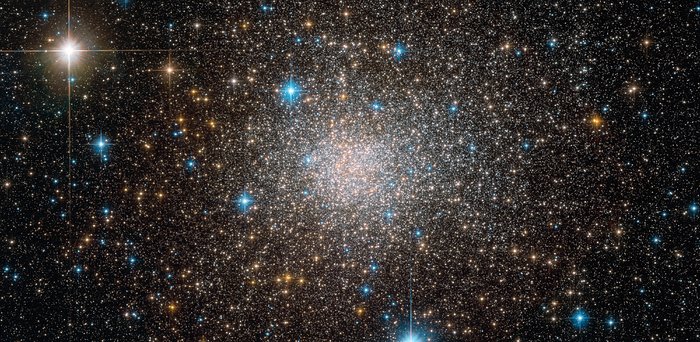
Peering through the thick dust clouds of the galactic bulge an international team of astronomers has revealed the unusual mix of stars in the stellar cluster known as Terzan 5. The new results indicate that Terzan 5 is in fact one of the bulge’s primordial building blocks, most likely the relic of the very early days of the Milky Way. Observations were made with the Wide Field Camera 3 (WFC3) on board the Hubble, the Multi-conjugate Adaptive Optics Demonstrator (MAD) instrument on ESO’s Very Large Telescope and the second generation Near Infrared Camera at the Keck Telescope.
A fossilised remnant of the early Milky Way harbouring stars of hugely different ages has been revealed by an international team of astronomers. This stellar system resembles a globular cluster, but is like no other cluster known. It contains stars remarkably similar to the most ancient stars in the Milky Way and bridges the gap in understanding between our galaxy’s past and its present.
Terzan 5, 19 000 light-years from Earth, has been classified as a globular cluster for the forty-odd years since its detection. Now, an Italian-led team of astronomers have discovered that Terzan 5 is like no other globular cluster known.
The team scoured data from the Advanced Camera for Surveys and the Wide Field Camera 3 on board Hubble, as well as from a suite of other ground-based telescopes [1]. They found compelling evidence that there are two distinct kinds of stars in Terzan 5 which not only differ in the elements they contain, but have an age-gap of roughly 7 billion years [2].
This sequence takes the viewer from a wide view of the Milky Way to the central regions, where many bright star forming regions and star clusters can be seen. The final view is a close-up of the sky around the star cluster Terzan 5 taken with Hubble, the Very Large Telescope at ESO’s Paranal Observatory and the Keck Telescope. Credit: Nick Risinger (skysurvey.org)/DSS/Hubble. Music: Johan B. Monell
The ages of the two populations indicate that the star formation process in Terzan 5 was not continuous, but was dominated by two distinct bursts of star formation.
“This requires the Terzan 5 ancestor to have large amounts of gas for a second generation of stars and to be quite massive. At least 100 million times the mass of the Sun,” explains Davide Massari, co-author of the study, from INAF, Italy, and the University of Gröningen, Netherlands.
Its unusual properties make Terzan 5 the ideal candidate for a living fossil from the early days of the Milky Way. Current theories on galaxy formation assume that vast clumps of gas and stars interacted to form the primordial bulge of the Milky Way, merging and dissolving in the process.
“We think that some remnants of these gaseous clumps could remain relatively undisrupted and keep existing embedded within the galaxy,” explains Francesco Ferraro from the University of Bologna, Italy, and lead author of the study. “Such galactic fossils allow astronomers to reconstruct an important piece of the history of our Milky Way.”
While the properties of Terzan 5 are uncommon for a globular cluster, they are very similar to the stellar population which can be found in the galactic bulge, the tightly packed central region of the Milky Way. These similarities could make Terzan 5 a fossilised relic of galaxy formation, representing one of the earliest building blocks of the Milky Way.
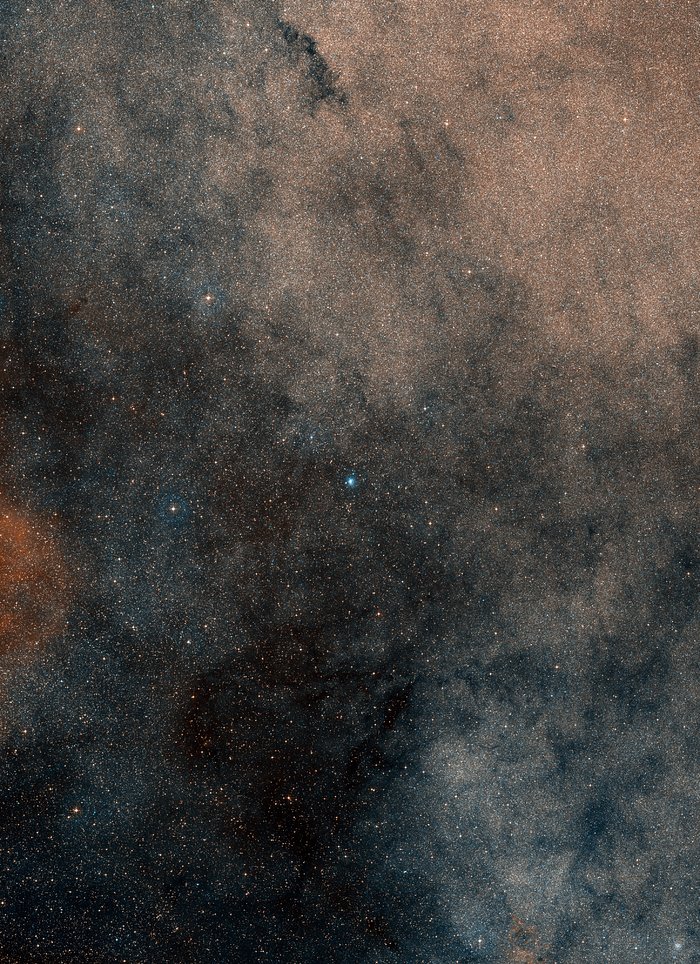
This wide-field image, based on data from Digitized Sky Survey 2, shows the whole region around the stellar grouping Terzan 5.
This assumption is strengthened by the original mass of Terzan 5 necessary to create two stellar populations: a mass similar to the huge clumps which are assumed to have formed the bulge during galaxy assembly around 12 billion years ago. Somehow Terzan 5 has managed to survive being disrupted for billions of years, and has been preserved as a remnant of the distant past of the Milky Way.
“Some characteristics of Terzan 5 resemble those detected in the giant clumps we see in star-forming galaxies at high-redshift, suggesting that similar assembling processes occurred in the local and in the distant Universe at the epoch of galaxy formation,“ continues Ferraro.
Hence, this discovery paves the way for a better and more complete understanding of galaxy assembly.
“Terzan 5 could represent an intriguing link between the local and the distant Universe, a surviving witness of the Galactic bulge assembly process,” explains Ferraro while commenting on the importance of the discovery.
The research presents a possible route for astronomers to unravel the mysteries of galaxy formation, and offers an unrivaled view into the complicated history of the Milky Way.
Notes
[1] The researchers also used data from the Multi-conjugate Adaptive Optics Demonstrator at ESO’s Very Large Telescope and the Near Infrared Camera 2 at the W. M. Keck Observatory.
[2] The two detected stellar populations have ages of 12 billion years and 4.5 billion years respectively.
A lonely 3-mile-high (5-kilometer-high) mountain on Ceres is likely volcanic in origin, and the dwarf planet may have a weak, temporary atmosphere. These are just two of many new insights about Ceres from NASA’s Dawn mission published this week in six papers in the journal Science.
Ceres’ lonely mountain, Ahuna Mons, is seen in this simulated perspective view. The elevation has been exaggerated by a factor of two. The view was made using enhanced-color images from NASA’s Dawn mission. Images taken using blue (440 nanometers), green (750 nanometers) and infrared (960 nanometers) spectral filters were combined to create the view. The spacecraft’s framing camera took the images from Dawn’s low-altitude mapping orbit, from an altitude of 240 miles (385 kilometers) in August 2016. The resolution of the component images is 120 feet (35 meters) per pixel.Chris Russell, principal investigator of the Dawn mission, based at the University of California, Los Angeles, said
“Dawn has revealed that Ceres is a diverse world that clearly had geological activity in its recent past”
Ahuna Mons as a Cryovolcano
Ahuna Mons is a volcanic dome unlike any seen elsewhere in the solar system, according to a new analysis led by Ottaviano Ruesch of NASA’s Goddard Space Flight Center, Greenbelt, Maryland, and the Universities Space Research Association. Ruesch and colleagues studied formation models of volcanic domes, 3-D terrain maps and images from Dawn, as well as analogous geological features elsewhere in our solar system. This led to the conclusion that the lonely mountain is likely volcanic in nature. Specifically, it would be a cryovolcano — a volcano that erupts a liquid made of volatiles such as water, instead of silicates.
“This is the only known example of a cryovolcano that potentially formed from a salty mud mix, and that formed in the geologically recent past,” Ruesch said.
A surprising finding emerged in the paper led by Russell: Dawn may have detected a weak, temporary atmosphere. Dawn’s gamma ray and neutron (GRaND) detector observed evidence that Ceres had accelerated electrons from the solar wind to very high energies over a period of about six days. In theory, the interaction between the solar wind’s energetic particles and atmospheric molecules could explain the GRaND observations.
A temporary atmosphere would be consistent with the water vapor the Herschel Space Observatory detected at Ceres in 2012-2013. The electrons that GRaND detected could have been produced by the solar wind hitting the water molecules that Herschel observed, but scientists are also looking into alternative explanations.
“We’re very excited to follow up on this and the other discoveries about this fascinating world,” Russell said.
Ceres: Between a Rocky and Icy Place
While Ahuna Mons may have erupted liquid water in the past, Dawn has detected water in the present, as described in a study led by Jean-Philippe Combe of the Bear Fight Institute, Winthrop, Washington. Combe and colleagues used Dawn’s visible and infrared mapping spectrometer (VIR) to detect probable water ice at Oxo Crater, a small, bright, sloped depression at mid-latitudes on Ceres.
The small, bright crater Oxo (6 miles, 10 kilometers wide) on Ceres is seen in this perspective view. The elevation has been exaggerated by a factor of two. The view was made using enhanced-color images from NASA’s Dawn mission. Dawn’s visible and infrared mapping spectrometer (VIR) has found evidence of water ice at this crater. The results were published in the journal Science in Sept. 2016. Images taken using blue (440 nanometers), green (750 nanometers) and infrared (960 nanometers) spectral filters were combined to create the view. The spacecraft’s framing camera took the images from Dawn’s low-altitude mapping orbit, from an altitude of 240 miles (385 kilometers) in August 2016. The resolution of the component images is 120 feet (35 meters) per pixel.Exposed water-ice is rare on Ceres, but the low density of Ceres, the impact-generated flows and the very existence of Ahuna Mons suggest that Ceres’ crust does contain a significant component of water-ice. This is consistent with a study of Ceres’ diverse geological features led by Harald Hiesinger of the Westfälische Wilhelms-Universität, Münster, Germany. The diversity of geological features on Ceres is further explored in a study led by Debra Buczkowski of the Johns Hopkins Applied Physics Laboratory, Laurel, Maryland.
Impact craters are clearly the most abundant geological feature on Ceres, and their different shapes help tell the intricate story of Ceres’ past. Craters that are roughly polygonal — that is, shapes bounded by straight lines — hint that Ceres’ crust is heavily fractured. In addition, several Cerean craters have patterns of visible fractures on their floors.
Some, like tiny Oxo, have terraces, while others, such as the large Urvara Crater (106 miles, 170 kilometers wide), have central peaks. There are craters with flow-like features, and craters that imprint on other craters, as well as chains of small craters. Bright areas are peppered across Ceres, with the most reflective ones in Occator Crater. Some crater shapes could indicate water-ice in the subsurface.
The dwarf planet’s various crater forms are consistent with an outer shell for Ceres that is not purely ice or rock, but rather a mixture of both — a conclusion reflected in other analyses. Scientists also calculated the ratio of various craters’ depths to diameters, and found that some amount of crater relaxation must have occurred. Additionally, there are more craters in the northern hemisphere of Ceres than the south, where the large Urvara and Yalode craters are the dominant features.
“The uneven distribution of craters indicates that the crust is not uniform, and that Ceres has gone through a complex geological evolution,” Hiesinger said.
Distribution of Surface Materials
What are the rocky materials in Ceres’ crust? A study led by Eleonora Ammannito of the University of California, Los Angeles, finds that clay-forming minerals called phyllosilicates are all over Ceres. These phyllosilicates are rich in magnesium and also have some ammonium embedded in their crystalline structure. Their distribution throughout the dwarf planet’s crust indicates Ceres’ surface material has been altered by a global process involving water.
Although Ceres’ phyllosilicates are uniform in their composition, there are marked differences in how abundant these materials are on the surface. For example, phyllosilicates are especially prevalent in the region around the smooth, “pancake”-like crater Kerwan (174 miles, 280 kilometers in diameter), and less so at Yalode Crater (162 miles, 260 kilometers in diameter), which has areas of both smooth and rugged terrain around it. Since Kerwan and Yalode are similar in size, this may mean that the composition of the material into which they impacted may be different. Craters Dantu and Haulani both formed recently in geologic time, but also seem to differ in composition.
“In comparing craters such as Dantu and Haulani, we find that their different material mixtures could extend beneath the surface for miles, or even tens of miles in the case of the larger Dantu,” Ammannito said.
Looking Higher
Now in its extended mission, the Dawn spacecraft has delivered a wealth of images and other data from its current perch at 240 miles (385 kilometers) above Ceres’ surface, which is closer to the dwarf planet than the International Space Station is to Earth. The spacecraft will be increasing its altitude at Ceres on Sept. 2, as scientists consider questions that can be examined from higher up.
Dawn’s mission is managed by JPL for NASA’s Science Mission Directorate in Washington. Dawn is a project of the directorate’s Discovery Program, managed by NASA’s Marshall Space Flight Center in Huntsville, Alabama. UCLA is responsible for overall Dawn mission science. Orbital ATK Inc., in Dulles, Virginia, designed and built the spacecraft. The German Aerospace Center, Max Planck Institute for Solar System Research, Italian Space Agency and Italian National Astrophysical Institute are international partners on the mission team. For a complete list of mission participants, visit: http://dawn.jpl.nasa.gov/mission
More information about Dawn is available at the following sites:
An extraordinary hydraulically powered robot dummy designed for NASA to use in testing space suits, circa 1963–1965, produced by the IIT Research Institute. The life-size dummy could simulate 35 basic human motions and was equipped with torque sensors at each joint to gather data on forces imposed on the human body by a pressurized suit. While a person could qualitatively describe the comfort and restrictions of a certain suit, the articulated dummy could provide direct quantitative information for a more scientific method of refining the design.
Weighing 230 pounds, the dummy was made height adjustable from 5´ 5″ to 6´ 2″ so that it could represent the average American male from the fifth to ninety-fifth percentile. The movements of the robot were enabled by hydraulic actuators powered by oil flowing through a nylon-tube circulatory system, and controlled by the operator from a separate console. The exterior is covered with a 1/32-inch thick aluminum skin with cutaways to allow freedom of motion, and the facial section of the fiberglass head is removable for access to the interior connections. The dummy is missing a forearm and hand, has various scuffs and dings to the body, and some of the wiring is frayed or damaged.
Only two of these robot dummies were produced, and the other is owned by the Smithsonian’s National Air and Space Museum; this one was purchased as surplus from the University of Maryland. The ‘Power Driven Articulated Dummy’ project was under Contract No. NAS 9-1370 and ran from May 22, 1963 through July 31, 1965, and is described at length in an official report dated December 14, 1965. The report covers, in great detail, the specifications of the dummy, its various systems, and technical hurdles encountered while creating it.
Although the development team succeeded in creating this impressive android—it could swivel its hips, raise and lower its arms and legs, shrug its shoulders, clench its fists, and even shake hands—the robot was never deployed as intended. The hydraulic system could not handle the pressure needed to move the robot’s extremities without leaking, and despite some creative test solutions—including outfitting it with a scuba wetsuit—the problem was never solved. NASA ultimately dropped the project in order to direct its funding elsewhere. Nevertheless, this remarkable robot stands as a testament to the innovative creativity NASA inspired in its quest skyward. Oversized.