Astronomers using NASA’s Hubble Space Telescope have imaged what may be water vapor plumes erupting off the surface of Jupiter’s moon Europa. This finding bolsters other Hubble observations suggesting the icy moon erupts with high altitude water vapor plumes.
This composite image shows suspected plumes of water vapor erupting at the 7 o’clock position off the limb of Jupiter’s moon Europa. The plumes, photographed by NASA’s Hubble’s Space Telescope Imaging Spectrograph, were seen in silhouette as the moon passed in front of Jupiter. Hubble’s ultraviolet sensitivity allowed for the features, rising over 100 miles above Europa’s icy surface, to be discerned. The water is believed to come from a subsurface ocean on Europa. The Hubble data were taken on January 26, 2014. The image of Europa, superimposed on the Hubble data, is assembled from data from the Galileo and Voyager missions. [Larger images]The observation increases the possibility that missions to Europa may be able to sample Europa’s ocean without having to drill through miles of ice.
“Europa’s ocean is considered to be one of the most promising places that could potentially harbor life in the solar system,” said Geoff Yoder, acting associate administrator for NASA’s Science Mission Directorate in Washington. “These plumes, if they do indeed exist, may provide another way to sample Europa’s subsurface.”
The plumes are estimated to rise about 125 miles (200 kilometers) before, presumably, raining material back down onto Europa’s surface. Europa has a huge global ocean containing twice as much water as Earth’s oceans, but it is protected by a layer of extremely cold and hard ice of unknown thickness. The plumes provide a tantalizing opportunity to gather samples originating from under the surface without having to land or drill through the ice.
The team, led by William Sparks of the Space Telescope Science Institute (STScI) in Baltimore observed these finger-like projections while viewing Europa’s limb as the moon passed in front of Jupiter.
The original goal of the team’s observing proposal was to determine whether Europa has a thin, extended atmosphere, or exosphere. Using the same observing method that detects atmospheres around planets orbiting other stars, the team realized if there was water vapor venting from Europa’s surface, this observation would be an excellent way to see it.
“The atmosphere of an extrasolar planet blocks some of the starlight that is behind it,” Sparks explained. “If there is a thin atmosphere around Europa, it has the potential to block some of the light of Jupiter, and we could see it as a silhouette. And so we were looking for absorption features around the limb of Europa as it transited the smooth face of Jupiter.”
In 10 separate occurrences spanning 15 months, the team observed Europa passing in front of Jupiter. They saw what could be plumes erupting on three of these occasions.
This diagram shows how the plumes on Europa are seen in silhouette as the moon moves across the face of Jupiter. Europa makes a complete orbit of Jupiter in just 3.5 Earth days. [ Larger images]This work provides supporting evidence for water plumes on Europa. In 2012, a team led by Lorenz Roth of the Southwest Research Institute in San Antonio, detected evidence of water vapor erupting from the frigid south polar region of Europa and reaching more than 100 miles (160 kilometers) into space. Although both teams used Hubble’s Space Telescope Imaging Spectrograph instrument, each used a totally independent method to arrive at the same conclusion.
“When we calculate in a completely different way the amount of material that would be needed to create these absorption features, it’s pretty similar to what Roth and his team found,” Sparks said. “The estimates for the mass are similar, the estimates for the height of the plumes are similar. The latitude of two of the plume candidates we see corresponds to their earlier work.”
But as of yet, the two teams have not simultaneously detected the plumes using their independent techniques. Observations thus far have suggested the plumes could be highly variable, meaning that they may sporadically erupt for some time and then die down. For example, observations by Roth’s team within a week of one of the detections by Sparks’ team failed to detect any plumes.
If confirmed, Europa would be the second moon in the solar system known to have water vapor plumes. In 2005, NASA’s Cassini orbiter detected jets of water vapor and dust spewing off the surface of Saturn’s moon Enceladus.
Scientists may use the infrared vision of NASA’s James Webb Space Telescope, which is scheduled to launch in 2018, to confirm venting or plume activity on Europa. NASA also is formulating a mission to Europa with a payload that could confirm the presence of plumes and study them from close range during multiple flybys.
“Hubble’s unique capabilities enabled it to capture these plumes, once again demonstrating Hubble’s ability to make observations it was never designed to make,” said Paul Hertz, director of the Astrophysics Division at NASA Headquarters in Washington. “This observation opens up a world of possibilities, and we look forward to future missions — such as the James Webb Space Telescope — to follow up on this exciting discovery.”
The work by Sparks and his colleagues will be published in the Sept. 29 issue of the Astrophysical Journal.
The Hubble Space Telescope is a project of international cooperation between NASA and ESA (the European Space Agency.) NASA’s Goddard Space Flight Center in Greenbelt, Maryland, manages the telescope. STScI, which is operated for NASA by the Association of Universities for Research in Astronomy in Washington, conducts Hubble science operations.
For images and more information about Europa and Hubble, visit:
The new finding from a group using the Hubble Space Telescope. (Someone living on a moon orbiting this gas giant would have quite a skyscape to enjoy.)
Two’s company, but three might not always be a crowd — at least in space.
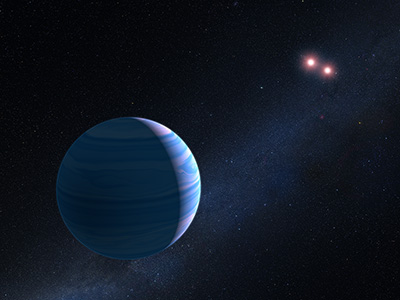
This artist’s illustration shows a gas giant planet circling a pair of red dwarf stars. [Larger images]Astronomers using NASA’s Hubble Space Telescope, and a trick of nature, have confirmed the existence of a planet orbiting two stars in the system OGLE-2007-BLG-349, located 8,000 light-years away towards the center of our galaxy.
The planet orbits roughly 300 million miles from the stellar duo, about the distance from the asteroid belt to our sun. It completes an orbit around both stars roughly every seven years. The two red dwarf stars are a mere 7 million miles apart, or 14 times the diameter of the moon’s orbit around Earth.
The Hubble observations represent the first time such a three-body system has been confirmed using the gravitational microlensing technique. Gravitational microlensing occurs when the gravity of a foreground star bends and amplifies the light of a background star that momentarily aligns with it. The particular character of the light magnification can reveal clues to the nature of the foreground star and any associated planets.
The three objects were discovered in 2007 by an international collaboration of five different groups: Microlensing Observations in Astrophysics (MOA), the Optical Gravitational Lensing Experiment (OGLE), the Microlensing Follow-up Network (MicroFUN), the Probing Lensing Anomalies Network (PLANET), and the Robonet Collaboration. These ground-based observations uncovered a star and a planet, but a detailed analysis also revealed a third body that astronomers could not definitively identify.
“The ground-based observations suggested two possible scenarios for the three-body system: a Saturn-mass planet orbiting a close binary star pair or a Saturn-mass and an Earth-mass planet orbiting a single star,” explained David Bennett of the NASA Goddard Space Flight Center in Greenbelt, Maryland, the paper’s first author.
The sharpness of the Hubble images allowed the research team to separate the background source star and the lensing star from their neighbors in the very crowded star field. The Hubble observations revealed that the starlight from the foreground lens system was too faint to be a single star, but it had the brightness expected for two closely orbiting red dwarf stars, which are fainter and less massive than our sun.
“So, the model with two stars and one planet is the only one consistent with the Hubble data,” Bennett said.
Bennett’s team conducted the follow-up observations with Hubble’s Wide Field Planetary Camera 2.
“We were helped in the analysis by the almost perfect alignment of the foreground binary stars with the background star, which greatly magnified the light and allowed us to see the signal of the two stars,” Bennett explained.
Kepler has discovered 10 other planets orbiting tight binary stars, but these are all much closer to their stars than the one studied by Hubble.
Now that the team has shown that microlensing can successfully detect planets orbiting double-star systems, Hubble could provide an essential role in this new realm in the continued search for exoplanets.
The team’s results have been accepted for publication in The Astronomical Journal.
International teams of astronomers have used the Atacama Large Millimeter/submillimeter Array (ALMA) to explore the distant corner of the Universe first revealed in the iconic images of the Hubble Ultra Deep Field (HUDF). These new ALMA observations are significantly deeper and sharper than previous surveys at millimetre wavelengths. They clearly show how the rate of star formation in young galaxies is closely related to their total mass in stars. They also trace the previously unknown abundance of star-forming gas at different points in time, providing new insights into the “Golden Age” of galaxy formation approximately 10 billion years ago.
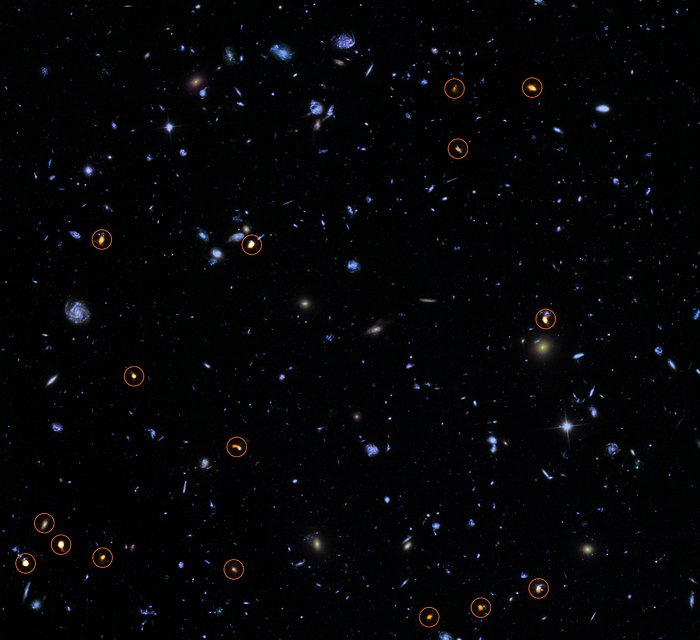
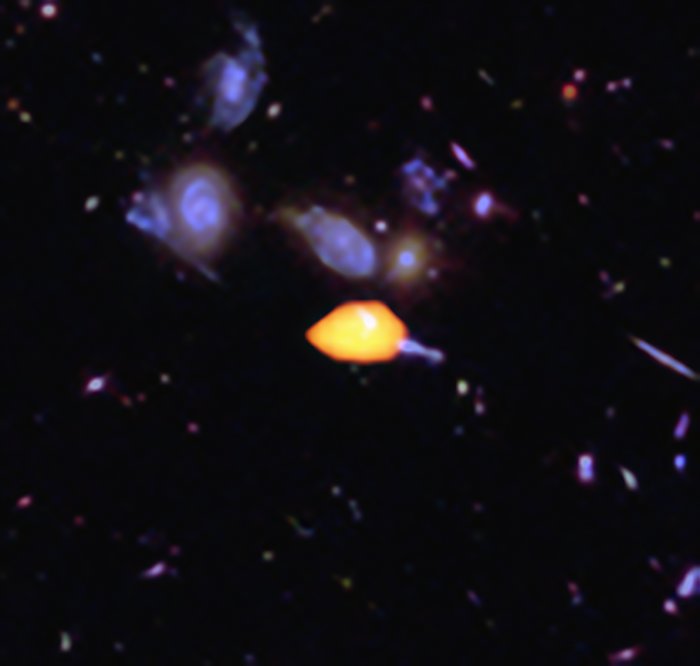
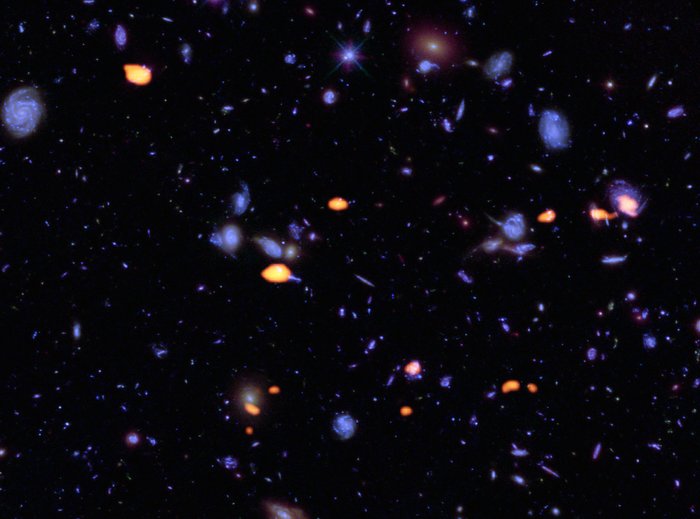
This image combines a background picture taken by the NASA/ESA Hubble Space Telescope (blue/green) with a new very deep ALMA view of this field (orange, marked with circles). All the objects that ALMA sees appear to be massive star-forming galaxies. This image is based on the ALMA survey by J. Dunlop and colleagues, covering the full HUDF area. [Larger images]The new ALMA results will be published in a series of papers appearing in the Astrophysical Journal and Monthly Notices of the Royal Astronomical Society. These results are also among those being presented this week at the Half a Decade of ALMA conference in Palm Springs, California, USA.
In 2004 the Hubble Ultra Deep Field images — pioneering deep-field observations with the NASA/ESA Hubble Space Telescope — were published. These spectacular pictures probed more deeply than ever before and revealed a menagerie of galaxies stretching back to less than a billion years after the Big Bang. The area was observed several times by Hubble and many other telescopes, resulting in the deepest view of the Universe to date.
This video sequence combines a background picture taken by the NASA/ESA Hubble Space Telescope (blue/green) with a new very deep ALMA view of this field (orange, marked with circles). All the objects that ALMA sees appear to be massive star-forming galaxies. This image is based on the ALMA survey by J. Dunlop and colleagues, covering the full HUDF area. Credit: NASA/ESA/ESO/J. Dunlop
Astronomers using ALMA have now surveyed this seemingly unremarkable, but heavily studied, window into the distant Universe for the first time both deeply and sharply in the millimetre range of wavelengths [1]. This allows them to see the faint glow from gas clouds and also the emission from warm dust in galaxies in the early Universe.
ALMA has observed the HUDF for a total of around 50 hours up to now. This is the largest amount of ALMA observing time spent on one area of the sky so far.
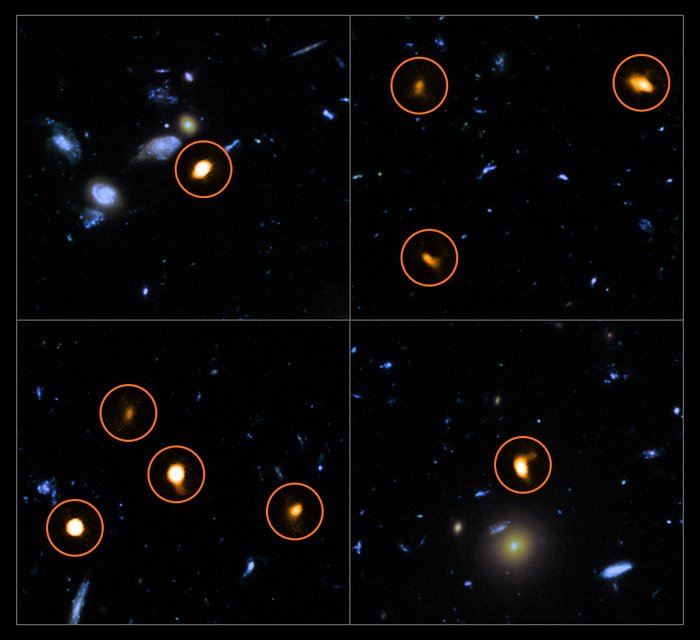
These cutout images are from a combination of a background picture taken by the NASA/ESA Hubble Space Telescope (blue/green) with a new very deep ALMA view of the field (orange, marked with circles). All the objects that ALMA sees appear to be massive star-forming galaxies. This image is based on the ALMA survey by J. Dunlop and colleagues, covering the full HUDF area. [Larger images.]One team led by Jim Dunlop (University of Edinburgh, United Kingdom) used ALMA to obtain the first deep, homogeneous ALMA image of a region as large as the HUDF. This data allowed them to clearly match up the galaxies that they detected with objects already seen with Hubble and other facilities.
This study showed clearly for the first time that the stellar mass of a galaxy is the best predictor of star formation rate in the high redshift Universe. They detected essentially all of the high-mass galaxies [2] and virtually nothing else.
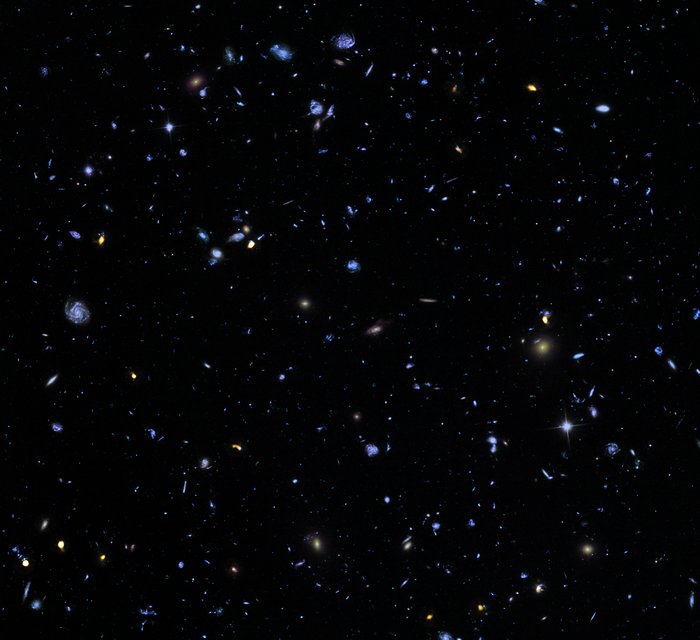
This image, called the Hubble eXtreme Deep Field (XDF), combines Hubble observations taken over the past decade of a small patch of sky in the constellation of Fornax. With a total of over two million seconds of exposure time, it is the deepest image of the Universe ever made, combining data from previous images including the Hubble Ultra Deep Field (taken in 2003 and 2004) and Hubble Ultra Deep Field Infrared (2009). The image covers a region less than a tenth of the width of the full Moon across, making it just a 30 millionth of the whole sky. Yet even in this tiny fraction of the sky, the long exposure reveals about 5500 galaxies, some of them so distant that we see them when the Universe was less than 5% of its current age. The Hubble eXtreme Deep Field image contains several of the most distant objects ever identified. [Larger images.]Jim Dunlop, lead author on the deep imaging paper sums up its importance:
“This is a breakthrough result. For the first time we are properly connecting the visible and ultraviolet light view of the distant Universe from Hubble and far-infrared/millimetre views of the Universe from ALMA.”
The second team, led by Manuel Aravena of the Núcleo de Astronomía, Universidad Diego Portales, Santiago, Chile, and Fabian Walter of the Max Planck Institute for Astronomy in Heidelberg, Germany, conducted a deeper search across about one sixth of the total HUDF [3].
ALMA surveyed the Hubble Ultra Deep Field, uncovering new details of the star-forming history of the Universe. This close-up image reveals one such galaxy (orange), rich in carbon monoxide, showing it is primed for star formation. The blue features are galaxies imaged by Hubble. This image is based on the very deep ALMA survey by Manuel Aravena, Fabian Walter and colleagues, covering about one sixth of the full HUDF area. [Larger images.]
“We conducted the first fully blind, three-dimensional search for cool gas in the early Universe,” said Chris Carilli, an astronomer with the National Radio Astronomy Observatory (NRAO) in Socorro, New Mexico, USA and member of the research team. “Through this, we discovered a population of galaxies that is not clearly evident in any other deep surveys of the sky.” [4]
Some of the new ALMA observations were specifically tailored to detect galaxies that are rich in carbon monoxide, indicating regions primed for star formation. Even though these molecular gas reservoirs give rise to the star formation activity in galaxies, they are often very hard to see with Hubble. ALMA can therefore reveal the “missing half” of the galaxy formation and evolution process.
A trove of galaxies, rich in carbon monoxide (indicating star-forming potential) were imaged by ALMA (orange) in the Hubble Ultra Deep Field. The blue features are galaxies imaged by Hubble.This image is based on the very deep ALMA survey by Manuel Aravena, Fabian Walter and colleagues, covering about one sixth of the full HUDF area. [Larger images]
“The new ALMA results imply a rapidly rising gas content in galaxies as we look back further in time,” adds lead author of two of the papers, Manuel Aravena (Núcleo de Astronomía, Universidad Diego Portales, Santiago, Chile). “This increasing gas content is likely the root cause for the remarkable increase in star formation rates during the peak epoch of galaxy formation, some 10 billion years ago.”
The results presented today are just the start of a series of future observations to probe the distant Universe with ALMA. For example, a planned 150-hour observing campaign of the HUDF will further illuminate the star-forming potential history of the Universe.
“By supplementing our understanding of this missing star-forming material, the forthcoming ALMA Large Program will complete our view of the galaxies in the iconic Hubble Ultra Deep Field,” concludes Fabian Walter.
Notes
[1] Astronomers specifically selected the area of study in the HUDF, a region of space in the faint southern constellation of Fornax (The Furnace), so ground-based telescopes in the southern hemisphere, like ALMA, could probe the region, expanding our knowledge about the very distant Universe.
Probing the deep, but optically invisible, Universe was one of the primary science goals for ALMA.
[2] In this context “high mass” means galaxies with stellar masses greater than 20 billion times that of the Sun ( 2 × 10¹⁰solar masses). For comparison, the Milky Way is a large galaxy and has a mass of around 100 billion solar masses.
[3] This region of sky is about seven hundred times smaller than the area of the disc of the full Moon as seen from Earth. One of the most startling aspects of the HUDF was the vast number of galaxies found in such a tiny fraction of the sky.
[4] ALMA’s ability to see a completely different portion of the electromagnetic spectrum from Hubble allows astronomers to study a different class of astronomical objects, such as massive star-forming clouds, as well as objects that are otherwise too faint to observe in visible light, but visible at millimetre wavelengths.
The search is referred to as “blind” as it was not focussed on any particular object.
The new ALMA observations of the HUDF include two distinct, yet complementary types of data: continuum observations, which reveal dust emission and star formation, and a spectral emission line survey, which looks at the cold molecular gas fueling star formation. The second survey is particularly valuable because it includes information about the degree to which light from distant objects has been redshifted by the expansion of the Universe. Greater redshift means that an object is further away and seen farther back in time. This allows astronomers to create a three-dimensional map of star-forming gas as it evolves over cosmic time.
[] “The methane river delta on Titan, one of Saturn’s moons, as depicted by space artist Ron Miller. (Photo: Ron Miller)”
Since 51 Pegasi b first swam into view 20 years ago, over 3,000 other exoplanets have been discovered. They vary in size, density and absurdity with some planets believed to have atmospheres of vaporized rock and mantles of liquid diamond. As such you’d think these would be boom times for space artists like Lynette Cook but in fact it’s been quite the opposite. Her space art career has never been more tenuous.
“The budgets to hire people like me on the part of publishers and science organizations has really dwindled in recent years,” she says. Partly this is due to recent changes in print economics. Cook has watched as publishers have become increasingly willing to use inaccurate and poorly rendered “no-fee” illustrations to keep costs down. “I saw a shift,” says Cook, “from commissioning new art, to wanting me to rework earlier images, so they looked different (but didn’t cost as much), to reusing older art “as is” for new discoveries.” Eventually her clients simply stopped calling, “as if they were stars in the heavens that were winking out.”