A couple of inspiring videos:
A couple of inspiring videos:
The European/Russian ExoMars mission is nearing the Red Planet. The spacecraft consists of two parts: the Trace Gas Orbiter (TGO) and the Schiaparelli lander. On Sunday, Oct. 16th the two will separate and on Wednesday, Oct. 19th the TGO will go into orbit and Schiaparelli will make its landing.
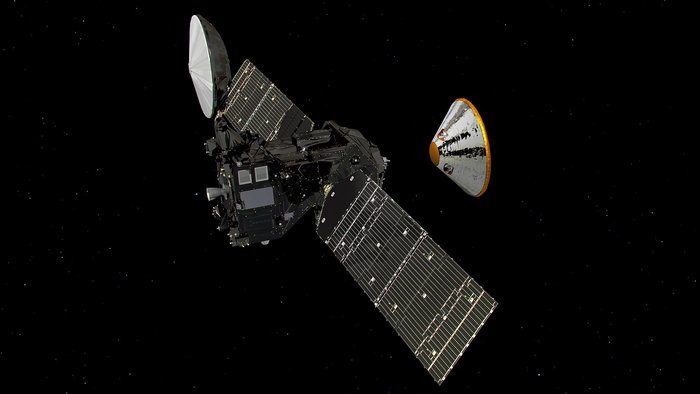
Webcasts reports will cover the events on both days:
The Live coverage overview
16 October – spacecraft separation
In addition to text updates here and via our twitter channels, a short statement confirming the outcome of the separation will be streamed live from the main control room of ESA’s Spacecraft Operations Centre starting at 14:30 GMT / 16:30 CEST.
19 October – landing and arriving at Mars
Live coverage of ExoMars Trace Gas Orbiter arrival and Schiaparelli landing on Mars will begin with our Social TV programme via ESA’s Facebook page and Livestream 13:00–15:15 GMT / 15:00–17:15 CEST on 19 October.
The ESA TV programme will be broadcast on this page in two parts on 19 October:
15:44–16:59 GMT / 17:44–18:59 CEST
18:25–20:03 GMT / 20:25–22:03 CEST
20 October – status report and first images
A press conference is scheduled for 20 October at 08:00 GMT / 10:00 CEST, when a mission status update is expected, along with the first images from the Schiaparelli descent camera. This will also be streamed live via the player above.
For additional mission status text updates starting 14 October, see here.
====
Here is this week’s episode of NASA’s Space to Ground report on activities related to the Int. Space Station:
And here is a video showing views of hurricane Nicole as seen from the ISS on Thursday:
Here is a report from Kennedy Space Center with a description of the effects of hurricane Matthew:
The latest finding with the Hubble space telescope:
Observable Universe contains ten times more galaxies
than previously thought

Astronomers using data from the NASA/ESA Hubble Space Telescopes and other telescopes have performed an accurate census of the number of galaxies in the Universe. The group came to the surprising conclusion that there are at least 10 times as many galaxies in the observable Universe as previously thought. The results have clear implications for our understanding of galaxy formation, and also help solve an ancient astronomical paradox — why is the sky dark at night?
Since Edwin Hubble discovered that the Milky Way is not the only galaxy in the Universe astronomers try to find out how many of them are there. This new Hubblecast focusses on the question “How many galaxies are there?” including the new numbers achieved in 2016.
One of the most fundamental questions in astronomy is that of just how many galaxies the Universe contains. The Hubble Deep Field images, captured in the mid 1990s, gave the first real insight into this. Myriad faint galaxies were revealed, and it was estimated that the observable Universe contains about 100 billion galaxies [1]. Now, an international team, led by Christopher Conselice from the University of Nottingham, UK, have shown that this figure is at least ten times too low.
This animation demonstrates the evolution of galaxy size and number over cosmic time. It starts with the modern Universe with rather few and large galaxies — as they can be seen in our cosmic neighbourhood — and ends with a view of the early Universe with many tiny galaxies. Credit: ESA/Hubble, M. Kornmesser
Conselice and his team reached this conclusion using deep space images from Hubble, data from his team’s previous work, and other published data [2]. They painstakingly converted the images into 3D, in order to make accurate measurements of the number of galaxies at different times in the Universe’s history. In addition, they used new mathematical models which allowed them to infer the existence of galaxies which the current generation of telescopes cannot observe. This led to the surprising realisation that in order for the numbers to add up, some 90% of the galaxies in the observable Universe are actually too faint and too far away to be seen — yet.
“It boggles the mind that over 90% of the galaxies in the Universe have yet to be studied. Who knows what interesting properties we will find when we observe these galaxies with the next generation of telescopes,” explains Christopher Conselice about the far-reaching implications of the new results.
In analysing the data the team looked more than 13 billion years into the past. This showed them that galaxies are not evenly distributed throughout the Universe’s history. In fact, it appears that there were a factor of 10 more galaxies per unit volume when the Universe was only a few billion years old compared with today. Most of these galaxies were relatively small and faint, with masses similar to those of the satellite galaxies surrounding the Milky Way.
This animation demonstrates the lookback into the distant, early Universe. While the modern Universe contains in average larger galaxies, the early Universe is dominated by many tiny galaxies. Credit: ESA/Hubble, M. Kornmesser
These results are powerful evidence that a significant evolution has taken place throughout the Universe’s history, an evolution during which galaxies merged together, dramatically reducing their total number. “This gives us a verification of the so-called top-down formation of structure in the Universe,” explains Conselice.
The decreasing number of galaxies as time progresses also contributes to the solution of Olbers’ paradox — why the sky is dark at night [3]. The team came to the conclusion that there is such an abundance of galaxies that, in principle, every point in the sky contains part of a galaxy. However, most of these galaxies are invisible to the human eye and even to modern telescopes, owing to a combination of factors: redshifting of light, the Universe’s dynamic nature and the absorption of light by intergalactic dust and gas, all combine to ensure that the night sky remains mostly dark.
This animation starts with a lookback into the early Universe. The local, modern Universe with large and evolved galaxies can be seen to the left. The distant, early Universe with many tiny and primordial galaxies can be seen to the right. These galaxies grew through mergers to the galaxies we see today. The animation slowly turns by 90 degree and ends with a view similar to the Hubble Deep fields. Credit: ESA/Hubble, M. Kornmesser
Notes
[1] The limited speed of light and the age of the Universe mean that the entire Universe cannot be seen from Earth. The part visible within our cosmological horizon is called the observable Universe.
[2] The study uses data from Perez-Gonzalez et al. (2008), Kajisawa et al. (2009), Fontanta et al. (2004, 2006), Caputi et al. (2011), Pozzetti et al. (2009), Mortlock et al. (2011), Muzzin et al. (2013), Mortlock et al. (2015), Duncan et al. (2014), Grazian et al. (2015), Tomczak et al. (2014) and Song et al. (2015).
[3] The astronomer Heinrich Olbers argued that the night sky should be permanently flooded by light, because in an unchanging Universe filled with an infinite number of stars, every single part of the sky should be occupied by a bright object. However, our modern understanding of the Universe is that it is both finite and dynamic — not infinite and static.
This video pans across the southern field of the Great Observatories Origins Deep Survey (GOODS). GOODS is a large galaxy census, a deep-sky study by several observatories to trace the formation and evolution of galaxies. Credit: NASA, ESA/Hubble, Music: Johan B. Monell (www.johanmonell.com)
Here are some recent additions to the collection of sci-fi short films at DUST – “sci fi videos and visions of the future” (see also this earlier posting):
** Wire Cutters:
“Wire Cutters” – Writer / Producer / Director: Jack Anderson www.jackanders.com/
A chance encounter proves fateful for 2 robots mining on a desolate planet.
** 9 Minutes:
‘9 Minutes’ – by P.J. WOLFF
9 Minutes is a tense science fiction thriller set in the middle of the desert. As this darkly atmospheric short progresses, this man and his dog are paid by a visit by unwelcome extraterrestrial guests. The encounter is sudden and terrifying. When the man comes to, he is unnerved by the footage captured by his phone.
The man tries to go about his business and move on but there is something irreversibly wrong with his dog after the encounter. Watch the short for yourself to find out what happened.
Dust loves the director’s resourceful use of one location, one actor, spare CGI, and patient suspense building. The short stars Joshua Leonard of “The Blair Witch Project” fame, who finds himself ensnared in yet another terrifying experience.
** Never Happened:
“Never Happened” a new film by Mark Slutsky markslutsky.com
When colleagues Laura and Grady have an impulsive fling on a business trip, they decide it might be for the best if it all just never happened.
====
DUST is the first multi-platform destination for binge watchable sci-fi. We feature science fiction short films and other content from emerging filmmakers with stunning visual effects, captivating plots and complex character explorations. Robots, aliens, space exploration, technology, and human experience are all a part of DUST. Explore, subscribe and follow for more:
Subscribe to DUST on YouTube: http://bit.ly/2aqc5vh
Watch more: http://bit.ly/2amTSen
Website: http://www.watchdust.com
Instagram: http://bit.ly/2amAhRt
Facebook: http://bit.ly/2aqYgtZ
Snapchat: http://bit.ly/2a9EV44
Sign-up for DUST newsletter: http://eepurl.com/b_SKAz
====