Two launches highlight the latest Space to Ground report from NASA on activities related to the Int. Space Station:
[ Update Oct.21.2016: Here are videos of the Soyuz with three new crew members docking at the ISS today and then entering the station:
After launching on Oct. 19, in their Soyuz MS-02 spacecraft from the Baikonur Cosmodrome in Kazakhstan, Expedition 49/50 Soyuz Commander Sergey Ryzhikov and Flight Engineer Andrey Borisenko of Roscosmos and Flight Engineer Shane Kimbrough of NASA arrived at the International Space Station on Oct. 21 to complete their two-day journey.
A few hours after docking to the International Space Station on Oct. 21, Expedition 49/50 Soyuz Commander Sergey Ryzhikov and Flight Engineer Andrey Borisenko of Roscosmos and Flight Engineer Shane Kimbrough of NASA, opened the hatch of their Soyuz MS-02 spacecraft and were greeted by station Commander Anatoly Ivanishin of Roscosmos and Flight Engineers Kate Rubins of NASA and Takuya Onishi of the Japan Aerospace Exploration Agency.
This week Lisa Stojanovski investigates the cargo onboard the next Cygnus to fly – including two Spire Cubesats, Cool Flames, and brand new lights.
TMRO Space Pods are crowd funded shows. If you like this episode consider contributing to help us to continue to improve. Head over to http://www.patreon.com/spacepod for information, goals and reward levels. Don’t forget to check out our weekly live show campaign as well over at http://www.patreon.com/tmro
Here is an interview with Chris Lewicki, chief of the asteroid mining company Planetary Resources:
As Humans venture out far away from the Earth into the solar system, they will need material resources to keep us going. Where do we get those from? One for-profit company, Planetary Resources, wants to be the one to make it happen.
We had a chance to speak with the company’s President and CEO, Chris Lewicki about the company’s plans to survey, prospect, and exploit near-Earth asteroids. The company has a lot of financial backing and has plans to send its first satellite to an asteroid in 2020.
This interview was originally broadcast as part of our ongoing Facebook Live segment, The Convo: www.facebook.com/PCMag/videos…
====
Jason Dunn, CTO of Made In Space, talks about the role of 3d printing in space development:
NASA intern turned Silicon Valley entrepreneur, Jason Dunn, saw what was holding humans back from colonizing outer space…and decided to do something about it. With his company Made in Space’s cutting-edge 3D printer, astronauts can break their reliance on costly resupply missions from Earth and—for the first time ever—build new supplies for themselves in space. Dunn and his team believe their invention will usher in a new era of dramatic progress in space.
===
Craig Clark, CEO of Clyde Space in Scotland, talks about their smallsat projects:
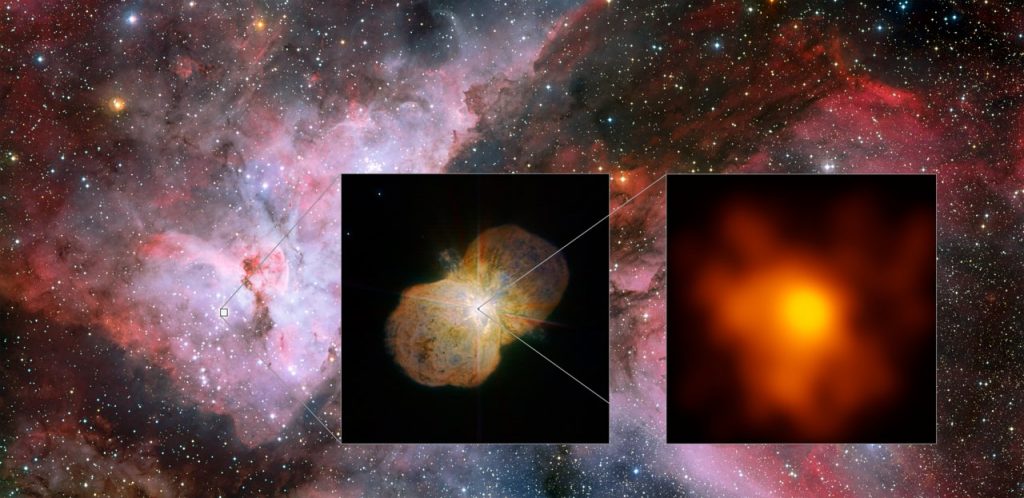
This mosaic shows the Carina Nebula (left part of the image), home of the Eta Carinae star system. This part was observed with the Wide Field Imager on the MPG/ESO 2.2-metre telescope at ESO’s La Silla Observatory. The middle part shows the direct surrounding of the star: the Homunculus Nebula, created by the ejected material from the Eta Carinae system. This image was taken with the NACO near-infrared adaptive optics instrument on ESO’s Very Large Telescope. The right image shows the innermost part of the system as seen with the Very Large Telescope Interferometer (VLTI). It is the highest resolution image of Eta Carinae ever. [Larger images.]An international team of astronomers have used the Very Large Telescope Interferometer to image the Eta Carinae star system in the greatest detail ever achieved. They found new and unexpected structures within the binary system, including in the area between the two stars where extremely high velocity stellar winds are colliding. These new insights into this enigmatic star system could lead to a better understanding of the evolution of very massive stars.
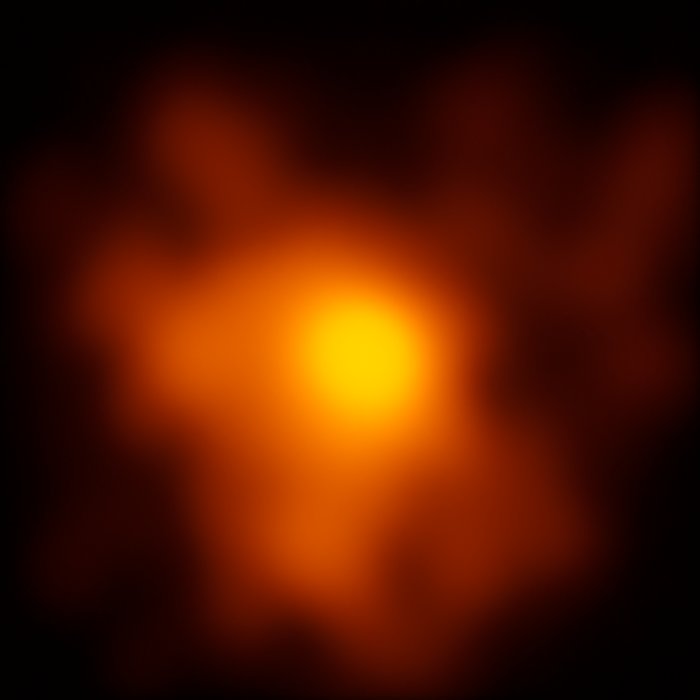
This image represent the best image of the Eta Carinae star system ever made. The observations were made with the Very Large Telescope Interferometer and could lead to a better understanding of the evolution of very massive stars. [Larger images]
This animation zooms in on the massive star system Eta Carinae, located in the Carina Nebula. During the zoom the Homunculus Nebula and finally the violent surrounding of Eta Carinae becomes visible.
This colossal binary system consists of two massive stars orbiting each other and is very active, producing stellar winds which travel at velocities of up to ten million kilometres per hour [1]. The zone between the two stars where the winds from each collide is very turbulent, but until now it could not be studied.
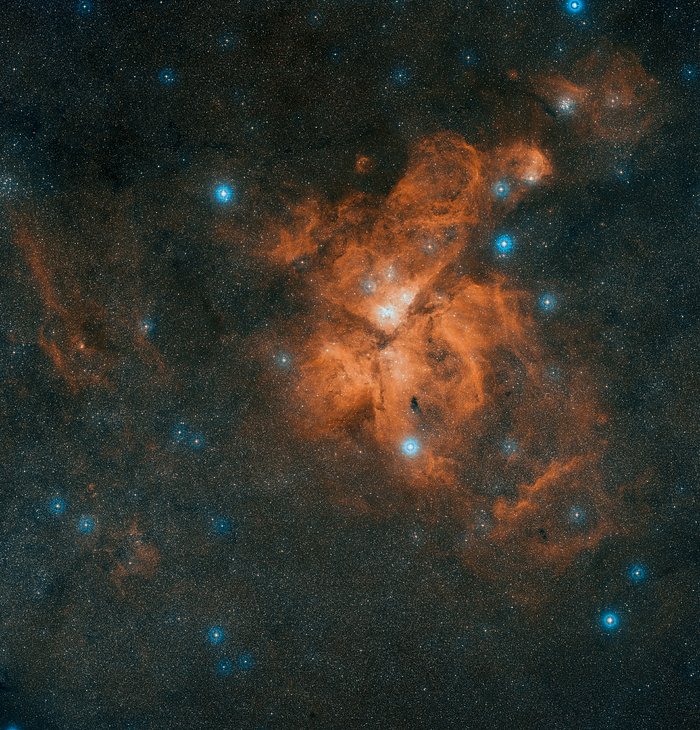
This image is a colour composite made from exposures from the Digitized Sky Survey 2 (DSS2). The field of view is approximately 4.7 x 4.9 degrees. [Larger images.]
The power of the Eta Carinae binary pair creates dramatic phenomena. A “Great Eruption” in the system was observed by astronomers in the 1830s. We now know that this was caused by the larger star of the pair expelling huge amounts of gas and dust in a short amount of time, which led to the distinctive lobes, known as the Homunculus Nebula, that we see in the system today. The combined effect of the two stellar winds as they smash into each other at extreme speeds is to create temperatures of millions of degrees and intense deluges of X-ray radiation.
This animation zooms from outside the Homunculus Nebula, which Eta Carinae ejected in a famous outburst in the 19th century, to the system’s two massive orbiting stars. Credit: NASA Goddard CI Lab
The central area where the winds collide is so comparatively tiny — a thousand times smaller than the Homunculus Nebula — that telescopes in space and on the ground so far have not been able to image them in detail. The team has now utilised the powerful resolving ability of the VLTI instrument AMBER to peer into this violent realm for the first time. A clever combination — an interferometer — of three of the four Auxiliary Telescopes at the VLT lead to a tenfold increase in resolving power in comparison to a single VLT Unit Telescope. This delivered the sharpest ever image of the system and yielded unexpected results about its internal structures.
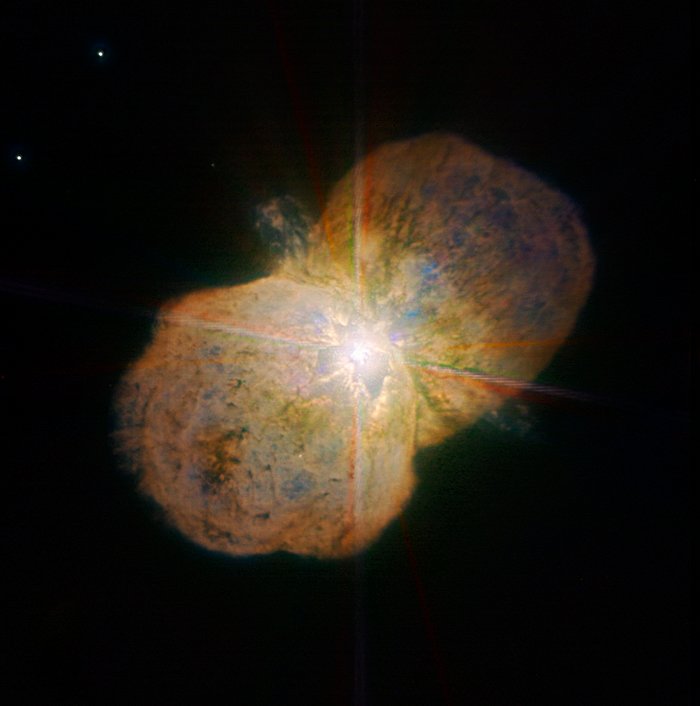
This new image of the luminous blue variable Eta Carinae was taken with the NACO near-infrared adaptive optics instrument on ESO’s Very Large Telescope, yielding an incredible amount of detail. The images clearly shows a bipolar structure as well as the jets coming out from the central star. The image was obtained by the Paranal Science team and processed by Yuri Beletsky (ESO) and Hännes Heyer (ESO). It is based on data obtained through broad (J, H, and K; 90 second exposure time per filters) and narrow-bands (1.64, 2.12, and 2.17 microns; probing iron, molecular and atomic hydrogen, respectively; 4 min per filter). [Larger images.]
The new VLTI image clearly depict the structure which exists between the two Eta Carinae-stars. An unexpected fan-shaped structure was observed where the raging wind from the smaller, hotter star crashes into the denser wind from the larger of the pair.
“Our dreams came true, because we can now get extremely sharp images in the infrared. The VLTI provides us with a unique opportunity to improve our physical understanding of Eta Carinae and many other key objects”, says Gerd Weigelt.
In addition to the imaging, the spectral observations of the collision zone made it possible to measure the velocities of the intense stellar winds [2]. Using these velocities, the team of astronomers were able to produce more accurate computer models of the internal structure of this fascinating stellar system, which will help increase our understanding of how these kind of extremely high mass stars lose mass as they evolve.
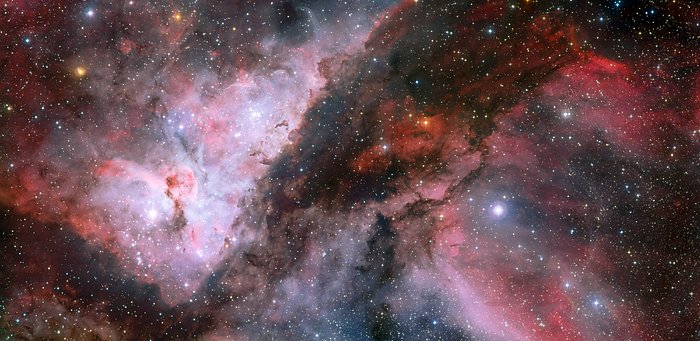
This spectacular panoramic view combines a new image of the field around the Wolf–Rayet star WR 22 in the Carina Nebula (right) with an earlier picture of the region around the unique star Eta Carinae in the heart of the nebula (left). The picture was created from images taken with the Wide Field Imager on the MPG/ESO 2.2-metre telescope at ESO’s La Silla Observatory in Chile. This image is available as a mounted image in the ESOshop. [Larger image]
Team member Dieter Schertl (MPIfR) looks forward:
“The new VLTI instruments GRAVITY and MATISSE will allow us to get interferometric images with even higher precision and over a wider wavelength range. This wide wavelength range is needed to derive the physical properties of many astronomical objects.”
Notes
[1] The two stars are so massive and bright that the radiation they produce rips off their surfaces and spews them into space. This expulsion of stellar material is referred to as stellar “wind”, and it can travel at millions of kilometres per hour.
[2] Measurements were done through the Doppler effect. Astronomers use the Doppler effect (or shifts) to calculate precisely how fast stars and other astronomical objects move toward or away from Earth. The movement of an object towards or away from us causes a slight shift in its spectral lines. The velocity of the motion can be calculated from this shift.
(See also the earlier posting here with the first two trailers.)
In this video, Andy Weir (author of The Martian) and others talk about the challenges of just getting to Mars:
The mission architecture as described in the TV program shares many aspects of the architecture for Mars settlement laid out recently by Elon Musk of SpaceX:
 ) and others talk about the challenges of just getting to Mars: