The Alpha Centauri star system is ideal to search for habitable planets by various observing techniques due to its proximity and wide range of stellar masses. Following the recent discovery of an Earth-size planet candidate located inside the Proxima Centauri habitable zone, Dr. Marois will discuss this remarkable discovery and the planet’s potential to find life. He will also present our current instrument project for the Gemini South observatory, TIKI, to discover similar planets around the two Sun-like pair located 15,000 AU from Proxima Centauri. The Alpha Centauri system is the prime target of the Breakthrough Starshot program, a project to send small quarter-size probes to take resolve images of these new worlds, and to prepare for Humanity’s first step into a new star system.
More about Dr. Marois:
Dr Marois completed his Ph.D. at the Université de Montréal in 2004. The main topic of his thesis work was to understand the limits in exoplanet imaging and to design innovating observing strategies. After his thesis, he did postdoctoral researches at the Lawrence Livermore National Laboratory, Univ. of California Berkeley and NRC. In 2008, while at NRC, he led the team that took the first image of another planetary system (HR 8799) using the Keck and Gemini telescopes. He is currently pursuing his research at the NRC Herzberg where he is part of the Gemini Planet Imager campaign, and leading the development of instruments for imaging Earth-like planets at Gemini South and at the TMT.
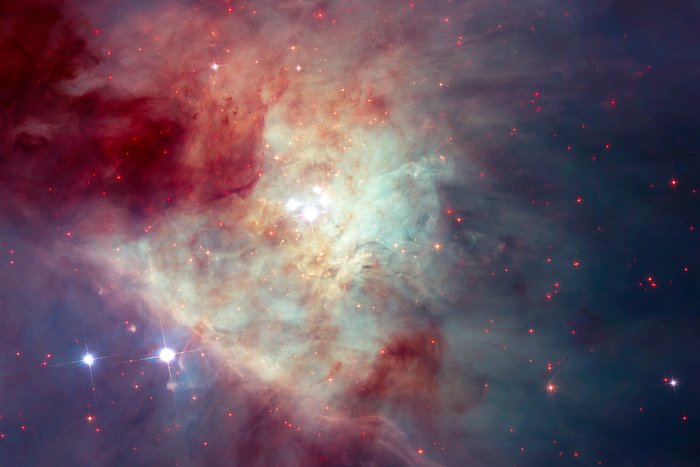
This composite image of the Kleinmann-Low Nebula, part of the Orion Nebula complex, is composed of several pointings of the NASA/ESA Hubble Space Telescope in optical and near-infrared light. Infrared light allows to peer through the dust of the nebula and to see the stars therein. The revealed stars are shown with a bright red colour in the image. With this image, showing the central region of the Orion Nebula, scientists were looking for rogue planets and brown dwarfs. As side-effect they found a fast-moving runaway star. [Larger image]In the search for rogue planets and failed stars astronomers using the NASA/ESA Hubble Space Telescope have created a new mosaic image of the Orion Nebula. During their survey of the famous star formation region, they found what may be the missing piece of a cosmic puzzle; the third, long-lost member of a star system that had broken apart.
The Orion Nebula is the closest star formation region to Earth, only 1400 light-years away. It is a turbulent place — stars are being born, planetary systems are forming and the radiation unleashed by young massive stars is carving cavities in the nebula and disrupting the growth of smaller, nearby stars.
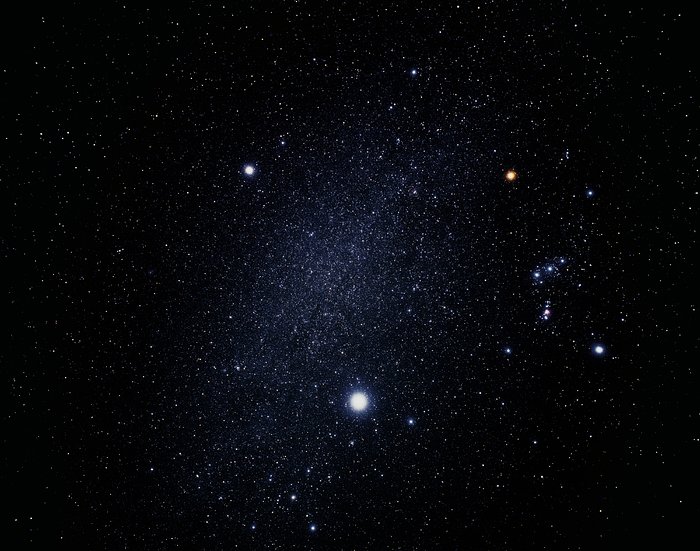
This video starts with a ground-based image of the night sky, taken by Akira Fujii, zooms on the star formation region of the Orion Nebula — observed by Martin Kornmesser — and ends with a detailed view of the nebula as seen by Hubble. Credit: ESA/Hubble, A. Fujii, M. KornmesserMusic: Johan B. Monell (www.johanmonell.com)
Because of this ongoing turmoil, Hubble has observed the nebula many times to study the various intriguing processes going on there. This large composite image of the nebula’s central region, combining visual and near-infrared data, is the latest addition to this collection.
Astronomers used these new infrared data to hunt for rogue planets — free-floating in space without a parent star — and brown dwarfs in the Orion Nebula. The infrared capabilities of Hubble also allow it to peer through the swirling clouds of dust and gas and make the stars hidden within clearly visible; the unveiled stars appear with bright red colours in the final image. Among these, astronomers stumbled across a star moving at an unusually high speed — about 200 000 kilometres per hour [1]. This star could be the missing piece of the puzzle of a star system that had been broken apart 540 years ago.
This ground-based image was taken by Japanese amateur astronomer Akira Fujii and shows the constellations Orion, Canis Minor and Canis major. [Larger image]Astronomers already knew about two other runaway stars in the Orion Nebula which were most likely once part of a now-defunct multiple-star system. For years it was suspected that the original system contained more than just these two stars. Now, by virtue of accident and curiosity, Hubble may have found the missing third piece of this cosmic puzzle.
Whether the new star is indeed the missing — and the last — piece of the puzzle will require further observations. So will the answer to the question of why the original star system broke apart in the first place. While there are several theories — interactions with other, nearby stellar groups, or two of the stars getting too close to each other — none can be ruled out or confirmed yet.
And while the astronomers are looking for the answers to these questions, who knows what mystery they will find next?
Notes
[1] The relative speed of the star was calculated by comparing observations made in 1998 with the recent ones. The speed of the newly discovered star is almost 30 times the speed of most of the nebula’s stellar inhabitants.
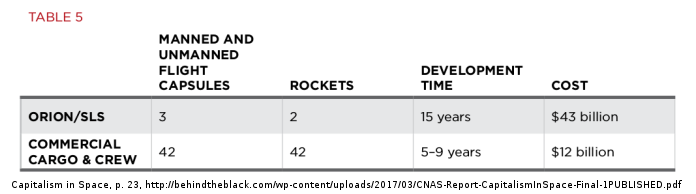
Author and journalist Bob Zimmerman points me to a report, sponsored by the Center for a New American Security (CNAS), in which he examines the current state of development of space transportation by NASA and by the private sector. He focuses in particular on a comparison between NASA’s Space Launch System (SLS) rocket and Orion crew spacecraft programs versus the commercial vehicles developed in partnership with NASA via the Commercial Cargo and Crew programs.
CNAS Report Capitalism In Space (pdf) – Full report with several tables summarizing costs for SLS, Orion, NASA commercial cargo and crew programs, etc.
Bob talked about the report with John Batchelor this week:
As this table from Bob’s report illustrates, the cost of development of the SLS/Orion is enormous:
Furthermore, an operational SLS/Orion will only launch once every year or two. So with an annual budget of $2B or more, that means each launch will cost at least $2B, not counting the above development costs. (Often NASA officials will quote something in the range of $500M per launch but this is a mythical “marginal” cost number that includes only what was paid for fuel, metals, etc. for one rocket, not the full expense required to make the launch happen.)
Meanwhile, SpaceX has already pushed launch costs 2-3 times lower for NASA and commercial satellite customers compared to a few years ago. And SpaceX, Blue Origin and others are developing reusable launch systems and spacecraft that will dramatically lower the cost of getting to space below today’s prices.
The SLS rocket was forced on NASA by Congress (or more accurately by the space policy and budget committees dominated by Senators and Representatives of states and districts with NASA centers and major contractors), which actually dictated most of the design of the all-throwaway rocket.
The money saved by dropping SLS/Orion and instead flying on competitively sourced commercial space transport services could be redirected by NASA to develop crucially needed space technologies such as in-space tugs, propellant depots, lunar and asteroid mining and manufacturing systems, rotating habitats to provide spin-gravity, etc. These technologies are required to make travel beyond earth affordable and space settlement feasible.
Here is a video preview of Blue Origin’s New Glenn, which will start flying in 2020 (a factory to build the New Glenn is under construction on Cape Canaveral):
And here is a NASA video from an interview with Dan Rasky, who worked as a Senior Scientist for NASA on the Commercial Orbital Transportation Systems (COTS) program, talking about how SpaceX built the Falcon 9 for a factor of 10 less than the NASA/USAF procurement cost model said it should cost (and the model usually underestimates aerospace project cost):
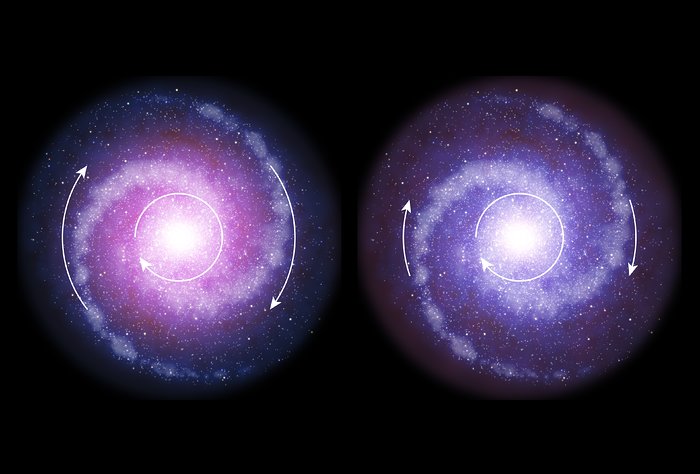
Schematic representation of rotating disc galaxies in the early Universe (right) and the present day (left). Observations with ESO’s Very Large Telescope suggest that such massive star-forming disc galaxies in the early Universe were less influenced by dark matter (shown in red), as it was less concentrated. As a result the outer parts of distant galaxies rotate more slowly than comparable regions of galaxies in the local Universe. [Full size image. See also same image with graphs of rotation speeds. ]New observations indicate that massive, star-forming galaxies during the peak epoch of galaxy formation, 10 billion years ago, were dominated by baryonic or “normal” matter. This is in stark contrast to present-day galaxies, where the effects of mysterious dark matter seem to be much greater. This surprising result was obtained using ESO’s Very Large Telescope and suggests that dark matter was less influential in the early Universe than it is today. The research is presented in four papers, one of which will be published in the journal Nature this week.
We see normal matter as brightly shining stars, glowing gas and clouds of dust. But the more elusive dark matter does not emit, absorb or reflect light and can only be observed via its gravitational effects. The presence of dark matter can explain why the outer parts of nearby spiral galaxies rotate more quickly than would be expected if only the normal matter that we can see directly were present [1].
New observations from ESO’s Very Large Telescope have revealed that the outer parts of massive disc galaxies 10 billion years ago were rotating less quickly than the spiral galaxies, like the Milky Way, that we see today. This ESOcast Light summarises the important points of this discovery and the significance of dark matter, and how it is distributed.
Now, an international team of astronomers led by Reinhard Genzel at the Max Planck Institute for Extraterrestrial Physics in Garching, Germany have used the KMOS and SINFONI instruments at ESO’s Very Large Telescope in Chile [2] to measure the rotation of six massive, star-forming galaxies in the distant Universe, at the peak of galaxy formation 10 billion years ago.
What they found was intriguing: unlike spiral galaxies in the modern Universe, the outer regions of these distant galaxies seem to be rotating more slowly than regions closer to the core — suggesting there is less dark matter present than expected [3].
“Surprisingly, the rotation velocities are not constant, but decrease further out in the galaxies,” comments Reinhard Genzel, lead author of the Nature paper. “There are probably two causes for this. Firstly, most of these early massive galaxies are strongly dominated by normal matter, with dark matter playing a much smaller role than in the Local Universe. Secondly, these early discs were much more turbulent than the spiral galaxies we see in our cosmic neighbourhood.”
Both effects seem to become more marked as astronomers look further and further back in time, into the early Universe. This suggests that 3 to 4 billion years after the Big Bang, the gas in galaxies had already efficiently condensed into flat, rotating discs, while the dark matter halos surrounding them were much larger and more spread out. Apparently it took billions of years longer for dark matter to condense as well, so its dominating effect is only seen on the rotation velocities of galaxy discs today
This explanation is consistent with observations showing that early galaxies were much more gas-rich and compact than today’s galaxies.
The six galaxies mapped in this study were among a larger sample of a hundred distant, star-forming discs imaged with the KMOS and SINFONI instruments at ESO’s Very Large Telescope at the Paranal Observatory in Chile. In addition to the individual galaxy measurements described above, an average rotation curve was created by combining the weaker signals from the other galaxies. This composite curve also showed the same decreasing velocity trend away from the centres of the galaxies. In addition, two further studies of 240 star forming discs also support these findings.
Detailed modelling shows that while normal matter typically accounts for about half of the total mass of all galaxies on average, it completely dominates the dynamics of galaxies at the highest redshifts.
Comparison of rotating disc galaxies in the distant Universe and the present day. The imaginary galaxy on the left is in the nearby Universe and the stars in its outer parts are orbiting rapidly due to the presence of large amounts of dark matter around the central regions. On the other hand the galaxy at the right, which is in the distant Universe, and seen as it was about ten billion years ago, is rotating more slowly in its outer parts as dark matter is more diffuse. The size of the difference is exaggerated in this schematic view to make the effect clearer. Credit: ESO/L. Calçada
Notes
[1] The disc of a spiral galaxy rotates over a timescale of hundreds of millions of years. Spiral galaxy cores have high concentrations of stars, but the density of bright matter decreases towards their outskirts. If a galaxy’s mass consisted entirely of normal matter, then the sparser outer regions should rotate more slowly than the dense regions at the centre. But observations of nearby spiral galaxies show that their inner and outer parts actually rotate at approximately the same speed. These “flat rotation curves ” indicate that spiral galaxies must contain large amounts of non-luminous matter in a dark matter halo surrounding the galactic disc.
[2] The data analysed were obtained with the integral field spectrometers KMOS and SINFONI at ESO’s Very Large Telescope in Chile in the framework of the KMOS3D and SINS/zC-SINF surveys. It is the first time that such a comprehensive study of the dynamics of a large number of galaxies spanning the redshift interval from z~0.6 to 2.6, or 5 billion years of cosmic time, has been carried out.
[3] This new result does not call into question the need for dark matter as a fundamental component of the Universe or the total amount. Rather it suggests that dark matter was differently distributed in and around disc galaxies at early times compared to the present day.