ZERO-G provide weightlessness for university research projects

ZERO-G sends the  message below about university research projects flown on the companies Boeing 727 that provides periods of weightlessness by flying parabolic trajectories.

ZERO-G Research Flights Advance Technology for Future Deep-Space Missions
As Part of NASA’s Flight Opportunities Program, Research Groups
Tested Systems in Zero Gravity Crucial to Long-Term Space Missions

ORLANDO, Fla. – April 6, 2017 – As part of NASA’s Flight Opportunities Program, Zero Gravity Corporation (ZERO-G®) recently worked with research groups from University of Florida, Carthage College and University of Maryland to validate technology designed to further humanity’s reach into space. A collection of flights on G-FORCE ONE, ZERO-G’s specially modified Boeing 727, gave researchers the chance to run experiments and test innovative systems in the only FAA-approved, manned microgravity lab on Earth.

“G-FORCE ONE is the perfect test bed for space-bound technology and is one of the last steps before sending experiments into orbit,” said Terese Brewster, CEO of ZERO-G. “The data collected from these universities and future groups who do research with us is vital for the future of space exploration.”

The below experiments were conducted by groups during the research flight:

Rocket Propellant Thermal Management System for Deep-Space Missions
University of Florida

Long-duration space travel to Mars and beyond will utilize primarily liquid oxygen and hydrogen – cryogens – for rocket propellant. Before these cryogens can be injected into the engine as liquids, transfer lines must be cooled to temperatures below 20 to 80 Kelvin, approximately minus 425 to minus 315 degrees Fahrenheit. This cooling process is typically done the initial flow of liquid cryogens, which are then vented outside the spacecraft as vapor. For long-distance space missions, the transfer line “chilldown” must be accomplished with minimal consumption of cryogen to conserve that material for propellant use.

A team of nine undergraduate and four graduate students led by Professor Jacob Chung developed a special coating for the inside of the propellant transfer pipe to enable a faster cooling process and minimize cryogen loss. The team’s system proved viable in extreme temperature changes and maintained integrity in microgravity and high G-forces during the research flight with ZERO-G. Findings show that coating a transfer pipe reduced chilldown time and fuel consumption by as much as 50 to 70 percent. The team will continue its research on perfecting the technology and revolutionizing space travel.

Measuring Propellant Levels in Low Gravity
Carthage College

Current methods to gauge spacecraft propellant in low gravity have a margin of error of five to 10 percent of the total propellant mass, creating a challenge for NASA’s goal of a sustained human presence in space. These limitations also cost the satellite industry millions of dollars as satellites are required to carry an extra 10 percent of fuel to make up for inaccuracies.

Working with engineers at Kennedy Space Center, a team of students led by Carthage College Professor Kevin Crosby developed the Modal Propellant Gauging (MPG) Project. MPG is a non-invasive, real-time and low-cost method of measuring liquid propellant volume by analyzing sound waves produced by vibrations applied to the tank. Findings show MPG has a margin of error less than two percent over a range of propellant volumes. This increase in accuracy is equivalent to an annual industry-wide savings of tens of millions of dollars.

Creating Reliable Models for the Effects of Gravity on Flow Boiling Heat Transfer
University of Maryland

Future space missions will require lighter, smaller and more powerful spacecraft, which will utilize two-phase thermal systems. Currently, single-phase thermal subsystems are used due to lack of reliable models to predict two-phase system performance in various types of gravity. In order to design efficient heat removal equipment for these spacecraft, a heat transfer database and dependable models must be developed.

Researchers from the Department of Mechanical Engineering at University of Maryland designed an experiment to collect the data and develop the models needed. Unlike previous work in this area, the team obtained local measurements using temperature-sensitive paints. Data analyzed in Martian gravity, lunar gravity and low-G will determine how inlet subcooling, wall heat flux and flow rate are affected by varied gravity environments.

ZERO-G’s current schedule includes additional research flights during the week of November 13, 2017. For more information about the ZERO-G research program, please visit www.gozerog.com and click on the Research Tab.

About ZERO-G:  Zero Gravity Corporation is a privately held space entertainment and tourism company whose mission is to make the excitement and adventure of space accessible to the public.  ZERO-G is the first and only FAA-approved provider of weightless flight in the U.S. for the general public; entertainment and film industries; corporate and incentive markets; non-profit research and education sectors; and the government. ZERO-G’s attention to detail, excellent service and quality of experience combined with its exciting history has set the foundation for the most exhilarating adventure-based tourism.  For more information about ZERO-G, please visit www.gozerog.com.

New night lights maps of the earth released by NASA

NASA has recently released new improved images and video of night-time views of the earth’s surface lighting.

New Night Lights Maps Open Up Possible Real-Time Applications

NASA scientists have just released the first new global map of Earth at night since 2012. By studying Earth at night, researchers can investigate how cities expand, monitor light intensity to estimate energy use and economic activity, and aid in disaster response.
Credits: NASA’s Goddard Space Flight Center/Kathryn Mersmann

NASA scientists are releasing new global maps of Earth at night, providing the clearest yet composite view of the patterns of human settlement across our planet.

Satellite images of Earth at night — often referred to as “night lights” — have been a gee-whiz curiosity for the public and a tool for fundamental research for nearly 25 years. They have provided a broad, beautiful picture, showing how humans have shaped the planet and lit up the darkness. Produced every decade or so, such maps have spawned hundreds of pop-culture uses and dozens of economic, social science and environmental research projects.

These three composite images provide full-hemisphere views of Earth at night. The clouds and sun glint — added here for aesthetic effect — are derived from MODIS instrument land surface and cloud cover products. Credits: NASA Earth Observatory images by Joshua Stevens, using Suomi NPP VIIRS data from Miguel Román, NASA’s Goddard Space Flight Center Download Americas image – Download Europe and Africa image – Download Asia and Australia image

But what would happen if night lights imagery could be updated yearly, monthly or even daily? A research team led by Earth scientist Miguel Román of NASA’s Goddard Space Flight Center in Greenbelt, Maryland, plans to find out this year.

In the years since the 2011 launch of the NASA-NOAA Suomi National Polar-orbiting Partnership (NPP) satellite, Román and colleagues have been analyzing night lights data and developing new software and algorithms to make night lights imagery clearer, more accurate and readily available. They are now on the verge of providing daily, high-definition views of Earth at night, and are targeting the release of such data to the science community later this year.

Composite image of continental U.S. at night, 2016. Credits: NASA Earth Observatory images by Joshua Stevens, using Suomi NPP VIIRS data from Miguel Román, NASA’s Goddard Space Flight Center

Since colleagues from the National Oceanic and Atmospheric Administration and NASA released a new Earth at night map in 2012, Román and teammates at NASA’s Earth Observing Satellite Data and Information System (EOSDIS) have been working to integrate nighttime data into NASA’s Global Imagery Browse Services (GIBS) and Worldview mapping tools. Freely available to the science community and the public via the Web, GIBS and Worldview allow users to see natural- and false-color images of Earth within hours of satellite acquisition.

Composite image of Mid-Atlantic and Northeastern U.S. at night, 2016. Credits: NASA Earth Observatory images by Joshua Stevens, using Suomi NPP VIIRS data from Miguel Román, NASA’s Goddard Space Flight Center

Today they are releasing a new global composite map of night lights as observed in 2016, as well as a revised version of the 2012 map (8 MB jpg | 265 MB jpg). The NASA group has examined the different ways that light is radiated, scattered and reflected by land, atmospheric and ocean surfaces. The principal challenge in nighttime satellite imaging is accounting for the phases of the moon, which constantly varies the amount of light shining on Earth, though in predictable ways. Likewise, seasonal vegetation, clouds, aerosols, snow and ice cover, and even faint atmospheric emissions (such as airglow and auroras) change the way light is observed in different parts of the world. The new maps were produced with data from all months of each year. The team wrote code that picked the clearest night views each month, ultimately combining moonlight-free and moonlight-corrected data.

Composite image of Nile River and surrounding region at night, 2016. Credits: NASA Earth Observatory images by Joshua Stevens, using Suomi NPP VIIRS data from Miguel Román, NASA’s Goddard Space Flight Center

Román and colleagues have been building remote sensing techniques to filter out these sources of extraneous light, gathering a better and more consistent signal of how human-driven patterns and processes are changing. The improved processing moves Suomi NPP closer to its full potential of observing dim light down to the scale of an isolated highway lamp or a fishing boat. The satellite’s workhorse instrument is the Visible Infrared Imaging Radiometer Suite (VIIRS), which detects photons of light reflected from Earth’s surface and atmosphere in 22 different wavelengths. VIIRS is the first satellite instrument to make quantitative measurements of light emissions and reflections, which allows researchers to distinguish the intensity, types and the sources of night lights over several years.

Composite image of Europe at night, 2016.

Suomi NPP observes nearly every location on Earth at roughly 1:30 p.m. and 1:30 a.m. (local time) each day, observing the planet in vertical 3000-kilometer strips from pole to pole. VIIRS includes a special “day-night band,” a low-light sensor that can distinguish night lights with six times better spatial resolution and 250 times better resolution of lighting levels (dynamic range) than previous night-observing satellites. And because Suomi NPP is a civilian science satellite, the data are freely available to scientists within minutes to hours of acquisition.

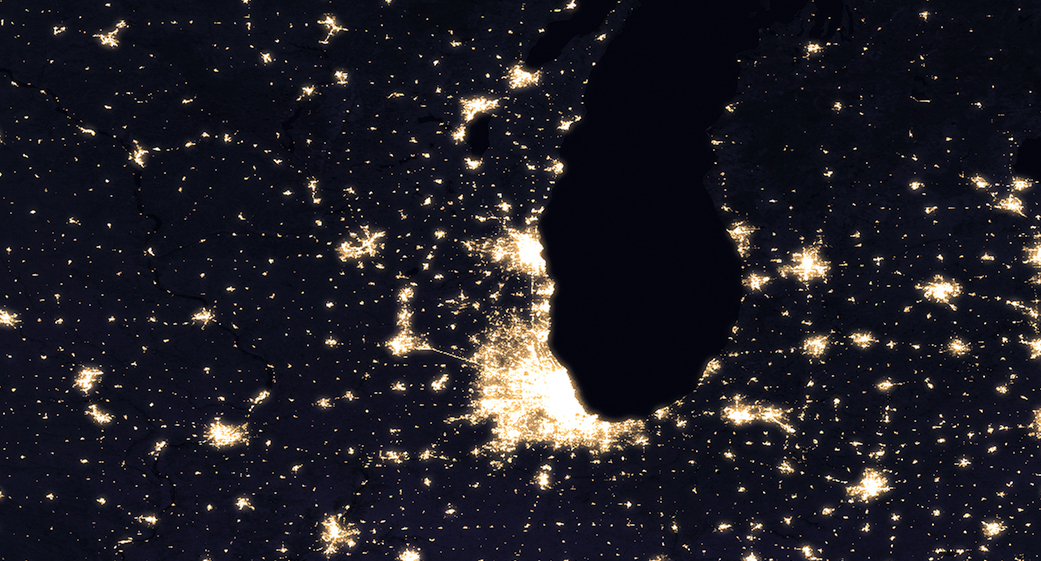
[Chicago and Lake Michigan area in 2016. See NASA posting for comparison with 2012 image of same area.]

[India in 2016. See NASA posting for comparison with 2012 image of same area.]
Armed with more accurate nighttime environmental products, the NASA team is now automating the processing so that users will be able to view nighttime imagery within hours of acquisition. This has the potential to aid short-term weather forecasting and disaster response.

“Thanks to VIIRS, we can now monitor short-term changes caused by disturbances in power delivery, such as conflict, storms, earthquakes and brownouts,” said Román. “We can monitor cyclical changes driven by reoccurring human activities such as holiday lighting and seasonal migrations. We can also monitor gradual changes driven by urbanization, out-migration, economic changes, and electrification. The fact that we can track all these different aspects at the heart of what defines a city is simply mind-boggling.”

For instance, VIIRS detected power outages in the wake of Hurricane Matthew, a major storm that struck the northeastern Caribbean and the southeastern United States in late September 2016. NASA’s Disasters Response team provided the data to colleagues at the Federal Emergency Management Agency; in the future, NASA, FEMA and the Department of Energy hope to develop power outage maps and integrate the information into recovery efforts by first responders.

The NASA team envisions many other potential uses by research, meteorological and civic groups. For instance, daily nighttime imagery could be used to help monitor unregulated or unreported fishing. It could also contribute to efforts to track sea ice movements and concentrations. Researchers in Puerto Rico intend to use the dataset to reduce light pollution and help protect tropical forests and coastal areas that support fragile ecosystems. And a team at the United Nations has already used night lights data to monitor the effects of war on electric power and the movement of displaced populations in war-torn Syria.

In a separate, long-term project, Román is working with colleagues from around the world to improve global and regional estimates of carbon dioxide emissions. The team at NASA’s Global Modeling and Assimilation Office (GMAO) is combining night lights, urban land use data, and statistical and model projections of anthropogenic emissions in ways that should make estimates of sources much more precise.

Related Links

====

Video: “Space to Ground” ISS report – Apr.14.2017

Here is this week’s Space to Ground report from NASA on activities related to the International Space Station

A video about STEM on Station:

=====

Ocean Worlds: New details on sub-surface water in moons of Saturn and Jupiter

NASA today presented new results from studies of the water plumes emitted from underground seas of Saturn’s moon Enceladus and Jupiter’s moon Europa. The new NASA website Ocean Worlds describes these moons and the many other objects in our solar system, including large asteroids and Mars, that also have significant amounts of sub-surface water.

NASA Missions Provide New Insights into ‘Ocean Worlds’ 

Two veteran NASA missions are providing new details about icy, ocean-bearing moons of Jupiter and Saturn, further heightening the scientific interest of these and other “ocean worlds” in our solar system and beyond. The findings are presented in papers published Thursday by researchers with NASA’s Cassini mission to Saturn and Hubble Space Telescope.

This illustration [Larger version] shows Cassini diving through the Enceladus plume in 2015. New ocean world discoveries from Cassini and Hubble will help inform future exploration and the broader search for life beyond Earth. Credits: NASA/JPL-Caltech
In the papers, Cassini scientists announce that a form of chemical energy that life can feed on appears to exist on Saturn’s moon Enceladus, and Hubble researchers report additional evidence of plumes erupting from Jupiter’s moon Europa.

“This is the closest we’ve come, so far, to identifying a place with some of the ingredients needed for a habitable environment,” said Thomas Zurbuchen, associate administrator for NASA’s Science Mission Directorate at Headquarters in Washington. ”These results demonstrate the interconnected nature of NASA’s science missions that are getting us closer to answering whether we are indeed alone or not.”

The paper from researchers with the Cassini mission, published in the journal Science, indicates hydrogen gas, which could potentially provide a chemical energy source for life, is pouring into the subsurface ocean of Enceladus from hydrothermal activity on the seafloor.

This graphic illustrates how Cassini scientists think water interacts with rock at the bottom of the ocean of Saturn’s icy moon Enceladus, producing hydrogen gas. Credits: NASA/JPL-Caltech Full image and caption

The presence of ample hydrogen in the moon’s ocean means that microbes – if any exist there – could use it to obtain energy by combining the hydrogen with carbon dioxide dissolved in the water. This chemical reaction, known as “methanogenesis” because it produces methane as a byproduct, is at the root of the tree of life on Earth, and could even have been critical to the origin of life on our planet.

Life as we know it requires three primary ingredients: liquid water; a source of energy for metabolism; and the right chemical ingredients, primarily carbon, hydrogen, nitrogen, oxygen, phosphorus and sulfur. With this finding, Cassini has shown that Enceladus – a small, icy moon a billion miles farther from the sun than Earth – has nearly all of these ingredients for habitability. Cassini has not yet shown phosphorus and sulfur are present in the ocean, but scientists suspect them to be, since the rocky core of Enceladus is thought to be chemically similar to meteorites that contain the two elements.

“Confirmation that the chemical energy for life exists within the ocean of a small moon of Saturn is an important milestone in our search for habitable worlds beyond Earth,” said Linda Spilker, Cassini project scientist at NASA’s Jet Propulsion Laboratory (JPL) in Pasadena, California.

The Cassini spacecraft detected the hydrogen in the plume of gas and icy material spraying from Enceladus during its last, and deepest, dive through the plume on Oct. 28, 2015. Cassini also sampled the plume’s composition during flybys earlier in the mission. From these observations scientists have determined that nearly 98 percent of the gas in the plume is water, about 1 percent is hydrogen and the rest is a mixture of other molecules including carbon dioxide, methane and ammonia.

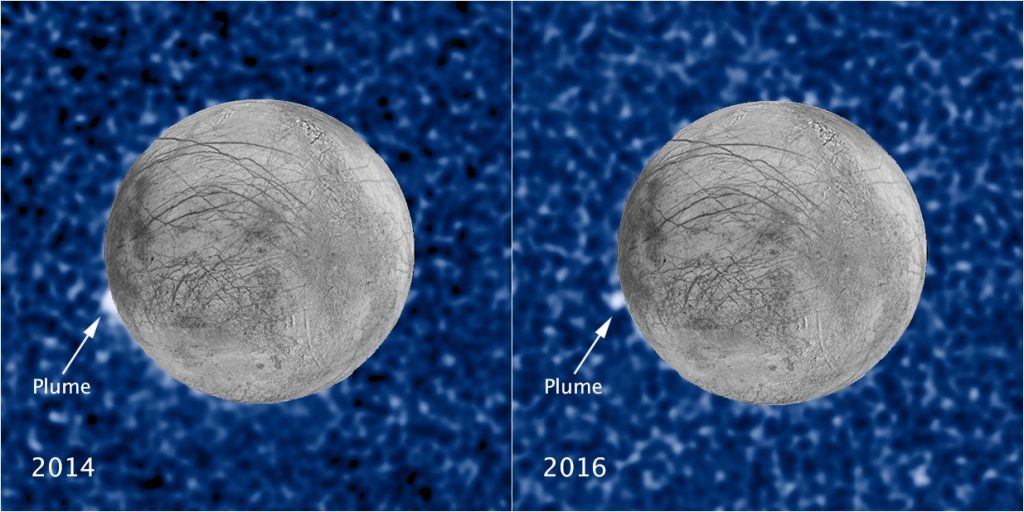
These composite images show a suspected plume of material erupting two years apart from the same location on Jupiter’s icy moon Europa. Both plumes, photographed in UV light by Hubble, were seen in silhouette as the moon passed in front of Jupiter. Credits: NASA/ESA/STScI/USGS. Full image and caption

The measurement was made using Cassini’s Ion and Neutral Mass Spectrometer (INMS) instrument, which sniffs gases to determine their composition. INMS was designed to sample the upper atmosphere of Saturn’s moon Titan. After Cassini’s surprising discovery of a towering plume of icy spray in 2005, emanating from hot cracks near the south pole, scientists turned its detectors toward the small moon.

Cassini wasn’t designed to detect signs of life in the Enceladus plume – indeed, scientists didn’t know the plume existed until after the spacecraft arrived at Saturn.

“Although we can’t detect life, we’ve found that there’s a food source there for it. It would be like a candy store for microbes,” said Hunter Waite, lead author of the Cassini study.

The new findings are an independent line of evidence that hydrothermal activity is taking place in the Enceladus ocean. Previous results, published in March 2015, suggested hot water is interacting with rock beneath the sea; the new findings support that conclusion and add that the rock appears to be reacting chemically to produce the hydrogen.

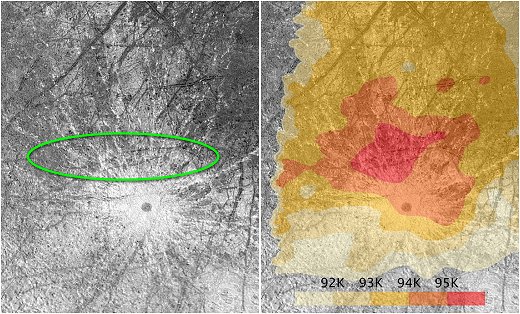
The green oval highlights the plumes Hubble observed on Europa. The area also corresponds to a warm region on Europa’s surface. The map is based on observations by the Galileo spacecraft. Credits: NASA/ESA/STScI/USGS Full image and caption

The paper detailing new Hubble Space Telescope findings, published in The Astrophysical Journal Letters, reports on observations of Europa from 2016 in which a probable plume of material was seen erupting from the moon’s surface at the same location where Hubble saw evidence of a plume in 2014. These images bolster evidence that the Europa plumes could be a real phenomenon, flaring up intermittently in the same region on the moon’s surface.

The newly imaged plume rises about 62 miles (100 kilometers) above Europa’s surface, while the one observed in 2014 was estimated to be about 30 miles (50 kilometers) high. Both correspond to the location of an unusually warm region that contains features that appear to be cracks in the moon’s icy crust, seen in the late 1990s by NASA’s Galileo spacecraft. Researchers speculate that, like Enceladus, this could be evidence of water erupting from the moon’s interior.

“The plumes on Enceladus are associated with hotter regions, so after Hubble imaged this new plume-like feature on Europa, we looked at that location on the Galileo thermal map. We discovered that Europa’s plume candidate is sitting right on the thermal anomaly,” said William Sparks of the Space Telescope Science Institute in Baltimore, Maryland. Sparks led the Hubble plume studies in both 2014 and 2016.

The researchers say if the plumes and the warm spot are linked, it could mean water being vented from beneath the moon’s icy crust is warming the surrounding surface. Another idea is that water ejected by the plume falls onto the surface as a fine mist, changing the structure of the surface grains and allowing them to retain heat longer than the surrounding landscape.

For both the 2014 and 2016 observations, the team used Hubble’s Space Telescope Imaging Spectrograph (STIS) to spot the plumes in ultraviolet light. As Europa passes in front of Jupiter, any atmospheric features around the edge of the moon block some of Jupiter’s light, allowing STIS to see the features in silhouette. Sparks and his team are continuing to use Hubble to monitor Europa for additional examples of plume candidates and hope to determine the frequency with which they appear.

NASA’s future exploration of ocean worlds is enabled by Hubble’s monitoring of Europa’s putative plume activity and Cassini’s long-term investigation of the Enceladus plume. In particular, both investigations are laying the groundwork for NASA’s Europa Clipper mission, which is planned for launch in the 2020s.

“If there are plumes on Europa, as we now strongly suspect, with the Europa Clipper we will be ready for them,” said Jim Green, Director of Planetary Science, at NASA Headquarters.

Hubble’s identification of a site which appears to have persistent, intermittent plume activity provides a tempting target for the Europa mission to investigate with its powerful suite of science instruments. In addition, some of Sparks’ co-authors on the Hubble Europa studies are preparing a powerful ultraviolet camera to fly on Europa Clipper that will make similar measurements to Hubble’s, but from thousands of times closer. And several members of the Cassini INMS team are developing an exquisitely sensitive, next-generation version of their instrument for flight on Europa Clipper.

For more information on ocean worlds in our solar system and beyond, visit: https://www.nasa.gov/specials/ocean-worlds

Space Art: “Why we need space artists” + An “Inner Telescope” on the ISS + Expressing ourselves through space exploration

Three space art related items:

** Why We Need Space Artists – Room: The Space Journal – In this  brief intro to space art, David A. Hardy, a well noted space artist himself, explains why the artist’s view will always be needed even after there are high-res photos of a celestial place.

In the BBC six o’clock news of 15 July 2015, as a result of the first New Horizons images, several paintings of Pluto were shown (some by myself) with the statement, ‘There is no longer any need for artists’ impressions.’ This comment was of course intended to be whimsical but, as the public sees it, there is an element of truth in it. We have after all now received images from all of the major bodies in our Solar System.

There will always be a need for artists (quite apart from the aesthetic aspects; space art can be at least as beautiful as terrestrial art) because from space probes we only see the whole object – planet, moon, comet – or close-ups of it, as it looks from space. Only artists can visualise what it would look like for someone actually standing on the surface. Of course, we heard the same sort of comments when photography was invented, when digital art became available, when the Hubble Space Telescope sent back its first amazing images of distant stars and nebulae. . . But let’s take a look at the history and background of space art.

[]
“From Moon To Mars” by David A. Hardy

** A Space Odyssey: Making Art Up There – The New York Times – French astronaut Thomas Pesquet, currently lives on the International Space Station. In February, he took a break from his usual work load:

… there was a more unusual item on Mr. Pesquet’s agenda. Working with the earthbound artist Eduardo Kac, he created an artwork in space. It was a simple piece: nothing more than could be done with two sheets of paper and a pair of scissors. “Since the goal was to be born in space, it had to be created with materials that were already in the space station,” Mr. Kac (pronounced katz) explained in a telephone interview from his home in suburban Oak Park, Ill. Transporting art materials by rocket ship was not in the plan.

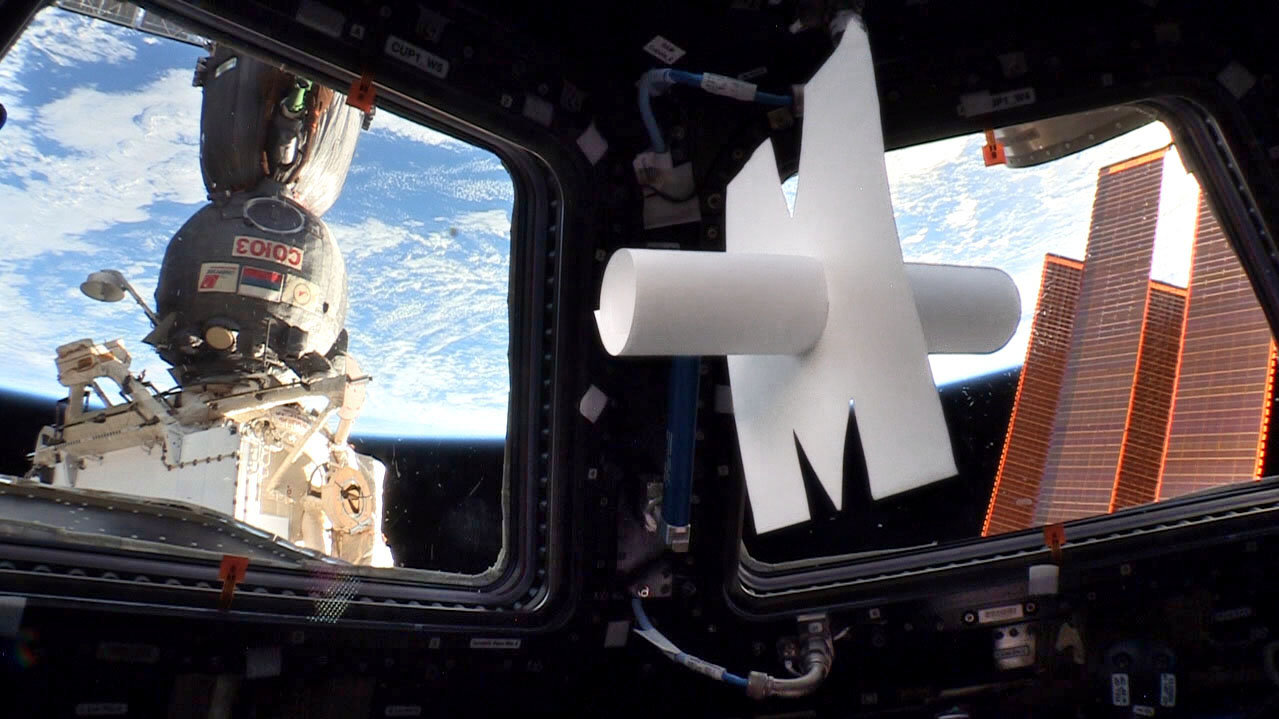
“Inner Telescope” floats in the ISS Cupola.

The artwork — a piece of paper cut into an M, and another piece of paper rolled into a tube and stuck through the middle of the M — might look a bit silly on Earth, where gravity would accentuate its flimsiness. But floating weightlessly in the space station, it looks fragile, even magical — not unlike the planet beyond.

Viewed with a certain amount of imagination, the paper construction can be said to spell “moi.” Mr. Kac, a professor of art and technology at the School of the Art Institute of Chicago, means this not as an individual “me” but in the collective sense: His “moi” stands for all of us. The piece itself is called “Inner Telescope,” for reasons that become clear only when you look through the O formed by the paper tube and view a tiny portion of Earth. “We point a telescope to the stars,” he said. “But this is a telescope that from the stars we point to ourselves.”

The project was supported by the L’Observatoire de l’Espace (The Space Observatory).

Here is a video about the project. (It is in French but you can obtain rough translated captions via Settings -> Subtitles/CC -> Language selection. Then click on the CC control.)

** Extraterrestrial culture: How we express ourselves through space exploration | The Planetary Society – Theater scholar Felipe Cervera writes about how “extraterrestrial space” is  expressed in our culture.

Humankind has practiced outer space—that is, we have performed it—since time immemorial. Through science, philosophy and the arts, we have practiced extraterrestrial culture since the first time we took a star as a reference to life on Earth—Ptolemy, Copernicus and Galileo were all already practicing extraterrestrial culture. However, today extraterrestrial culture acquires a much more material potential. In an age of climate change and orbital trash, of planetary stewardship and satellite telecommunication, of interplanetary colonialism and orbital cosmopolitanism, the performativity of our extraterrestrial culture is no longer exclusively a projection for the future, but rather the pressing expression of the material relationality between us, our planet, and with the universe at large. How we enact space now is therefore a determinant factor in the ways in which we will continue to practice space in the future.

And how would he like to express extraterrestrial space?

Myself? I want to stage Waiting for Godot in orbit, and have Neil deGrasse Tyson and Bill Nye play Vladimir and Estragon. The play is a seminal work in the history of theatre in general, and an exemplary case of a genre called “theatre of the absurd.” This particular genre’s main characteristics are that the storyline is often circular and the characters live through a cyclical, almost nonsensical existence. In Waiting for Godot, Vladimir and Estragon spend the entire play waiting for Godot, whose complete identity we never really learn and who actually never shows up. The play has often been interpreted as a poetic representation of humans’ existential agony, and the search for a meaning in a world that may not have one at all. The end of the play encapsulates this:

Estragon (Neil): Well? Shall we go?

Vladimir (Bill): Yes, let’s go.

They don’t move.

Imagine Neil deGrasse Tyson and Bill Nye playing these characters and saying these lines…in orbit…on board the ISS…wouldn’t that be something?

====

Everyone can participate in space