Lisa Tatge, Subsystem Engineer on the Spacecraft Operations Team for the Cassini Mission to Saturn joins us for an incredible interview about the Cassini mission and it’s upcoming Grand Finale.
Space news topics:
* WFIRST set for 2025 Launch, $3.2Billion Budget * Commercial Crew Q1 Progress Updates * First Detailed Images of a Star’s Accretion Disk from ALMA * French Guiana to resume launches * The Event Horizon Telescope will soon produce an image
TMRO is viewer supported:
TMRO:Space is a crowd funded show. If you like this episode consider contributing to help us to continue to improve. Head over to http://www.patreon.com/tmro for information, goals and reward levels.
Vera Mulyani, founder of Mars City Design joins hosts Chris and Karen Radcliff to talk about the future of Martian cities being designed today here on Earth.
In City News:
* Singapore tests a bus stop that’s a destination in itself * United Arab Emirates commits to building a city on Mars * Oslo’s downtown to become car-free by 2019 * Australia is testing apartments for heat stress * San Francisco’s red lanes are controversial, but working * China proposes “forest cities” to improve air quality
TMRO Cities is viewer supported as well:
TMRO Cities is a crowd funded show. If you enjoy this episode consider contributing to our Patreon campaign at https://www.patreon.com/tmro — THANK YOU to the Citizens of TMRO Space for helping to make TMRO Cities a possibility!
Here is a video of a Russian Soyuz blasting off on Thursday to take a Russian cosmonaut and a NASA astronaut to the station:
Just six hours later the Soyuz spacecraft docked to the ISS:
China also has a space station. On Thursday launched a Long March 7 rocket with the Tianzhou-1 cargo vehicle at the Wenchang Space Launch Center in south China’s Hainan Province. The spacecraft will dock with the unoccupied Tiangong-2 space station. It will transfer fuel to the station so that it can maintain its orbit.
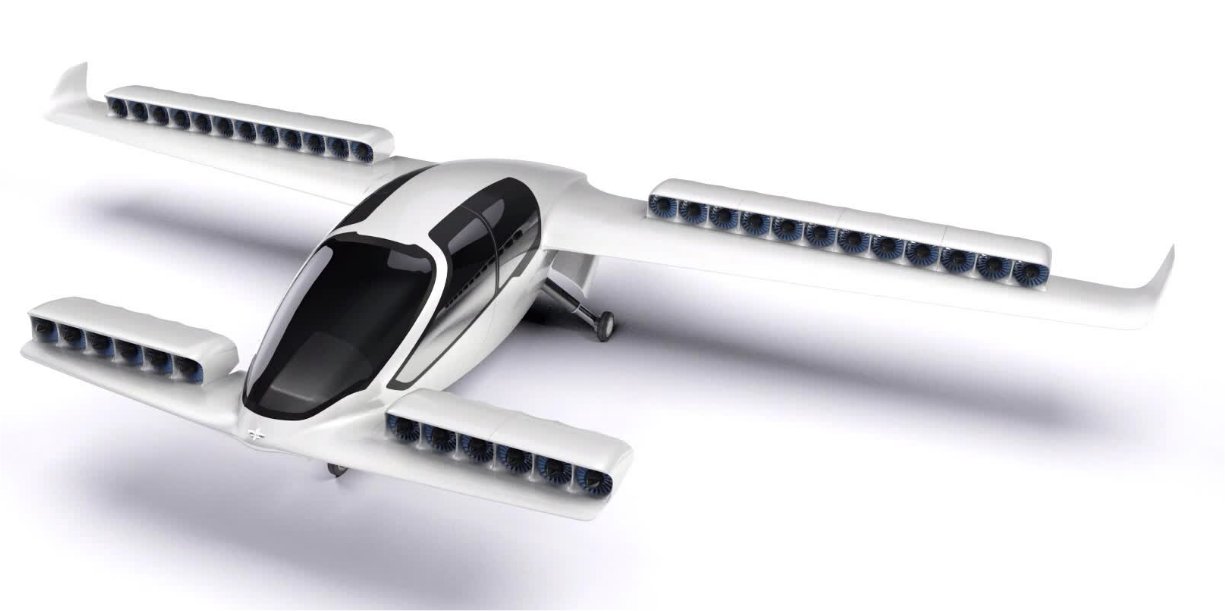
The German startup company Lilium has now flown the first full-scale prototype of their electric-powered vertical-takeoff-and-landing (VTOL) aircraft called the Lilium Jet:
They explain what they mean by electric jet as follows:
The electric jet engines work like turbofan jet engines in a regular passenger jet. They suck in air, compress it and push it out the back. However, the compressor fan in the front is not turned by a gas turbine, but by a high performance electric motor. Therefore, they run much quieter and completely emission-free.
The vehicle will have a range of 300 km (186 miles) at 300km/hour. The goal is to fly in 2019 “the first fully functional jet”, which can carry up to five passengers. The key target market is dial-up taxi service by early 2020s.
The current design of the production vehicle looks like this:
We have incredibly exciting news to share. The Lilium Jet successfully completed its maiden test flight series in the skies above Bavaria. The 2-seater Eagle prototype executed a range of complex maneuvers, including its signature mid-air transition from hover mode to wing-borne forward flight.
Seeing the Lilium Jet take to the sky and performing sophisticated maneuvers with apparent ease is testament to the skill and perseverance of our amazing team. We have solved some of the toughest engineering challenges in aviation to get to this point. The successful test flight programme shows that our ground-breaking technical design works exactly as we envisioned. We can now turn our focus to designing a 5-seater production aircraft.
We are now developing a larger, 5-seater version of our Lilium Jet, designed for on-demand air taxi and ridesharing services. A typical journey with the Lilium Jet will be at least 5x faster than by car, with even greater efficiencies in busy cities. So a flight from Manhattan to New York’s JFK Airport will take around 5 minutes, compared to the 55 minutes it would take you by car.
Please make sure you read more about Lilium’s mission and technology.
As well as making great progress in the air, we’ve also updated our Lilium brand. Enjoy our new website, we hope you like it!
A galaxy or other massive object can bend light. Light from a star far beyond and behind such an object from our point of view can be bent just like light going through a lens. This lens effect can result in multiple views of the same star. This gravitational lens phenomena has been studied for many years but no one till now has used it to see a special kind of “standard candle” supernova that provides a way to measure distances in the universe. Here is a report on these new observations with the Hubble space telescope:
A Swedish-led team of astronomers used the NASA/ESA Hubble Space Telescope to analyse the multiple images of a gravitationally lensed type Ia supernova for the first time. The four images of the exploding star will be used to measure the expansion of the Universe. This can be done without any theoretical assumptions about the cosmological model, giving further clues about how fast the Universe is really expanding. The results are published in the journal Science.
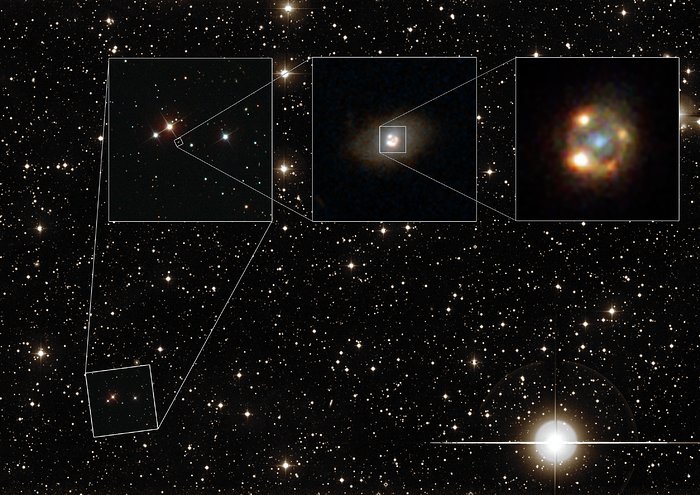
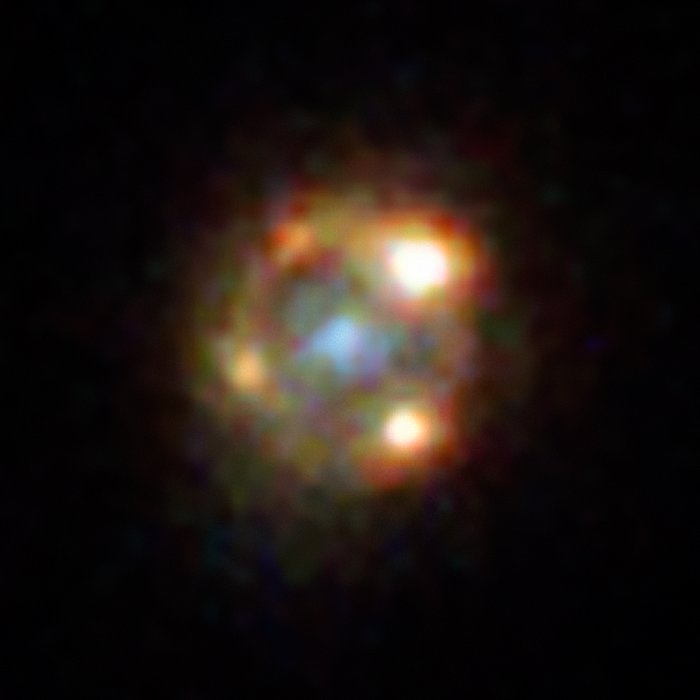
This composite image shows the gravitationally lensed type Ia supernova iPTF16geu, as seen with different telescopes. The background image shows a wide-field view of the night sky as seen with the Palomar Observatory located on Palomar Mountain, California. The leftmost image shows observations made with the Sloan Digital Sky Survey (SDSS). The central image was taken by the NASA/ESA Hubble Space Telescope and shows the lensing galaxy SDSS J210415.89-062024.7. The rightmost image was also taken with Hubble and depicts the four lensed images of the supernova explosion, surrounding the lensing galaxy. [Larger images]An international team, led by astronomers from the Stockholm University, Sweden, has discovered a distant type Ia supernova, called iPTF16geu [1] — it took the light 4.3 billion years to travel to Earth [2]. The light from this particular supernova was bent and magnified by the effect of gravitational lensing so that it was split into four separate images on the sky [3]. The four images lie on a circle with a radius of only about 3000 light-years around the lensing foreground galaxy, making it one of the smallest extragalactic gravitational lenses discovered so far. Its appearance resembles the famous Refsdal supernova, which astronomers detected in 2015 (heic1525). Refsdal, however, was a core-collapse supernova.
This animation shows the phenomenon of strong gravitational lensing. This effect caused the supernova iPTF16geu to appear 50 times brighter than under normal circumstances and to be visible on the sky four times. Credit:ESA/Hubble, L. Calçada
Type Ia supernovae always have the same intrinsic brightness, so by measuring how bright they appear astronomers can determine how far away they are. They are therefore known as standard candles. These supernovae have been used for decades to measure distances across the Universe, and were also used to discover its accelerated expansion and infer the existence of dark energy. Now the supernova iPTF16geu allows scientists to explore new territory, testing the theories of the warping of spacetime on smaller extragalactic scales than ever before.
The supernova iPTF16geu exploded at a distance corresponding to a time 4.3 billion years ago. It could only be detected because a foreground galaxy lensed the light of the explosion, making it 50 times brighter for observers on Earth. It also caused the supernova to appear in four distinct places on the sky, surrounding the lensing galaxy in the foreground. [Larger versions]
“Resolving, for the first time, multiple images of a strongly lensed standard candle supernova is a major breakthrough. We can measure the light-focusing power of gravity more accurately than ever before, and probe physical scales that may have seemed out of reach until now,” says Ariel Goobar, Professor at the Oskar Klein Centre at Stockholm University and lead author of the study.
The critical importance of the object meant that the team instigated follow-up observations of the supernova less than two months after its discovery. This involved some of the world’s leading telescopes in addition to Hubble: the Keck telescope on Mauna Kea, Hawaii, and ESO’s Very Large Telescope in Chile. Using the data gathered, the team calculated the magnification power of the lens to be a factor of 52. Because of the standard candle nature of iPTF16geu, this is the first time this measurement could be made without any prior assumptions about the form of the lens or cosmological parameters.
Last month saw the inauguration of a new Hubble observing program: Frontier Fields. This will use the powerful magnifying properties of massive galaxy clusters to peer even deeper into the space around us. Hubblecast 70 takes a look at this phenomenon — known as gravitational lensing — exploring how it works, and how it can help us to uncover the secrets of the very distant Universe.
Currently the team is in the process of accurately measuring how long it took for the light to reach us from each of the four images of the supernova. The differences in the times of arrival can then be used to calculate the Hubble constant — the expansion rate of the Universe — with high precision [4]. This is particularly crucial in light of the recent discrepancy between the measurements of its value in the local and the early Universe (heic1702).
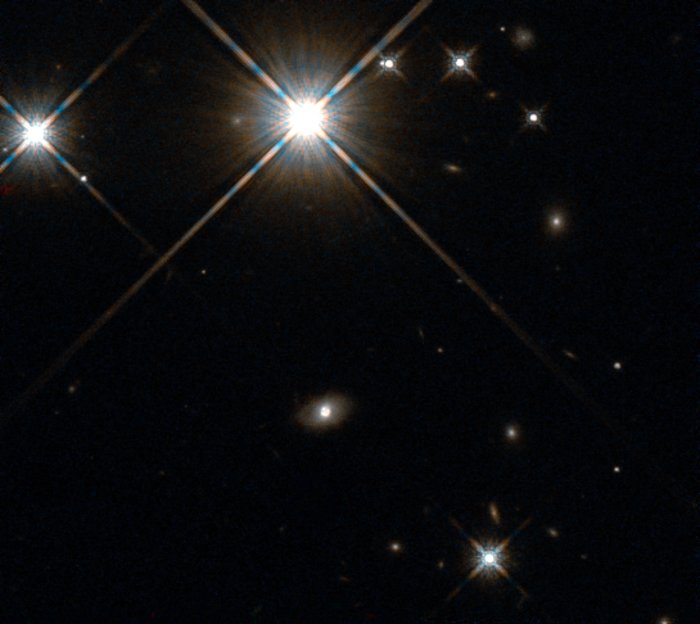
The galaxy SDSS J210415.89-062024.7 is located 2.5 billion light years away. It acted as a lens for a supernova at an even greater distance, creating four distinct images of the explosion — an effect created by strong gravitational lensing. [Larger images]As important as lensed supernovae are for cosmology, it is extremely difficult to find them. Not only does their discovery rely on a very particular and precise alignment of objects in the sky, but they are also only visible for a short time.
“The discovery of iPTF16geu is truly like finding a somewhat weird needle in a haystack,” remarks Rahman Amanullah, co-author and research scientist at Stockholm University. “It reveals to us a bit more about the Universe, but mostly triggers a wealth of new scientific questions.”
Studying more similarly lensed supernovae will help shape our understanding of just how fast the Universe is expanding. The chances of finding such supernovae will improve with the installation of new survey telescopes in the near future.
Notes
[1] iPTF16geu was initially observed by the iPTF (intermediate Palomar Transient Factory) collaboration with the Palomar Observatory. This is a fully automated, wide-field survey delivering a systematic exploration of the optical transient sky.
[2] This corresponds to a redshift of 0.4. The lensing galaxy has a redshift of 0.2.
[3] Gravitational lensing is a phenomenon that was first predicted by Albert Einstein in 1912. It occurs when a massive object lying between a distant light source and the observer bends and magnifies the light from the source behind it. This allows astronomers to see objects that would otherwise be to faint to see.
[4] For each image of the supernova, the light is not bent in the same way. This results in slightly different travel times. The maximum time delay between the four images is predicted to be less than 35 hours.