Project Karman: UCB undergrad team aims to launch rocket past 100 kilometers

Project Karman is an undergraduate student led initiative at UC Berkeley to design, build, and launch a rocket that exceeds 100 kilomters in altitude. They currently have a crowdfunding campaign underway, which has raised $13,725 so far towards a goal of $25,000 with 16 days left:  UC Berkeley | PROJECT KARMAN: 1 Launch, 10 Months, 100 Kilometers to Space!

The group is also challenging students at other schools to compete with them to reach the Karman Line: PROJECT KARMAN goes global

Tonight, we officially challenged colleges across the globe to join us in the Intercollegiate Space Race of the 21st Century, competing to see who can truly be the first college team to reach space with its own rocket. Through the UN-backed World Space Week Association, we were able to broadcast this challenge internationally! See their Facebook post here: https://www.facebook.com/pg/WorldSpaceWeek/posts/?ref=page_internal. To see more details regarding the formal rules of the competition, visit berkeleyse.org/spacerace.

A video about Project Karman:

And here is a profile of one of the students – Autumn Kleinman – working on the project: Rocket Ambitions: San Clemente Native Works on Suborbital Craft with UC Berkeley club | San Clemente Times.

The group estimates the final cost of the Eureka-1 rocket project to be about $250k. They hope to reach this figure with additional crowd-funding, grants, and sponsorships.

The goal is for Eureka-1 to be reusable and to fly many times:

While the technical know-how to send payloads to space has existed for over 60 years, the requisite technology has remained incredibly expensive, failure-prone, and dangerous to use.

Recent advances in materials science coupled with proprietary cost-saving technologies have allowed Space Enterprise at Berkeley to entirely eliminate the turbo pump, the single most expensive and delicate element of modern rocket engines.

This innovation has allowed us to reduce the typical $2.8 million price tag of a suborbital launch to less than $150,000. In addition, in-development recovery systems will allow for a fly-land-fly turnaround for Eureka-1. With full implementation of this system, Eureka could fly multiple times per week, with only a short refurbishment and refueling period between launches. This would reduce total launch cost to less than $10,000.

A couple of other videos from Project Karman:


No spots but the Sun is stormy nonetheless

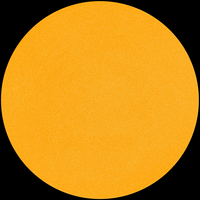
The sun has gone spotless for the past seven days: Spaceweather.com – Oct.15.2017.

Nevertheless, there has continued to be solar eruptions leading to brilliant aurora on earth:

NO SUNSPOTS, NO PROBLEM: A minor G1-class geomagnetic storm is underway on Oct. 15th. This marks the 5th consecutive day that polar geomagnetic storms have been observed–a remarkable string considering that there are NO SUNSPOTS on the face of the sun. It just goes to show that blank suns can indeed produce stormy space weather. Arctic sky watchers should remain alert for auroras as the solar wind continues to blow faster than 550 km/s. 

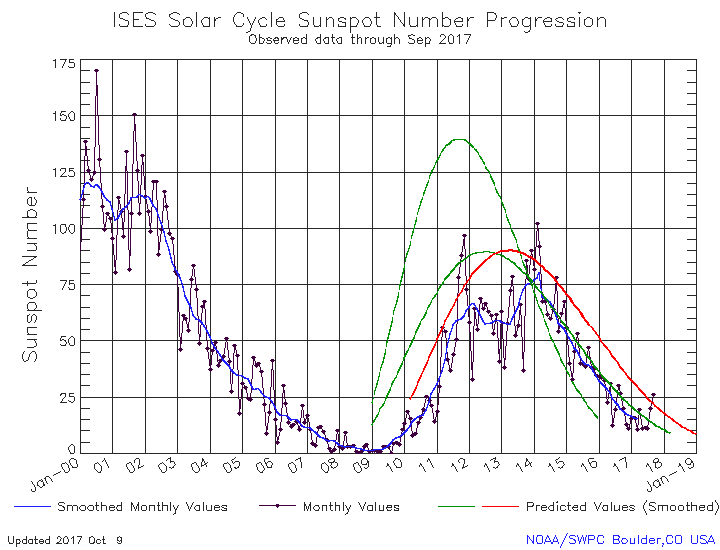
In September the number of sunspots went up a bit but the trend for the year shows a continued downturn towards a minimum in the cycle: Sunspot update for September 2017 | Behind The Black


====

Videos: “Space to Ground” ISS report – Oct.13.2017

Here is this week’s Space to Ground report from NASA on activities related to the International Space Station:

Here is a new NASA video about food on the station:

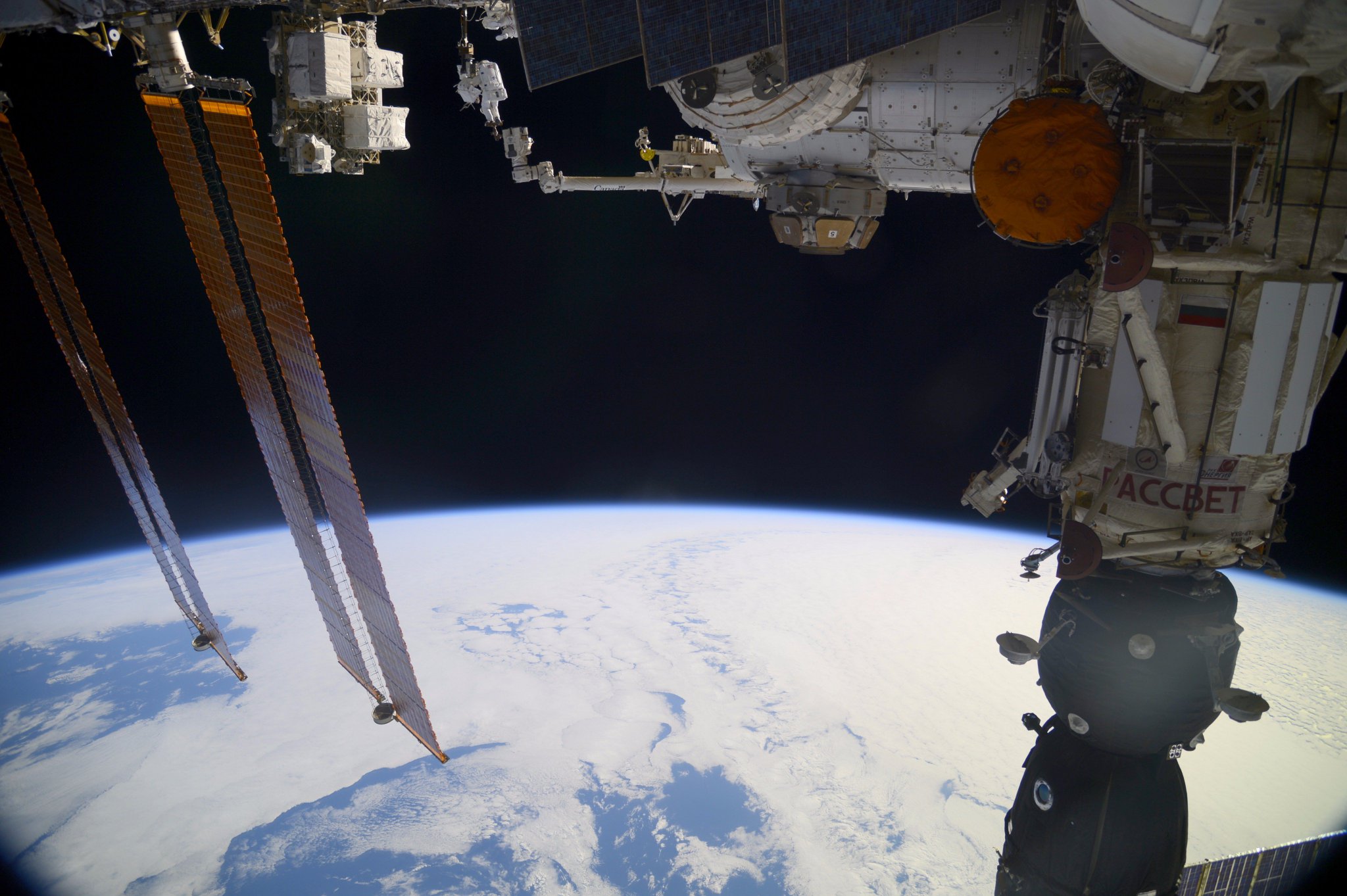
This photo taken during a spacewalk this week gives a sense of the scale of the ISS – Mark T. Vande Hei on Twitter:

“My 2nd #spacewalk is complete for Expedition 53! Can you find the two people working outside in this picture?”

====

Satellites image California wildfires + Using satellites to spot wildfires globally within 15 minutes

California has been hit with more wildfires than usual this year. Here is a short video from NOAA showing fires as seen by the GOES-16 satellite:

—

An article from NASA about the fires and satellite observations of them:

Wildfires Running Amok in California

Fires broke out quickly this past weekend in northern California.  Sixty mile an hour winds did nothing to help either quell or stop the runaway fires from jumping fire lines and decimating whole neighborhoods.  Dry, hot conditions which have been problematic for much of the west coast this summer erupted into flames after a series of lightning strikes. October is always a difficult time in California for wildfires, but this year, the wildfire eruptions seem extreme even to the most seasoned Californian.  The deadly combination of lightning, winds, and hot weather which dries the landscape into tinder is all it takes to set off a wildfire that will consume thousands and thousands of acres in just a few short hours.

Fifteen fires ignited late Sunday evening, remained mostly uncontained, and are likely to continue spreading because of heat, low humidity and wind with many of these fires located in Sonoma Valley and Napa Valley, heart of California’s wine country.  Despite the massive number of firefighters deployed to fight the flames, most fires remain 0% contained at present.  Too many other factors are in play that make containment difficult including high winds, dry conditions, and low humidity.

NASA’s Aqua satellite collected this natural-color image with the Moderate Resolution Imaging Spectroradiometer, MODIS, instrument on October 09, 2017. Actively burning areas (hot spots), detected by MODIS’s thermal bands, are outlined in red. Each hot spot is an area where the thermal detectors on the MODIS instrument recognized temperatures higher than background. When accompanied by plumes of smoke, as in this image, such hot spots are diagnostic for fire.NASA image courtesy Jeff Schmaltz LANCE/EOSDIS MODIS Rapid Response Team, GSFC. Caption by Lynn Jenner

For specific incident information on any particular fire, please visit the California Fire Incident Information website.

—

More sat photos :

—

FireSat is a project started at NASA JPL to develop a constellation of satellites with sensors specialized at spotting wildfires. The goal is to detect and report a wildfire anywhere in the world within 15 minutes of its starting.

The FireSat sensors would be able to detect fires that are at least 35 to 50 feet (10 to 15 meters) wide, within an average of 15 minutes from the time they begin. Within three minutes of detecting a fire from orbit, FireSat would notify emergency responders in the area of the fire, improving support for time-critical response decisions.

The sensors and their associated products for data analysis would also be able to locate explosions, oil spills and other dangerous events involving high heat around the globe.

More at:

====

Astronomers discover ring around faraway dwarf planet Haumea

A collaboration of astronomers and observatories have discovered that the dwarf planet Haumea, which orbits out beyond Neptune, has  a ring around it: Oddball dwarf planet Haumea has a ring | Science News

On January 21, [Jose-Luis Ortiz of the Institute of Astrophysics of Andalusia in Granada, Spain] and colleagues used 12 telescopes at 10 observatories to peer into the Kuiper Belt, a region of icy objects beyond the orbit of Neptune, and watch Haumea block the light of a distant star. That tiny eclipse let the team measure the dwarf planet’s size, shape and surrounding environment more accurately than ever before.

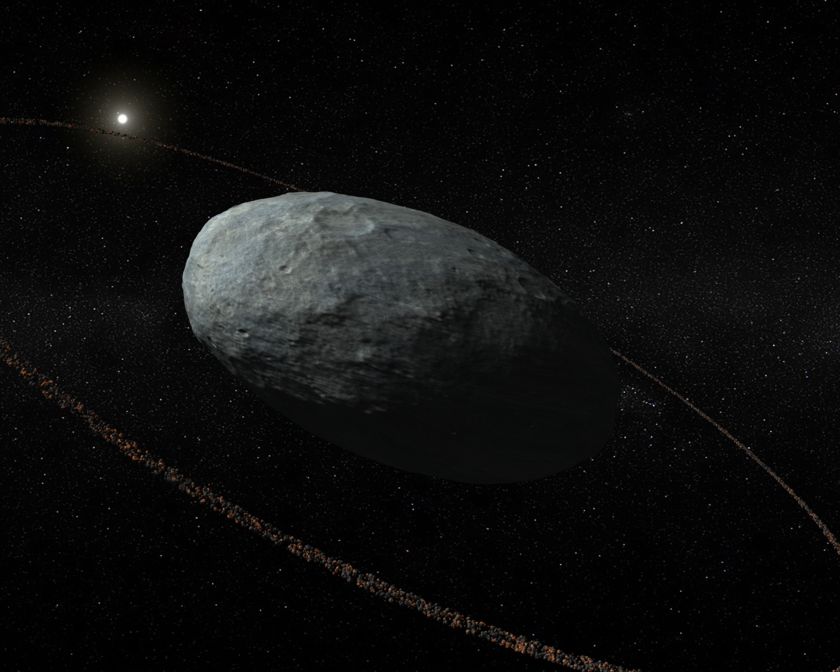
Haumea turned out to be larger — its long axis stretches at least 2,322 kilometers, a bit more than half the width of the contiguous United States — and less dense than previously thought, the team reports October 11 in Nature. To their surprise, the researchers also saw the background star flicker before and after its light was blocked by Haumea itself. That flicker is consistent with a 70-kilometer-wide ring about 1,000 kilometers above the dwarf planet’s surface.

The ring presumably consists of rocks and ice like planetary rings elsewhere: Planetary Society-funded telescopes help find ring around Haumea, a distant dwarf planet | The Planetary Society

We know giant planets like Jupiter, Saturn, Uranus and Neptune have rings, but thus far, we’ve only found them around two small worlds. Chariklo is about 250 kilometers wide, and has two rings, while Chiron, about the same size, is also suspected to have a ring. Both Chariklo and Chiron are Centaurs, small worlds orbiting the Sun between the asteroid belt and Kuiper belt, crisscrossing the giant planets’ orbits. 

With today’s announcement, Haumea becomes the first, small, non-Centaur known to have a ring, and the farthest ring world we’ve found in our solar system. 

An artist’s rendering of how the ring around Haumea might look.

Lockheed seeing payoff from investments in commercial space technology – SpaceNews.com


====

Everyone can participate in space