Here is the latest Space to Ground short video report from NASA on this week’s activities related to the International Space Station
This video shows all of the discussion on Thursday between Pope Francis and the ISS crew:
Aboard the International Space Station, Expedition 53 Commander Randy Bresnik and Flight Engineers Joe Acaba and Mark Vande Hei of NASA and Flight Engineer and Italian astronaut Paolo Nespoli of the European Space Agency discussed life and work in space and the spirit of international cooperation during a question and answer session Oct. 26 with Pope Francis at the Vatican. The pope also discussed the crew members’ view of the Earth from orbit and praised the crew for its accomplishments in demonstrating the value of international collaboration for peaceful purposes. The crewmembers are in various stages of their respective five and a half month missions on the outpost.
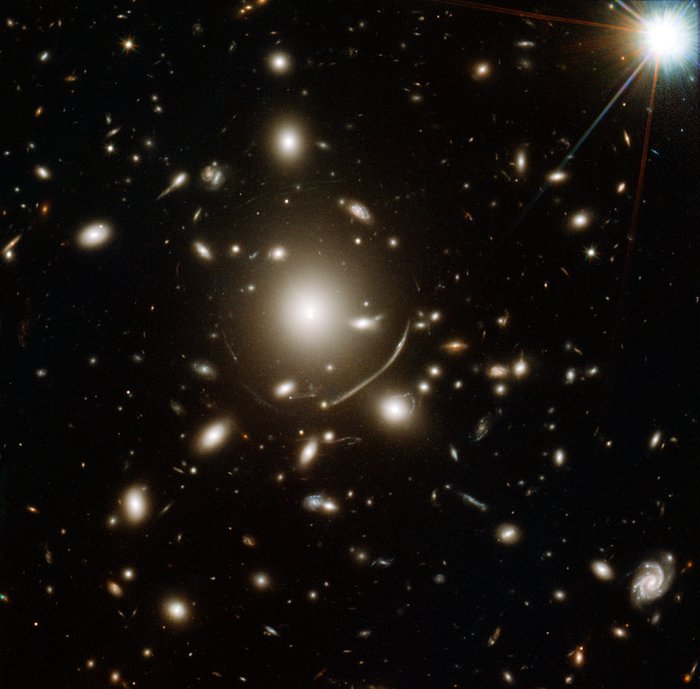
Abell S1063, a galaxy cluster, was observed by the NASA/ESA Hubble Space Telescope as part of the Frontier Fields programme. The huge mass of the cluster acts as a cosmic magnifying glass and enlarges even more distant galaxies, so they become bright enough for Hubble to see. [Larger images]
Using the NASA/ESA Hubble Space Telescope, astronomers have discovered that the brightest galaxies within galaxy clusters “wobble” relative to the cluster’s centre of mass. This unexpected result is inconsistent with predictions made by the current standard model of dark matter. With further analysis it may provide insights into the nature of dark matter, perhaps even indicating that new physics is at work.
This video pans over NASA/ESA Hubble Space Telescope observations of the galaxy cluster Abell S1063, which were made as part of the Frontier Fields programme. The many galaxies within the cluster become clearly visible, as well as the background galaxies, enlarged by gravitational lensing.
Dark matter constitutes just over 25 percent of all matter in the Universe but cannot be directly observed, making it one of the biggest mysteries in modern astronomy. Invisible halos of elusive dark matter enclose galaxies and galaxy clusters alike. The latter are massive groupings of up to a thousand galaxies immersed in hot intergalactic gas. Such clusters have very dense cores, each containing a massive galaxy called the “brightest cluster galaxy” (BCG).
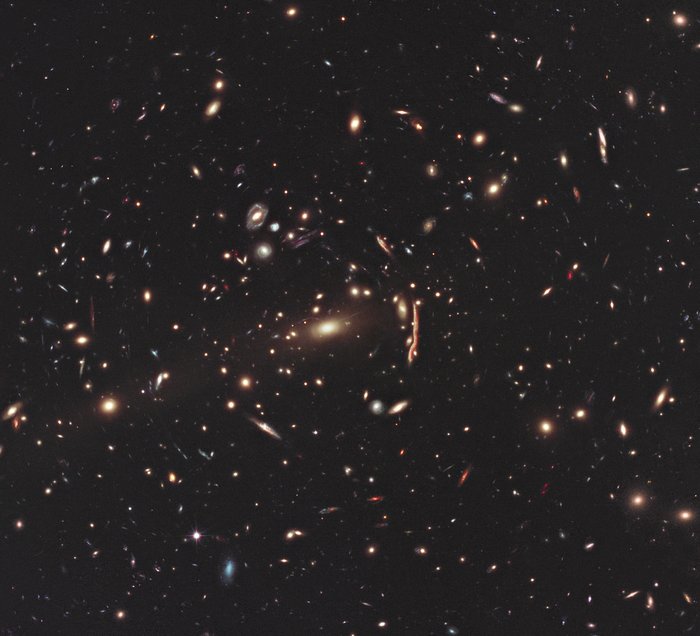
This image from the NASA/ESA Hubble Space Telescope shows the galaxy cluster MACS J1206. Galaxy clusters like these have enormous mass, and their gravity is powerful enough to visibly bend the path of light, somewhat like a magnifying glass. These clusters are useful tools for studying very distant objects, because this lens-like behaviour amplifies the light from faraway galaxies in the background. They also contribute to a range of topics in cosmology, as the precise nature of the lensed images encapsulates information about the properties of spacetime, the expansion of the cosmos and the distribution of dark matter within the cluster. This is one of 25 clusters being studied as part of the CLASH (Cluster Lensing and Supernova survey with Hubble) programme, a major project to build a library of scientific data on lensing clusters. [Larger images]The standard model of dark matter (cold dark matter model) predicts that once a galaxy cluster has returned to a “relaxed” state after experiencing the turbulence of a merging event, the BCG does not move from the cluster’s centre. It is held in place by the enormous gravitational influence of dark matter.
This video pans across a giant cluster of elliptical galaxies which contains so much mass that its gravity bends light beams. This means that for very distant galaxies in the background, the cluster acts as a sort of magnifying glass, bending the path of the distant object’s light towards Hubble. These gravitational lenses are one tool that astronomers can use to extend Hubble’s vision beyond its normal range.
But now, a team of Swiss, French, and British astronomers have analysed ten galaxy clusters observed with the NASA/ESA Hubble Space Telescope, and found that their BCGs are not fixed at the centre as expected [1].
The giant galaxy cluster in the centre of this image contains so much dark matter mass that its gravity bends the light of more distant objects. This means that for very distant galaxies in the background, the cluster’s gravitational field acts as a sort of magnifying glass, bending and concentrating the distant object’s light towards Hubble. These gravitational lenses are one tool astronomers can use to extend Hubble’s vision beyond what it would normally be capable of observing. This way some of the very first galaxies in the Universe can be studied by astronomers. The lensing effect can also be used to determine the distribution of matter — both ordinary and dark matter — within the cluster. [Larger images]The Hubble data indicate that they are “wobbling” around the centre of mass of each cluster long after the galaxy cluster has returned to a relaxed state following a merger. In other words, the centre of the visible parts of each galaxy cluster and the centre of the total mass of the cluster — including its dark matter halo — are offset, by as much as 40 000 light-years.
“We found that the BCGs wobble around centre of the halos,” explains David Harvey, astronomer at EPFL, Switzerland, and lead author of the paper. “This indicates that, rather than a dense region in the centre of the galaxy cluster, as predicted by the cold dark matter model, there is a much shallower central density. This is a striking signal of exotic forms of dark matter right at the heart of galaxy clusters.”
The wobbling of the BCGs could only be analysed as the galaxy clusters studied also act as gravitational lenses. They are so massive that they warp spacetime enough to distort light from more distant objects behind them. This effect, called strong gravitational lensing, can be used to make a map of the dark matter associated with the cluster, enabling astronomers to work out the exact position of the centre of mass and then measure the offset of the BCG from this centre.
If this “wobbling” is not an unknown astrophysical phenomenon and in fact the result of the behaviour of dark matter, then it is inconsistent with the standard model of dark matter and can only be explained if dark matter particles can interact with each other — a strong contradiction to the current understanding of dark matter. This may indicate that new fundamental physics is required to solve the mystery of dark matter.
Co-author Frederic Courbin, also at EPFL, concludes:
“We’re looking forward to larger surveys — such as the Euclid survey — that will extend our dataset. Then we can determine whether the wobbling of BGCs is the result of a novel astrophysical phenomenon or new fundamental physics. Both of which would be exciting!”
This video pans across galaxy cluster MACS J1206.2-0847 (or MACS 1206 for short). The cluster has been observed by Hubble as part of CLASH (Cluster Lensing and Supernova survey with Hubble), a major programme to observe galaxy clusters whose gravity bends and distorts light passing through them.
Notes
[1] The study was performed using archive data from Hubble. The observations were originally made for the CLASH and LoCuSS surveys.
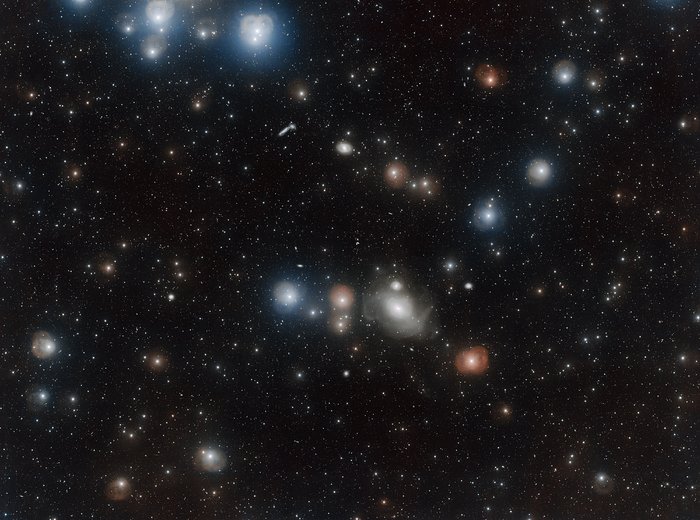
Countless galaxies vie for attention in this dazzling image of the Fornax Cluster, some appearing only as pinpricks of light while others dominate the foreground. One of these is the lenticular galaxy NGC 1316. The turbulent past of this much-studied galaxy has left it with a delicate structure of loops, arcs and rings that astronomers have now imaged in greater detail than ever before with the VLT Survey Telescope. This image was processed with the VST-Tube data reduction program. [Larger images]Countless galaxies vie for attention in this monster image of the Fornax Galaxy Cluster, some appearing only as pinpricks of light while others dominate the foreground. One of these is the lenticular galaxy NGC 1316. The turbulent past of this much-studied galaxy has left it with a delicate structure of loops, arcs and rings that astronomers have now imaged in greater detail than ever before with the VLT Survey Telescope. This astonishingly deep image also reveals a myriad of dim objects along with faint intracluster light.
Captured using the exceptional sky-surveying abilities of the VLT Survey Telescope (VST) at ESO’s Paranal Observatory in Chile, this deep view reveals the secrets of the luminous members of the Fornax Cluster, one of the richest and closest galaxy clusters to the Milky Way. This 2.3-gigapixel image is one of the largest images ever released by ESO.
Perhaps the most fascinating member of the cluster is NGC 1316, a galaxy that has experienced a dynamic history, being formed by the merger of multiple smaller galaxies. The gravitational distortions of the galaxy’s adventurous past have left their mark on its lenticular structure [1]. Large ripples, loops and arcs embedded in the starry outer envelope were first observed in the 1970s, and they remain an active field of study for contemporary astronomers, who use the latest telescope technology to observe the finer details of NGC 1316’s unusual structure through a combination of imaging and modelling.
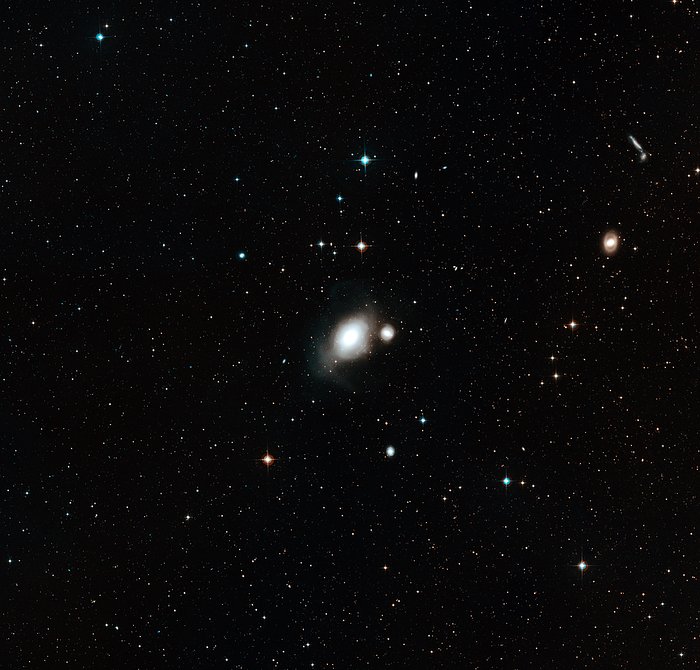
This picture shows the sky around the pair of galaxies NGC 1316 and 1317. It was created from images forming part of the Digitized Sky Survey 2. [Larger images]
The mergers that formed NGC 1316 led to an influx of gas, which fuels an exotic astrophysical object at its centre: a supermassive black hole with a mass roughly 150 million times that of the Sun. As it accretes mass from its surroundings, this cosmic monster produces immensely powerful jets of high-energy particles , that in turn give rise to the characteristic lobes of emission seen at radio wavelengths, making NGC 1316 the fourth-brightest radio source in the sky [2].
NGC 1316 has also been host to four recorded type Ia supernovae, which are vitally important astrophysical events for astronomers. Since type Ia supernovae have a very clearly defined brightness [3], they can be used to measure the distance to the host galaxy; in this case, 60 million light-years. These “standard candles” are much sought-after by astronomers, as they are an excellent tool to reliably measure the distance to remote objects. In fact, they played a key role in the groundbreaking discovery that our Universe is expanding at an accelerating rate.
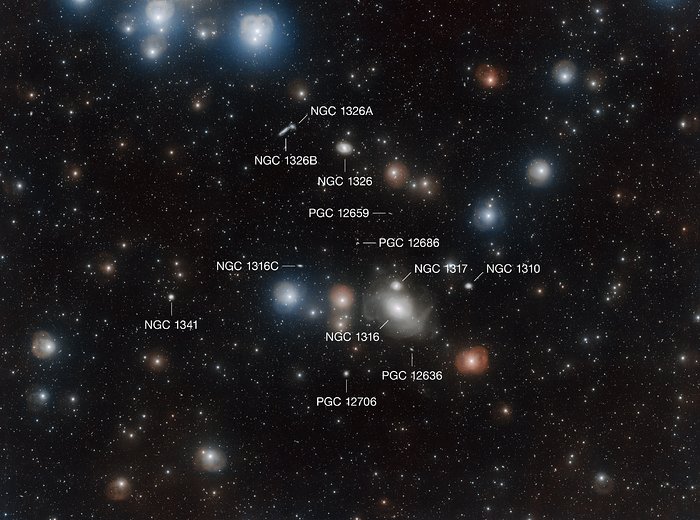
This annotated view labels the major galaxies around NGC 1316, a lenticular galaxy that is both in the constellation of Fornax (The Furnace) and in the Fornax Cluster. This astonishingly deep view of the cluster was captured by the VLT Survey Telescope as part of the Fornax Deep Survey. [Larger images]This image was taken by the VST at ESO’s Paranal Observatory as part of the Fornax Deep Survey, a project to provide a deep, multi-imaging survey of the Fornax Cluster. The team, led by Enrichetta Iodice (INAF – Osservatorio di Capodimonte, Naples, Italy), have previously observed this area with the VST and revealed a faint bridge of light between NGC 1399 and the smaller galaxy NGC 1387 (eso1612) . The VST was specifically designed to conduct large-scale surveys of the sky. With its huge corrected field of view and specially designed 256-megapixel camera, OmegaCAM, the VST can produce deep images of large areas of sky quickly, leaving the much larger telescopes — like ESO’s Very Large Telescope (VLT) — to explore the details of individual objects.
Notes [1] Lenticular or “lens-shaped” galaxies are an intermediate form between diffuse elliptical galaxies and the better-known spiral galaxies such as the Milky Way.
[2] As this radio source is the brightest in the constellation of Fornax it is also known as Fornax A.
[3] Type Ia Supernovae occur when an accreting white dwarf in a binary star system slowly gains mass from its companion until it reaches a limit that triggers the nuclear fusion of carbon. In a brief period of time, a chain reaction is initiated that eventually ends in a huge release of energy: a supernova explosion. The supernova always occurs at a specific mass, known as the Chandrasekhar limit, and produces an almost identical explosion each time. The similarity of type Ia supernovae allow astronomers to use the cataclysmic events to measure distance.
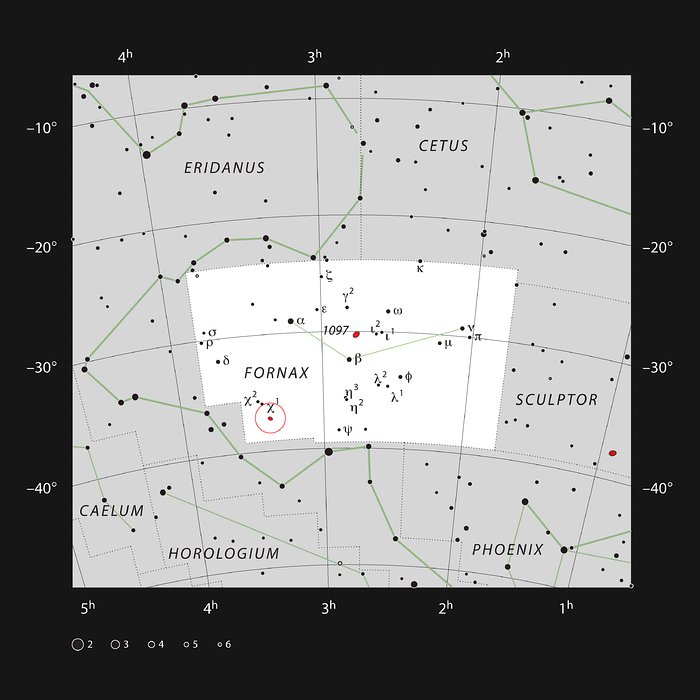
This chart shows most of the stars that can be seen with the naked eye on a clear dark night. The small constellation of Fornax (The Furnace) contains a concentration of nearby galaxies, including the galaxies NGC 1316 and 1317 (indicated with a red circle). These are bright enough to be seen as faint circular hazy patches in a middle-sized amateur telescope.
… some cool pictures of spaceships, I wanted to do something a bit more original than yet another generic sci-fi. I wanted to do proper research, get science and engineering as correct as possible, then do illustrations along with concept and graphic design.
[] “ITS landers at Alpha Site, first large scale human colony on Mars. My take on SpaceX Interplanetary Transport System announced by Elon Musk last year.” – Maciej Rebisz
I thought it would be pretty cool to depict how all these planned and never realized missions would look like. Apollo based spacecraft going to Venus, Voyager 3 visiting Jupiter, Saturn and then Pluto. Soviet landing on the Moon. Crewed missions to Mars. Launch of the first interstellar probe. I have started doing research and taking courses about history of spaceflight, where and when it began, where it headed, what space agencies wanted to do and where to go before their funding got cut off. All that research was great inspiration and gave me hundreds of ideas and fueled the development of this alternative history project.
Imagine a world where Space Race has not ended. Where space agencies were funded a lot better than military. Where private space companies emerged and accelerated development of space industry. Where people never stopped dreaming big and aiming high.

![[] Engine maintenance Art: Maciej Rebisz](http://hobbyspace.com/Blog/wp-content/uploads/2017/10/tumblr_nczimlAhwj1u0vd4co1_12801.png)