The Chinese derelict Tiangong-1 space station will soon hit Earth’s atmosphere as it makes an unpowered, uncontrolled reentry. Much of it will be burnt up but some of the 9 tonne spacecraft will reach the ground (or more likely, the ocean waves). The current estimate is that the station will meet its doom sometime on April 1st (and that’s no joke).
It’s unclear how much of Tiangong-1 will survive the journey, but it’s possible some pieces will fall to the ground. The station has an orbital inclination between 43 degrees north and 43 degrees south latitudes, so it could fall anywhere within those bands. But experts point out that Tiangong-1 is much smaller than the NASA Skylab space station, parts of which crashed into remote areas of Australia in 1979, so most of it may burn up during re-entry. Tiangong-1 weighs only 8.5 metric tons (9.4 tons), compared to Skylab’s 100 tons.
We are joined by Dr. Chris McKay from NASA Ames Research Center to talk about the search for life in our solar system.
News topics and launches covered:
2014 MU69 gets a name Humanity Star Once Around In A Billion Years
Launches: Soyuz launched Expedition 55-56
TMRO is viewer supported:
TMRO shows are crowd funded. If you like this episode consider contributing to help us to continue to improve. Head over to http://www.patreon.com/tmro for per-episode contribution or http://www.makersupport.com/tmro for monthly contributions and reward information.
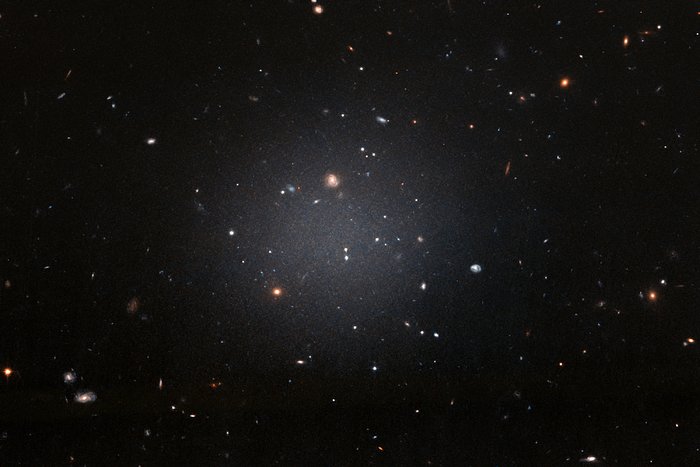
An international team of researchers using the NASA/ESA Hubble Space Telescope and several other observatories have, for the first time, uncovered a galaxy in our cosmic neighborhood that is missing most — if not all — of its dark matter. This discovery of the galaxy NGC 1052-DF2 challenges currently-accepted theories of and galaxy formation and provides new insights into the nature of dark matter. The results are published in Nature.
NGC 1052-DF2 resides about 65 million light-years away in the NGC 1052 Group, which is dominated by a massive elliptical galaxy called NGC 1052. This large, fuzzy-looking galaxy is so diffuse that astronomers can clearly see distant galaxies behind it. This ghostly galaxy is not well-formed. It does not look like a typical spiral galaxy, but it does not look like an elliptical galaxy either. Based on the colours of its globular clusters, the galaxy is about 10 billion years old. However, even the globular clusters are strange: they are twice as large as typical groups of stars. All of these oddities pale in comparison to the weirdest aspect of this galaxy: NGC 1052-DF2 is missing most, if not all, of its dark matter. The galaxy contains only a tiny fraction of dark matter that astronomers would expect for a galaxy this size. But how it formed is a complete mystery. Hubble took this image on 16 November 2017 using its Advanced Camera for Surveys.
Astronomers using Hubble and several ground-based observatories have found a unique astronomical object: a galaxy that appears to contain almost no dark matter [1]. Hubble helped to accurately confirm the distance of NGC 1052-DF2 to be 65 million light-years and determined its size and brightness. Based on these data the team discovered that NGC 1052-DF2 larger than the Milky Way, but contains about 250 times fewer stars, leading it to be classified as an ultra diffuse galaxy.
“I spent an hour just staring at this image,” lead researcher Pieter van Dokkum of Yale University says as he recalls first seeing the Hubble image of NGC 1052-DF2. “This thing is astonishing: a gigantic blob so sparse that you see the galaxies behind it. It is literally a see-through galaxy.”
Further measurements of the dynamical properties of ten globular clusters orbiting the galaxy allowed the team to infer an independent value of the galaxies mass. This mass is comparable to the mass of the stars in the galaxy, leading to the conclusion that NGC 1052-DF2 contains at least 400 times less dark matter than astronomers predict for a galaxy of its mass, and possibly none at all [2]. This discovery is unpredicted by current theories on the distribution of dark matter and its influence on galaxy formation.
“Dark matter is conventionally believed to be an integral part of all galaxies — the glue that holds them together and the underlying scaffolding upon which they are built,” explains co-author Allison Merritt from Yale University and the Max Planck Institute for Astronomy, Germany. And van Dokkum adds: “This invisible, mysterious substance is by far the most dominant aspect of any galaxy. Finding a galaxy without any is completely unexpected; it challenges standard ideas of how galaxies work.”
Merritt remarks:
“There is no theory that predicts these types of galaxies — how you actually go about forming one of these things is completely unknown.”
Although counterintuitive, the existence of a galaxy without dark matter negates theories that try to explain the Universe without dark matter being a part of it [3]: The discovery of NGC 1052-DF2 demonstrates that dark matter is somehow separable from galaxies. This is only expected if dark matter is bound to ordinary matter through nothing but gravity.
This video zooms in from a view of the night sky, through the constellation of Cetus (the Whale), to end on the NASA/ESA Hubble Space Telescope observations of the ultra diffuse galaxy NGC 1052-DF2. This is the first galaxy to be found to not have dark matter. Credit: ESA/Hubble, Digitized Sky Survey, Nick Risinger (skysurvey.org). Music: Astral Electronic
Meanwhile, the researchers already have some ideas about how to explain the missing dark matter in NGC 1052-DF2. Did a cataclysmic event such as the birth of a multitude of massive stars sweep out all the gas and dark matter? Or did the growth of the nearby massive elliptical galaxy NGC 1052 billions of years ago play a role in NGC 1052-DF2’s dark matter deficiency?
These ideas, however, still do not explain how this galaxy formed. To find an explanation, the team is already hunting for more dark-matter deficient galaxies as they analyse Hubble images of 23 ultra-diffuse galaxies — three of which appear to be similar to NGC 1052-DF2.
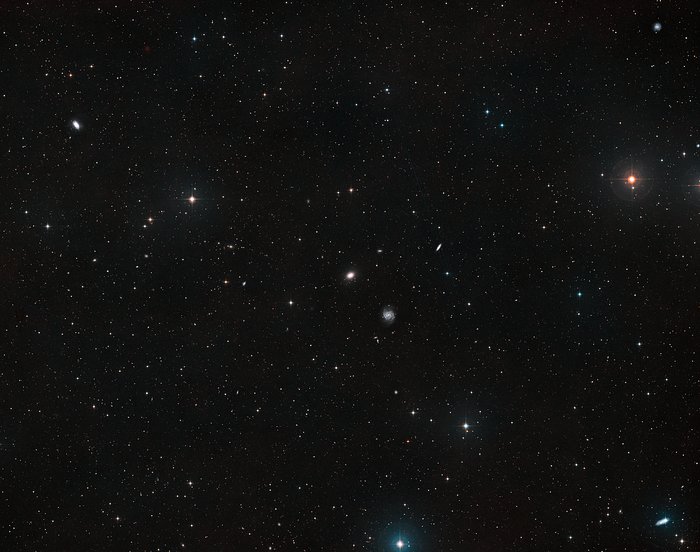
This image shows the sky around the ultra diffuse galaxy NGC 1052-DF2. It was created from images forming part of the Digitized Sky Survey 2. NGC 1052-DF2 is basically invisible in this image. It is located to the southwest of the bright elliptical galaxy NGC 1052, which is dominating the field of view, and east of the bright red star HD 16873.
Notes
[1] The galaxy was identified with the Dragonfly Telephoto Array (DFA) and also observed by the Sloan Digital Sky Survey (SDSS). As well as the NASA/ESA Hubble Space Telescope, the Gemini Observatory and the Keck Observatory were used to study the object in more detail.
[2] Since 1884 astronomers have invoked dark matter to explain why galaxies do not fly apart, given the speed at which the stars within galaxies move. From Kepler’s Second Law it is expected that the rotation velocities of stars will decrease with distance from the centre of a galaxy. This is not observed.
[3] The MOND theory — Modified Newtonian Dynamics — suggests that the phenomena usually attributed to dark matter can be explained by modifying the laws of gravity. The result of this would be that a signature usually attributed to dark matter should always be detected, and is an unavoidable consequence of the presence of ordinary matter.
1. Monday, March 26, 2-3:30 pm PDT (4-5:30 pm CDT, 5-6:30 pm EDT): We welcome back Dr. Marc Rayman to update us with the Dawn Mission and Ceres. Be sure to check our his DAWN Journal prior to air time.
3. Wednesday, March 28, 2018: Hotel Mars. See Upcoming Show Menu and the website newsletter for details. Hotel Mars is pre-recorded by John Batchelor. It is archived on The Space Show site after John posts it on his website.
4. Friday, March 30, 2018; 9:30 am -11 am PDT, (12:30 -2 pm EDT; 11:30 am -1 pm CDT): We welcome back DRAGOS BRATASANU re space entrepreneurism and more.
5. Sunday, April 1, 2018: 12-1:30 pm PDT; 2-3:30 pm CDT; 3-4:30 pm EDT. OPEN LINES. No show today due to EASTER.