Here is the latest Space To Ground report from NASA on activities related to the International Space Station:
And here’s a report on what’s been happening at Kennedy Space Center
====
Here is the latest Space To Ground report from NASA on activities related to the International Space Station:
And here’s a report on what’s been happening at Kennedy Space Center
====
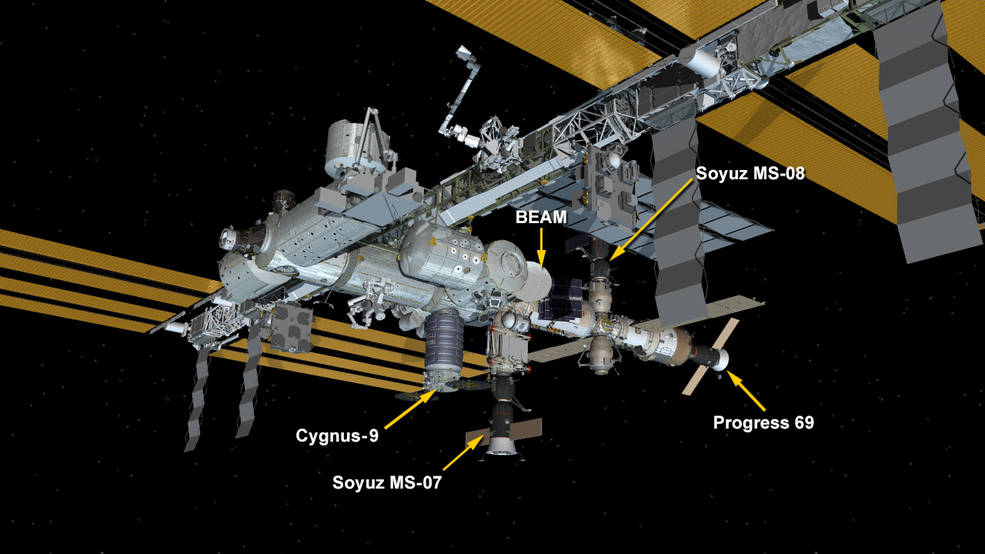
The Orbital ATK Cygnus spacecraft launched on Monday made its scheduled rendezvous with the International Space Station this morning. NASA astronaut Scott Tingle controlled a robotic arm on the station to capture the craft and bring it up to the Unity module where it was attached.
A brief overview of some of the research payloads delivered to the station:
This diagram shows where the Cygnus is berthed on the station as well as where other vehicles are located:
=====
Two launches by US commercial rocket companies took place this week:
** A SpaceX Falcon 9 launched on Tuesday from Vandenberg Air Force Base on the coast of California with seven satellites. First released after reaching a low earth orbit were the two GRACE-FO (Gravity Recovery and Climate Experiment Follow-on) research spacecraft sponsored by NASA and the German Research Centre for Geosciences (GFZ). After a coast period and a brief firing of the upper stage engine, five Iridium NEXT communications satellites were deployed successfully.
The GRACE-FO spacecraft
will continue a study begun by the original GRACE mission, which proved that water movement can be tracked with high precision by its effect on Earth’s gravitational field. GRACE-FO will continue the record of regional variations in gravity, telling us about changes in glaciers, ground water, sea levels and the health of our planet as a whole.
The five NEXT satellites join 50 others launched previously by SpaceX, ten at a time. There will be two more F9 launches of NEXT satellites this year to complete the constellation.
Another video of the mission:
also find lots of great pictures of the launch at Official SpaceX Photos | Flickr

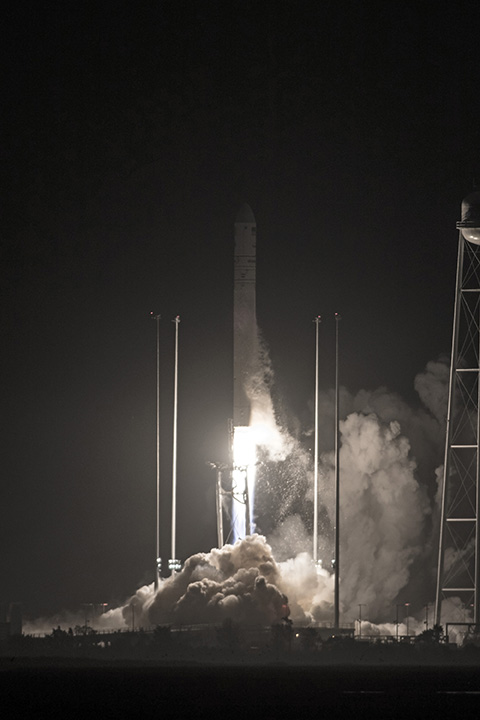
** An Orbital ATK Antares rocket launched early Monday morning from Wallops Island, Virginia with a Cygnus cargo spacecraft that is carrying over 3.3 tons of supplies, equipment, and science and technology R&D payloads to the International Space Station. The Cygnus will reach the ISS on Thursday morning. See the OA-9 Mission Page for updates.
A view of the launch:
====
American astronaut Sally Ride is commemorated with a new US postage stamp:
Sally Ride Stamp Launches Tomorrow
America’s First Female Astronaut to Soar on Forever Stamp

The Sally Ride Forever stamp 5 p.m. PDT dedication ceremony, free and open to the public, will take place at the Price Center, University of California San Diego . Ride served as a professor of physics at the university, which also is home to Sally Ride Science @ U C San Diego, a non-profit organization she co-founded to inspire young people in science, engineering, technology and math (STEM) and to promote STEM literacy.
Followers of the U.S. Postal Service’s Facebook page can view the ceremony live at Facebook.com/USPS. The stamps may be pre-ordered now at this link for delivery shortly after tomorrow’s issuance.
“Sally Ride’s history-making journey has made it easier for young girls to dream of one day being an astronaut, an engineer, a physicist or a mathematician. Today, girls don’t just dream. Because of trailblazers like Sally Ride, they have been empowered to do!”
said U.S. Postal Service Chief Information Officer and Executive Vice President Kristin Seaver.
Scheduled to join Seaver are Pradeep K. Khosla, chancellor at UC San Diego; Becky Petitt, vice chancellor for equity, diversity and inclusion at UC San Diego, who will serve as master of ceremonies; Billie Jean King, tennis legend, champion of social justice and Ride’s friend; Ellen Ochoa, the first Hispanic woman in space, director of NASA’s Johnson Space Center, and another friend of Ride; and Tam O’Shaughnessy, co-founder and executive director of Sally Ride Science @ U C San Diego and Ride’s widow.
“Sally started collecting stamps when she was a girl, and she continued to do so her whole life —especially stamps of the Olympics and space exploration,” said O’Shaughnessy. “Sally would be deeply honored to have her portrait on a U.S. stamp.“
[Ochoa said, ]
“I admired Sally for her intellect that she applied as a scientist, her focus and passion for STEM education, and her astounding competence in so many areas, including her critical contributions to NASA and the nation,” … “As much in demand as she was, she always made time to meet with young women who dreamed of becoming astronauts. I am thrilled to be part of the Sally Ride Forever stamp dedication, continuing her legacy of inspiring people across the country, and indeed around the world.”
The stamp art features a colorful portrait of Ride in her light blue space suit with a dramatic depiction of a space shuttle lifting off in the background. Sketched first in charcoal and then rendered in oil paint, artist Paul Salmon of Burke, VA, reflects her positivity and confident spirit, as well as the excitement and danger of space travel. Art director Ethel Kesslerof Bethesda, MD, designed the stamp.
Her Legacy
Ride galvanized the country with her pioneering space flight and inspired generations of students as a physicist, astronaut and champion of science education.
After completing her doctorate in physics, Ride joined NASA’s 1978 class of astronaut candidates for the agency’s new space shuttle program. She was the first woman to serve as a capsule communicator for Columbia’s second flight in 1981, communicating from the ground with both the shuttle crew in space and the flight director at Mission Control. In spring 1982, NASA assigned her to her first flight crew as a mission specialist.
On June 18, 1983, at 7:33 a.m., Ride realized her ultimate adventure when she launched through Earth’s atmosphere aboard space shuttle Challenger, becoming the first American woman to reach space. For six days, she worked closely with her four male crewmates, proving to the world below that women were as adept as men in the final frontier. She completed a second successful trip to space the next year, breaking another barrier as a member of the first flight crew with two women.
Ride was the only person to sit on the investigative panels for both the Challenger and Columbia accidents. As a professor, she used her experiences in space to explain complicated physics concepts. She also co-authored six children’s books about science with O’Shaughnessy. In 2001, Ride and O’Shaughnessy joined three friends to start a science education company, Sally Ride Science, with the goal of narrowing the gender gap in science, technology, engineering and math.
The Sally Ride stamp is being issued as a Forever stamp. This Forever stamp will always be equal in value to the current First-Class Mail 1-ounce price.
Stamp ideas welcome
The public is encouraged to submit stamp suggestions. Visit the Citizens’ Stamp Advisory Committee website for details on the stamp selection process and instructions for submitting suggestions in writing. Due to the time required for research and approval, ideas for stamp subjects should be received at least three years prior to the proposed release. Each submission should include pertinent historical information and important dates associated with the subject.
Ordering first-day-of-issue postmarks
Customers have 120 days to obtain first-day-of-issue postmarks by mail. They may purchase new stamps at Post Office locations, at The Postal Store usps.com/shop or by calling 800-782-6724. Customers must affix the stamps to envelopes of their choice, address the envelopes to themselves or others and place them in larger envelopes addressed to:
FDOI – Sally Ride Forever Stamp
USPS Stamp Fulfillment Services
8300 NE Underground Drive, Suite 300
Kansas City, MO 64144-9900
After applying the first-day-of-issue postmark, the Postal Service will return the envelopes through the mail. There is no charge for postmarks up to a quantity of 50. For more than 50, customers are charged 5 cents each. All orders must be postmarked by September 23, 2018.
Ordering first-day covers
The Postal Service also offers first-day covers for new stamps and stationery items postmarked with the official first-day-of-issue cancellation. Each item has an individual catalog number and is offered in the USA Philatelic publication and online at usps.com/shop. Customers may register to receive a free USA Philatelic publication online at usps.com/philatelic.
Philatelic products
The following Philatelic products are available at usps.com/shop.
You may view many of this year’s other stamps on Facebook at facebook.com/USPSStamps or via Twitter @USPS. All postage stamps are available for purchase at Post Office locations, online at usps.com and by toll-free phone order at 1-800 STAMP-24.
The Postal Service receives no tax dollars for operating expenses and relies on the sale of postage, products and services to fund its operations.
====
Winners have been selected in the Guardians of the Galaxy Space Station Challenge student competition mentioned here back in January:
Guardians of the Galaxy Space Station Challenge Winning Projects Selected
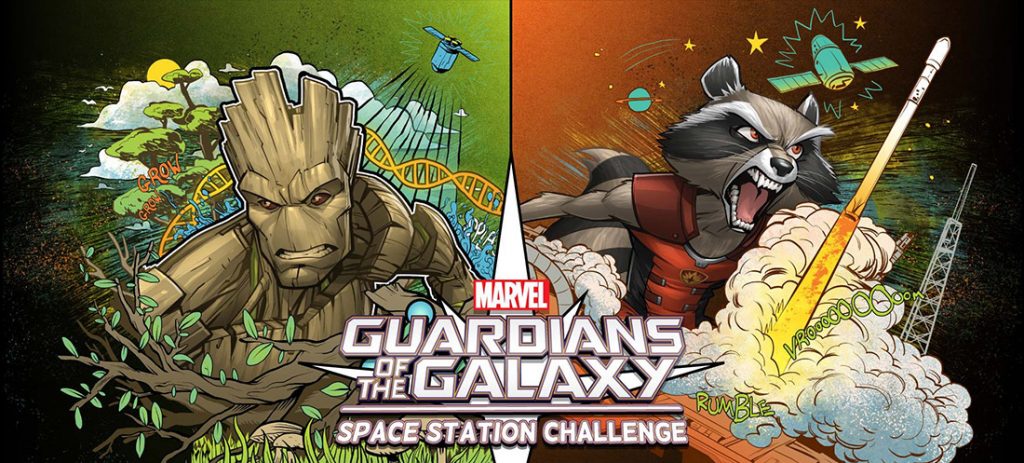
KENNEDY SPACE CENTER, FL. (May 22, 2018) – After a robust response from students around the country, the Center for the Advancement of Science in Space (CASIS) and Marvel Entertainment today announced two winning concepts from the recent Guardians of the Galaxy Space Station Challenge. The challenge was an opportunity for American students ages 13-18 to submit microgravity flight experiment concepts that could be conducted on the International Space Station (ISS) U.S. National Laboratory. The contest focused on Rocket and Groot, characters from the Guardians of the Galaxy comic book franchise. Students were encouraged to develop innovative concepts to be tested in space based on the attributes of these Super Heroes. The two selected flight concepts will become official ISS National Lab investigations, intending to launch to the space station in 2018.
Students with an interest in technology and engineering were encouraged to submit flight concepts through Team Rocket—a Super Hero with strong ties to technological innovation and engineering. Students interested in fundamental biological concepts were encouraged to submit flight proposals under Team Groot—a member of the Guardians of the Galaxy who is the embodiment of genetics and plant biology.
Below is an overview on the two research concepts selected through the challenge.
Team Groot:
Aeroponic Farming in Microgravity
Project Lead: Sarina Kopf
Golden, CO
This experiment seeks to explore an alternative method for watering plants in the absence of gravity. Aeroponic farming utilizes a misting device to deliver water to the plant roots and an air pump to blow excess water off of the roots. In space, aeroponic farming has advantages over other methods of watering plants that are gravity dependent. The project aims to test mister behavior in microgravity. Specifically, how the water behaves immediately after it is ejected from the head of the nozzle, and how moving air affects the water on the roots in the absence of gravity. Too much water is just as bad for plants as too little water, and root rot from over watering can be a problem when growing plants in space. Results from this experiment may have profound implications for both the future of spaceflight and for life on Earth by enabling humans to grow fruits and vegetables in microgravity and eliminate a major obstacle for long-term spaceflight.
Hardware Partner: Space Tango
Team Rocket:
Staying Healthy in Space
Project Lead: Adia Bulawa
Greeneville, TN
Staying healthy in space is extremely important. A broken tooth or a lost filling is painful on Earth, but in space it can be detrimental to an astronaut’s health. This experiment intends to analyze the effectiveness in microgravity of a dental glue that is activated by UV light. The team proposes to treat simulated, broken teeth with the dental glue, expose them to UV light, and observe them onboard the space station. Soldering in microgravity results in weaker bonds due to air bubbles, and the team wonders whether the same will happen with UV activated glue.
Hardware Partner: DreamUp (with hardware integration partner NanoRacks, LLC)
“This challenge created an incredible response from young researchers around our country, which is a testament to the reach and excitement of collaborating with an entity like Marvel Entertainment,” said CASIS Director of Operations and Education Initiatives, Ken Shields. “The two selected investigations provide diverse, fun, and important research concepts, and we thank our partners at Marvel for bringing further awareness to research opportunities available through the International Space Station.”
The winning students will work alongside partners DreamUp (with team member NanoRacks, LLC) and Space Tango, Inc. to help transform their ideas into research questions to be tested on the space station. In the coming months, students will work with these commercial partners and be exposed to space station facilities, hardware development, and the engineering required to ensure successful projects on the orbiting laboratory.
The Guardians of the Galaxy Space Station Challenge is a featured program of Space Station Explorers, a CASIS-led collaborative science, technology, engineering, and mathematics (STEM) consortium of partners who are committed to developing, promoting, and delivering ISS National Lab-themed educational curriculum, products, and outreach to student explorers. To learn more about Space Station Explorers’ broad range of student opportunities, please visit http://www.spacestationexplorers.org/
To learn more about the ISS U.S. National Laboratory, please visit: www.iss-casis.org
About CASIS: The Center for Advancement of Science in Space (CASIS) is the nonprofit organization selected to manage the ISS National Laboratory, with a focus on enabling a new era of space research to improve life on Earth. In this innovative role, CASIS promotes and brokers a diverse range of research in life sciences, physical sciences, remote sensing, technology development, and education.
Since 2011, the ISS National Lab portfolio has included hundreds of novel research projects spanning multiple scientific disciplines, all with the intention of benefitting life on Earth. Working together with NASA, CASIS aims to advance the nation’s leadership in commercial space, pursue groundbreaking science not possible on Earth, and leverage the space station to inspire the next generation.
About the ISS National Laboratory: In 2005, Congress designated the U.S. portion of the International Space Station as the nation’s newest national laboratory to maximize its use for improving life on Earth, promoting collaboration among diverse users, and advancing STEM education. This unique laboratory environment is available for use by other U.S. government agencies and by academic and private institutions, providing access to a permanent microgravity setting, a vantage point in low Earth orbit, and varied environments of space.
About Marvel Entertainment: Marvel, a wholly-owned subsidiary of The Walt Disney Company, is one of the world’s most prominent character-based entertainment companies, built on a proven library of more than 8,000 characters featured in a variety of media over seventy-five years. Marvel utilizes its character franchises in entertainment, licensing and publishing. For more information visit marvel.com. © 2018 MARVEL