A sampling of recent articles, press releases, etc. related to student and amateur CubeSat / SmallSat projects and programs (find previous smallsat roundups here):
** Lightweight 3D printed composite CubeSat structure built by French university students with industrial partners:
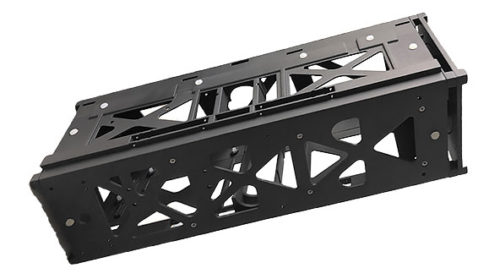
LISA, an Italian-based company specialist for over 25 years in the use and development of advanced additive manufacturing technologies and materials, has collaborated with the Laboratoire InterUniversitaire des Système Atmosphérique (LISA) of Universite Paris-est Creteil (UPEC) on the construction of a nano-satellite that is a 3U CubeSat formfactor.
The project was carried by students under CNES and Space Campus University supervision. The goal was to develop a demonstrator that can be flight-ready in Low Earth Orbit. The engineering team at LISA and CNES decided to rely on CRP Technology and its Windform Top-Line family of high-performance materials for the manufacturing of the nano-satellite.
A sampling of recent articles, videos, and images dealing with space transport (find previous roundups here):
[ Update 2: Unfortunately, the SARGE appeared to once again suffer guidance problems and failed to achieve the target altitude. The booster apparently hit the ground hard when it’s parachute did not deploy. At least one parachute was seen, however, and this may have been nosecone with the payloads. No details released from the company yet.
During his IAC presentation, Bezos revealed a video of what is almost certainly the first full-scale prototype hardware of Blue Origin’s reusable New Glenn rocket. In the clip, a massive carbon-composite payload fairing half is moved inside an even larger curing oven located on Blue Origin’s Cape Canaveral, FL campus, offering an incredibly rare glimpse inside the company’s purported New Glenn factory.
Skyrora is building a new small sat launcher that is environmentally conscious, possibly reusable and unlike anything else on the market. This week we’re joined by Skyrora Lead Engineer Robin Hague to talk about what they are building and when we can see it fly!
European launch provider Arianespace is planning a rideshare mission to the moon in 2023 as an early step toward increasing Europe’s involvement in lunar activity, CEO Stéphane Israël said Oct. 22.
Israël, speaking at the 70th International Astronautical Congress here, said the rideshare mission will be able to deliver 8,500 kilograms into a lunar transfer orbit. Orbiters and/or landers would reach the moon three days after liftoff, he said
China recently made an important breakthrough in developing its own space plane, a genre of aircraft that is expected to become a crucial weapon in the future, a state-owned research institute said.
The First Research Institute of the Chinese Academy of Aerospace and Aerodynamics successfully conducted a wind tunnel experiment, in which the second-stage aircraft freely detached from the first-stage aircraft of a two-stage-to-orbit (TSTO) space plane, according to a statement the academy released on its WeChat account on Monday.
A little-known Korean startup backed by Samsung is preparing to launch a small orbital rocket in July.
Perigee Aerospace of Daejeon, South Korea, has raised around $12 million from Samsung Venture Investments, LB Investment and others to develop Blue Whale 1, a small launcher capable of carrying 50 kilograms to a 500-kilometer sun-synchronous orbit, CEO Yoon Shin said in an interview.
Shin said Perigee Aerospace has had sufficient funding to develop the very small rocket, allowing the company to operate in stealth mode until getting within a year of launch.
[ MLS CEO Steven ] Matier said the Cyclone 4M upper stage tests were completed in August. The first tests were for the 7000 series qualification profile on August 23 which was then followed by a second full duration burn on August 30.
In a press release Matier also said “the full-duration burn of our C4M upper stage brings us closer to introducing this medium-class launcher into commercial operation in 2021 from our spaceport in Canada. The C4M, with well-proven rocket technology heritage over 220 successful launches, will cater to our small-GEO, constellation and rideshare customers worldwide.”
“The proven heritage of the C4M launch family, with over 220 launches to date, will provide Nanoracks with plenty of opportunities to choose the appropriate missions on which to test and develop the proposed upper stage conversions into resilient automated habitats, and one day human habitats,” says Steve Matier, Maritime Launch CEO. “Canada has a reputation for providing in-space robotics for the International Space Station, such as the CANADARM and the Dextre programs. With Nanoracks, we hope to see this country’s legacy expanding further into economically viable space habitats, and to organize the related launch missions to bring equipment and supplies to these new working structures.”
“It’s Nanoracks vision to re-purpose upper stages of launch vehicles and convert them into Outposts. We envision populating the solar system with cost-efficient platforms, that can serve as hotels, research parks, fuel depots, storage centers and more,” says Nanoracks CEO Jeffrey Manber. “We are proving time and time again that there are new ways to look at how we explore deep space, and that we need to think creatively, but work cost-efficiently. This agreement with Maritime Launch will provide us with the in-orbit test bench second stage articles to do exactly that, and to grow our space industry even further.”
Virgin Orbit, while preparing for the first flight of its LauncherOne smallsat rocket, is in the process of choosing an engine for a three-stage variant that would be capable of sending payloads to other planets.
John Fuller, Virgin Orbit advanced concepts director, said the company is deciding between three “highly energetic third stage” options for LauncherOne that would enable the rocket to launch up to 50 kilograms to Mars or 70 kilograms to Venus. The “Exploration 3-Stage Variant” of LauncherOne would also have the ability to launch around 100 kilograms to the moon or toward Lagrange points, he said.
Of the 148 small launch vehicles on a popular industry watch list, about 40 efforts “are likely dead but the watch list continues to grow,” Carlos Niederstrasser, a Northrop Grumman master systems engineer, said at the 2019 International Astronautical Congress here.
The problem for Niederstrasser and anyone trying to keep up with the market is that the list continues to grow. “Every time I kill off one [launch vehicle], two more show up,” he said.
*** SpaceX President Gwynne Shotwell interviewed at the IAC 2019. She gave an “aspirational” timetable for Starship:
First Starship to orbit within a year
Starship cargo mission to the Moon by 2022. She said this was would provide supplies for those who will come in 2024. She might have been referring to a Starship landing in 2024 but I think she was actually talking about NASA’s target of putting people on the Moon in 2024.
Baron pointed out that Bezos, as the world’s wealthiest man, has more than enough money, asking Shotwell, “So why hasn’t he done this?”
“I think engineers think better when they’re pushed hardest to do great things in a very short period of time, with very few resources. Not when you have twenty years,” Shotwell said. “I don’t think there’s a motivation or a drive there.”
Both ventures have remained private — one of the factors Shotwell credits for SpaceX’s success. But she believes Blue Origin has not taken on nearly as much risk.
“They’ve got a ton of money, and they’re not doing a lot,” Shotwell said.
*** Starlink to open for business by late 2020. Reusable rockets enable a high launch rate:
SpaceX is confident it can start offering broadband service in the United States via its Starlink constellation in mid-2020, the company’s president and chief operating officer Gwynne Shotwell said Oct. 22.
Getting there will require the company to launch six to eight batches of satellites, Shotwell told reporters during a media roundtable. SpaceX also has to finish the design and engineering of the user terminals, which is not a minor challenge, Shotwell acknowledged.
A SpaceX Dragon cargo spacecraft is scheduled to launch on a Falcon 9 rocket from Space Launch Complex 40 at Cape Canaveral Air Force Station (CCAFS) in Florida no earlier than Wednesday, Dec. 4 at 12:48 p.m. EST.
*** Crucial Crew Dragon systems tests and flights coming soon:
But amongst the success have also been setbacks. SpaceX has been working two primary technical challenges over the past year. These include a major test stand anomaly and continued problems with the spacecraft’s parachutes.
…
… the company must redo the static fire test. A successful static fire of the abort sequence will help to verify that the redesigned system is safe for crewed spaceflight.
It is understood that the test could occur as soon as early November.
Test of Crew Dragon’s upgraded launch escape system ahead of static fire and in-flight abort tests – altogether we are conducting hundreds of tests to verify the system’s advanced capabilities to carry astronauts to safety in the unlikely event of an emergency pic.twitter.com/a4FucMh85l
A senior SpaceX director says that the Starship Mk1 prototype could lift off for the first time before the end of 2019, a flight debut SpaceX hopes will successfully demonstrate the next-generation spacecraft’s exotic ‘skydiver’ landing method.
*** Sights and sounds from Boca Chica:
It’s a beautiful morning at Boca Chica. Work on Starship Mk1 continues and these sounds are the sounds of progress being made. 🤩🚀@NASASpaceflightpic.twitter.com/49Cjv4AuZT
SpaceX’s South Texas Starship facilities and Mk1 prototype fell under threat of damage when stormy weather – including multiple tornadoes and heavy rain – impacted the area in the early hours of October 21st.
With a healthy serving of luck, SpaceX’s Boca Chica campus managed to escape largely unscathed, but much of the surrounding area lost power after high winds knocked down numerous utility poles. Thankfully, one of the first things SpaceX installed in Boca Chica, Texas was a large Tesla solar array and multiple Tesla Powerpacks.
Here is the latest episode of NASA’s weekly Space to Ground report on activities related to the International Space Station:
** Astronauts Christina Koch and Jessica Meir reflect on the first All Woman Spacewalk [Short version]
NASA astronauts Christina Koch and Jessica Meir reflect on the historic spacewalk they performed on Oct. 18 – the first ever to be conducted by two women. They spent a total of 7 hours and 17 minutes in the vacuum of space. It was Koch’s fourth spacewalk and Meir’s first.
**Expedition 61 Crew News Conference with Jessica Meir and Christina Koch – October 21, 2019 [Complete version]
** Expedition 61 In Flight Event with the SMPTE Conference – October 24,2 019
Aboard the International Space Station, Expedition 61 Flight Engineers Christina Koch, Jessica Meir and Drew Morgan of NASA discussed the value of capturing imagery of human spaceflight from orbit and the future use of video and digital still cameras for deep space exploration during a question and answer session Oct. 24 with participants at a broadcast industry conference in Los Angeles. The three NASA astronauts are in various stages of long duration missions on the orbital laboratory.
A sampling of links to recent space policy, politics, and government (US and international) related space news and resource items that I found of interest (find previous space policy roundups here):
** Blue Origin and Virgin Galactic move agonizingly slowly towards operational flights. After successful tests early this year (SpaceShipTwo in February and New Shepard in May ), there seemed to be high momentum in both programs towards more frequent flights, including New Shepard flights with people finally on board. However, neither program has flown since those tests.
Virgin Galactic has focused instead on outfitting the interior of the SpaceShipTwo with seats and other features needed for the spaceflight participants. VG has also been moving its base of operations from Mojave, California to Spaceport America in New Mexico (see entry below about the spaceport). Blue has been upgrading the New Shepard for operational spaceflights. Both companies claim they will do a few more test flights and then start flying customers in 2020.
“The New Shepard booster lands during Mission NS-11 on May 2, 2019.” Credits: Blue Origin
Here are some misc. items about the state of the two programs:
In a suborbital space tourism panel, Clare Pelly of Virgin Galactic says the VSS Unity SpaceShipTwo will be flown from Mojave to Spaceport America in New Mexico around the end of this year for final flight tests before beginning commercial service in 2020. #IAC2019
.@blueorigin’s Greg “Ray J” Johnson says there’ll be one more #NewShepard suborbital test flight before year’s end; acknowledges they’re “tapping the brakes” before flying people.
Greg Johnson, senior VP of New Shepard at Blue Origin, mentioned in passing that the company will have a program to fly poets and artists on its suborbital vehicle, but no details. Says there’s room in space tourism market for both Blue and Virgin. #IAC2019
** In July, Virgin Galactic announced plans to go public via a merger with Social Capital Hedosophia (SCH), a publicly traded company created solely to acquire a revenue producing company. The company claims a value of $1.5 billion. By 2023 they project flying SpaceShipTwo vehicles 270 times per year and carrying over 600 people. Annual profits are predicted to reach $275M.
Virgin Galactic (“VG”), a vertically integrated aerospace company, and Social Capital Hedosophia (“SCH”), a public investment vehicle, today announced the completion of their previously announced business combination. The resulting company is named Virgin Galactic Holdings, Inc. (“VGH”) and its common stock, units and warrants are expected to commence trading on the New York Stock Exchange under the new ticker symbol “SPCE”, ”SPCE.U” and “SPCE WS”, respectively, on October 28, 2019. The Company manufactures its space vehicles in Mojave, California, through its aerospace development subsidiary The Spaceship Company, with commercial operations centered at Spaceport America in New Mexico.
VG already has customer reservations from more than 600 people in 60 countries representing approximately $80 million in total collected deposits, and over $120 million of potential revenue. The completion of this merger and trading as a public company are the next milestones on the path towards building a thriving commercial service business and investing appropriately for the future.
[SCH] said it expects the merged company to start trading Oct. 28 under the Virgin Galactic name and the ticker symbol SPCE. Virgin Galactic founder Sir Richard Branson, speaking at a conference in Israel Oct. 23, said he planned to be at the exchange Oct. 28 to ring the opening bell, according to Israeli media reports.
The merger will make Virgin Galactic the first publicly traded company whose primary line of business is human spaceflight. Large aerospace companies such as Boeing, Lockheed Martin and Northrop Grumman have long been traded on stock exchanges, but space is only a small part of their overall business.
Virgin Galactic today revealed the first look at the interior fit-out of its Gateway to Space building at Spaceport America in New Mexico. The work completed showcased two floors of the building primarily focused on spaceflight operations, which also incorporates communal spaces designed for use in the future by Virgin Galactic customers, along with their friends and families. Completion of this interior work means the spaceport facility is now operationally functional and able to support Virgin Galactic’s flight requirements.
After travels to the North and South Poles and skydiving over Mount Everest, Namira Salim wants to go to the next level of adventure:
The Earthly accomplishments were fine, sure, but for Salim, whose dreams have turned skyward since birth, they just filled the gap while she waited to obtain the “first” she’s been after all along.
“I’ve been inspired to do more,” she told the Orlando Sentinel while on a trip to Cocoa Beach for the Apollo 11 moon landing 50th anniversary. “So first of all, I think I should go as far as possible on Earth before I break the orbit.”
That’s right — the “first” that Salim is seeking won’t take place on our planet at all, not really. She wants to become the first Pakistani to fly to space. And with her $200,000 ticket on Virgin Galactic’s suborbital flights, she’s well on her way.
As timing for the first Earth-bound launches of space tourists grows near, the public, governments and the innovation sector continue to hold their collective breath.
Many predict that once the first space tourism mission starts flying, it will spur a lot of activity.
To Lopez-Urdiales, the world is currently in the second of three phases of space activity — the first began with government-sponsored programs like the Apollo program and continued to the present day, with space projects backed by billionaires. It’s only in the third phase — when a broader base of entrepreneurs with cool ideas are funded and can compete for market share — will space tourism be sustainable, he says.
“When that happens and the financial sector invests in not only the Musks of the world but also in folks like us, space tourism will truly take off,” he concludes.