** What’s Up: December 2019 – Skywatching Tips from NASA JPL
What can you see in the December sky? Beautiful pairings of planets and the crescent Moon throughout the month, at sunrise and sunset. Here’s where and when to look to see Venus, Saturn and Mars. Additional information about topics covered in this episode of What’s Up, along with still images from the video, and the video transcript, are available at https://solarsystem.nasa.gov/whats-up… . Credit: NASA-JPL/Caltech
Step outside on a cold December night when the stars shine bright to find the Big Dipper, Cassiopeia, and Cepheus. They will help you locate a binary star system, a fan-shaped open star cluster, and a variable star. Stay tuned for space-based views of a ragged spiral galaxy, an open star cluster, and an edge-on galaxy.
** What’s in the Night Sky December 2019 – Alyn Wallace
A sampling of recent articles, videos, and images dealing with space transport (find previous roundups here):
** Rocket Lab‘s launch of an Electron rocket has been delayed:
Launch update: We’re standing down from today’s launch attempt to conduct further tests on ground systems. We’ll update with a new target launch date soon. The window remains open until 12 December. 🚀
** China launched the Gaofen-12 earth observation satellite on a Long March-4C rocket from the Taiyuan Satellite Launch Center in Taiyuan, capital of north China’s Shanxi Province, on Wednesday Nov. 28th9.
The SL-14 Launch Vehicle reached an altitude of 57 miles. Additionally, as a fundamental step in UP Aerospace’s testing of new systems, this mission included a small second stage rocket motor and attitude control system. Advances made with the successful mission of these payloads will be pivotal as UP Aerospace moves toward the launch of their larger orbital vehicle, SPYDER.
In addition to these systems, SL-14 carried an experimental payload that seeks to improve access to space through the use of Automatic Dependent Surveillance-Broadcast (ADS-B) technology. Using ADS-B for future space launch missions is expected to improve safety and reduce detrimental effects on commercial aviation. Other payloads on the mission also were designed to advance the state-of-the-art in avionics, flight management, and data recording with particular applications for emerging small launch vehicles.
Work has been ongoing on the launch complex preparing for New Glenn’s first launch but recently locals say it’s starting to take shape.
Space Florida’s Dale Ketcham called it a “monster” of a launch pad.
“It is going to be a beast,” Ketcham said.
BLUE ORIGIN CONSTRUCTION: BO continues its construction of at least 3 new buildings at #NASA where it will build its 270′ & 313′ variants of the New Glenn reusable rocket. 1st & 2nd stages as well as payload fairings will be constructed here. #blueorigin#Space#newglennpic.twitter.com/6JjeNLwvws
Amazon CEO Jeff Bezos’ Blue Origin space venture is rapidly expanding on several fronts, ranging from its headquarters facility south of Seattle to a new beachhead in the Los Angeles area — within the orbit of its main competitor, Elon Musk’s SpaceX.
Just three and a half years ago, Blue Origin’s workforce amounted to 600 employees, and even then, Bezos said his company’s 300,000-square-foot office and production facility in Kent was “busting out of the seams.”
Now the employee count is at around 2,500, heading toward 3,500 in the next year. That’s according to a report from a Bangkok space conference quoting Clay Mowry, Blue Origin’s vice president for global sales, marketing and customer experience.
** Boeing highlights reuse of Starliner crew spacecraft:
Each #Starliner spacecraft has a six month turnaround time from landing to launch.
Reusability will increase access to and capabilities on @Space_Station.
The Dragon spacecraft supporting this mission previously flew in support of our fourth and eleventh commercial resupply missions pic.twitter.com/P6ceGX9Pz1
This will be among the final major tests for the company before NASA astronauts will fly aboard the Crew Dragon spacecraft. As part of the test, SpaceX will configure the spacecraft to trigger a launch escape shortly after liftoff and demonstrate Crew Dragon’s capability to safely separate from the rocket in the unlikely event of an in-flight emergency. The demonstration also will provide valuable data toward NASA certifying SpaceX’s crew transportation system for carrying astronauts to and from the International Space Station.
Assuming SpaceX’s technical know-how is mature enough to allow Starship to preserve cryogenic propellant for weeks or months after launch, it’s entirely conceivable that a Moon launch with, say, 10 tons of cargo could be achieved with just one or two in-orbit refuelings, all while leaving that Starship enough margin to safely return to Earth. Given that NASA awarded Intuitive Machines and Astrobotic approximately $80M apiece to land 50-100 kg on the Moon, it’s far too easy to imagine SpaceX quoting a similar price to deliver 10+ tons to the Moon by enabling full Starship reuse.
All things considered, politics still looms in the distance and there is just as much of a chance that SpaceX (and maybe even Blue Origin) will be passed over by CLPS when the time comes to award the next round of Moon delivery contracts. Still, the odds of something far out of the ordinary happening are much higher with a program like CLPS. Stay tuned!
*** Lots of interesting activities at the Boca Chica beach facilities in the aftermath of the Mk.1 demo Starship explosion during pressure testing. This includes construction of a launch site for the complete Super Heavy Booster/Starship.
**** SpaceX Boca Chica – Building the Starship Super Heavy Pad – November 26, 2019 [NSF]
Views around SpaceX Boca Chica, including groundwork on the future Super Heavy’s pad. Guest Stars: Concrete Smoother Guys. Footage and photos from Mary (@bocachicagal) for NSF.
As parts of Starship Mk3 arrive (mostly bulkhead), expansion of the Boca Chica site continues, including at the Super Heavy pad. Guest appearance from Stargate Arrays being tested (likely ahead of CRS-19). Footage and photos from Mary (@bocachicagal) for NSF.
**** SpaceX Starship Bulkhead and Second Ring Relocated Boca Chica, Texas [Nov.29.2019 – LabPadre]
Time lapse of the new partial bulkhead being moved to Iron Henge and second ring being moved from ring tent. This 24/7 stream is powered by LabPadre, in cooperation with Sapphire Condominiums and @BocaChicaMaria1 (Twitter) @SpaceXBocaChica (Facebook). All copyrights to live images are owned explicitly by LabPadre.
Second new tent frame continues to be erected. Tons of earth being moved on the West end of the property. More close ups of the damaged bulkhead from last weeks failure. New bulkhead has been moved into Iron Henge. MK-1’s nose sits quietly awaiting its fate.
**** SpaceX Starship Mk3 – Bulkhead heading for assembly/ongoing launch site work – November 29, 2019 [NSF]
The pace is picking up for Starship Mk3 in Boca Chica, with monolithic steel rings being fabricated (seen previous videos) and the bulkhead heading into the windbreak facility for assembly. Includes ongoing launch site work. Footage and photos from Mary (@bocachicagal) for NSF. Edited by Jack Beyer (@thejackbeyer) Learn about Starship Mk1, Mk3 onwards: UPDATES: https://forum.nasaspaceflight.com/ind… ARTICLES: https://www.nasaspaceflight.com/?s=St…
*** In Florida, there are signs the Mk.2 components will move soon to KSC. There are also hints that construction activities will be re-distributed to facilities with fewer roadblocks for reaching KSC.
STARSHIP MK1 COCOA: While there is much speculation about just when the move will be made for Starship from its current build site to this recently improved ramp for transfer to the barge to take it to #NASA, it does seem the timeline is close now. #Spacex#ElonMusk#Spacepic.twitter.com/lJVFzWFG2k
**** SpaceX Closing Down Starship work at Cocoa? [Nov.27.2019 – John Winkopp]
Aerial view. The big white crane is positioned at the nose cone so they can remove the header tank from the nose cone in prep for a move out of Cocoa. The header tank extends below the lip of the nosecone. The nosecone needs to be lifted to remove the header tank. It needs to be removed if the nosecone comes off its base for shipping. Wish I knew they were going to remove it, but did not see the actual removal.
Here is the latest episode in NASA’s Space to Ground weekly report on activities related to the International Space Station:
** How NASA will bake in space for the first time and why that’s a BIG deal!
On November 2nd, 2019, Northrop Grumman launched a Cygnus Cargo Ship on a resupply mission to the International Space Station for NASA. On board was just over 3,700 kg of science experiments, vehicle hardware, crew supplies, and other important space stuff. But included on this flight was a space first. An oven. And not just any oven, but a custom zero g oven developed by Nanoracks, a leading provider of commercial access to space, that will be used to bake the first food in space – the DoubleTree chocolate chip cookie. So today, I thought we should do a history of space food, figure out why we haven’t ever baked anything in space before, and learn from the experts on how DoubleTree by Hilton, the sponsor of this video, will actually bake their cookies on the International Space Station. Article version here – https://everydayastronaut.com/cookies…
** Expedition 61 Thanksgiving Message
Right now, half of the crew members on board the International Space Station are American astronauts who are getting ready to celebrate Thanksgiving, and they have a message for us. Check in with NASA’s Christina Koch, Jessica Meir and Andrew Morgan, to learn more about what the holiday means to them and get a look at what Thanksgiving in space will be like in 2019.
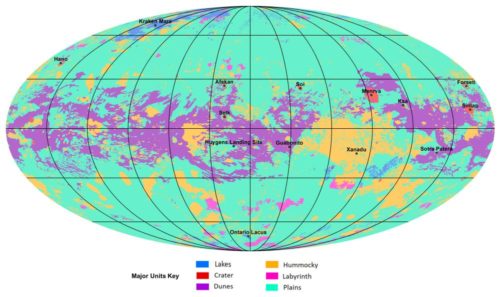
“The first global geologic map of Titan is based on radar and visible-light images from NASA’s Cassini mission, which orbited Saturn from 2004 to 2017. Labels point to several of the named surface features. Credit: NASA/JPL-Caltech/ASU [Click to enlarge]“. Via Universe Today and Carnival of Space
A sampling of recent articles, videos, and images dealing with space transport (find previous roundups here):
[ Update: Videos of the rocket action that took place on Tuesday:
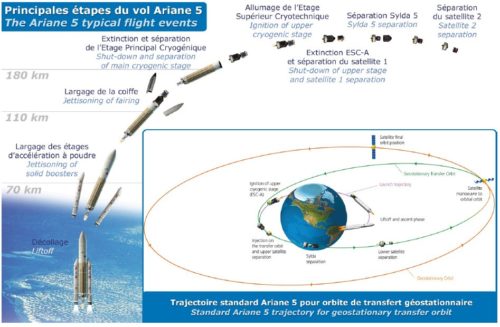
** Successful Ariane V launch of the “TIBA-1, for Thales Alenia Space and Airbus Defence and Space on behalf of the Government of Egypt; and GX5 for the operator Inmarsat”:
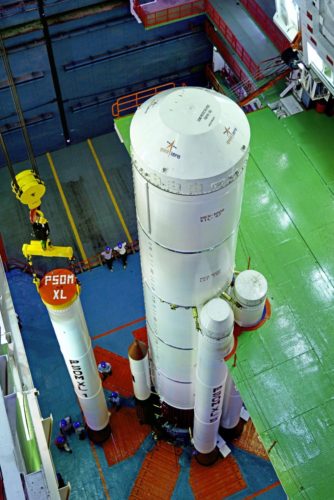
** A Indian PSLV successfully launched the Cartosat-13 remote sensing satellite and 13 commercial smallsats from the Satish Dhawan Space Centre in Andhra Pradesh :
** The static test of the Falcon 9 that will launch the upcoming Cargo Dragon mission to the ISS went well:
Falcon 9 static fire test complete — targeting December 4 launch from Pad 40 in Florida for Dragon’s nineteenth resupply mission to the @Space_Station
This is the aftermath downrange following a Chinese Long March 3B launch from Xichang early Saturday. And that yellow smoke is very toxic hypergolic propellant. Source: https://t.co/VEh5X8Ors0pic.twitter.com/22IVIpyJOk
** Ariane V to launch TIBA 1 and Inmarsat GX5 comm-sats on Tuesday Nov.26th. The mission has endured several weather delays. Liftoff is set for 4:09 pm EST (2109 GMT, 6:09 pmFrench Guiana time). TIBA-1 was developed for the Govt. of Egypt byThales Alenia Space and Airbus Defence and Space. The GX5 satellite os for the Inmarsat. This launch will be the 250th launch of the Ariane family of rockets. The first launch was in 1979.
In the last two weeks alone, both companies have checked off major milestones while preparing their human-rated spacecraft for flight, and – with a little luck over the next few weeks – Starliner and Crew Dragon processing could align for back-to-back launches in the last few weeks of 2019.
** India to launch PSLV with Cartosat-3 imaging satellite plus 13 commercial smallsats. Liftoff now set for November 27, 2019 at 0928 hrs from Satish Dhawan Space Centre SHAR, Sriharikota
Rocket Lab, the global leader in dedicated small satellite launch, announced today that its next mission will launch multiple microsatellites in a rideshare mission representing five different countries. The launch window for Rocket Lab’s tenth flight, named ‘Running Out Of Fingers,’ will open 25th November NZDT and take place from Rocket Lab Launch Complex 1 on New Zealand’s Māhia Peninsula.
Onboard this rideshare mission are six spacecraft comprised of 5cm PocketQube microsatellites from satellite manufacturer and mission management provider Alba Orbital. The final payload on board was procured by satellite rideshare and mission management provider Spaceflight for ALE Co., Ltd (ALE), a Tokyo-based company creating microsatellites that simulate meteor particles.
Electron’s first stage will not be recovered from this mission, however the stage includes new hardware and sensors to inform future recovery efforts. As part of a first stage block upgrade, Electron’s booster will include guidance and navigation hardware, including S-band telemetry and onboard flight computer systems, to gather data during the first stage’s atmospheric re-entry. The stage is also equipped with a reaction control system to orient the booster during its re-entry descent.
Rocket Lab’s Founder and CEO, Peter Beck, says increasing launch frequency for small satellite operators is the key driver behind Rocket Lab’s reusability program.
A new antenna will help with the booster recovery plans:
Say hi to LC-1’s newest range tracking asset. This 5.0m diameter dish gives us the ability to track Electron to Stage 2/ Stage 3 separation from LC-1. It also allows us to retask other tracking assets to support the recovery of Electron’s 1st stage as we work towards reusability. pic.twitter.com/h4yrwBHC9X
Great work by the entire Firefly team to complete qualification of the Alpha 2nd stage. This build of the stage ran a total of 949 seconds during the qual campaign, including two Mission Duty Cycles and a successful relight after a simulated coast. On to Stage 1 Qualification! pic.twitter.com/IvzgFkPvlJ
As United Launch Alliance prepares for the maiden flight of its Vulcan Centaur rocket, the company no longer has a clear timeline for a major second-stage upgrade.
ULA is preparing to launch Vulcan Centaur in 2021. The rocket features a new first stage powered by BE-4 engines from Blue Origin and an improved version of the Centaur upper stage currently used on ULA’s Atlas 5.
ULA had planned as recently as 2018 to replace Centaur with ACES, short for the Advanced Cryogenic Evolved Stage, in 2023. ACES would have the ability to operate in space for weeks instead of hours, enabling transport between orbits and more missions beyond Earth, while also increasing how much Vulcan could lift.
Bonguet declined to say how much funding ArianeGroup is seeking at the ministerial. But the company has already started several Ariane 6 upgrades in anticipation of future ESA support, he said. Gaining ESA funding at the ministerial would ensure Ariane 6 continues to evolve in its early years. Bonguet listed five improvements ArianeGroup will seek funding for at the ministerial.
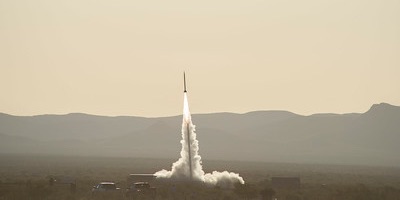
SpaceLoft XL launch on Nov.22, 2019. Credits: NASA
On Nov. 22 UP Aerospace launched its SpaceLoft rocket on a flight funded by the company’s NASA Tipping Point award. The Affordable Vehicle Avionics (AVA) project from NASA’s Ames Research Center was one of several payloads onboard.
The AVA technology flew on two previous SpaceLoft flights supported by Flight Opportunities, with the goals of testing the technology in a relevant environment and leveraging the knowledge gained from the flights to aid development. The most recent flight was the first to test the flight computer’s ability to provide the “brains” for UP Aerospace’s own guidance and control system in a fully integrated demonstration that included firing a second-stage motor. Ultimately, the small company plans to integrate its guidance and control system with technology like AVA on Spyder Orbital—a four-stage solid motor rocket that UP Aerospace is developing specifically for dedicated small payload launches.
The launch also included Flight Opportunities–supported tests for three other technologies. They included an autonomous flight termination system from NASA’s Kennedy Space Center in Florida, a micro-avionics system from Tyvak Nano-Satellite Systems and a ADS-B transmitter prototypefrom the Federal Aviation Administration. Development teams for each experiment aim to gather data that will help them advance their technologies, working toward eventual inclusion on NASA missions or commercial space vehicles, including dedicated small payload launchers.
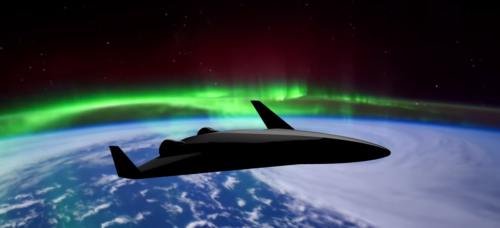
Development of spaceplanes for suborbital tourism, satellite launches and point-to-point terrestrial transportation are benefiting from advanced technology, panelists said at the Space Tech Expo Europe here.
“It was completely different 30 years ago,” said Koichi Yonemoto, co-founder and chief technical officer of Space Walker, a Japanese startup developing a suborbital spaceplane to launch satellites and, later, carry tourists. “At that time, everyone wanted to do single stage to orbit. To do that, you need a very efficient air-breathing engine. We did not have such an engine.”
SPACE WALKER was established in December 2017 with the aim of designing and developing sub-orbital space planes and providing operational services with the aim of creating a future where anyone can travel to space as easily as riding a plane.Currently, we are working on the development of a sub-orbital space plane for scientific experiments scheduled to be launched in 2022 with a technology partner company (* 2).
As of October 15, 2018, the angel round for the purpose of maintaining the development team structure and the basic concept of the aircraft was completed, and we received support from many people including Chairman Kasahara of Mixi Inc. We have been working on development with technology partners.
As of September 30, 2019, we have raised 370 million yen [US$3,405,850] in total from the Angel Round in less than two years since our establishment in December 2017.
Through this funding, we will strongly advance the research and development of a sub-orbital space plane technology demonstration machine that will be launched in 2022.
** Watch China’s Chang’e 4 spacecraft land on the Moon:
The full length high resolution video of Chang’e 4 soft landing on the far side of the moon on 3 January 2019.
** Progress on construction of Blue Origin facilities for New Glenn at the Cape:
BLUE ORIGIN: Work is steady on both the New Glenn complex beside the existing BO building & the work on the LC @ #NASA. New Glenn rockets will be transported to LC-36 for liftoff, but launch control for missions will be handled from the top floor of the New Glenn factory. #Spacepic.twitter.com/J2EAaoNFYq
However, it must be pointed out that the rocket performance required to go halfway around the world on a ballistic flight is only slightly less than going into orbit. So VG will need to achieve a substantial upgrade from the suborbital SpaceShipTwo to a P2P vehicle.
*** SpaceX to launch Falcon 9 with Cargo Dragon on CRS-19 mission to the ISS. Liftoff currently set for Wednesday, Dec.4th at 12:51 pm EST (1751 GMT) from Cape Canaveral.
A static test firing of the F9 engines is expected today:
SpaceX has raised a Falcon 9 rocket vertical at Cape Canaveral’s Complex 40 launch pad in preparation for a hold-down test-firing later today. The rocket is set for launch Dec. 4 on a resupply flight to the International Space Station. LIVE UPDATES: https://t.co/r74BsOCSlPpic.twitter.com/tYtZtLFtUx
The same day that several dozen Starlink-1 satellites finished the climb up to their operational orbits, SpaceX announced media accreditation for its next Starlink launch, presumed to be Starlink-2. According to SpaceX, the mission is targeted for the last two weeks of December 2019, a schedule that will tighten as it gets closer. Previously expected to launch in early November, as few as two weeks after Starlink-1, Starlink-2 has suffered similar delays but still appears to be on track for 2019.
***More about the destruction of the Mk.1 demo Starship during pressure tests:
*** Work at Boca Chica transitioning to Mk.3 construction:
Workers are clearing up the remains of Starship Mk1, while preparing Boca Chica for the launch of future Starships, including Mk3, for which monolithic rings are already being machined on site, likely for this Mk3 vehicle. Footage and photos from Mary (@bocachicagal) for NSF. Edited by Jack Beyer (@thejackbeyer). Learn about Starship Mk1: UPDATES: https://forum.nasaspaceflight.com/ind… ARTICLES: https://www.nasaspaceflight.com/?s=St…
*** SpaceX Starship Mk1: Funeral for a Bulkhead – Super Heavy Pad Construction
Multiple videos and photos of the recovery of the Mk1 Bulkhead that went flying during the test failure this week. Plus a view of the Super Heavy and Starship Launch Pads, the latter still with some debris yet to be removed. Footage from Mary (@bocachicagal) for NSF.
*** More views of Boca Chica activities:
*** Florida Starship activity:
**** MK2 orbital demo Starship may be moving soon to the Kennedy Space Center:
The big move of @SpaceX#Starship#MK2 appears to be happening soon. (credit @Andy_trains screen capture) There was activity at the barge loading point last week. There have been taking scaffolding out of the lower section. pic.twitter.com/zZ4SPlVGPm



![Click to enlarge]](https://photojournal.jpl.nasa.gov/figures/PIA23174_fig1.jpg)