A sampling of recent articles, videos, and images from space-related science news items (find previous roundups here):
Mars
** The Mars 2020 Perseverance Rover is getting ready for its launch in a few weeks. The launch period opens on July 17, 2020 and the target date for landing on Mars is February 18, 2021. Here are reports on the final preparations.
NASA’s Mars 2020 Perseverance rover lives up to its name by enduring a series of tests to prepare for its journey to the Red Planet. Tests for the mission were performed between September and December of 2019 at NASA’s Jet Propulsion Laboratory in Southern California. This video highlights the following tests:
Spin test
Shake test
Mobility deployment test
Rover’s first unassisted stand Solar test
Thermal vacuum test
Sample caching test
Drive test
- NASA’s Perseverance Rover Mission Getting in Shape for Launch – NASA’s Mars Exploration Program. In early May, the rover development team began
the process of placing the Mars-bound rover and other spacecraft components into the configuration they’ll be in as they ride on top of the United Launch Alliance Atlas V rocket. …
Called “vehicle stacking,” the process began on April 23 with the integration of the rover and its rocket-powered descent stage. One of the first steps in the daylong operation was to lift the descent stage onto Perseverance so that engineers could connect the two with flight-separation bolts.
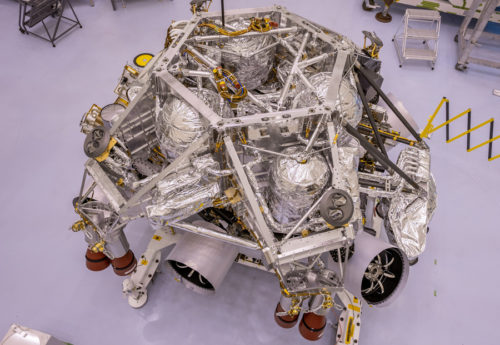
- NASA Perseverance Mars Rover Scientists Train in the Nevada Desert – NASA’s Mars Exploration Program
Did life ever form on Mars? NASA is launching its new Perseverance rover to find out. In February 2020, mission scientists practiced skills they’ll need while Perseverance explores the Red Planet. A seven-person field team served as a simulated rover, carrying cameras and science instruments to the Nevada desert. Meanwhile, mission scientists at institutions like NASA’s Jet Propulsion Laboratory in Southern California sent commands for them to take pictures or collect data from the landscape. The region of Nevada they studied is a former lakebed, just like Jezero Crater, Perseverance’s landing site on Mars.
** The deployment of the Ingenuity helicopter will be a highlight of the Perseverance mission:
** The UAE “Hope” spacecraft is in Japan in final preparation for launch to Mars where it will study the planet’s atmosphere from orbit: UAE-built Mars orbiter arrives at launch site ahead of July liftoff – NASASpaceFlight.com
Emirati-built Mars explorer, named Al Amal (“Hope” in English) and developed by engineers at the Mohammed bin Rashed Space Centre, has been shipped to the JAXA-run Tanegashima Space Center for final checkouts and preparations ahead of its launch aboard an H-IIA rocket. The launch window for this mission is currently scheduled to open July 14th, with an arrival at the Red Planet set for 2021.
The Hope spacecraft is the singular major component of the Emirates Mars Mission, which will study the Martian atmosphere and weather, daily and seasonal weather cycles, and how the climate varies in different regions. The scientific data that will be collected from Hope will help us answer key questions about Mars’ atmosphere, such as why gaseous hydrogen and oxygen are being lost to space and how the planet’s drastic climate changes occur.
The orbiter was built in collaboration with several of American institutions:
The Hope spacecraft was built by 150 Emirati engineers and 200 partnering U.S. engineers and scientists, with construction having taken place at the Laboratory for Atmospheric and Space Physics at the University of Colorado in Boulder, Colorado. Academic partners from the University of California, Berkeley and Arizona State University also collaborated in the development of the spacecraft.
مسبار الأمل هو إنجاز يمثل نقطة تحول للعالمين العربي والإسلامي في مجال الفضاء … الوصول للمريخ لم يكن هدفه علمياً فقط … بل هدفه أن نرسل رسالة للجيل الجديد في عالمنا العربي بأننا قادرون .. وبأن لا شيء مستحيل .. وبأن قوة الأمل تختصر المسافة بين الأرض والسماء.. pic.twitter.com/44S9H09xzF
— HH Sheikh Mohammed (@HHShkMohd) April 25, 2020
[Google Translation: The probe of hope is an achievement that represents a turning point for the Arab and Islamic worlds in the space field … reaching Mars was not only a scientific goal … but its goal is to send a message to the new generation in our Arab world that we are capable … and that nothing is impossible … and that the power of hope is shortened The distance between the earth and the sky ..]
** Leonard David describes the rover Curiosity’s recent explorations:
- Curiosity Mars Rover: Still Busy at “Glasgow”
- Curiosity Mars Rover: Weekend Sample Analysis
- Curiosity Mars Rover: Prep for Drill Hole Analysis
- Curiosity Mars Rover: The 26th Drill Hole
- Curiosity Mars Rover: New Imagery of “Glasgow” Drilling
- Curiosity Mars Rover: Go for Drilling
- Curiosity Mars Rover: Next Stop – New Drill Site
- Curiosity Mars Rover: New Imagery of Robot’s Whereabouts
- Curiosity Mars Rover: Hitting the Martian Road
** Tour more sites on the marvelous Martian surface with Bob Zimmerman
- A shadowed ice patch on Mars
- The edge of an eroded buried Martian glacier
- The blobby wettish flows of Mars
- The salty liquid water on Mars
- A relaxed crater on Mars
- The eroding edge of Mars’ largest volcanic ash field
- The edge of Mars’ north polar ice cap
- A Martian lava flood plain
- Stucco on Mars
Astronomy
** The TESS space observatory can study stellar phenomena as well as search for exoplanets: TESS Aids Study of Perplexing Stellar Pulsations | NASA
Astronomers have detected elusive pulsation patterns in dozens of young, rapidly rotating stars thanks to data from NASA’s Transiting Exoplanet Survey Satellite (TESS). The discovery will revolutionize scientists’ ability to study details like the ages, sizes and compositions of these stars — all members of a class named for the prototype, the bright star Delta Scuti.
“Delta Scuti stars clearly pulsate in interesting ways, but the patterns of those pulsations have so far defied understanding,” said Tim Bedding, a professor of astronomy at the University of Sydney. “To use a musical analogy, many stars pulsate along simple chords, but Delta Scuti stars are complex, with notes that seem to be jumbled. TESS has shown us that’s not true for all of them.”
Geologists studying seismic waves from earthquakes figured out Earth’s internal structure from the way the reverberations changed speed and direction as they traveled through it. Astronomers apply the same principle to study the interiors of stars through their pulsations, a field called asteroseismology.
Sound waves travel through a star’s interior at speeds that change with depth, and they all combine into pulsation patterns at the star’s surface. Astronomers can detect these patterns as tiny fluctuations in brightness and use them to determine the star’s age, temperature, composition, internal structure and other properties.
This video shows simulations of the pulsations:
Watch the pulsations of a Delta Scuti star! In this illustration, the star changes in brightness when internal sound waves at different frequencies cause parts of the star to expand and contract. In one pattern, the whole star expands and contracts, while in a second, opposite hemispheres swell and shrink out of sync. In reality, a single star exhibits many pulsation patterns that can tell astronomers about its age, composition and internal structure. The exact light variations astronomers observe also depend on how the star’s spin axis angles toward us. Delta Scuti stars spin so rapidly they flatten into ovals, which jumbles these signals and makes them harder to decode. Now, thanks to NASA’s Transiting Exoplanet Survey Satellite, astronomers are deciphering some of them. Credits: NASA’s Goddard Space Flight Center
** A fast radio burst (FRB) has been detected in our own galaxy for the first time. The observation of the signal from a system known to hold a magnetar (a neutron star with a high magnetic field) should help solve the mystery of the origin of FRBs, which were first observed in 2007.
- Radio burst inside Milky Way may give clues about fast radio bursts – phys.org
- Fast radio bursts could be distant magnetars, new evidence suggests | Astronomy.com
- ATel #13681: A bright millisecond-timescale radio burst from the direction of the Galactic magnetar SGR 1935+2154
A discussion of the event: Mysterious origin of the FRB resolved? The Galactic FRB SGR 1935+2154 – SETI
Researchers announced that they have discovered the first fast radio burst (FRB) detected in our galaxy, the galactic soft gamma repeater, SGR 1935+2154. Panelists from that discussion, Daniele Michilli and Wael Farah, to share their insights about this new discovery, Hosted by Franck Marchis
** The Hubble Space Telescope recently celebrated 30 years in orbit: Hubblecast 128: 30 Years of Science with the Hubble Space Telescope | ESA/Hubble
Sun
** The Sun remains nearly spotless: Sunspot update: The deep minimum continues | Behind The Black
…In April sunspot activity went up, but trivially so, with only four sunspots during the month, three of which had a magnetic polarity assigning them to the next solar maximum.
The solar minimum remains very deep, deeper than the very deep previous minimum, and possibly the least active in two hundred years. The presence however of more sunspots for the new cycle strengthens the expectation that we will not be entering a grand minimum, with no sunspots for decades. It just appears that, as predicted, the next solar maximum will be a very weak one.
How this weak activity will effect the climate remains an unknown. In the past, such as the weak maximum that just ended as well as during past weak maximums at the beginning of the 1800s and the 1900s, the Earth’s climate cooled. It also cooled during the Little Ice Age in the 1600s, during the last grand minimum.
Check SpaceWeather.com for a daily reading of the sunspot number.
Moon
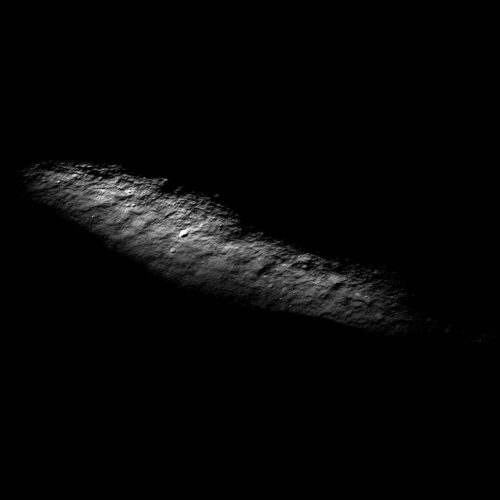
** High spots at the Moon’s lunar poles get extra sunlight. Unlike the Earth, the Moon has very little tilt with respect to the plane of the orbit of the Earth-Moon system around the Sun. This results in low elevation areas in the lunar polar regions receiving little or no sunlight over the course of a year and high places getting lots of sunlight for much of the year. While there are in fact no lunar peaks of eternal light, there are several areas that are in sunshine for over 80% of the year.
Bob Zimmerman points to a report from the Lunar Reconnaissance Orbiter (LRO) about an image taken by the orbiter of the “Rim of Aepinus crater rising above a sea of dark during a winter night”: Dawn at the Moon’s North Pole | Behind The Black
The [Aepinus] crater itself sits between Hermite and Peary craters, both of which have shown evidence suggesting the presence of water ice in their permanently shadowed regions.
Thus, this rim on Aepinus Crater is prime real estate on the Moon. It will have extended periods of light, even during the lunar night, providing access to solar power energy. And it is likely close to those permanently shadowed crater floors, where ice is suspected to exist.
It is now dawn there. It is also one of the places where the dawn of the human settlement of the solar system will begin. Who will be first to land and take possession of this territory?
** China’s Chang’e-4 lander and Yutu-2 rover continue to survive the 2 week long lunar nights and then resume studies of the Moon’s far side during the 2 week long lunar day.
- China’s Chang’e-4 probe survives 500 Earth days on Moon’s far side – Xinhua
- China’s lunar rover travels about 448 meters on moon’s far side – Xinhua
** US Geological Survey releases hi-res map showing the Moon’s geology:
Have you ever wondered what kind of rocks make up those bright and dark splotches on the moon? Well, the USGS has just released a new authoritative map to help explain the 4.5-billion-year-old history of our nearest neighbor in space.
For the first time, the entire lunar surface has been completely mapped and uniformly classified by scientists from the USGS Astrogeology Science Center, in collaboration with NASA and the Lunar Planetary Institute.
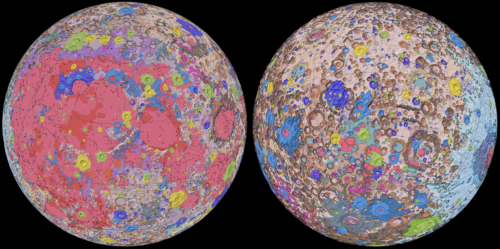
The lunar map, called the “Unified Geologic Map of the Moon,” will serve as the definitive blueprint of the moon’s surface geology for future human missions and will be invaluable for the international scientific community, educators and the public-at-large. The digital map is available online now and shows the moon’s geology in incredible detail (1:5,000,000 scale).
“People have always been fascinated by the moon and when we might return,” said current USGS Director and former NASA astronaut Jim Reilly. “So, it’s wonderful to see USGS create a resource that can help NASA with their planning for future missions.”
- USGS Releases First-Ever Comprehensive Geologic Map of the Moon – USGS
- The first complete geologic map of Moon | Behind The Black
** Asteroids and Comets
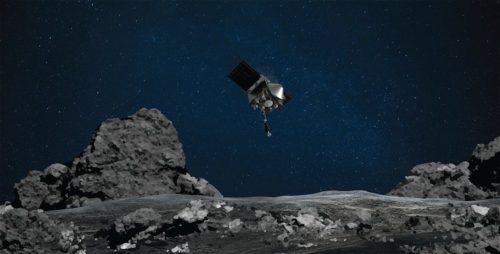
**** The OSIRIS-REx Mission has selected a spot to grab a sample of the Bennu asteroid. NASA’s OSIRIS-REx Ready for Touchdown on Asteroid Bennu – OSIRIS-REx Mission
NASA’s first asteroid sample return mission is officially prepared for its long-awaited touchdown on asteroid Bennu’s surface. The Origins, Spectral Interpretation, Resource Identification and Security – Regolith Explorer (OSIRIS-REx) mission has targeted Oct. 20 for its first sample collection attempt.
“The OSIRIS-REx mission has been demonstrating the very essence of exploration by persevering through unexpected challenges,” said Thomas Zurbuchen, NASA’s associate administrator for science. “That spirit has led them to the cusp of the prize we all are waiting for – securing a sample of an asteroid to bring home to Earth, and I’m very excited to follow them through the home stretch.”
From discovering Bennu’s surprisingly rugged and active surface, to entering the closest-ever orbit around a planetary body, OSIRIS-REx has overcome several challenges since arriving at the asteroid in December 2018. Last month, the mission brought the spacecraft 213 ft (65 m) from the asteroid’s surface during its first sample collection rehearsal — successfully completing a practice run of the activities leading up to the sampling event.
Now that the mission is ready to collect a sample, the team is facing a different kind of challenge here on Earth. In response to COVID-19 constraints and after the intense preparation for the first rehearsal, the OSIRIS-REx mission has decided to provide its team with additional preparation time for both the final rehearsal and the sample collection event. Spacecraft activities require significant lead time for the development and testing of operations, and given the current requirements that limit in-person participation at the mission support area, the mission would benefit from giving the team additional time to complete these preparations in the new environment. As a result, both the second rehearsal and first sample collection attempt will have two extra months for planning.
** It was hoped Comet ATLAS might become visible to the naked eye but instead it broke up into dozens of smaller pieces in April: Hubble Captures Breakup of Comet ATLAS | ESA/Hubble
The NASA/ESA Hubble Space Telescope has provided astronomers with the sharpest view yet of the breakup of Comet C/2019 Y4 (ATLAS). The telescope resolved roughly 30 fragments of the fragile comet on 20 April and 25 pieces on 23 April.
The comet was first discovered in December 2019 by the ATLAS (Asteroid Terrestrial-impact Last Alert System) robotic astronomical survey system in Hawaiʻi, USA. It brightened quickly until mid-March, and some astronomers initially anticipated that it might be visible to the naked eye in May to become one of the most spectacular comets seen in the last two decades. However, the comet abruptly began to get dimmer, leading astronomers to speculate that the icy core may be fragmenting, or even disintegrating. ATLAS’s fragmentation was confirmed by amateur astronomer Jose de Queiroz, who photographed around three pieces of the comet on 11 April.
The Hubble Space Telescope’s new observations of the comet’s breakup on 20 and 23 April reveal that the broken fragments are all enveloped in a sunlight-swept tail of cometary dust. These images provide further evidence that comet fragmentation is probably common and might even be the dominant mechanism by which the solid, icy nuclei of comets die.
A comparison of the Hubble images:
This animation dissolves between the Hubble Space Telescope’s observations of Comet C/2019 Y4 (ATLAS) on 20 and 23 April. The NASA/ESA Hubble Space Telescope has provided astronomers with the sharpest view yet of the breakup of Comet C/2019 Y4 (ATLAS). The telescope resolved roughly 30 fragments of the comet on 20 April and 25 pieces on 23 April. The comet was first discovered in December 2019 by the ATLAS (Asteroid Terrestrial-impact Last Alert System) and its fragmentation was confirmed in April 2020. Credit: NASA, ESA, D. Jewitt (UCLA), Q. Ye (University of Maryland)
SETI
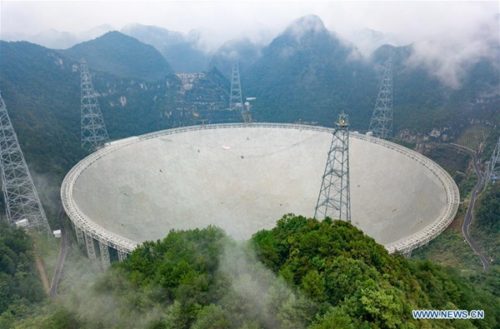
** China’s big new radio telescope gives it a chance to be first to detect ET. The dish could be used for sending signals to ET as well. Ready, SETI, go: Is there a race to contact E.T.? – Space.com
Researchers using China’s new Five-hundred-meter Aperture Spherical radio Telescope (FAST), the largest single-dish scope in the world, are piecing together a technological strategy to carry out a major and sweeping search for extraterrestrial intelligence (SETI).
What if China someday announces that this hunt has been successful? How would such a claim be verified, and what might the consequences be? And could an unofficial international SETI race already be underway?
=== Amazon Ad ===
The Demon in the Machine:
How Hidden Webs of Information Are Solving the Mystery of Life