Space policy roundup – June.29.2020

A sampling of links to recent space policy, politics, and government (US and international) related space news and resource items that I found of interest (find previous space policy roundups here):

International space

Webcasts:

** Episode 19 – What’s Hot! 2nd Quarter 2020 – Space Thoughts – Michael Listner, space lawyer, publishes The Précis space law and policy journal.

** Webinar Replay | Mars Exploration: Blueprint for the Red Planet – SpaceNews.com

Author and award-winning space journalist Leonard David and SpaceNews Senior Staff Writer Jeff Foust talk with the director of NASA’s Mars Exploration Program and the project scientist for the soon-to-launch Mars 2020 Perseverance rover mission about the status of the mission, next steps in robotic exploration, and how it leads to sending humans to Mars.

    • Jim Watzin, Director – Mars Exploration Program, NASA HQ
    • Ken Farley, Project Scientist, Mars 2020 Perseverance rover,  Jet Propulsion Laboratory
    • Richard (Rick) Davis, Jr.,  Assistant Director for Science and Exploration, NASA HQ

** MSBN S01E20 – Marek Ziebart and Why OneWeb Is A Bad Global Navigation System Investment for the UK – Cold Star Technologies

Dr. Marek Ziebart, Professor of Space Geodesy at University College London, is on the Make Space Boring show to share his views about why the proposed UK government investment in failing satellite constellation provider OneWeb is a bad idea. He dissects why investing to turn this constellation into a global navigation system is fraught with problems and could become a money pit.

** Space Café WebTalk Recap: Jessy Kate Schingler on Lunar Policy – SpaceWatch.Global

In this week’s Space Cafe Web Talk, Jessy Kate Schingler, Director of Policy and Governance for the Open Lunar Foundation, and a founding convener of the Moon Dialogs shared some food for thoughts on lunar policy and future governance models.

Jessy Kate Schingler talked about the rise of lunar policy, where the Moon, its topography, and cislunar space intersects with nascent private and state activity over the next 5-10 years. She focussed in particular on participation:

** The Space Show – June.28.2020 – David Livingston hosted an open lines program in which were discussed many different topics with multiple callers.

** The Space Show – Fri. June26.2020 – Jim Lewis first gave “an update on the business and economy of the Space Coast of Florida”. He then talked about his
“new Amazon Prime sci fy TV series” and about “film-making, science fiction and lots of related topics”.

** The Space Show – Tues. June.23.2020 – Dr. Jim Logan talked about “space policy, vision, lunar, China and more”.

** Chris Stott – Spectrum Filing Surprises In Satellite Manufacturing – Cold Star Project S02E45

Chairman & CEO of the ManSat group of companies Chris Stott is on the Cold Star Project, and our main topic is satellite spectrum. Where does the authorization for satellite communication frequencies come from, and how is it distributed? With host Jason Kanigan, Chris discusses: – the definition of “satellite spectrum” – how ManSat got the authority to distribute satellite spectrum, and from whom? Who is the target market, and what does the process of working with ManSat look like?

– what SpaceIsle.com is and how it is different from the ManSat corporate site
– experiences he has had as a member of the ISU Board of Directors
– projects he has worked on and produced as a “Multi Award winning Documentary Film Maker and Executive Producer”, per his LI profile
– what the Space & Satellite Professionals International organization is and what his involvement is
– how Chris helped develop Geeks Without Frontiers.

ManSat website: http://www.mansat.com/
SpaceIsle website:
https://www.spaceisle.com/
SSPI website:
https://www.sspi.org/
International Institute of Space Commerce website:
https://iisc.im/
Geeks Without Frontiers website:
http://geekswf.org/

** June 23, 2020 Zimmerman/Batchelor podcast | Behind The Black

** June 26, 2020 Zimmerman/Batchelor podcast | Behind The Black

==
=== Amazon Ad ===

2008-2018: A NewSpace Primer

Videos: “Space to Ground” ISS report – June.27.2020

Here is the latest episode in NASA’s Space to Ground weekly report on activities related to the International Space Station:

** NASA animations highlight the activities carried out during the two spacewalks this week by astronauts Chris Cassidy and Robert Behnken :

** The Most Dangerous EVA in US History – NASA Video

Chris Hansen, NASA EVA Office Manager, presents lessons learned from the EVA 23 incident that occurred on July 16, 2013 onboard the International Space Station. 44 minutes into the ISS EVA, Astronaut Luca Parmitano’s helmet began filling up with water. As the water level continued to rise it propagated around to the front of his face, which could have resulted in a fatal accident. What followed became the most dangerous EVA incident in US history. The mishap investigation identified many lessons learned that will be presented and can be used to make any hazardous operation safer.

** Expedition 63 InFlight with Late Late Show and NPR Morning Edition – June 24, 2020 – NASA Video

Aboard the International Space Station, Expedition 63 Flight Engineers Douglas Hurley and Robert Behnken discussed their historic mission on the SpaceX Crew Dragon spacecraft to the orbital laboratory during a pair of in-flight interviews June 24 with CBS’ “Late Late Show with James Corden” and NPR’s “Morning Edition.” Hurley and Behnken arrived on the complex May 31 after launching in Dragon Endeavour atop the SpaceX Falcon 9 rocket from the Kennedy Space Center, Florida – the first launch of American astronauts on an American rocket from American soil to the station since the retirement of the space shuttle in July 2011.

** Why The Docking Adapters On The Space Station Are Shaped Oddly –

There are many docking systems on the International Space Station, reflecting the fact that it’s the product of multiple space programs which combined their space station plans into the ISS. The history of the program has lead to some design choices which seem to be strange, until you look at them in the context of the whole program history. In particular, I often get asked about the pressurized mating adapters at the front of the space station and how the tunnel includes a bend rather than simply going straight through, and of course it’s all because of historical choices. Some further reading on the docking and berthing hardware used on the ISS https://ntrs.nasa.gov/archive/nasa/ca…

== Amazon Ads ==

LEGO Ideas International Space Station Building Kit,
Adult Set for Display,
Makes a Great Birthday Present
(864 Pieces)

===

Outpost in Orbit:
A Pictorial & Verbal History of the Space Station

Asteroid Day: June 30, 2020

The annual Asteroid Day returns again this Tuesday, June 30th: Asteroid Day LIVE 2020

Asteroid Day is held on 30 June each year to mark the date of Earth’s largest asteroid impact in recorded history, the Siberia Tunguska event. Asteroid Day was co-founded by astrophysicist and famed musician Dr Brian May of the rock group QUEEN, Apollo 9 astronaut Rusty Schweickart, filmmaker Grig Richters, and B612 Foundation President Danica Remy, to educate the public about the importance of asteroids in our history and the role they play in the solar system. In 2016, with the leadership of the Association of Space Explorers (ASE), the United Nations declared Asteroid Day to be a global day of education to raise awareness and promote knowledge in the general public about asteroids. Major events in past years have taken place in London, San Francisco, Washington, DC, Tanzania, Milan and Rimini, Italy; Garching, Germany; and Rio de Janeiro, Brazil; in addition to thousands of events worldwide.

Asteroid Day’s major partners include: Association of Space Explorers, B612 Foundation, Broadcasting Center Europe, EC GROUP, European Space Agency, Luxembourg Space Agency, OHB SE, and SES. Asteroid Day, Asteroid Day LIVE, Asteroid Day TV and SpaceConnectsUs are all programmes of Asteroid Foundation, a Luxembourg based non-profit.

The day’s Programme of presentations, interviews, and panel discussions will be hosted by Luxembourg and webcast at AsteroidDay on Twitch.TV.

This year, the event is a fully digital celebration of asteroid science and exploration. Panel discussions and one-on-one interviews with astronauts and world experts will be broadcast on 30 June 2020.

Each year Asteroid Day presents the public with a snap-shot of cutting-edge asteroid research from the largest telescopes on Earth to some of the most ambitious space missions. Topics of discussion this year include the acceleration in the rate of our asteroid discoveries and why it is set to accelerate even faster, the imminent arrival of samples from asteroid Ryugu and Bennu, the exciting preparations for the joint US-Europe mission to binary asteroid Didymos, and much more. 

Asteroids are the leftover remnants of the birth of the planets in the Solar System, and many are the shattered fragments of these diminutive proto-planets that never made it to maturity. “Asteroid exploration missions tell us about the birth of our own planet and reveal how asteroids can serve astronauts as stepping stones to Mars,” says Tom Jones, PhD, veteran astronaut and planetary scientist, and Asteroid Day Expert Panel member.

Each asteroid is an individual with its own story to tell. And that’s what Asteroid Day is all about: bringing those stories to the widest audience possible. “Space and science have been an endless source of inspiration for SES! This is one of the reasons why we and our partners continue to do extraordinary things in space to deliver amazing experiences everywhere on earth,” says Ruy Pinto, Chief Technology Officer at SES. “Through satellite broadcasting, we are able to reach millions of TV households and this enables us to unite people around science, space, and technology topics.”

“The valuable expertise of SES and BCE play a central role in making Asteroid Day an international success and enabling us to have a global conversation about space, space resources, and asteroids in these COVID-19 times.” says Mark Serres, the CEO of the Luxembourg Space Agency.

The panel discussions include:

A highlight of this year’s events will be the official premier of the documentary Apollo 9 & Beyond (at Vimeo.com), which profiles Apollo 9 astronaut Rusty Schweickart,  who has been a leader in efforts to deal with the threat of asteroid impacts on Earth:

In this profoundly beautiful and moving film, Apollo 9 Astronaut Rusty Schweickart discusses the Apollo 9 mission, his life-altering spacewalk, and our cosmic birth. Rusty describes testing the Lunar Module, the first true spaceship that would four month later land men on the moon, his historic spacewalk, the first EVA of the Apollo era, and the incredible beauty of the Earth from space.

Beyond the Apollo 9 mission itself, Rusty goes much deeper to explore the philosophical and evolutionary implications of humanity’s first steps into the cosmos, describing the powerful effects of his “five minutes” alone on the Lunar Module porch as he observed the Earth below and pondered the big questions of existence – questions he would come to answer back on Earth.

More at  Apollo 9 and Beyond Film – Rusty Schweickart – Asteroid Day.

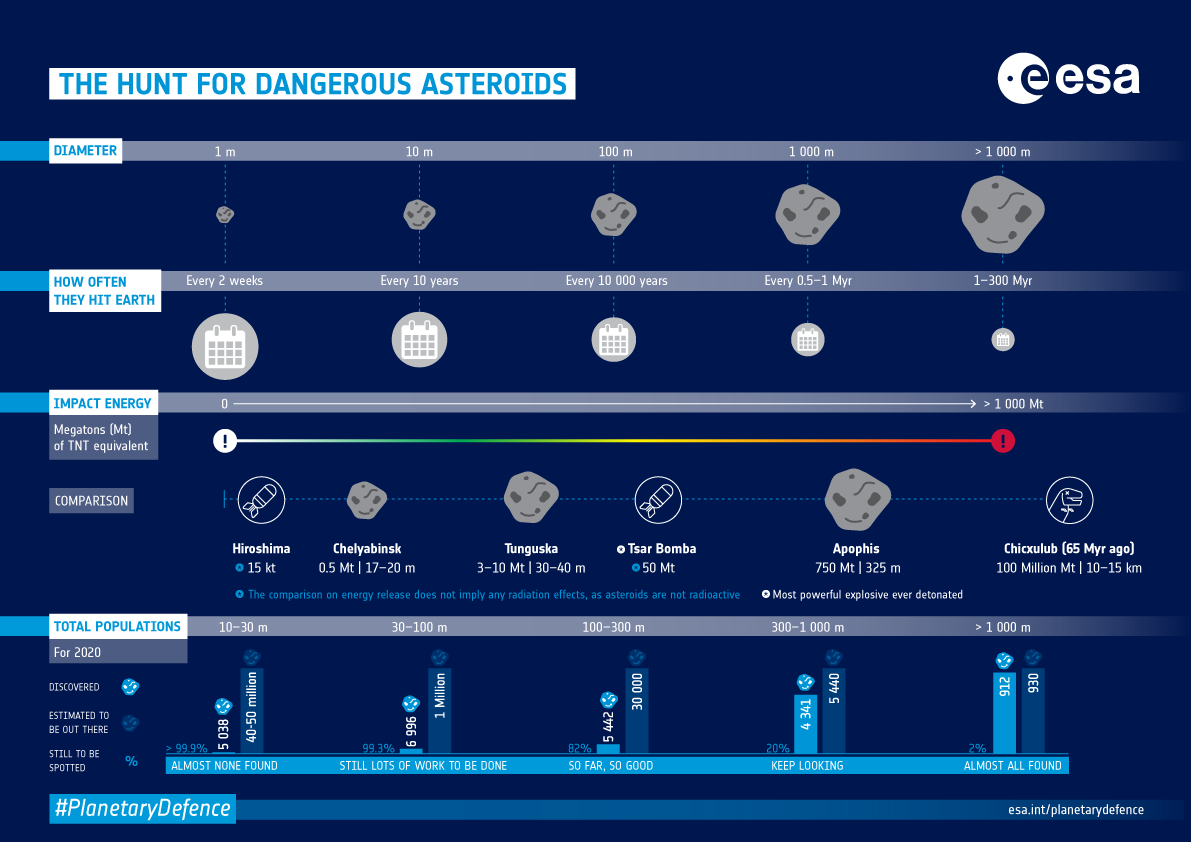
Here is an infographic illustrating the rate of impacts on earth versus the size of the asteroids: Asteroid danger explained – ESA

Chart showing impact rate vs asteroid size. (Click for full size.) Credits: ESA

=== Amazon Ad ===

Fire in the Sky:
Cosmic Collisions, Killer Asteroids, and
the Race to Defend Earth


Student and amateur CubeSat news roundup – Jan.26.2020

A sampling of recent articles, press releases, etc. related to student and amateur CubeSat / SmallSat projects and programs (find previous smallsat roundups here):

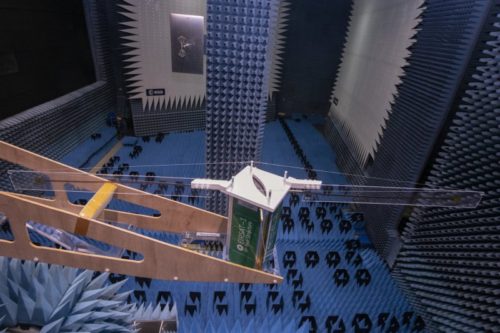
** Ireland’s student built EIRSAT-1 Cubesat undergoing antenna tests: The image below shows Ireland’s first official satellite, EIRSAT-1, a 2U CubeSat, in preparation for testing in ESA’s Hertz antenna test chamber: Testing for Ireland’s first satellite – ESA ESTEC

Educational Irish Research Satellite 1, or EIRSAT-1 for short, is being built by students and staff of University College Dublin, who are participating in ESA Education’s Fly Your Satellite! programme.

At just 22 by 10 by 10 cm, the miniature EIRSAT-1 is smaller than a shoebox but is still equivalent in complexity to a standard space mission.

Normally the EIRSAT-1 student team would have joined the test campaign in person, but current Covid-19 restrictions made this impossible. Instead the team delivered their self-made Antenna Deployment Module (ADM) plus a mock-up of the satellite body, along with detailed test preparation procedures.

“Ireland’s first space mission, EIRSAT-1, seen taking place at ESA’s Hertz antenna test chamber”. Credits: ESA

See earlier item here and also this article from 2018: Ireland’s First Ever Satellite Moves One Step Closer to Launch into Space: EIRSAT-1 designed by a team of University College Dublin students – NovaUCD.

** ** Embry-Riddle student group builds CubeSat Hermes-1. The Embry-Riddle Future Space Explorers and Developers Society (RFSEDS) has several projects underway including Hermes-1, which they plan to launch in 2021:

Project Hermes is a 1U cubesat development project and is ERFSEDS first satellite effort. Our team is in the design development phase and is planning to launch the project within the next two years. Hermes is communications based satellite that will be used to communicate with the Hermes ground team.

Building their own ground station for communications, the Hermes ground team is certified with HAM Radio Technician liscenses.

** Interview with a 16 year old CubeSat experimenter: Cubesat Experiments With Julie Sage, a Gen Z Aspiring Astrophysicist – Via Satellite

Julie Sage is an aspiring astrophysicist, science communicator, and the host of SuperNova Style Science News. At just 16-years-old, she’s been doing some real science with running a variety of different experiments on cubesats, including material testing.

** AMSAT news on student and amateur CubeSat/smallsat projects: ANS-173 AMSAT News Service Special Bulletin

  • AMSAT Announces Candidates for 2020 Board of Directors Election
  • AMSAT Announces GridMaster Award
  • CAS-6 Online
  • Amicalsat – Aurora Pictures
  • Raspberry Pi FUNcube Satellite Telemetry Decoder Now Available
  • ORI Announces ARRL Foundation Grant Award
  • ORI Announces YASME Foundation Grant Award
  • 38th Annual AMSAT Space Symposium and Annual General Meeting Moving to Virtual Event
  • Upcoming Satellite Operations
  • ARISS News
  • Hamfests, Conventions, Maker Faires, and Other Events
  • Satellite Shorts From All Over

See also

  • 6th anniversary of NANOSATC-BR1 | Southgate Amateur Radio News
    “Friday, 19-06-2020, completes six years since we successfully launched the NANOSATC-BR1, CubeSat 1U, which was launched on June 19, 2014, from Yasny Base, in Russia. The first Brazilian Scientific Nanosatellite remains in operation, sending telemetry to the Earth Stations of the NanosatC-BR Program, Cubesats Development and Amateur Radio Support Stations.“

General CubeSat/SmallSat info:

**  [WEBINAR] Cubesats Made Easy: Streamlining Integration & Collaboration for Australian Space Missions – Australian Centre for Space Engineering Research Engineering

In this webinar, we will be focusing on the questions that must’ve crossed every developer’s mind, i.e. “Someone else must’ve have this problem too! How did they solve it?” Sometimes, it’s about the lack of time and manpower, sometimes it’s about the problem’s complexity. With our panellists, we will explore these problems and current (and potentially future) solutions, and how collaboration may help especially in the Australian context. This webinar will cater to both newcomers, where we streamline up-to-date resources, and to the experienced, where we can share ideas on how to make things better. These include:

1. A survey on Australian small satellite developers
2. Existing standards, available resources, and what are the current shortfalls?
3. Interfacing subsystems – hardware and software issues
4. Space Communications – RF issues and how cloud solutions may help
5. Building a Cubesat developer’s community – open source approaches?

** Tracking CubeSats with a Telescope – Bruce Van Deventer

CubeSats are miniature satellites typically deployed into low earth orbit. A standard 1U CubeSat is a cube ten centimeters on a side. Here, I tracked three different CubeSats on the night of 6/17 at our dark site observatory. Tracking is performed blind, meaning there is no optical assist to help the telescope point to the target. These videos are shot using a Celestron RASA 11 telescope and the ZWO ASI 6200 mono camera, operated in 8 bit video mode, quarter frame size, 100ms exposure. That video is further cropped here to make it easier to find the satellite.

=== Amazon Ad ===

Introduction to CubeSat Technology and Subsystem:
Orbit Design, Debris Impact, and Orbital Decay Prediction


Space transport roundup – June.24.2020

A sampling of recent articles, videos, and images dealing with space transport (find previous roundups here):

** SpaceX SN5 prototype Starship was moved to the launchpad from the assembly area this morning at Boca Chica Beach. Initial pressure testing is expected to start next Monday. This would be followed by at least one static firing of the engine(s). If those tests go well, then a low altitude hop would be the next step.

** SpaceX Starship test article SN7 was pressure tested to destruction on Tuesday. The tank had previously popped a leak on June 16th during its initial tests. Elon Musk indicated in Tweets then that the test reached a satisfactory 7.6 Bars of pressure before leaking rather than bursting. After repairs were made, the cryogenic pressure tests were resumed today with the intention of raising the pressure until the tank ruptured. No word yet from Elon on what pressure level was reached before the tank failed.  Here is a video of the event, which was much more dramatic than the earlier one:

Another view:

Find more about DM-2 and other SpaceX activities below

** China launched a Beidou navigation satellite on Long March 3B rocket this week. This completes the constellation for the  BeiDou Navigation Satellite System (BDS). The launch took place from the inland Xichang space center in southwestern China. Images later surfaced showing the smoking remains of the booster near a lake. For decades China has sent such boosters into populated areas despite the fact that the rockets use very toxic propellants.

** Arianespace Vega to  launch 53 smallsats. The launch on the initial target date of June 20 was canceled due to upper level winds. No new date has been announced as of June 23rd. This will be the first launch of a Vega rocket since a launch failed for the first time on July 11, 2019after fourteen successful flights. This is also the first of the Vega’s Small Spacecraft Mission Service (SSMS) missions. The smallsats come from 21 different customers. A list of the spacecraft can be found in the Launch Toolkit (pdf).

** United Launch Alliance (ULA) carried out a wet dress rehearsal for the Atlas V launch of the Perseverance Mars mission.  The launch is currently set for July 20th. A wet dress rehearsal means the rocket was loaded with propellants and the steps in a launch were followed up to the moment when it would lift off the pad. There was no firing of the engine as happens with a SpaceX Falcon 9 pre-launch static test.

Wet Dress Rehearsal: Atlas V Mars 2020

** Skyrora launches low altitude sounding rocket: Hattrick for rocket company after first ever launch from Shetland soil | Skyrora

Edinburgh-based Skyrora successfully launched its Skylark Nano rocket from remote land, the Fethaland Peninsula at North Roe on the Scottish island on Saturday, the 13th of June.

Skyrora plans to launch from one of the three proposed spaceports in Scotland and commercially launching from Shetland in the future is a potential option for them.

Reaching an altitude of six kilometers, this marked the third time the 2 meter (6.5ft) projectile took to the skies. The launch was completed for educational purposes, collecting meteorological data, measuring wind profiles, analysing the vehicles trajectory and providing critical training in support of Skyrora’s future plans.

Skyrora invited local journalists to attend the launch and to be apart of the education and learning process. All social distancing measures were met during the launch days.

Robin Hague, Head of Launch said: “The launch signifies a vital step towards Skyrora’s ambitions to become the UK’s “go-to” satellite launch provider. We’re ecstatic and truly proud. This is a great success for Skylark Nano, and the Skyrora team in general. Launching from Shetland is very important for us because it’s a potential option for our Skyrora XL orbital commercial launch vehicle. To understand the local launch conditions learning more about the wind profiles in Shetland is critical.

“Skylark Nano’s third successive launch is testament to the engineers who have worked tirelessly to bring to life a reusable rocket that can provide valuable intelligence for the future of the UK space programme.”

It comes after Skyrora successfully completed a full static fire test on their Skylark-L launch vehicle.

Volodymyr Levykin, CEO, said: “With this successful launch from Shetland we are further closing the gap to making the UK a rocket launching nation again.

** Update on Relativity Space and the company’s large scale metal 3D printing technology: Relativity Space may be printing the future of more than just rocketry – SpaceQ

Yes, Relativity’s inexpensive launch capabilities are attracting clients. While Noone was not at liberty to discuss all of their potential clients, he did mention that Canada’s own Telesat is betting on Relativity Space to launch a portion of their LEO broadband satellite constellation. Relativity had made that announcement public in April of 2019 with Telesat’s approval.

As Noone pointed out, though, it’s much bigger than that. Nobody has ever had the resources or opportunity to learn this much about additive manufacturing. “Manufacturing as software” means that creating a single part or product is as economical as a million-part run; even creating new parts only waits on Relativity’s engineers and Stargate AI’s to sort out the optimal way to produce them. Iteration becomes as fast for hardware as it is for software. While Noone didn’t get into details, this could change manufacturing in ways that go far beyond rockets.

It’s also incredibly scalable. While only one Stargate [a very large 3D printer used to build the company’s rockets] currently exists, any new Stargate will be as capable as the first. A Stargate in their Mississippi facility has the same capabilities as the one in Los Angeles; and any future Stargates in any future factories would as well. A Stargate (with accompanying small printers) in Jakarta would be as capable as the one in Los Angeles. Terran rockets, with Aeon engines, could be built and launched almost anywhere.

** And Relativity gets a contract for future launches of Iridium replacement satellites : Iridium Selects Relativity Space as On-Demand Single Satellite Launch Partner — Relativity Space

Relativity Space today announced that Iridium Communications Inc. (NASDAQ: IRDM) has signed a launch contract to deliver satellites to orbit. The contract includes flexible timing for up to six dedicated launches to deploy Iridium’s ground spare satellites to Low Earth Orbit (LEO). The launches will take place on an as-needed basis, determined by Iridium and utilizing Relativity’s Terran 1, the world’s first 3D printed launch vehicle. Launches are planned for no earlier than 2023.

See also:

** Rocket Lab to launch NASA probe to the Moon in 2021: How Rocket Lab plans to pull off its first mission to the Moon next year – The Verge

Rocket Lab is known for launching tiny satellites into Earth orbit, but the company has big plans to venture deeper into space, with its first mission to the Moon set for next year. Thanks to a contract with NASA, Rocket Lab will send a small spacecraft called CAPSTONE into orbit around the Moon to test out how to navigate in lunar orbit and help human missions to the Moon in the future.

It’ll be the most ambitious mission yet for Rocket Lab, which just launched its workhorse Electron rocket on its 12th flight this weekend. In total, the company has put up to 53 spacecraft into space, and so far, all of the those launches have sent satellites into low Earth orbit. But the company has been eyeing ways to push the envelope. “From day one that I came to Rocket Lab, it’s been an interest to stretch the legs of Electron and keep pushing to see what we can do,” Amanda Stiles, the Moon program manager for Rocket Lab who used to be the director for Google Lunar X Prize, tells The Verge. “And I know from the very highest levels of the company, there’s always been a big interest in going to the Moon.”

This mission will rely on a key piece of hardware that Rocket Lab has been using for the last few years: its Photon spacecraft. The cylindrical vehicle sits on the top of Rocket Lab’s Electron rocket, propelling customers’ hardware into low Earth orbit. It can also serve as a customizable satellite that can carry various payloads and instruments into space. “For most people’s purposes, they’re looking at low Earth orbit, but it’s also flexible where we can upgrade it and use it as a platform for these more advanced missions,” says Stiles. “So, this is the first advanced version of a Photon for that purpose.”

Meanwhile, Rocket Lab wins two NRO launches: Rocket Lab wins NRO contracts for back-to-back launches – SpaceNews.com.

Here is an interview with Peter Beck, CEO of Rocket Lab: Perspectives Video Interview with Peter Beck, Chief Executive, Rocket Lab – Satellite News

The next Electron launch is targeted for July 3rd: Rocket Lab to Demonstrate Fastest Launch Turnaround to Date | Rocket Lab

The mission, ‘Pics Or It Didn’t Happen,’ is scheduled to launch from Rocket Lab Launch Complex 1 Pad A on New Zealand’s Māhia Peninsula no earlier than 3 July, 2020 UTC— just days after the successful launch of Rocket Lab’s most recent mission, ‘Don’t Stop Me Now,’ on 13 June, 2020 UTC. The back-to-back missions will represent Rocket Lab’s fastest turnaround between missions to date.

‘Pics Or It Didn’t Happen’ will deploy seven small satellites to a 500km circular low Earth orbit for a range of customers, including Spaceflight Inc.’s customer Canon Electronics, as well as Planet and In-Space Missions.

** An interview with Simon Gwozdz, CEO and Founder of Equatorial Space Systems in Singapore. Space Café Podcast Episode 005 Featuring Simon Gwozdz Is Now Available – SpaceWatch.Global

** Briefs:

==================

Check out the
The Lurio Report
for news and analysis of key developments in NewSpace

The latest issue:
Riding a Dragon, Rockets Rising, Space Resource Policy
Vol. 15, No. 4, June 14, 2020

Space Frontier Foundation Award for NewSpace Journalism

==================

** SpaceX:

**** A SpaceX Falcon 9 launch of another batch of Starlink satellites along with two Blacksky earth imaging satellites is set to lift off on Thursday, June 25th at 4:39 pm EDT (2039 GMT).  A static test firing on the pad is planned for today.

**** SpaceX attracting strong customer response to rideshare opportunities on the Starlink launches:

**** Tom Mueller, former chief of SpaceX propulsion development, gave an on-line presentation and extended Q&A with the Launch Canada student/amateur rocketry group last Friday. His main emphasis was on his experiences with home built liquid-fueled rockets but he occasionally made a SpaceX related remark. See the Highlights entry in the comments there for an overview of topics discussed.

Tom gave this video conference yesterday to Canadian student rocketeers. The first hour focuses on his successes and failures in amateur rocketry and his early career, as well as future goals now that he took a back seat with SpaceX. In the second part, he answers various questions from the audience on rocketry, SpaceX, his personal life, and more.

** More rocket and spaceship projects discarded by SpaceX – Scott Manley

In its 18 year history SpaceX has developed a lot of concepts on paper which never made it to flight, or, were never made to work. Either way the company has a rich history of projects that seemed like a good idea at the time but fell out of favour due to difficulties with engineering, a dearth of time, or a lack of a customer wanting to pay the cost.

**** Starship

****** Boca Chica Beach kept rock’in for the past week. The Starship prototypes SN5 and SN6 were both fully stacked except for the nosecone sections. The SN7 test article under went repairs and then was pushed to its breaking point in a final pressure test (see video at the top of this blog item).

Multiple construction projects are also underway, including what may be a pad for SuperHeavy Booster tests.

A new launch stand was being readied for the SN5 prototype, which reached the launch site today (see item at top).

Fingers crossed that SN5 will not explode, implode, or destroyed by ground support equipment detonations and actually do a low altitude flight.

****** Elon Musk comments on offshore launch/landing platforms for Starship/Super Heavy operations:

See also Elon Musk names Hobart boat builder Incat as potential rocket pad supplier – ABC News

****** Videos of Boca Chica activities over the past week:

****** June 18: SpaceX Boca Chica – Starship SN5 & SN6 have a get together in the high bay – NASASpaceflight – YouTube

Starship SN5 and Starship SN6 were spotted together in the high bay. Meanwhile, SpaceX teams continue to prepare the launch site ahead of the resumption of full-scale Starship testing. Video and Pictures from Mary (@bocachicagal). Edited by Jack Beyer (@thejackbeyer).

****** June 19: SpaceX Boca Chica – Starship SN7 Repaired & Superheavy Launch Pad Construction – NASASpaceflight – YouTube

Starship SN7 is repaired and upgraded while the Superheavy Launch Pad undergoes further construction including pouring multiple new foundations. Cory’s Taco Dome makes a reappearance as well as some other unknown ring stacks. Video and Pictures from Mary (@bocachicagal). Edited by Jack Beyer (@thejackbeyer).

****** June 19:  SpaceX Boca Chica – Starships, Test Tanks, Big Cranes and Thrust Pucks – NASASpaceflight – YouTube

With Test Tank SN7 at the launch site, Starship SN5 and SN6 in the High Bay, a huge crane is being assembled and a new Thrust Puck was being transported during Friday. Video and Pictures from Mary (@bocachicagal). Edited by Jack Beyer (@thejackbeyer).

****** June 21:  SpaceX Boca Chica – Super Heavy Pad Construction & SN7 Test Prep – NASASpaceflight – YouTube

SpaceX teams continued to lay the foundations for the Super Heavy orbital launch pad in Boca Chica. Meanwhile, SN7 was getting ready for another round of testing and a large crane is on-site to assemble the new high bay. Video and Pictures from Mary (@bocachicagal). Edited by Jack Beyer (@thejackbeyer).

****** June 22: SpaceX Boca Chica – Super Heavy Pad Work and Flare Stack Returns – NASASpaceflight – YouTube

With SN7 preparing for testing on Tuesday, and the return of the Flare Stack – work at next door’s Super Heavy launch pad involved the installation of huge columns of rebar. Video and Pictures from Mary (@bocachicagal). Edited by Jack Beyer (@thejackbeyer).

** Webcast rocket reports:

*** SpaceX Starship News, Starship/Super Heavy offshore Spaceport and Starlink Beta Testing coming soon – Marcus House

**** SpaceX Starship Updates – Chinas Next-Gen Crew Capsule & Long March 5B Rocket Explained – What about it!?

=====

=== Space Art from C. Sergent Lindsey ===

Sweatshirt imprinted with “SpaceX Delivers the Goods” by C Sergent Lindsey.

Everyone can participate in space