Space tourism roundup – July.29.2020

A sampling of recent articles, videos, and images related to commercial human space travel (see also previous space tourism related posts):

** Survey of announced orbital spaceflights involving private individuals:

From Dennis Tito in 2001 to Guy Laliberté in 2009  there were seven private citizens who flew on Soyuz spacecraft to the ISS and spent several days there. (Charles Simonyi flew twice.) These flights were arranged by Space Adventures. The flights stopped with the retirement of the Shuttle because spare seats on the Soyuz were needed by NASA astronauts to reach the Station. With the debut flight of the SpaceX Crew Dragon, private individuals will again be heading to  orbit either in a Dragon or a Soyuz, which has seats available once again.

** Suborbital space tourism awaits final tests of Virgin Galactic SpaceShipTwo and Blue Origin New Shepard. Notes on the two leading suborbital human space flight programs:

  • VG SS2:
    • See the item below on the unveiling on July 28th of the SpaceShipTwo interior design.
    • Some details about the plan to reach commercial service were unveiled to BBC by George Whitesides, “Chief Space Officer”: Virgin Galactic set for last key rocket test flights – BBC News
      • “Our next flight will be just purely two pilots in the front to do a systems check,” he told BBC News.“And then, once we’ve done that – well, we’re in pretty exciting territory because the plan is to start putting [four of our] people in the back. We haven’t shared exactly how many flights that will be because we’ve got to see how it goes. But it could be a fairly small number.”Commercial service would begin thereafter.
    • Reportedly about 600 people currently have tickets for SS2 flights, which take six spaceflight participants and two pilots to about 80-90 km in altitude. This is below the Kármán line  of 100 km, but is sufficient to meet the USAF criteria for spaceflight.
    • After a lengthy pause, the company resumed taking reservations with $1000 deposits. See announcement below.
    • Following the relocation of flight operations from Mojave to Spaceport America in New Mexico, the company carried out two drop-glide tests of the SS2 Unity. Powered test flights should resume soon.
    • The company is now publicly traded and so is under an even more intense public spotlight than it was previously. While safety will obviously be a top priority, they will be under stockholder pressure to start flying paying customers as soon as possible.
    • With the help of NASA, VG will develop a training program for private astronauts planning to visit the ISS: Virgin Galactic Signs Space Act Agreement with NASA for Private Orbital Spaceflight to the International Space Station (ISS) – Virgin Galactic
  • Blue NS:
    • Blue is still not taking reservations for flights on the New Shepard. Management has hinted that the prices will be in the same ball park as other companies, i.e. VG. So in the $250k range.
    • The test flights so far have had no one on board. There had been indications that flights with company personnel would start by the end of the year following two or three more uncrewed flights. However, this is looking increasingly unlikely.
    • The company has never explained why their flight rate is so low. The vehicle is fully reusable and appears to have performed well so far. Yet there are usually several months between flights. There has been no flight since Dec. 11, 2019.
    • There apparently was going to be a flight in late spring but some employees balked at working during the Covad-19 crisis and the flight was canceled.

** NASA may buy seats on commercial suborbital vehicles for astronauts. The agency has “has initiated a new effort to enable NASA personnel to fly on future commercial suborbital spaceflights”: NASA Developing a Plan to Fly Personnel on Suborbital Spacecraft | NASA.

Commercial suborbital spaceflight capabilities are anticipated to be more accessible, affordable, and available than missions to the International Space Station and could provide NASA additional commercial human spaceflights to conduct such activities as testing and qualification of spaceflight hardware, human-tended microgravity research, and additional training opportunities for astronauts and other NASA personnel. The agency has developed an intensive, comprehensive training program for astronauts and astronaut candidates, and suborbital crew space transportation services could provide even more training opportunities for NASA astronauts, engineers, scientists, operators, and trainers.

This could provide an additional revenue source for Virgin Galactic and Blue Origin and supplement their suborbital tourism businesses. However, if NASA requires an elaborate certification process as the agency did for the SpaceX Dragon and Boeing Starliner, it could be many years before any NASA astronaut steps into a SS2 or New Shepard for a ride to suborbital space. ASAP To Keep Eye on NASA’s Safety Review of Commercial Suborbital Flights – SpacePolicyOnline.com.

** Virgin Galactic shows off the interior of the SpaceShipTwo: Virgin Galactic Reveals SpaceshipTwo Cabin Interior – Virgin Galactic

One of the defining hallmarks of the Virgin brand over 50 years, has been the use of inspired and bold design to transform the customer experience. It’s an ethos that has been successfully applied across industrial sectors and design disciplines: from aircraft cabins and hotel bedrooms to fitness classes and personal banking.

Virgin Galactic, in collaboration with London design agency, Seymourpowell, has striven to remain faithful to that tradition by developing an elegant but progressive, experience-focused concept for the cabin of its spaceship. While it has been created to integrate seamlessly with every other aspect of the Virgin Galactic astronaut journey – the cabin is also the design centrepiece; providing safety without distraction, quietly absorbing periods of sensory intensity and offering each astronaut a level of intimacy required for personal discovery and transformation.

Virgin Galactic SpaceshipTwo seats rotated back for launch and reentry configuration. Credits: VG

Here’s the unveiling event:

** Virgin Galactic restarts spaceflight participant reservation registrations: Virgin Galactic Invites Aspiring Astronauts to Take “One Small Step” as Company Experiences Rocketing Global Demand – Virgin Galactic

Virgin Galactic announced today that in preparation for the re-opening of spaceflight sales, it is introducing the One Small Step initiative. The company formally closed its doors to new ticket sales after its history-making first space flight in December 2018.

In addition to more than 600 firm reservations it has already taken from Future Astronaut customers from 60 countries, Virgin Galactic has received a consistently high level of interest from aspiring astronauts. This has resulted in 7957 online reservation registrations in the fourteen months since the first spaceflight and more than double the number the Company last reported in September 2019.

In light of continuing, strong progress towards commercial service, Virgin Galactic is now preparing to release its next tranche of seats for sale to the general public. In the first phase of that process, the Company will be launching its new One Small Step qualification process on Wednesday, February 26th, allowing those who are serious about flying to space, to register now and be front of line for firm seat reservations, once they become available.

To take One Small Step, future flyers will pay a fully refundable deposit of US$1,000 in a simple online registration process at www.virgingalactic.com/smallstep/

**  Virgin Galactic gets new leadership: Virgin Galactic Announces Michael Colglazier as Chief Executive Officer in Preparation for Commercial Service – Virgin Galactic

[July 15, 2020] Virgin Galactic Holdings, Inc. (NYSE: SPCE) (“Virgin Galactic”), a vertically integrated aerospace and space travel company, today announced the appointments of Michael Colglazier as Virgin Galactic’s new Chief Executive Officer and George Whitesides as Chief Space Officer, effective July 20, 2020.

Michael assumes the CEO role at an exciting time for Virgin Galactic as the Company progresses through its test flight program and prepares for commercial service. He will also join the Company’s Board of Directors effective July 20, 2020. Michael joins Virgin Galactic following a long and successful career at The Walt Disney Company (NYSE: DIS), bringing over three decades of experience in developing and growing consumer-oriented multi-billion dollar businesses strategically, commercially, and operationally. Most recently Michael was President and Managing Director, Disney Parks International, where he was responsible for operations, strategy, and commercial and experiential development of Disney’s international parks and resorts.

George will assume the role of Chief Space Officer, focused on developing the Company’s future business opportunities, including point-to-point hypersonic travel and orbital space travel. George will also chair the Company’s Space Advisory Board, and in conjunction with his new role will step down from the Company’s Board of Directors. George joined Virgin Galactic in 2010 as its first CEO, after serving as Chief of Staff at NASA. During the past decade, he has built the Company from 30 people to a workforce of over 900 today, and he has successfully guided Virgin Galactic through its human space flight research and development program as well as the progress to date in its flight test program, culminating in two successful space flights. These historic flights saw the first humans launched into space from US soil since the retirement of the Space Shuttle, as well as the first woman to fly on a commercial space vehicle. During the last year, George led the transition of operations from Mojave, California to Spaceport America, New Mexico, and oversaw the Company’s successful public listing —creating the world’s first publicly traded human spaceflight venture.

See also

**  VG has released a number of videos about various aspects of the SS2 development and its applications. Here is one with Beth Moses talking about her flight:

Learn what it’s like to travel to space from Beth Moses, Virgin Galactic’s Chief Astronaut Trainer, in this special Spacechat for all young people currently studying at home! Beth was the world’s 571st human to look down at Earth from the black sky of space as she became Commercial Astronaut 007. Hear Beth talk about her spaceflight, including highlights such as the rocket ride and floating in zero G! Beth invites you to join her and talk traveling through space in the first part of this series – Spacechat #WithMe!

** The “space experience company” Orbite will provide space flight training for private individuals planning to

** Other companies such as KBR are also offering various training services for space flight for private persons:

KBR, the Houston company currently training NASA astronauts, will start training their private, deep-pocket counterparts at NASA facilities.

KBR signed a Space Act Agreement with NASA’s Johnson Space Center to train private astronauts in a wide variety of spaceflight tasks, including operating onboard International Space Station systems, integrating into the existing ISS crew, performing routine operational tasks, maintaining health and performance and responding to emergencies. KBR will also provide medical operations and services prior to, during and after spaceflights.

** Space flight is typically described as one of the greatest experiences in the lives of those who have experienced it. For example, see the testimonies in Six NASA Astronauts Describe the Moment in Space When “Everything Changed – getpocket.com”

Nicole Scott
104 Days in Space

All I know is I was stunned in a way that was completely unexpected. It was overwhelmingly impressive — beyond anything I’d heard from my colleagues who’ve flown before. We just can’t describe it, you know? When you go to different places here on Earth and experience things that you never thought you would before, it’s difficult to describe it. I think with a lot of those things, you’re seeing it, but you’re feeling it, too. You feel like it’s just getting in you.

The planet just glows. I remember trying to describe to my son, who was seven at the time, what it was looking like to me. I’m like, “Okay, the simplest way I can think is just, take a lightbulb — the brightest lightbulb that you could ever possibly imagine — and just paint it all the colors that you know Earth to be, and turn it on, and be blinded by it.” Because day, night, sunrise, sunset, it is just glowing in all of those colors.

People go all over the world, often at great expense in both money and time, for no other reason than to see sights of historical significance, beauty, uniqueness, etc. Space travelers like those above come back to earth reporting that space offers stupendously unforgettable sights and mind-bending experiences. Any suggestion that there is no market for space flight is absurd.

** Many private space travelers will want flight insurance if available at a reasonable price:  Space Insurance and the New Era of Space Exploration

The private sector has been gearing up outside the public eye for many years now. Soon, Virgin Galactic and Blue Origin may both begin space tourism flights sending guests to the edge of space and back. While SpaceX is the first private company to send humans to the ISS, Boeing’s Starliner will soon follow performing the same mission. Currently scheduled for 2021, the NASA Artemis program, using a new launch vehicle, Space Launch System, and crew capsule, Orion, are scheduled to begin missions that will eventually take humans to deep space destinations such as the Moon and Mars.

Human space flight brings new risks to the companies involved. The ISS will now host guests that are not sponsored by governments but by the private commercial sector. These individuals could be NASA astronauts as with the SpaceX crew, but they could also be employees of the launch company or space tourists. NASA and the FAA are still refining how these new risks are addressed. The space underwriters are working with the private space companies and NASA/FAA to create the insurance product that appropriately addresses the risks facing s the private sector when it comes to human flight. As the space industry evolves so too do the insurance programs that address the hazards.

** Experiencing weightlessness continues to attract customers to ZERO-G, which has been flying parabolas since 2004: Zero-G plans international expansion – SpaceNews.com

At a press conference during the Next-Generation Suborbital Researchers Conference here March 3, Matt Gohd, who became chief executive of [ZERO-G] about three months ago, said global interest in the company’s flights prompted him to examine the possibility of doing flights in other countries.

“One thing that stuck out for me was the amount of people from all over the world who would fly into the various places where a plane would go up for either passenger flights or research experiments,” he said, with customers coming to the U.S. from as far away as the Middle East and New Zealand, often just for the experience.

To tap into that demand, he said Zero-G is planning to conduct flights outside in other countries. He declined to identify what countries the company is considering to conduct such flights, but said more information about this “global initiative” will be released in the coming months.

** Michael Lyon – Space Tourism and Space Startups – Cold Star Project S02E13

Michael Lyon, founder of Xtronaut Enterprises, is a mentor at the Creative Destruction Lab tech accelerator, with a history of work in the space tourism and education fields. He has been an Adjunct Professor at the George Mason University School of Management, and was general counsel with James Cameron on Deep Ocean Expeditions (Titanic, Bismark).

On the Cold Star Project with host Jason Kanigan we discuss:

– the experience of traveling in a submersible to hydrothermal vents 8600 feet beneath the ocean surface
– what Michael has learned as a mentor at the Creative Destruction Lab
– what space and AI company founders need to do before they start looking for seed round funding
– the deadly things startups consistently miss to protect themselves legally as they begin operation
– how Michael’s company, Xtronaut Enterprises, is involved in the NASA OSIRIS-REx mission
– the hurdles to commercial space tourism and how the field may develop.

** High-altitude Near Space balloon travel adventures have been promised for many years but, like suborbital space tourism on rockets, have yet to take off.

Zero2Infinity of Spain was probably the first company to begin serious development of a high altitude (~35 km) system to provide a Near Space travel experience. Several adventurers would ride in a large enclosed gondola capsule below a helium balloon and they would enjoy a multi-hour journey in luxuious comfort before the capsule would detach from the balloon and parachute back to earth. Their Bloon system has yet to lift off as a business, but they have carried out extensive testing.

The Bloon’s experience consists in a four hour trip sitting in a pleasant, intimate environment. Fly up to an altitude of 36 km to enjoy of a spectacular view of our planet and learn about Earth in the most unique way.

World View, founded by Jane Poynter and Taber MacCallum, whose company Paragon Space Development Corp. had advised Zero2Infinity on life support systems, started out planning to offer similar Near Space trips but later became focused on using hi-alt balloon systems as platforms for broadband internet routers, scientific experiments, remote sensing, etc.

Poynter and MacCallum subsequently left World View and have now started a new company called Space Perspective, which returns to a focus on flying people in a hi-alt system: Space Perspective to fly people and payloads to the edge of space | Space Perspective

Space Perspective today announced its plans to fly passengers and research payloads to the edge of space with its Spaceship Neptune, a high-performance balloon and pressurized capsule. The human space flight company plans to launch from the iconic Shuttle Landing Facility at NASA’s Kennedy Space Center (KSC) in Florida, with the first un-crewed test flight scheduled in early 2021 that will include a suite of research payloads.

“We’re committed to fundamentally changing the way people have access to space – both to perform much-needed research to benefit life on Earth and to affect how we view and connect with our planet,” said Space Perspective Founder and Co-CEO Jane Poynter. “Today, it is more crucial than ever to see Earth as a planet, a spaceship for all humanity and our global biosphere.”

The company has completed extensive international market research and a new design built on 50+ years of proven technology. Spaceship Neptune was developed from the ground up for maximum safety, accessibility, near zero-emissions and routine operations around the world. The balloon measures the length of a football stadium and the pressurized capsule is comfortable and spacious.

Flown by a pilot, Neptune takes up to eight passengers called “Explorers” on a six-hour journey to the edge of space and safely back, where only 20 people have been before. It will carry people and research payloads on a two-hour gentle ascent above 99% of the Earth’s atmosphere to 100,000 feet, where it cruises above the Earth for up to two hours allowing passengers to share their experience via social media and with their fellow Explorers. Neptune then makes a two-hour descent under the balloon and splashes down, where a ship retrieves the passengers, the capsule, and the balloon. Neptune’s commercial human spaceflight launches are regulated by the FAA Office of Commercial Spaceflight.

A Neptune flight from takeoff to landing in the sea. Credits: Space Perspective

See also:

** The annual Space Tourism Conference will take place April 28, 2021 in Los Angeles.  The STC is sponsoring a series of webinars between now and the conference. The first webinar took place on June 25th and is available for viewing: STC Webinar 1: “Space Tourism: A View into the Future” featuring John Spencer, Founder, Space Tourism Society & Jane Poynter, CEO, Space Perspective.

The next webinar is titled “Space Tourism: Follow the Money” and will be held on Thursday, August 6th at 12:00 p.m. PST.

Space tourism is the most profitable commercial space service to date and soon to be the fastest growing and most exciting sector within the space industry. Analysts say that by 2030 outer space travel will represent an annual market of at least $20 billion. Given the advancements, trials and growth already implemented this century, the Space Tourism Society and team behind the Space Tourism Conference foresee the acceleration of this marketplace in the near future, dubbing it the Space Tourism Decade. This session examines how and why the space tourism market is trending waaay up and analyzes the potential profits awaiting investors in this dynamic field.

The event will be hosted by Allison Dollar, CEO of ITV Alliance, and moderated by Robert Jacobson,  author of Space is Open for Business, and will include speakers:

  • Bonnie Rosen, Program Manager to the Techstars Starburst Space Accelerator.
  • Meagan Crawford, Managing Partner, SpaceFund
  • Matthew Kuta, Co-Founder, President, and COO of Voyager Space Holdings

This webinar series is free for Space Tourism Conference ticket holders

=====

=== The Art of C. Sergent Lindsey ===
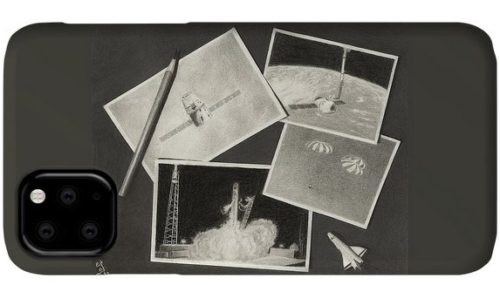
SpaceX Delivers the Goods” by C. Sergent Lindsey printed on phone cover. Available at Fine Art America.

The Space Show this week – July.27.2020

The guests and topics of discussion on The Space Show this week:

1. Monday, July 30, 2020; 7 pm PDT (9 pm CDT, 10 pm EDT: No special programming.

2. Tuesday, July 31, 2020; 7 pm PDT (9 pm CDT, 10 pm EDT): We welcome back Jeffrey Smith regarding his recent Space Review article, CSI: Rocket Science, from July 13, 2020.

3. Wednesday, July 1, 2020: Hotel Mars TBA pre-recorded. See upcoming show menu on the home page for program details.

4. Thursday, July 2, 2020; 7-8:30 pm PDT (9-10:30 pm CDT, 10-11:30 pm EDT): No special program today.

5. Friday, July 3, 2020; 9:30-11 am PDT (11:30 am-1 pm CDT, 12:30-2 pm EDT): We welcome Scott Herman to discuss Geospatial Intelligence & Dawn-to-Dawn Monitoring.

6. Sunday, July 5, 2020; 12-1:30 pm PDT (3-4:30 pm EDT, 2-3:30 pm CDT): We welcome back Dr. Ken Davidian to talk about his space tourism work.

Some recent shows:

** Sun. July.26.2020Dr. Michael Gleason of the Aerospace Corp talked about his new paper, The Value of Space.

** Fri. July.24.2020Steven Wolfe discussed “space settlement, the new Beyond Earth Institute and more on the settlement issue”.

** Tues. July.21.2020Dr. Pat Patterson of Utah State University talked about “the upcoming SmallSat Conference for 2021 that is now 100% virtual due to the Covid-19 virus”.

** Mon. July.20.2020Rand Simberg “was welcomed back for a two segment 91 minute discussion about Apollo 11 and the entire Apollo program, the significance of the ceremony he and others created, Evoloterra (evoloterra.com) plus a commercial space and property rights update”.

** See also:
* The Space Show Archives
* The Space Show Newsletter
* The Space Show Shop

The Space Show is a project of the One Giant Leap Foundation.

The Space Show - David Livingston
The Space Show – David Livingston


=== Amazon Ad ===

2008-2018: A NewSpace Primer

Space policy roundup – July.27.2020

A sampling of links to recent space policy, politics, and government (US and international) related space news and resource items that I found of interest (find previous space policy roundups here):

International space

Webcasts:

** Episode 21 July 15th Russian Co-Orbital ASAT Test – Michael Listner, Space Law & Policy Solutions

Preliminary thoughts on the orbital ASAT test performed by the Russian Federation on July 15th.

** Space ethics explainer: What are the restrictions for outer space travel? – Afternoons – ABC Radio

As more nations send satellites and missions into the galaxy, new questions about space ethics are being raised.

Advances in space technology potentially open up whole new worlds for humans to explore.

But what are the rules to prevent those technologies from having negative outcomes in the cosmos.

Associate Professor of Ethics and Leadership at UNSW Canberra, Dr Stephen Coleman spoke to ABC Radio Canberra’s Paula Kruger about some of the difficult questions regarding space travel.

** Space Café WebTalk Recap: Niklas Hedman on Space Multilateralism – SpaceWatch.Global

In this week’s Space Cafè WebTalk, Niklas Hedman, Chief of the Committee, Policy and Legal Affairs Section of the United Nations Office for Outer Space Affairs (UNOOSA) in Vienna talked about the governance phases under the 60 year history of the United Nations Committee on the Peaceful Uses of Outer Space (UNCOPUOS) and the “New Frontier” with increasing governance, commercial and scientific interests in planetary exploration, space resources, and planetary protection. The talk addressed the role of multilateralism in this “New Frontier” Era.

** E25 – What is Planetary Protection and Why Should We Care (Meg Abraham and Bhavya Lal) – Aerospace CSPS on Vimeo

** Michael Maloney – The Space Traffic Management PhantomCold Star Technologies – YouTube

Michael Maloney of Satellite Design for Recovery returns to the Cold Star Project, and we’re continuing our discussion of the problems in space traffic management. While many people think STM is already figured out, the truth is this is a phantom idea. Current systems are cobbled together and do not represent a serious solution to the problem. With host Jason Kanigan, Michael discusses:

– what space traffic management is and why we need it – how we can measure capacity and utilization in STM
– why Air Traffic Control can be used as a model in developing a functional STM solution
– what limits there are in executing a Space Traffic Management program
– a future path to STM including better Space Situational Awareness, mitigation of space debris, and timely remediation.

Satellite Design for Recovery website: https://satdfr.org/

** The Space Show – Sun. July.26.2020Dr. Michael Gleason of the Aerospace Corp talked about his new paper, The Value of Space.

** The Space Show – Fri. July.24.2020Steven Wolfe discussed “space settlement, the new Beyond Earth Institute and more on the settlement issue”.

** The Space Show – Mon. July.20.2020Rand Simberg “was welcomed back for a two segment 91 minute discussion about Apollo 11 and the entire Apollo program, the significance of the ceremony he and others created, Evoloterra (evoloterra.com) plus a commercial space and property rights update”.

** July 21, 2020 Zimmerman/Batchelor podcast | Behind The Black

** July [25] 2020 Zimmerman/Batchelor podcast | Behind The Black

==

=== The Art of C. Sergent Lindsey ===

SpaceX Delivers the Goods” by C. Sergent Lindsey printed on phone cover. Available at Fine Art America.

Space sciences roundup – July.26.2020

A sampling of recent articles, videos, and images from space-related science news items (find previous roundups here):

Mars

** Launch of the UAE Hope Mars mission on a Japanese H-IIA rocket on July 19th  was a success. The spacecraft is on course to reach Mars and go into orbit in February. It’s primary mission is to study the Martian atmosphere and weather.

HOPE-2 infographic shows mission phases from launch to Mars orbit operations.

Here is the first image taken from the Hope spacecraft: HH Sheikh Mohammed shares first image of Mars taken by Hope Probe – SatellitePro ME

See also

** Long March 5 launched China’s Tianwen 1 mission to Mars on July 23rd from the Wenchang Space Launch Center on the southern coast of Hainan province.

The payload includes an orbiter, lander, and rover.

Here are previews of the mission:

** Perseverance rover set to launch on July 30th on ULA Atlas V rocket. The rover will then land on the Red Planet on  Feb. 18, 2021. The final launch preparations and reviews are underway: NASA’s Mars Perseverance Rover Passes Flight Readiness Review – NASA

Everyone is invited to participant in some way with the mission liftoff: NASA Invites Public to Share Excitement of Mars 2020 Perseverance Rover Launch – NASA

Here is a set of hands-on activities for young people such as making a Mars helicopter out of paper: Learning Space With NASA at Home – NASA Jet Propulsion Laboratory

** An overview of Perseverance from the Everyday Astronaut:

** A true microphone is included on the  Perseverance: Perseverance Microphones Fulfill Long Planetary Society Campaign to Hear Sounds from Mars | The Planetary Society

If you could stand on the surface of Mars, what would you hear? While 8 missions have returned stunning views from the surface of the Red Planet, none have returned any sound.

That’s about to change. NASA’s Perseverance rover, which is days away from blasting off on a mission to search for signs of past life and collect samples for future return to Earth, will have not one, but two microphones aboard. One will listen as the rover plummets through the Martian atmosphere for landing, and another will record sounds as the rover does its scientific work in Jezero Crater—an ancient river delta where life may have flourished.

If all goes well, Perseverance’s microphones will fulfill the wishes of Planetary Society co-founder Carl Sagan, who wrote a letter to NASA in 1996 urging the space agency to send a microphone to Mars.

“Even if only a few minutes of Martian sounds are recorded from this first experiment, the public interest will be high and the opportunity for scientific exploration real,” Sagan wrote.

More about the Perseverance rover:

** Update on InSight Mars lander’s Mole digger: NASA’s InSight Flexes Its Arm While Its ‘Mole’ Hits Pause – NASA’s InSight Mars Lander – July.7.2020

NASA’s InSight lander has been using its robotic arm to help the heat probe known as the “mole” burrow into Mars. The mission is providing the first look at the Red Planet’s deep interior to reveal details about the formation of Mars and, ultimately, all rocky planets, including Earth.

Akin to a 16-inch-long (40-centimeter-long) pile driver, the self-hammering mole has experienced difficulty getting into the Martian soil since February 2019. It’s mostly buried now, thanks to recent efforts to push down on the mole with the scoop on the end of the robotic arm. But whether it will be able to dig deep enough – at least 10 feet (3 meters) – to get an accurate temperature reading of the planet remains to be seen. Images taken by InSight during a Saturday, June 20, hammering session show bits of soil jostling within the scoop – possible evidence that the mole had begun bouncing in place, knocking the bottom of the scoop.

NASA InSight’s ‘Mole’ Taps the Bottom of the Lander’s Scoop – NASA’s InSight Mars Lander: After the scoop on the end of NASA’s Mars InSight lander was used to push down on the top of the spacecraft’s “mole,” or self-hammering heat probe, it was held in place to essentially block the mole from popping out of the soil. The movement of sand grains in the scoop, seen here, suggested that the mole had began bumping up against the bottom of the scoop while hammering on June 20, 2020. Credit: NASA/JPL-Caltech.

** Dust up on Mars: I Can See Clearly Now: Dust-up on Mars! – Leonard David

Comparative images from NASA’s InSight Mars lander from Sol 10 to Sol 578 show that the spacecraft is quite dusty.

Robotic arm-mounted, Instrument Deployment Camera (IDC) images taken on December 7, 2018, Sol 10 and recent July 12, 2020, Sol 578 photos reveal the coating of Mars dust.

InSight landed on the Red Planet on November 26, 2018.

** The latest on Curiosity rover’s activities and plans:

NASA’s Curiosity Mars rover has started a road trip that will continue through the summer across roughly a mile (1.6 kilometers) of terrain. By trip’s end, the rover will be able to ascend to the next section of the 3-mile-tall Martian (5-kilometer-tall) mountain it’s been exploring since 2014, searching for conditions that may have supported ancient microbial life.

Located on the floor of Gale Crater, Mount Sharp is composed of sedimentary layers that built up over time. Each layer helps tell the story about how Mars changed from being more Earth-like – with lakes, streams and a thicker atmosphere – to the nearly-airless, freezing desert it is today.

Once they complete this week’s drilling effort, expect the rover to quickly head east again, aiming for the gap between the very rough Greenheugh Piedmont and the first steep cliffs of Mt. Sharp. They hope to reach this point in the fall, when the rover will finally leave the foothills of Mt Sharp and begin climbing the mountain. Their goal is the dark canyon in the first image above, uphill from where Curiosity sits now.

** Leonard David also gives frequent updates on Curiosity’s roving:

** Tour more sites on the marvelous Martian surface with Bob Zimmerman

Solar system

**  A review of missions that return samples of celestial bodies to Earth: Sample Return Roundup | The Planetary Society

It’s a banner year for sample return missions. Not since the 1970s has there been so much invested in returning rocks to Earth from space. This year, China, Japan, and the United States will all have sample return missions in flight, seeking to retrieve material from near-Earth asteroids, the Moon, and eventually Mars.

** The latest on the Saturn moon TitanDr. Linda Spilker of NASA JPL talks about the latest findings with John Batchelor and Dr. David Livingston on the Hotel Mars radio program:

** Illustrating the scale of planets and Earth-Moon separation: Fun Fact: All the Planets in the Solar System Could Fit Between Earth and the Moon – Lights in the Dark

It might seem a bit far-fetched but yes, it’s true: if you could line up all of the other planets in our Solar System in a row edge-to-edge (or more geometrically accurately, limb-to-limb) and for good measure even include Pluto, the entire queue would easily fit within the space between Earth and the Moon.

** The first view of Ganymede’s north pole: NASA Juno Takes First Images of Jovian Moon Ganymede’s North Pole | NASA

On its way inbound for a Dec. 26, 2019, flyby of Jupiter, NASA’s Juno spacecraft flew in the proximity of the north pole of the ninth-largest object in the solar system, the moon Ganymede. The infrared imagery collected by the spacecraft’s Jovian Infrared Auroral Mapper (JIRAM) instrument provides the first infrared mapping of the massive moon’s northern frontier.

Larger than the planet Mercury, Ganymede consists primarily of water ice. Its composition contains fundamental clues for understanding the evolution of the 79 Jovian moons from the time of their formation to today.

Ganymede is also the only moon in the solar system with its own magnetic field. On Earth, the magnetic field provides a pathway for plasma (charged particles from the Sun) to enter our atmosphere and create aurora. As Ganymede has no atmosphere to impede their progress, the surface at its poles is constantly being bombarded by plasma from Jupiter’s gigantic magnetosphere. The bombardment has a dramatic effect on Ganymede’s ice.

“The JIRAM data show the ice at and surrounding Ganymede’s north pole has been modified by the precipitation of plasma,” said Alessandro Mura, a Juno co-investigator at the National Institute for Astrophysics in Rome. “It is a phenomenon that we have been able to learn about for the first time with Juno because we are able to see the north pole in its entirety.”

These images [from the JIRAM instrument aboard NASA’s Juno spacecraft [taken] on Dec. 26, 2019, provide the first infrared mapping of Ganymede’s northern frontier. Frozen water molecules detected at both poles have no appreciable order to their arrangement and a different infrared signature than ice at the equator.” Credits: NASA/JPL-Caltech/SwRI/ASI/INAF/JIRAM
See also: First Images of Jovian Moon Ganymede’s North Pole | Mission Juno.

Astronomy

** A big list of the most exotic objects detected in the universe is being maintained by the Berkeley SETI program:

San Francisco, CA – June 22, 2020 – Breakthrough Listen, the initiative to find signs of intelligent life in the Universe, today released an innovative catalog of “Exotica” – a diverse list of objects of potential interest to astronomers searching for technosignatures (indicators of technology developed by extraterrestrial intelligence). The catalog is a collection of over 700 distinct targets intended to include “one of everything” in the observed Universe – ranging from comets to galaxies, from mundane objects to the most rare and violent celestial phenomena.

The comprehensive new catalog is the first in recent times that aims to span the entire breadth of astrophysical phenomena, from distant galaxies, to objects in our own Solar System. The Listen team developed it conceptually, compiled it, and shared it with the astronomical community in the hope that it can guide future surveys – studying life beyond Earth and/or natural astrophysics – and serve as a general reference guide for the field.

“Many discoveries in astronomy were not planned,” remarked the lead author of the new catalog, Dr. Brian Lacki. “Sometimes a major new discovery was missed when nobody was looking in the right place, because they believed nothing could be found there. This happened with exoplanets, which might have been detected before the 1990s if astronomers looked for solar systems very different than ours. Are we looking in the wrong places for technosignatures? The Exotica catalog will help us answer that question.”

“The catalog is not just limited to SETI, though,” noted Lacki. “My hope is that any program with a new capability may use the Exotica catalog as a shakedown cruise around the Universe.”

Sun

** First images from ESA/NASA Solar Orbiter released.

“The Extreme Ultraviolet Imager (EUI) on ESA’s Solar Orbiter spacecraft took these images on 30 May 2020. They show the Sun’s appearance at a wavelength of 17 nanometers, which is in the extreme ultraviolet region of the electromagnetic spectrum. Images at this wavelength reveal the upper atmosphere of the Sun, the corona, with a temperature of around 1 million degrees.”. Credits: ESA

Find more images in the ESA Solar Orbiter  gallery.

** The solar cycle appears to be turning slowly towards next maximum according to June sunspot activity: Sunspot update: More evidence of an upcoming weak maximum | Behind The Black

The ratio of next cycle sunspots vs sunspots from the past maximum has also been shifting. More and more, the new sunspots belong to the next cycle and less to the last. The ramp up to the next maximum is definitely beginning, though to call it a “ramp up” at this point is a big exaggeration. Sunspot activity remains low, though the last few months have seen some activity, unlike the seven months of nothing seen during the second half of last year.

The upcoming prediction for the next maximum calls for it to be very weak. Interestingly, the activity in June surpassed that prediction. This does not mean that the prediction will be wrong, only that June was more active when compared to the smooth prediction curve. As the cycle unfolds the monthly numbers will fluctuate up and down, as they did last cycle. The question will be whether their overall numbers will match closely with the prediction. In the past cycle actual sunspot activity was consistently below all predictions. It is too soon to say how well the new prediction is doing.

Moon

** The Chinese Yutu-2 rover will soon be ending another active lunar day and preparing to sleep through the two earth-week long lunar night. The rover should be approaching a half kilometer on the odometer from its travels since the Chang’e 4 mission landed on the Moon’s far side on January 3, 2019: China’s lunar rover travels about 463 meters on moon’s far side – Xinhua – June.28.2020.

Here is a report on some unusual looking material that Yutu-2 spotted a year or so ago: Study Reveals Composition of “Gel-like” Substance Discovered by Chang’e-4 Rover on Moon’s Far Side—-Chinese Academy of Sciences

The unusual dark greenish and glistening “gel-like” substance in a crater on the far side of the moon has attracted widespread interest following its discovery by the Chang’e-4 rover in July 2019. 

A research team led by Prof. DI Kaichang from the Aerospace Information Research Institute (AIR) of the Chinese Academy of Sciences and their collaborators analyzed the substance in detail by using multiple datasets from the rover’s panoramic camera (Pancam), hazard avoidance camera (Hazcam), and the visible and near-infrared spectrometer (VNIS).  

The researchers found that the unusual substance is actually an impact melt breccia, and the provenance of the rover measured surrounding regolith might originate from a differentiated melt pool or from a suite of igneous rocks. Their findings were published in Earth and Planetary Science Letters. 

“Impact melt breccia and surrounding context.” Credits: CNSA, CLEP, and AIR

** The Moon is more metal heavy than previously thought: Radar Points to Moon Being More Metallic Than Researchers Thought | NASA

What started out as a hunt for ice lurking in polar lunar craters turned into an unexpected finding that could help clear some muddy history about the Moon’s formation.

Team members of the Miniature Radio Frequency (Mini-RF) instrument on NASA’s Lunar Reconnaissance Orbiter (LRO) spacecraft found new evidence that the Moon’s subsurface might be richer in metals, like iron and titanium, than researchers thought. That finding, published July 1 in Earth and Planetary Science Letters, could aid in drawing a clearer connection between Earth and the Moon.

“The LRO mission and its radar instrument continue to surprise us with new insights about the origins and complexity of our nearest neighbor,” said Wes Patterson, Mini-RF principal investigator from the Johns Hopkins Applied Physics Laboratory (APL) in Laurel, Maryland, and a study coauthor.

** Investigating ancient volcanism on the Moon with images and altimetry data from the Lunar Reconnaissance Orbiter (LRO):

“Kathleen, a pyroclastic vent, and Rima Mozart extending east from the vent found in the eastern-most DTM in the Featured Image (seen above). Centered at 25.3263°N, 359.322°E – here in Quickmap.” Credits: LRO

From Bob Zimmerman at Behind The Black:

The image above, reduced to post here, is a colorized digital terrain model produced from Lunar Reconnaissance Orbiter (LRO) data. On top of the original mosaic of photos the LRO science team has overlaid the elevation data obtained by LRO’s laser altimeter. It shows a tadpole shaped pit dubbed Kathleen, with its tail trailing off to the southeast. As they note:

Kathleen is a pyroclastic vent with a sinuous rille (colloquially known as Rima Mozart [Not IAU confirmed]) that extends from the southeast end of the vent. Rilles are large channels formed by sustained channelized lava flows. This vent is a great location to investigate ancient volcanism on the Moon.

The elevation data reveals one interesting feature: The lowest part of the vent pit is not at its western end, where one would think at first glance, based on the general dip that produced the rill flowing to the east. That the lowest point is at the widest section of the pit instead suggests that this pit no longer looks as it did when it was venting. In the almost four billion years since it is thought all volcanic activity here ceased, there has been plenty of time for the slow erosion processes on the Moon, caused by radiation, micrometeorites, and the solar wind, to partly fill this pit and round out its cliff walls.

Asteroids and Comets

** The small companion to the Didymos asteroid christened Dimorphos. The pair are the target destination for the ESA’s Hera and NASA’s DART missions. Name given to asteroid target of ESA’s planetary defence mission – ESA

A near-Earth binary asteroid system, named after the Greek word for ‘twin’, Didymos’s main body measures about 780 m across, with its previously nameless moonlet about 160 m in diameter, approximately the size of Egypt’s Great Pyramid.

In 2022, this moonlet will be the target of NASA’s Double Asteroid Redirection Test (DART), the first full-scale demonstration of an asteroid deflection technology for planetary defence. ESA’s Hera mission will be launched two years later, to perform a close-up survey of Dimorphos, along with its parent asteroid, following DART’s impact.

NASA DART will impact the small Dimorphos companion to the Didymos asteroid in 2022. Credits: ESA

“Dimorphos is Greek for ‘having two forms’,” says Kleomenis Tsiganis, a planetary scientist at the Aristotle University of Thessaloniki and member of both the DART and Hera teams, who suggested the name.  

“It has been chosen in anticipation of its future status as the first celestial body to have its ‘physique’ intentionally altered by human intervention, the kinetic impact of DART. Hence, it will be known to us by two, very different forms, the one seen by DART before impact and the other seen by Hera, a few years later.”

DART’s kinetic impact into Dimorphos is expected to alter its orbit around Didymos as well as create a substantial crater, which will be studied by the Hera spacecraft when it arrives several years later. The DART impact itself will be recorded by the Italian-made LICIACube CubeSat, deployed from DART several days earlier, with longer-term effects studied by telescopes on Earth’s surface and in space.

See also Hera and its asteroid target – ESA.

** Haybabusa2 will drop off a capsule of material from asteroid Ryugu this December:

Japan’s Hayabusa2 spacecraft is nearly home. Having collected samples from the asteroid Ryugu last year, the spacecraft is just months away from returning them to Earth. The samples contain material that likely dates back to the dawn of the solar system, 4.6 billion years ago. They could provide fresh insights into how celestial bodies came to be and even how life on Earth began. But before all that, there is the small matter of getting Hayabusa2’s precious cargo down from the harsh vacuum of space and safely into scientists’ hands.

On July 14 the Japanese Aerospace Exploration Agency (JAXA), in partnership with the Australian Space Agency, announced the landing date for the samples: December 6, 2020. JAXA’s landing site for the mission is a 122,000-square-kilometer region of South Australian outback known as the Woomera Range Complex. “Woomera is a very remote area,” says Karl Rodrigues, acting deputy director of the Australian Space Agency. “It makes it ideal for the safe management and landing of this particular craft and capsule.”

** Watch Comet Neowise from the ISS to the accompaniment of a nice soundtrack:

=====

=== The Art of C. Sergent Lindsey ===

SpaceX Delivers the Goods” by C. Sergent Lindsey printed on phone cover. Available at Fine Art America.


Auction of Apollo astronauts’ autographed photos

Paul Fraser Collectibles points me to autographed NASA astronaut photos for sale at Prestige Collectibles Auction  through the end of July.

The items include a set photos autographed by the 12 Apollo astronauts who walked on the Moon.

Moonwalkers autographs: complete set of 12 signed photos


== Amazon Ad ==

LEGO Ideas NASA Apollo Saturn V 21309
Outer Space Model Rocket for Kids and Adults, Science Building Kit
(1900 pieces)

Everyone can participate in space