The latest newsletter of the International Space Elevator Consortium is now available on line: ISEC Newsletter – Oct.2013.
===
Here’s a nice infographic for the Mars One project: Mission Mars One – Graph.net.
The latest newsletter of the International Space Elevator Consortium is now available on line: ISEC Newsletter – Oct.2013.
===
Here’s a nice infographic for the Mars One project: Mission Mars One – Graph.net.
Kristian von Bengtson at Copenhagen Suborbitals reports on the development of the TDS-80 capsule that they intend to fly on their HEAT2X rocket next summer: Video of TDS-80 Space Capsule Structure Assembly – and Vodka – Wired Science
Caption:
A demonstration of the very first structure assembly of the HEAT2X payload, TDS-80. A scaled down capsule for launch summer 2014 for re-entry data.
The 10 day Lunar/Mars mission simulation by the North Dakota UND Human Spaceflight Laboratory has been underway since Sunday. (See earlier post.)
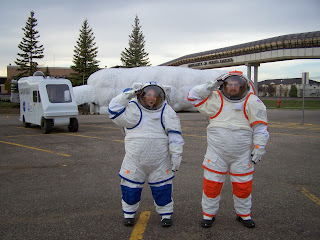
Three graduate students are living
inside an Inflatable Planetary Module, using a Pressurized Rover and two NDX-2AT space suits. All these elements were developed at the UND Space Suit Laboratory www.human.space.edu under a 3-year NASA grant.
.JPG)
You can follow their activities on the NDX Space Suit Projects. Here are their reports so far:
And a local newspaper story: UND starts a ten day lunar habitat experiment – WDAY | Fargo, ND (includes video news report):

Yet more space policy/politics related items:
Update:
An announcement from the National Space Society and the Space Journal at Ohio University:
Participate in the International SunSat Competition
Over $40,000 in Prizes Will Be Awarded!
The National Space Society in affiliation with Ohio University is pleased to announce that the International SunSat Design Competition is now registering competitive teams. This two-year project is designed to link global scientific communities with university-based (and other) digital media labs for the purposes of advancing knowledge of space-based solar power satellites (SunSats) and illustrating their many Earth-energy applications.
If you are a space scientist, engineer, academic, business or digital media professional with an idea for moving space solar power closer to implementation, consider forming a team to join in this effort. And please forward this message to others.
In the first cycle of this competition, two First Place prizes of $10,000 and three Second Place prizes of $5,000 are expected to be awarded at the May 2014 International Space Development Conference in Los Angeles. For registered teams successfully completing the Feb. 2014 “significant progress point,” an additional $1,000 incentive can be earned, and $1,000 travel assistance will be awarded to winners.
Winning entries of 2014 and 2015 will be published in the Space Journal as Issue No.18: Top SSP Designs.