China has been in the news a lot lately, mostly about trade tariffs and their expansion in the South China Sea. But in addition to the country’s growing economic power and international influence, it has also made some very impressive strides in terms of its space program. With us today is Blaine Curcio, the founder of Orbital Gateway Consulting. He discusses China’s development of the Long March rocket family, the deployment of the first space station, the Chinese lunar exploration program and the
Belt and Road Spatial Information Corridor, a significant space initiative that, among other things, plans to have a global GPS available by 2020. He explains the difference between the meritocratic nature of the U.S. space industry versus China’s incumbent advantage, as well as the “Elon Musk” factor in China’s space industry.
Note that the long-standing cliche criticism of space – “We should spend money on the poor instead of space” – is not supported by the Chinese experience. Absolute poverty there has dropped from about 85% of the population in the mid-1980s, when the economy was transformed from socialism into a mostly free market structure, to around 5% today. They did that with a space program growing in parallel. So the two things are clearly not in conflict.
The earth’s magnetic field and the atmosphere protect life from much of the radiation prevalent in space. That radiation consists primarily of two types: energetic charged particles from the sun and super-energetic particles, typically referred to as galactic cosmic rays (GCR), from deep space sources far beyond our solar system.
The sun’s particles, mostly protons and electrons, can be quite intense during a solar storm but are in an energy range such that a modest amount of shielding will block them. Though they are above the atmosphere, crews on the ISS are fairly well protected by the deflection properties of the earth’s magnetic fields. (Particles trapped by these fields create the Van Allen Belts and the aurora at the north and south poles.)
Cosmic rays, on the other hand, are very sparse but their extremely high energies makes them difficult to shield against. And a bit of shielding can, in fact, be a bad thing since when a GCR runs into another particle, it will create a shower of many additional particles, which if not blocked by additional shielding, will greatly multiply the radiation dosage to any living tissue they encounter.
Cosmic ray shower. Credits: John Slough, 2018 NIAC Symposium
They are so energetic, cosmic rays are hardly affected by the earth’s magnetic fields. However, the earth’s atmosphere is thick enough to absorb most of them such that the showering particles are either blocked or converted to particles like muons that interact every little and are eventually absorbed deep in the earth’s surface.
For human settlements on the Moon, Mars or other body, the local materials can provide material shielding sufficient to block both solar radiation and cosmic rays. For spacecraft traveling in space, keeping the total mass as minimal as possible is a top design requirement, at least with current propulsion systems. While solar radiation can be fairly easily blocked (an extra heavily shielded “safe room” could be available during a solar flare), cosmic rays are much more problematic. Designing spacecraft habitats inside out such that a crew on the way to, say, Mars is surrounded by all the equipment, food storage containers, fuel tanks, etc. would definitely help but could still result in substantial cumulative dosages. (Even those dosages, though, are likely to be minor risks compared to all the other risks on a Martian mission.)
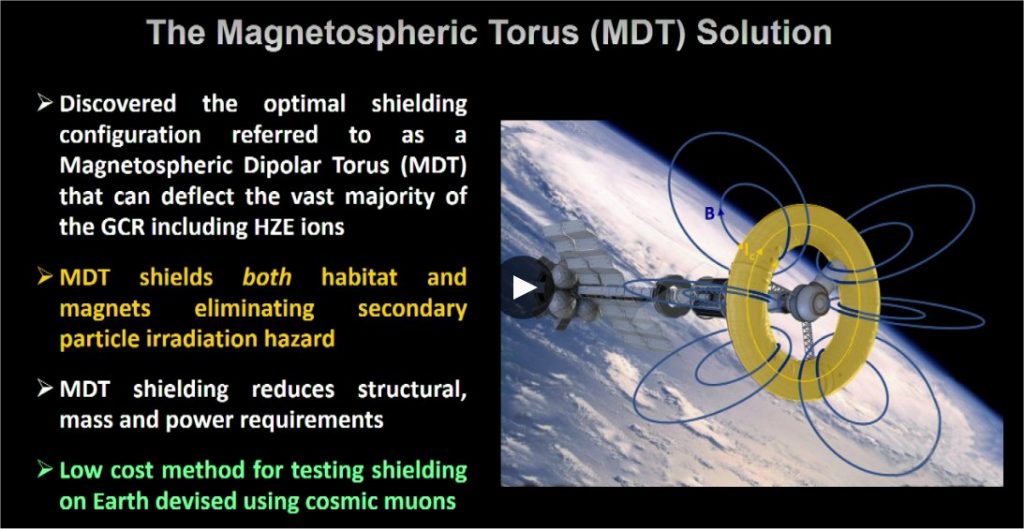
An alternative, or supplement, to material shielding is to use a magnetic field that deflects particles from the spacecraft’s habitat. Such a system should be designed in such a way that no magnetic fields reside inside the internal volume of the spacecraft where people live.
There have been various designs proposed over the years for magnetic shields. During the recent NIAC Symposium (see earlier posting), plasma physicist John Slough described what looks to be a viable design that he calls the Magnetospheric Torus (MDT). It appears to be doable with current technology, e.g. high-temperature superconducting magnets are now commonplace, and is quite effective, even for the highest energy GCR.
The Magnetospheric Torus (MDT) provides protection against GCR. Credits: John Slough, 2018 NIAC Symposium
A prototype system can be tested and optimized on earth by examining how well the system deflects all those muons flowing through us constantly. Slough describes the MDT design in this video of his NIAC talk (his presentation starts at around 27:00):
Space radiation is often portrayed in the press as some sort of deal-breaker for long distance spaceflight. That is simply not true. Whether building really big spaceships that allow for a lot of material shielding or using magnetic shielding (or employing both approaches), radiation can be dealt such that it becomes a relatively minor issue.
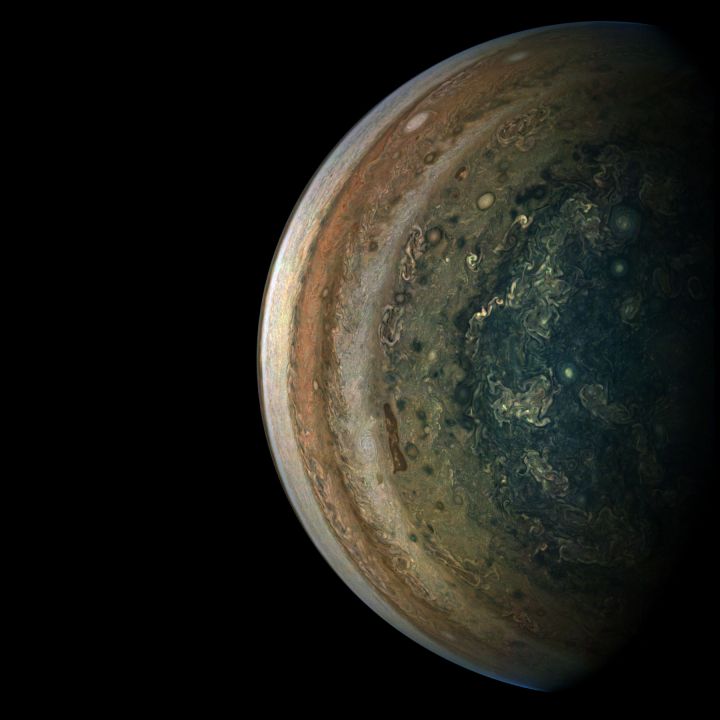
In the final minutes of a recent close flyby of Jupiter, NASA’s Juno spacecraft captured a departing view of the planet’s swirling southern hemisphere. This color-enhanced image was taken at 7:13 p.m. PDT on Sept. 6, 2018 (10:13 p.m. EDT) as the spacecraft performed its 15th close flyby of Jupiter. At the time, Juno was about 55,600 miles (89,500 kilometers) from the planet’s cloud tops, above a southern latitude of approximately 75 degrees. Citizen scientist Gerald Eichstädt created this image using data from the spacecraft’s JunoCam imager. Image Credits: NASA/JPL-Caltech/SwRI/MSSS/Gerald Eichstädt
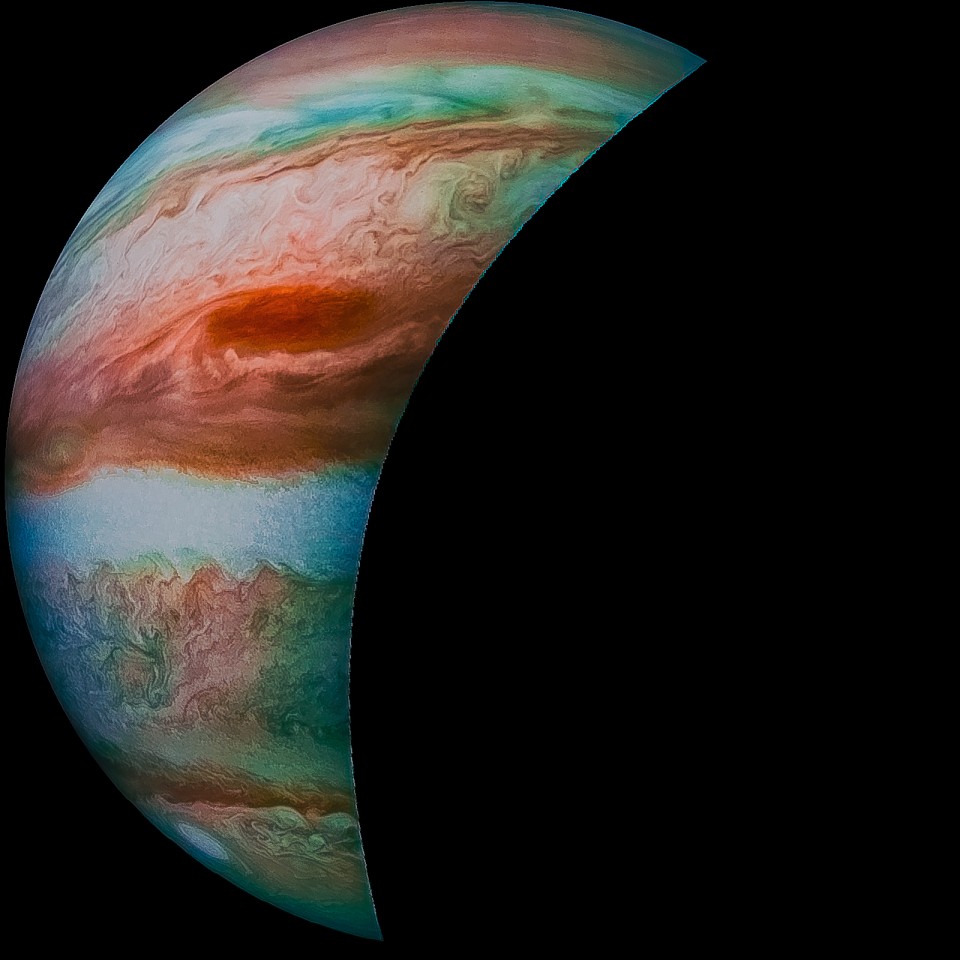
Early on September 07, 2018, UTC, NASA’s Juno probe successfully performed her Perijove-15 Jupiter flyby. Like during most of the recent Jupiter flybys, good contact to Earth and incremented storage allowed taking close-up images of good quality.
The movie is a reconstruction of the 112 minutes between 2018-09-07T00:30:00.000 and 2018-09-07T02:22:00.000 in 125-fold time-lapse. It is based on 25 of the JunoCam images taken, and on spacecraft trajectory data provided via SPICE kernel files.
In steps of five real-time seconds, one still images of the movie has been rendered from at least one suitable raw image. This resulted in short scenes, usually of a few seconds. Playing with 25 images per second results in 125-fold time-lapse.
This month marks 61 years since the launch of the Sputnik 1 satellite by the Soviet Union on October 4, 1957. Here are three documentaries (of increasing length) about Sputnik and the opening of the Space Age:
Small satellites, which typically refers to spacecraft in the kilogram to a few hundred kilograms range, have become in the past few years a large and growing part of what is happening in space. Smallsats have actually been around since the start of the Space Age. Just a few years after Sputnik reached orbit, the first amateur satellite reached orbit as well. (See A Brief History of AMSAT.) Note that “amateur” here refers primarily to the involvement of the amateur radio community and the use of amateur radio bands for communications with the satellites.
For decades, smallsats remained a niche activity carried out mostly by AMSAT and university student teams. Now companies like Planet and Spire operate hundreds of satellites in orbit for commercial purposes and constellations with thousands of satellites are set to be deployed during the coming years.
After referring to the 84 kg Sputnik, launched in 1957 as a “small satellite,” Dr. Patterson discusses the three keys to the growth of the small sat industry: affordability, responsiveness and shorter development cycles. And because the barrier to entry is so much lower for small satellites, more and more small companies begin to come online bringing a lot more competition, which brings a lot more good ideas to the table.