Blue Origin, the space company owned by Jeff Bezos of Amazon.com, released a video animation this week showing the New Glenn rocket, which they will start building next year at a factory currently in construction at Cape Canaveral. First flights are expected in 2020:
The first stage of the New Glenn will land on a ship platform and be reused up to 100 times.
The company also announced contracts with Eutelsat and OneWeb for satellites launches.
Jeff Bezos has been a space enthusiasts since he was a kid and is determined to see large scale human settlement of space.
Tory Bruno the CEO of United Launch Alliance joins us to talk about the future of humans in space. The new Vulcan rocket, ACES upper stage and CisLunar 1000 are just a few of the topic we cover. Tory lays out an amazing vision with thousands of humans living and working in space.
Space news
SpaceX announces plans to send two people around the moon next year Blue Origin may have lunar ambitions too Autonomous Flight Safety System Virgin Orbit
TMRO is viewer supported:
TMRO:Space is a crowd funded show. If you like this episode consider contributing to help us to continue to improve. Head over to http://www.patreon.com/tmro for information, goals and reward levels. Don’t forget to check out our SpacePod campaign as well over at http://www.patreon.com/spacepod
Here’s a ULA video about their CisLunar 1000 concept:
SpaceX announced on Monday that two private persons will ride a Crew Dragon spacecraft launched by a Falcon Heavy on a trip around the Moon. The target date for the flight is late 2018. TMRO.tv‘s Lisa Stojanovsk gives an overview of the endeavor:
The first launch of the Falcon Heavy is planned for this summer. All three cores will fly back for landings.
The Falcon Heavy system will have flown three or four times before this Moon flyby happens. The Crew Dragon will have flown both unmanned and manned to the ISS before the trip as well.
SpaceX to Send Privately Crewed Dragon Spacecraft
Beyond the Moon Next Year
We are excited to announce that SpaceX has been approached to fly two private citizens on a trip around the moon late next year. They have already paid a significant deposit to do a moon mission. Like the Apollo astronauts before them, these individuals will travel into space carrying the hopes and dreams of all humankind, driven by the universal human spirit of exploration. We expect to conduct health and fitness tests, as well as begin initial training later this year. Other flight teams have also expressed strong interest and we expect more to follow. Additional information will be released about the flight teams, contingent upon their approval and confirmation of the health and fitness test results.
Most importantly, we would like to thank NASA, without whom this would not be possible. NASA’s Commercial Crew Program, which provided most of the funding for Dragon 2 development, is a key enabler for this mission. In addition, this will make use of the Falcon Heavy rocket, which was developed with internal SpaceX funding. Falcon Heavy is due to launch its first test flight this summer and, once successful, will be the most powerful vehicle to reach orbit after the Saturn V moon rocket. At 5 million pounds of liftoff thrust, Falcon Heavy is two-thirds the thrust of Saturn V and more than double the thrust of the next largest launch vehicle currently flying.
Later this year, as part of NASA’s Commercial Crew Program, we will launch our Crew Dragon (Dragon Version 2) spacecraft to the International Space Station. This first demonstration mission will be in automatic mode, without people on board. A subsequent mission with crew is expected to fly in the second quarter of 2018. SpaceX is currently contracted to perform an average of four Dragon 2 missions to the ISS per year, three carrying cargo and one carrying crew. By also flying privately crewed missions, which NASA has encouraged, long-term costs to the government decline and more flight reliability history is gained, benefiting both government and private missions.
Once operational Crew Dragon missions are underway for NASA, SpaceX will launch the private mission on a journey to circumnavigate the moon and return to Earth. Lift-off will be from Kennedy Space Center’s historic Pad 39A near Cape Canaveral – the same launch pad used by the Apollo program for its lunar missions. This presents an opportunity for humans to return to deep space for the first time in 45 years and they will travel faster and further into the Solar System than any before them.
Designed from the beginning to carry humans, the Dragon spacecraft already has a long flight heritage. These missions will build upon that heritage, extending it to deep space mission operations, an important milestone as we work towards our ultimate goal of transporting humans to Mars.
This morning SpaceX launched its Falcon 9 rocket with a Dragon spacecraft full of cargo heading to the International Space Station. The Dragon will berth to the station on Wednesday morning.
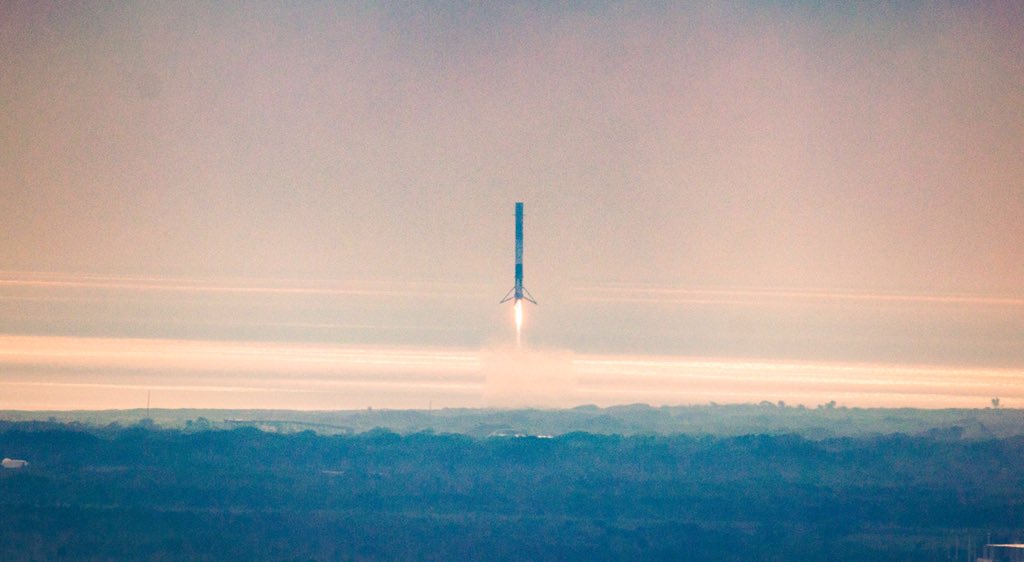
After the first stage booster separated from the upper stage, it came back down for a powered landing onto SpaceX’s Landing Zone 1 at Cape Canaveral.
Landing Shot from the roof of the VAB – credits Trevor Mahlmann (Hi-Res image)
Here is a video of the landing as seen during the SpaceX webcast:
After liftoff the rocket disappeared quickly into a cloudy sky:
The launch was the first for SpaceX from Pad 39A, which is the same pad used by most of the Apollo Saturn V launches to the Moon and for most of the Space Shuttle launches. Here is a brief history of the pad:
Update: This Dragon mission has a particular emphasis on science and technology cargo.
An Indian PSLV (Polar Satellite Launch Vehicle) rocket put 104 satellites into orbit yesterday. (See previous posting.) These include 88 smallsats for the earth observation company Planet, 8 smallsats for Spire, which is doing maritime tracking and weather measurements, and 1 for SpacePharma, which has a miniature laboratory on its satellite for carrying out microgravity experiments.
This video shows the launch and then provides some amazing views of the satellites being deployed into orbit: