Category Archives: Rockets

Video: Falcon Heavy launch a success. Two side boosters land in parallel

The Falcon Heavy launch was a major success today. The rocket, which was developed by SpaceX with its own private money, is not only the most powerful launch system in operation in the world today, it is the most cost effective.

The two side boosters came back for a successful landings at Cape Canavera:
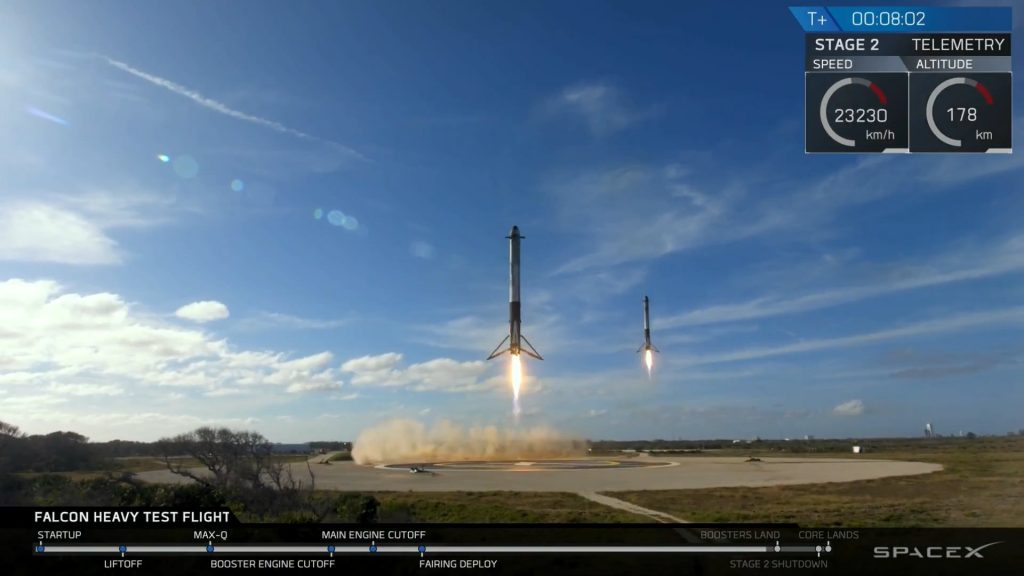
Two Falcon Heavy side boosters land simultaneously.

It appears the central core did not land successfully at sea but waiting word from SpaceX on exactly what happened with it.

In a few hours, the upper stage is to fire again and send the Tesla Roadster into its long orbit that will reach as far out as the Mars orbit. In the meantime, here are live views from the Roadster:

Yes, this is a screen capture of an actual Tesla Roadster in orbit with the earth in the background taken by a camera on the Falcon second stage:
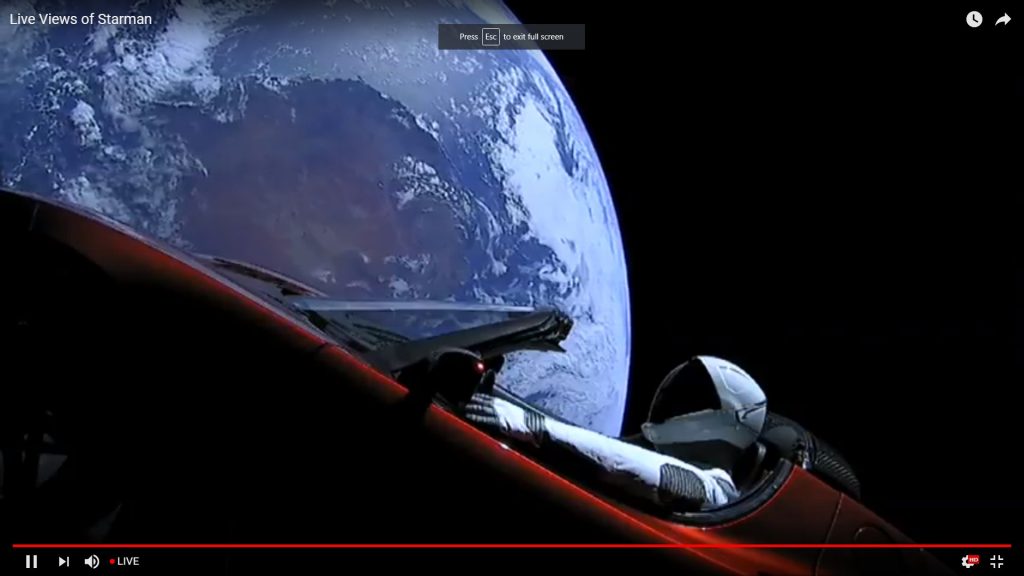
A screen capture of the Tesla with the earth in the background.

Here is a video of the complete SpaceX webcast of the launch:

====
Videos: SpaceX to attempt first launch of the Falcon Heavy rocket

SpaceX hopes to launch its  Falcon Heavy rocket today from Kennedy Space Center. The 3 hour window for the launch opens at 1:30 pm EST  (1830 GMT). There are large crowds reported gathering in the Cape Canaveral area to watch the launch.

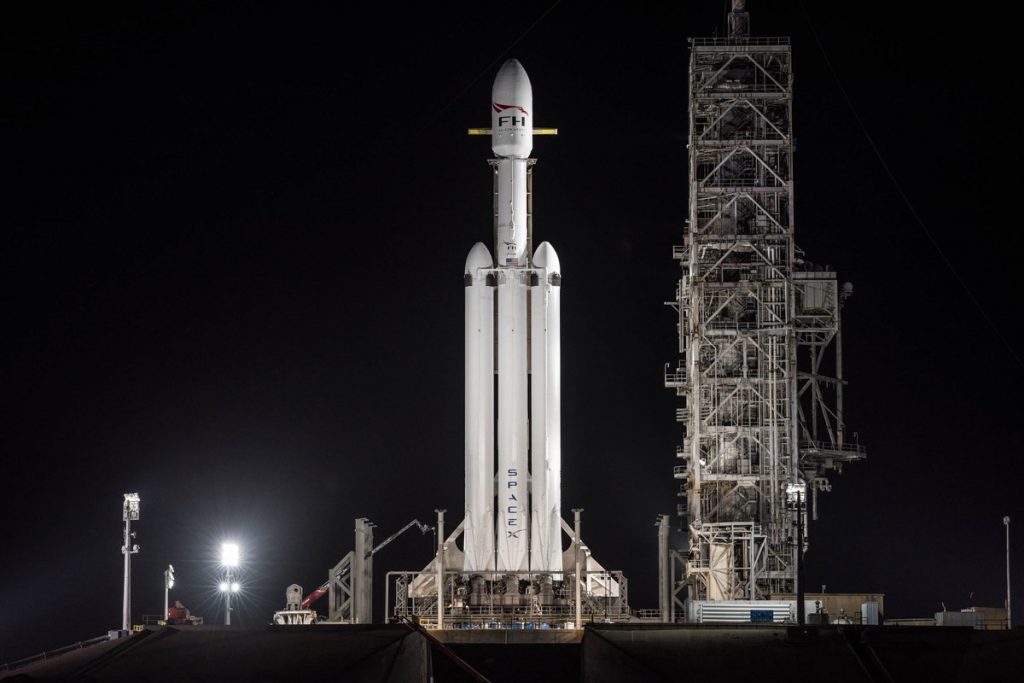
Falcon Heavy on Pad 39A on Monday evening, Feb.5, 2018

SpaceX founder and CEO Elon Musk gives this test a 50/50 chance of success. Problems could range from an explosion on the pad due violent interactions of the exhausts of 27 engines firing simultaneously to problems with the two side boosters separating from the core. Here is a recording of a press briefing given by ELon yesterday:

With the high risks for the first launch of a new rocket, usually a boilerplate mock-up of a spacecraft or just plain ballast is used as a payload. Elon instead chose to fly his red Tesla Roadster.

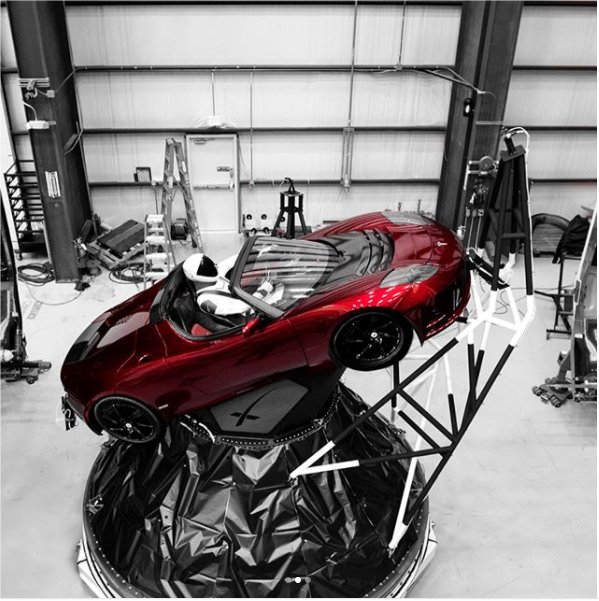
Elon’s red Tesla Roadster set on an adapter before placement in the Falcon Heavy nosecone.

If the flight is a success, the roadster will be sent into an orbit that will see the roadster cycling out to the orbit of Mars and back near earth for the next billion years or so.

Here is a SpaceX animation of the mission. Note that the two side boosters are to return to the Cape for landing on ground pads while the center core will attempt to land on a platform at sea:

About 15-20 minutes before lift off, the SpaceX webcast will go live. You can also watch it here:

As of 12:10 pm EST, the target liftoff time is 2:20 pm EST (1920 UTC) . If the rocket does not get off the ground today, there will be another opportunity on Wednesday afternoon.

Updates and background info on the launch:

====

Videos: Rocket launches in New Zealand, USA, China and Japan in one week

Several orbital launches happened in the past week. Here are videos of some of them:

** Rocket Lab, a small company based in the US and New Zealand, had its first successful orbital launch over the weekend with its second Electron rocket.  (liftoff at about 15 minutes into the video):

The Electron, built using carbon composite structures and 3D printing technologies, was developed solely with private investment. The three satellites orbited by the vehicle belonged to two private companies: Planet and Spire Global.

** United Launch Alliance put a US Air Force missile early warning satellite into orbit on Friday:

** Chinese Long March 11 rocket put 9 small satellites into orbit on Friday as well :

This was the fourth orbital launch in China this month.

** Japan’s Epsilon rocket on Jan.17th put a radar earth observation satellite into orbit:

====

Space books: “Spaceport Earth: The Reinvention of Spaceflight” by Joe Pappalardo

Joe Pappalardo, an editor at Popular Mechanics who often reports on space topics, has written the book, Spaceport Earth: The Reinvention of Spaceflight. He discusse the many NewSpace developments of the past several years and looks especially at the emergence of commercial launch facilities:

Is there a future in orbit? This timely book reveals the state of spaceflight at a crucial juncture in the industry’s history.

It’s the 21st-century and everything about the space industry is changing. Rather than despair over the end of American manned missions and a moribund commercial launch market, private sector companies are now changing the way humanity accesses orbit. Upstarts including Elon Musk’s SpaceX and Jeff Bezos’s Blue Origin are building a dizzying array of new spacecraft and rockets, not just for government use, but for any paying customer. At the heart of this space revolution are spaceports, the center and literal launching pads of spaceflight. Spaceports cost hundreds of millions of dollars, face extreme competition, and host operations that do not tolerate failures―which can often be fatal.

Aerospace journalist Joe Pappalardo has witnessed space rocket launches around the world, from the jungle of French Guiana to the coastline of California. In his comprehensive work Spaceport Earth, Pappalardo describes the rise of private companies in the United States and how they are reshaping the way the world is using space for industry and science. Spaceport Earth is a travelogue through modern space history as it is being made, offering space enthusiasts, futurists, and technology buffs a close perspective of rockets and launch sites, and chronicling the stories of industrial titans, engineers, government officials, billionaires, schemers, and politicians who are redefining what it means for humans to be a spacefaring species.

Here is a review of the book Review: Spaceport Earth – The Space Review.

And this is an entertaining interview with the author: John Batchelor Show – Spaceport Earth: The Reinvention of Spaceflight by Joe Pappalardo. PART 1 of 4: Texas and there billionaire rocketeers. @PappalardoJoe

====

SpaceX Falcon Heavy prepared for test firing and launch

SpaceX hopes to launch the Falcon Heavy rocket for the first time this month. The three core launch system was developed completely with internal funding. It can put up 63,800 kg (140,660 lb) to into low earth orbit, making it currently the most powerful rocket in the world and one of the most powerful since the start of the Space Age. The FH appeared in public for the first time when it rolled up to Pad 39A between Christmas and New Year. According to Elon Musk, SpaceX plans to do an on-pad engine firing test in the next week and a launch by the end of January.

If all goes as planned, the two side boosters will land back at the Cape and the center core will land on an ocean droneship platform.

A post shared by Elon Musk (@elonmusk) on

For this first test flight, they did not want to risk an expensive satellite so they decided to send Elon’s Tesla Roadster on a deep space orbit that will pass near Mars:

Falcon Heavy Demo Mission - Payload

Falcon Heavy Demo - Payload

More at

Here is a good tutorial from the Everyday Astronaut on the FH:

====