History on the Net debuts today a 6-episode podcast series titled Age of Discovery 2.0. It compares the transformative effects that the opening of the New World had on Western Civilization to the possible effects that opening space will have on Earth’s civilization.
How will the Age of Discovery 2.0 change our civilization the way the first one did five centuries ago?
To find the answer, History Unplugged is interviewing historians, scientists, and futurists who have spent decades researching this question by looking at the past to understand the future.
In this first episode of the series, historian and space enthusiast Scott Rank explains how the first Age of Discovery completely altered the global balance of power, elevating Europe from a poor backwater into the globe’s dominant military intellectual, and economic region. Today, with rocket launch costs dropping by orders of magnitude, we are on the verge of a second Age of Exploration equally — if not more — consequential than the one that the first.
The Age of Discovery changed Western culture in numerous ways. It increased human freedom because it allowed Europeans to escape the Old World’s rigid social hierarchy, increased wealth by increasing trade and utilizing new resources, and increased human ingenuity by forcing it to innovate and create new technologies in a challenging frontier environment. In upcoming episodes, he will interview historians and science writers (including yours truly) who will explain how we can expect more of this in the Second Age of Discovery.
The guests in episodes 2-4 include:
Robert Zubrin: Robert Zubrin is an American aerospace engineer, author, and advocate for the human exploration of Mars. Disappointed with the lack of interest from government in Mars exploration and after the success of his book The Case for Mars (1996), as well as leadership experience at the National Space Society, Zubrin established the Mars Society in 1998, an international organization advocating a human mission to Mars as a goal, by private funding if possible.
Glenn Reynolds: Glenn Harlan Reynolds is a Distinguished Professor of Law at the University of Tennessee College of Law, and is known for his American politics blog, Instapundit. He has written numerous books and articles on space law and policy and has served as Executive Vice President of the National Space Society, and on a White House advisory committee on space policy.
Robert Zimmerman: Robert has written multiple histories about the first forty years of space exploration as well as more than a hundred magazine and newspaper articles about the adventure of science and astronomy. He says that future generations will look back at Earth and see it only as the Old World.
1. Tuesday, Nov. 2, 2021; 7 pm PDT (9 pm CDT, 10 pm EDT): We welcome back Dr. Francis (Frank) Cucinotta of the Department of Health Physics and Diagnostic Sciences of the University of Nevada Las Vegas regarding radiation updates. See his paper on our blog.
3. Friday, Nov.5, 2021; 9:30-11 am PDT (11:30 am-1 pm CDT, 12:30-2 pm EDT): We welcome back Dr. Casey Handmer regarding his latest article on Starship and NASA plus other topics.
4. Sunday, Nov.7, 2021; 12-1:30 pm PDT (3-4:30 pm EDT, 2-3:30 pm CDT): Welcome to Open Lines. All calls, all callers welcome. We want to hear from you. Call us at 1-866-687-7223.
Some recent shows:
** Monday, Oct.25.2021 – Robert (Bob) Zimmerman talked about “commercial space, space station, demo flight, financing and related questions including policy and more“.
The astronauts flying on NASA’s SpaceX Crew-3 mission have been working together for months and months now to prepare for their launch, and then six months together on the International Space Station. You’d think they’ve gotten to know each other pretty well by now. Watch as Raja Chari, Tom Marshburn, Kayla Barron, and Matthias Maurer declare who on the crew is the funniest, who has an annoying habit, and who is the clear front-runner to beat the others in a race. Also, which crew member is the most perspicacious and what type of “smorgasbord” are they planning? Let’s find out!
Astronauts are public figures and much of their history is well known, but not all of it. We “grilled” the astronauts flying to the International Space Station on NASA’s SpaceX Crew-3 mission – Raja Chari, Tom Marshburn, Kayla Barron, and Matthias Maurer – with a dizzying series of rapid-fire questions to discover the truth about their favorite foods, guilty pleasures, and what these explorers would do with a free day on the Moon. Be on the lookout for the one thing that all four of them unanimously agree on!
** Expedition 66 inflight with Seeker.com – October 25, 2021 – NASA Video
Aboard the International Space Station, Expedition 66 Commander Thomas Pesquet of ESA (European Space Agency) and NASA Flight Engineer Shane Kimbrough discussed life and work aboard the orbital outpost during an in-flight event October 25 with Seeker.com. Pesquet and Kimbrough are in the midst of long duration missions living and working aboard the microgravity laboratory to advance scientific knowledge and demonstrate new technologies for future human and robotic exploration missions as part of NASA’s Moon and Mars exploration approach, including lunar missions through NASA’s Artemis program.
Blue Origin and Sierra Space have announced plans for Orbital Reef, a commercially developed, owned, and operated space station to be built in low Earth orbit. The station will open the next chapter of human space exploration and development by facilitating the growth of a vibrant ecosystem and business model for the future. Orbital Reef is backed by space industry leaders and teammates including Boeing, Redwire Space, Genesis Engineering Solutions, and Arizona State University. Designed to open multiple new markets in space, Orbital Reef will provide anyone with the opportunity to establish their own address on orbit. This unique destination will offer research, industrial, international, and commercial customers the cost competitive end-to-end services they need including space transportation and logistics, space habitation, equipment accommodation, and operations including onboard crew. The station will start operating in the second half of this decade. Learn more at OrbitalReef.com
** Axiom Rewind September 2021 – Axiom Space – Brief update on the projects by Axiom Space, which is developing commercial space habitat modules, which initially will attach to the ISS and then form an Axiom free-floating station.
** Blastoff! Progress 79 cargo spacecraft launches to space station – VideoFromSpace
A Russian Soyuz rocket launched the Progress 79 cargo resupply spacecraft from the Baikonur Cosmodrome in Kazakhstan to the International Space Station on Oct. 27, 2021 (Oct. 28 local time).
Timelapse video made during ESA astronaut Thomas Pesquet’s second mission to the International Space Station, “Alpha”. On 17 October 2021 at 01:14 GMT the Soyuz MS-18 undocked from the Space Station to return to Earth, inside were @Roscosmos Media cosmonaut Oleg Novitskiy (who had spent 191 days in space) and actress Yulia Peresild and Russian producer-director Klim Shipenko (who both spent 11 days in space). The trio landed on Earth just over three hours later. The camera for this timelapse was setup to take pictures at intervals of two a second, and the pictures are then edited into this video that plays at 25 pictures a second. The video is around 12 times faster than real speed. …
This roundup provides a sampling of recent articles, videos, and images dealing with space transport (find previous roundups here). The roundup is split into three postings:
Part 2: Light orbital lift development, suborbital, space transport articles, news, videos, etc.
Part 3: SpaceX Falcon 9, Dragon, and Starship
Falcon 9 and Dragon
The SpaceX Falcon 9 launch rate slowed considerably this past summer. There were 20 missions flown from January through June but none in July and just three from August till the middle of October. There were several factors leading to the slowdown, the primary one being the completion by June of the initial phase of the Starlink constellation buildup. (See links at bottom here for latest info on the Starlink project). Thirteen of those 20 missions each sent 50+ Starlink satellites into low earth orbit. Those Starlinks went into +/- 55 degree inclination orbits where they can provide Internet services to people living in the mid-latitudes.
The next phase of the Starlink project requires launching satellites to polar orbits to enable full global coverage. It appears most of these polar missions will be launched from Vandenberg AFB in California. The first polar orbital launch lifted off on September 14th (see below). These second-phase satellites carry laser communications systems that enable in-space intra-constellation links, greatly reducing the latency of packets transmitted between far distant points on the globe. Completing development of the laser system and ramping up its production took extra time, which also contributed to the delay in launches.
The F9 launch rate is now picking up again with ten missions scheduled for the remaining months of 2021. A NASA crew of 4 is set to head for the ISS this Sunday, Oct.31.2021.
Falcon 9 and Dragon rolling out of the hangar at Launch Complex 39A ahead of launching astronauts this weekend pic.twitter.com/ugTMUYQIJ5
Here are items about the three F9 missions for August and September:
** Sept.16: Inspiration4 mission success. The first all-civilian spaceflight mission successfully sent four non-professional astronauts into orbit for four days and returned them safely to Earth. It was very successful at public outreach as well. The mission gained widespread media attention, most of which seemed quite positive. A five episode special series on Netflix presented captivating profiles of the space travelers and followed their activities during training, the launch, in-orbit and through the return to a splashdown and recovery at sea. Funded by Jared Isaacman, the project surpassed his goal of raising $200M for St. Judes Children’s hospital. (Helped by a $50M contribution of Elon Musk and by Issacman’s own $100M.)
*** Sept.14: Falcon 9 launches first Starlink mission from Vandenberg. The first stage booster successfully landed after its 10th flight. The 51 satellites deployed by the upper stage will go into orbits at 70 degree inclination with respect to the equator. Over 1700 satellites of the initial Starlink shell were launched from Cape Canaveral into 53 degree inclinations that allow Internet service to a band of the earth between +/- 55 degrees latitude. This West Coast launch began the filling of a second shell that will provide coverage to the polar regions. These are the first Starlink satellites to carry laser systems for in-space communications. This will allow the sats to connect directly with each other. Ground stations are few and far between in the polar regions so a laser network will provide for in-space data transfers to whichever satellite is currently above a ground station. Eventually lower latitude shells will also be replaced with sats equipped with laser-comm systems since in-space comm is faster than transversing optical fibers and multiple routers to reach a particular destination.
** Aug.29: SpaceX Falcon 9 launches Cargo Dragon to the ISS with nearly 2180 kg of supplies, equipment, and research materials. The rocket lifted off at 3:14 am EDT from NASA’s Kennedy Space Center. The booster B1061, on its fifth flight, landed successfully on the new ocean platform named, Shortfall of Gravitas. The spacecraft docked to the station on the morning of Aug.30th.
** Third SpaceX Commercial Crew Mission set for end of October. Crew 3 includes NASA astronauts Thomas Marshburn, Kayla Barron and Raja Chari and German ESA astronaut Matthias Maurer. This mission will actually be the fifth Crew Dragon flight with people on board when one includes the CCP demonstration mission plus the Inspiration 4 civilian flight discussed above.
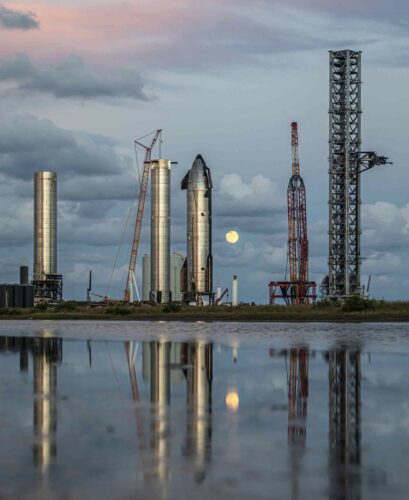
Though there were no Starship test flights since the previous roundup at the end of July, a tremendous amount of activity has taken place at the Boca Chica production and launch facility in preparation for future Starship missions. These activities can be divided among the following sites and hardware systems:
Orbital Launch Site (OLS):
The OLS includes a launch integration tower (note that a second one is planned as well), a launch mount, and a vast ground infrastructure that includes huge upright cryogenic fluid tanks, a maze of piping, multiple fluid handling and cooling systems, electrical power distribution systems, etc. Substantial progress has been made in all of these areas.
Orbital Launch Integration Tower (OLIT):
Fitting out of the OLIT has continued night and day since the final segment was set in place by a huge crane in July. The OLIT will not only provide propellants and power to the Starship and Super Heavy booster but it will also stack the former onto the latter for launch and then catch each of the two during landings.
Quick Disconnect arm (QD) was installed at a level near the joint between the Starship and the Booster. It will be used to transfer propellants to and from the vehicle as well as stabilize the combo during high winds.
Mechazilla, as tagged by Elon Musk, was installed this past week onto the OLIT. This mechanism includes long arms and moves up and down on the OLIT. It will lift, raise and stack a booster onto the Launch Mount and then stack a Starship on top of the booster. It also will work with the QD to hold the combo in place. Furthermore, the “Chopsticks” will catch a booster during its landing and then catch a Starship to stack upon the booster.
Launch Mount:
The Starship/Booster combo will sit atop the Launch Mount until the 29 Raptor engines (33 on a later design) fire and send it into space. The Launch Mount consists of a circular structure atop six tall heavy pillars. The mounting structure provides a number of important duties including the feeding of propellants up till the moment of liftoff when the feed-lines must quickly disconnect, hold-downs to keep the rocket securely upright until liftoff when they must quickly and uniformly let go of the booster, electric power connections, etc. Work on the circular mount structure has been going on continuously from the time it was at the production site to the current position at the launch site, where it is enveloped in metal tubular scaffolding.
Orbital Tank Farm:
The tank farm consists of eight vertical tanks for storing liquid oxygen, liquid methane, and water. The tanks were built by SpaceX in a manner very similar to the booster and Starship from cylinders of stainless steel. Each of the eight tanks has now been encapsulated by an insulating shell, also built by SpaceX.
There are also several other tanks on the OLS for additional fluid handling and storage.
“Starbase under construction” – Elon Musk, Oct.22.2021
Starship 20:
Thermal protection tiles:
Black ceramic tiles for thermal protection during reentry from orbit were installed on the “belly” side of Starship 20 while it was in the High Bay but many were marked with tape to indicate that they needed adjustment, replacement, and/or testing. After the vehicle was moved to a mount at the launch site, these problem tiles were dealt with by workers lifted via mobile elevated work platforms. This was the first time a complete set of tiles were attached to a Starship. A handful of tiles have fallen off during tank pressure and engine tests but Elon has indicated such problems were expected.
Raptor installation:
Raptor engines, both the sea-level and vacuum optimized types, have been installed, removed, and re-installed a few times. (The Starship uses three Raptors optimized for sea-level pressure and three for vacuum.)
Tests:
Pressure testing of the propellant tanks.
Structural test with hydraulic actuators pressing on the bottom of the vehicle during pressurization of the tanks.
Firing tests of the sea level and vacuum Raptors (see video below).
On October 21st, a vacuum-optimized Raptor was fired for the first time outside of the company’s McGregor, Texas engine test site.
Super Heavy Booster 4:
Preparation of Booster 4 has been quite intense. After the booster and Starship were briefly mounted atop one another on the Launch Mount, the booster was moved back to the Build Site for additional work and then returned to the OLS where it currently sits atop a temporary mount.
Engines on Booster 3 were test fired back in July but there has not yet been a test firing of engines installed on Booster 4. (Booster 3 was partially disassembled and the lower portion currently remains standing at the launch site.)
Build site:
Starship 21:
Stacking of the segments is nearly complete in the Mid-Bay hangar.
Starship 22:
Several of the segments have been assembled and await stacking.
Boosters:
Stacking of Booster 5 is nearly complete in the High Bay hangar. Segments for Booster 6 have been observed.
New Wide Bay:
Construction of a third hangar is proceeding apace with the first metal frame pillars for the walls are being put in place following the completion of the foundation.
This hangar will be as tall as the high bay but roughly twice as wide.
High Bay:
The penthouse dining/bar facility on top appears nearly complete with the installation of large clear glass walls to allow visitors to see the facilities and watch launches and landings.
Staircase segments have been built and will apparently be stacked along the side of the building and will probably enclose the elevator, which currently rises in the open air.
To help meet all of these goals for Boca Chica, the company initiated a surge of workers by bringing them in from other facilities:
** SpaceX Starbase, Tx Flyover (October 18, 2021) – RGV Aerial Photography. A recent view from above the Boca Chica site; includes helpful labels on the many features of interest.
***** Aug.1: Starbase – July 2018 vs Aug.2021 – RGV Aerial Photography – A look at how the Boca Chica site has changed in the past three years.
** Date of first Starship orbital test flight remains uncertain. The intense effort at Boca Chica has paid off in terms of preparation for a test launch. Elon Musk on Twitter:
If all goes well, Starship will be ready for its first orbital launch attempt next month, pending regulatory approval
However, as he indicates, the FAA may not license a launch for at least a few months (see FAA environmental review discussion below). A NASA project to use special cameras to observe a Starship’s thermal protection surface during reentry is expecting a launch in March. Whether this will be the first Starship orbital launch is not said.
** Pace of Starship development now depends on the FAA. The Commercial Space Transportation wing of the FAA is currently reviewing whether the environmental impact study (EIS) that was approved several years ago for the SpaceX launch facility at Boca Chica Beach, Texas remains valid. The earlier EIS was based on Falcon 9 launches from the site while SpaceX subsequently switched the spaceport completely to Starship/Super Heavy Booster operations.
The FAA could decide that no revisions are needed, or that some revisions are needed, or that a new enviro study must be completed from scratch. A whole new study could means years of delay. However, from a draft assessment released in September (see links below), such an option seems unlikely. If the FAA instead requires that some number of elements of the old study must be redone or that some elements must be added, that might still mean months of delay before any test flights can be carried out.
Recently, the FAA held hearings in which members of the public could express their views on the Boca Chica project. The pros greatly out-weighed the cons but we won’t know for weeks or months whether issues brought up at the hearing motivated additional requirements on SpaceX.
Links to items about the FAA regulatory situation:
Note that according to the FAA draft reviews, the number of Starship/Super Heavy launches from Boca Chica would be limited to five per year. So SpaceX’s goal of eventually making daily Starship flights to orbit will await the completion of the two offshore launch/landing platforms, Phobos and Deimos.
** Meanwhile, firing tests of the Raptors on the Starship, and presumably soon the Booster, have started:
Raptor has a very high chamber pressure, which in turn allows for a large expansion ratio nozzle without flow separation at sea level
Raptor V2.0 is a major improvement in simplication, while also increasing thrust from ~185 tons to ~230 tons. Long-term goal is engine cost below $1000/ton of thrust.
**** Starship SN20 stacked atop Super Heavy Booster #4. The stacking lasted only few hours for fit checks and a photo op. However, it was a great milestone on the road to eventual launch. Later, Booster 4 was moved from the Launch Mount to a separate stand so that work could continue on the Mount.
Aug.6: “There is a reason no fully reusable orbital rocket has been built – it’s an insanely hard problem. Moreover, it must be rapidly & completely reusable (like an airplane). This is the only way to make life multiplanetary. Efficiencies of scale is why Starship is so large.“
Higher structural margins overall are needed for reuse, plus:
Booster
– Grid fins for aero control
– Boostback & landing propellant tanks
– Protecting engines from entry loads
Ship
– Body flaps for aero control
– Deorbit & landing propellant tanks
– Heat shield
Aug.6: Elliott – “Will the tanks of the Ship and Booster be stretched over time, like how Falcon 9’s were?”
Elon: “Inevitably“
Aug.6: “Over time, we might get orbital payload up to ~150 tons with full reusabity. If Starship then launched as an expendable, payload would be ~250 tons. What isn’t obvious from this chart is that Starship/Super Heavy is much denser than Saturn V.“
Aug.6: Sheetz – “What’s next after destacking? Pressure tests?“
Elon: “4 significant items:
– Final heat shield tiles for ship
– Thermal protection of booster engines
– Ground propellant storage tanks
– QD arm for ship2 weeks.“
Oct.20: Pranay Pathole – “How much tons of payload could Starship deliver to orbit if it were to do an expendable launch? Could it deliver ~300 tons to orbit expendable? That’d be like double of Saturn V!”
Elon: “Well-optimized Starship would do ~250 tons to orbit as expendable & ~150 tons fully reusable“
Oct.21 : Toby Li – “Looks like some TPS tiles fell off during the static fire. Do you think this will be a major issue for the orbital launch or does the team already have a solution?”
Elon: “No, we expect some tiles to shake loose during static fires“
*** Elon Musk interview and tour of Boca Chica facility with Tim Dodd, the “Everyday Astronaut“. Below are the three videos in which Musk talks with Dodd as they first walk around the build site and then the launch site. Notes on Musk’s comments are available at Starbase Tour and Interview with Elon Musk | Everyday Astronaut.
With three engines lighting on each landing, the required engine reliability could be demonstrated with a high degree of confidence with a string of fewer than 100 nominal landings following fixes addressing engine failures on early flights.
Note that this does not take into account the fact that early crew flights will have a small enough complement that landed mass will be low enough for single engine landings, further reducing engine reliability requirements.
All this suggests that however hard other aspects of Starship may be to human-rate, the landing method is not likely to be a blocker to NASA astronauts landing on Earth with Starship this decade.
Orbital tourist flights with small complements require a similar degree of safety. Passenger counts are likely to increase over time as the system is refined and proven out. Eventual airliner-like reliability may or may not happen, but if it doesn’t, the engines, at least as far as soft failures are concerned, are highly unlikely to be bottleneck.
I imagine that somewhere between a 1:100k and 1:1 million whole flight fatality risk would be low enough for most people to feel comfortable using Starship for point to point transport — the most ambitious use case, in terms of required safety.
This would likely call for somewhere between a 1:3 million and 1:300 million risk due to soft engine failures on landing. On the low end, this calls for engine reliability comparable to the Merlin engine. On the high end, we’re looking at less than an order of magnitude improvement in reliability.
** Recent video reports on Boca Chica activities:
*** Hydraulic Actuator Lifted For Fit Checks on Mechazilla’s Chopsticks | SpaceX Boca Chica – NASASpaceflight – YouTube
A hydraulic actuator, used to move the Chopstick arms, was lifted for fit checks. Meanwhile, thermal insulating foam was spotted on Booster 4 around its QD plate and COPVs. Video and Pictures from Mary (@BocaChicaGal) and Nic (@NicAnsuini). Edited by Jack (@theJackBeyer).
The aft dome for Booster 6 was readied for sleeving as crews continue to work on Ship 21. Meanwhile, Perlite expansion furnaces were spotted at the launch site. Perlite is used as an insulator between the cryo shells and GSE tanks. Video and Pictures from Mary (@BocaChicaGal) and Nic (@NicAnsuini). Edited by Derek “DK” Knabenbauer (@DKlarations).
*** Oct.24: Ship 21 Nosecone Rolled Out of Production Tent Ahead of Stacking | SpaceX Boca Chica – NASASpaceflight – YouTube
Ship 21’s nosecone rolled out ahead of it being stacked atop its barrel section. Booster 9’s thrust puck was delivered, along with a booster methane transfer tube (aka downcomer). Meanwhile, work on Booster 5, the B2.1 test tank, and Mechazilla’s chopstick arms continued. Video and Pictures from Mary (@BocaChicaGal). Edited by Jack (@theJackBeyer).
**** Oct.23: SpaceX Starship fires up & tower arms go on, NASA to select second HLS, SLS Fully Stacked – Marcus House
**** Aug.8: How SpaceX Designed A Heat Shield For The Largest Spacecraft Ever Built – Scott Manley
For the first time we saw the fully assembled Starship/SuperHeavy stack assembled on the pad. This is all designed to put Starship, the largest spacecraft ever built, into orbit, but we also got a really good look at a near complete thermal protection system, and that’s critical to bringing the Starship back from orbit safely.
==================
Check out the The Lurio Report
for news and analysis of key developments in NewSpace
The latest issue: Space Suit Opportunities, Inspiration4, FAA & Starship
Vol. 16, No. 6, September 22, 2021
Space Frontier Foundation Award for NewSpace Journalism
A sampling of articles, videos, and images dealing with space transport from late July till today (find previous roundups here). The roundup is split into three postings:
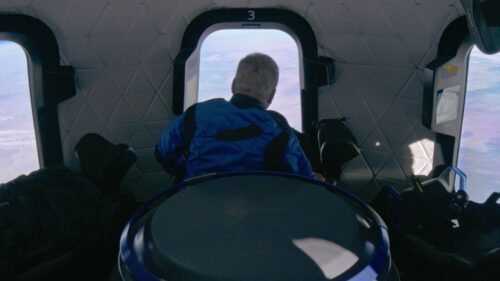
** USA – Oct.13: Blue Origin flies William Shatner and three others to suborbital space. The second flight of a New Shepard vehicle with people on board went quite well. The crew included actor William Shatner, who played Captain James T. Kirk on the original Star Trek series, Dr. Chris Boshuizen, a former NASA engineer and co-founder of Planet Labs, Glen de Vries, Vice-Chair, Life Sciences & Healthcare, Dassault Systèmes and co-founder, Medidata, and Audrey Powers, Blue Origin’s Vice President of Mission & Flight Operations.
“What you [Bezos] have done… everybody in the world needs to be in this [capsule]. Everybody in the world needs to see [in tears] … it was unbelievable, unbelievable.”
“William Shatner looks out of the New Shepard windows on NS-18.” Credits: Blue Origin
**** USA – Aug.26: Blue Origin launches an uncrewed New Shepard to suborbital space. This was the seventeenth flight of a New Shepard vehicle, the fourth in 2021, and the eighth for this particular vehicle.
“… a NASA lunar landing technology demonstration a second time on the exterior of the booster, 18 commercial payloads inside the crew capsule, 11 of which are NASA-supported, and an art installation on the exterior of the capsule“.
**** Blue Origin developing reusable second stage for New Glenn heavy lift rocket.
Although Blue Origin has not publicly discussed this effort to build a reusable upper stage for the New Glenn rocket, sources said the company’s primary goal is to bring down the overall launch cost of the New Glenn rocket. The vehicle’s large upper stage, which has a 7-meter diameter and two BE-3U engines, is costly. Making New Glenn fully reusable is necessary for Blue Origin to compete with SpaceX’s Starship launch system.
The tank project is one aspect of the reusable upper stage program, and the other aspect is selecting and finalizing a design for the second stage. Both of these projects, operating within Blue Origin’s Advanced Development Programs unit, are making progress.
Project Jarvis encompasses the tank program, which is intended to rapidly prototype a propellant tank to withstand the rigors of multiple launches and re-entries. The company’s engineers are studying the use of stainless steel as a material for these tanks, as SpaceX has chosen to do with its Starship booster and upper stage. Stainless steel is cheaper and better able to withstand atmospheric heating during re-entry, but it’s about five times heavier than composites.
**** Video updates on New Glenn rocket and the BE-4 engine:
Virgin Galactic today announced that it will now begin its planned enhancement program for VMS Eve and VSS Unity and will conduct the Unity 23 test flight after this work is complete.
The enhancement program is designed to improve vehicle performance and flight-rate capability for VMS Eve and VSS Unity. In preparation for this work, Virgin Galactic has been performing routine tests and analyses to update its material properties database. This data predicts how materials are expected to perform under certain load and environmental conditions and is used to inform the design and manufacturing enhancements that will support increased flight frequency. One of these recent laboratory-based tests flagged a possible reduction in the strength margins of certain materials used to modify specific joints, and this requires further physical inspection.
As is standard in aerospace test and evaluation practices, Virgin Galactic ships are designed to withstand forces that are substantially higher than those experienced in regular use, providing additional margin and layers of safety. The enhancement program is designed to further increase margins that will enable improved reliability, durability and reduced maintenance requirements when in commercial service. While this new lab test data has had no impact on the vehicles, our test flight protocols have clearly defined strength margins, and further analysis will assess whether any additional work is required to keep them at or above established levels. Given the time required for this effort, the Company has determined the most efficient and expedient path to commercial service is to complete this work now in parallel with the planned enhancement program.
Following the enhancement period, the Company intends to complete the vehicle testing program for VMS Eve and VSS Unity, including the planned research test flight with the Italian Air Force, before starting commercial flights.
**** Virgin Galactic raises ticket prices to $450k for a ride to space. The first commercial flight is now delayed till the second half of 2022 due to a various upgrades for the two SS2 vehicles (“VSS Unity” and “VSS Imagine“) and the WhiteKnightTwo “VMS Eve” carrier aircraft. The modificiations will enable a higher flight rate for the rocketplanes (roughly one month turnaround between flights rather than two months). With the changes, Eve will need major refurbishment every 100 flights rather than every 10.
Virgin Galactic will also begin test flights in the second half of 2022 of VSS Imagine, its first SpaceShipIII vehicle that the company unveiled in March. Colglazier said that work on a second SpaceShipIII vehicle, VSS Inspire, is on hold to focus resources on VSS Imagine, VSS Unity and VMS Eve.
The company is betting its long-term sustainability on a future “Delta class” of suborbital spaceplanes, which would be air-launched from a next-generation aircraft that replaces WhiteKnightTwo. It expects those vehicles to fly more frequently and affordably that current vehicles, allowing the company to increase its flight rate and turn toward profitability.
“The key to our ramp up is really leaning heavily into the Delta class as well as getting motherships that will carry all those spaceships,” he said, declining to provide specifics on production plans and schedules for those vehicles. “Delta class and the new mothership program clearly are important new programs for us as a company and we’ll be aligning our energy towards them.”
Here is a new promotional video:
An extraordinary spaceship design fit for an out-of-this-world experience. Learn how Virgin Galactic’s flight technology is revolutionizing space travel.
*** Controversy arises over an anomaly during SpaceShipTwo Unity’s flight back from space in July when Richard Branson was on board.
**** A possible defect flagged by a a third-party supplier was investigated. The company said on Oct.14th that the issue has been resolved.:
… the Company’s recent inquiry into a potential defect in a supplier component announced on September 10, 2021, […] has been successfully resolved. While the supplied component in question was not on either VMS Eve or VSS Unity, in accordance with safety protocols, Virgin Galactic completed detailed inspections and scans which found all components met quality and safety standards and were ready for flight. The enhancement period is now beginning approximately one month later than anticipated, and commercial service is now expected to commence in Q4 2022.
** Relativity Space prepares for first launch of Terran 1 rocket. Lift off from Cape Canaveral now set for early 2022.
We’re excited to share that Terran 1 Stage 2 just passed cryo pressure proof and hydro mechanical buckling test on our structural test stand. Up next: Stage 1 structural testing!
Here at Relativity, we’re often focused on the future, but we’re taking a beat to recognize our team’s hard work getting to this critical pre-launch phase. In 12 months, we’ve finalized Terran 1’s architecture, developed a brand new engine, upgraded its material, and grew from 150-500+ employees, all while keeping everyone’s safety a top priority.
Terran 1’s demonstration launch is now set for early 2022 from Cape Canaveral LC-16. While we recognize the wins of today, we will continue working at a breakneck speed, and provide updates along the way—as we prepare to launch the world’s first entirely 3D printed rocket.
Higher altitudes & faster speeds: Xogdor will be our fastest rocket yet! It will test descent and landing technologies at high subsonic speeds up to 200 meters per second (447 miles per hour).
Based on customer needs, Xogdor will also be capable of supersonic speeds to fly to the edge of space on a suborbital trajectory. Why is this important? Supersonic speeds of approximately Mach 3.5 are required to cross the Karman Line (100 km above Earth’s mean sea level). By deploying these speeds on Xogdor, we can test payloads in upper atmosphere and near-space environments with reduced gravity.
Ultimately, the closer we can simulate the lunar and Martian environment, the more accurately we can reduce risks and enable mission success with our test flights.
More payload accommodations: Xogdor will have payload capacity of at least 200 kg with accommodations that include power, data storage, thermal control, and ground telemetry. Xogdor can also provide a fully pressurized or vacuum environment for payloads. Since Earth has a thicker atmosphere than the Moon and Mars, Xogdor will have a layer in the control system that minimizes the effects of the atmosphere, such as lift and drag, from the technologies being tested.
The vehicle will also enable studies of long range point-to-point travel:
With the ability to fly longer ranges, Xogdor also offers more flexibility when it comes to the launch and landing location. That means we don’t necessarily have to launch and land at our Mojave test site. For example, based on a customer needs, we could launch Xogdor at another test site, such as Spaceport America, and land back in Mojave or vice versa. This opens the door for point-to-point payload transportation.
Dawn Aerospace, a New Zealand-Dutch space transportation company, has conducted five flights of the company’s Mk-II Aurora suborbital spaceplane. The flights were to assess the airframe and avionics of the vehicle, and were conducted using surrogate jet engines.
The campaign was run from Glentanner Aerodrome in New Zealand’s South Island. Taxi testing commenced in early July and five flights occurred between the 28th and 30th of July, reaching altitudes of 3,400 feet.
Dawn is creating reusable and sustainable space technologies – suborbital and orbital rocket-powered planes – that operate much like a fleet of aircraft, taking off and landing horizontally at airports.
Mk-II is a suborbital plane designed to fly 100 km above the Earth, and aims to be the first vehicle to access space multiple times per day. The vehicle serves as a technology demonstrator for the two-stage-to-orbit-vehicle, the Mk-III. Mk-II will also be used to capture atmospheric data used for weather and climate modelling, and to conduct scientific research and technology demonstrations.
** Rocket Factory Ausburg (RFA) pressure tests booster to destruction. The successful test of the steel structure marks an important milestone in the German company’s march towards a debut launch of the RFA One rocket in 2022 from Norway’s Andøya space port. The company recently announced progress with engine tests in Kiruna, Sweden. The booster will use nine full-scale staged combustion engines that burn kerosene and liquid oxygen. A second stage will use one of the same engines. An orbital third stage will place payloads into the desired orbit. The rocket will put up to 1600 kilograms into low earth orbit. The company says the first stage will be recovered and reused but has not given details on how this will be implemented.
You can’t make an omelet without breaking eggs! With our burst test, we pushed the limits of our first stage and successfully tested several systems and processes. A new first stage is already being built. On we go!
** A June update on Skyrora small lift rocket developer in Scotland:
In this week’s episode we chat with Skyrora’s Business Operations Manager Derek Harris. We discuss how Skyrora have been doing through the UK lockdown, ESA Boost Initiative funding, updates on Skyrora’s 2021 test launch and other exclusive updates! Skyrora designs, manufactures and deploys rockets to clear the way for small satellite manufacturers looking to access Space. Headquartered in Edinburgh, and with facilities across Europe, Skyrora is developing launch vehicle technology to ensure that the life-changing benefits of space are realised here on earth.
** Light-lift rocket company Isar Aerospace of Germany gains payload contracts:
Pretty cool footage of a 100 metre altitude vertical takeoff, vertical landing test by Chinese launch startup Deep Blue Aerospace today, following a 10-metre test in July. [DBA] https://t.co/GraIJEFHFlpic.twitter.com/p7DTz4Udh9
A historic UK first has taken place in the Outer Hebrides today (Thursday 26th August) with a unique commercial space launch conducted by a wholly-owned British company and a Scottish spaceport team.
Spaceport 1 joined forces with East Anglian firm Gravitilab Aerospace Services on the sub-orbital launch of flight test vehicle ‘ADA’, named after Ada Lovelace, the 19th century English mathematician who is considered the world’s first computer programmer.
ADA took off from Benbecula marking a successful launch for Spaceport 1, the consortium led by Comhairle nan Eilean Siar (Western Isles Council), which aims to open at Scolpaig, North Uist, in 2022. From this base, commercial sub-orbital space launches will begin to take place from within the UK.
The landmark launch moment represents a key milestone for this unique commercial partnership between Spaceport 1 and Gravitilab, providing proper physical evidence of how companies can work together commercially under the new Government space framework to deliver a successful rocket launch from the UK.
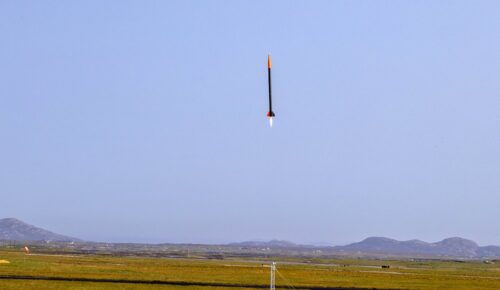
Gravitilab ADA suborbital rocket launches from the Outer Hebrides Spaceport 1 site.
The company has several other suborbital rockets in its fleet. A drop-pod system using a drone is also available:
Louis brings the laboratory to you, so you can undertake your research, de-risk your technology and validate your designs. Whether you’re looking for end-to-end campaign support or a streamlined route to launch, we provide the service so you can focus on the results. With a lead time to launch of one month and a cost from £63 per second of microgravity, we think you’ll agree it’s worth discovering more about this unique member of our fleet.
Payload: up to 6kg Microgravity duration: 5-10 seconds per drop Altitude: 600m-2,000m Available from: Q4 2021
==================
Check out the The Lurio Report
for news and analysis of key developments in NewSpace
The latest issue: Space Suit Opportunities, Inspiration4, FAA & Starship
Vol. 16, No. 6, September 22, 2021
Space Frontier Foundation Award for NewSpace Journalism
Can nuclear propulsion fundamentally transform our ability to send humans to Mars? Bhavya Lal, a policy and nuclear engineering expert now working at NASA, helped write a new report on the topic for the National Academies of Sciences. She joins the show to talk about the advantages of various types of nuclear propulsion, the engineering and policy challenges that face them, and the role of government versus the private sector in developing and deploying transformational technologies.
** NSS Space Forum – Rocket Summer: The Adventures of Blue Origin, SpaceX, and Virgin Galactic – National Space Society
It’s rocket summer! There has never been a summer like this in the history of commercial space. Virgin Galactic has just made a successful flight with Sir Richard Branson on board as one of the passengers. Blue Origin flew a crew of four to space on July 20 aboard its New Shepard vehicle, with Jeff Bezos as one of the passengers. SpaceX’s Starship may be making its first full-up orbital test flight later this summer. NSS Space Ambassadors Loretta Hall, Bruce Mackenzie, Casey Steadman, and moderator Jim Plaxco provided an overview of these historic events and discussed their larger implications for the development of commercial space.
** Aug.13: Media Telecon: NASA, Boeing to Provide Update on Starliner’s Orbital Flight Test-2 – NASA Video
** How India Developed World Class Rockets From Humble Beginnings. – Scott Manley
** ULA Stops Selling Atlas Rocket Launches – Scott Manley
The Atlas rocket traces its ancestry back to the 1950’s, it’s been at the core of the US space capabilities, carrying historic payloads for NASA, the DoD and commercial partners. This week ULA made it clear that it has no more Atlas rockets for sale as it move to transition to Vulcan which is not reliant on engines from Russia. There are 29 launches left, which is likely more than some ‘new’ rockets, but this decade should see the final flights of Atlas, Delta and Proton – all historic vehicles with their roots in the cold war.
 Here is the debut episode: Episode 1: Welcome to the Age of Discovery 2.0: