This week’s episode of NASA’s Space to Ground report on activities related to the Int. Space Station:
This week’s episode of NASA’s Space to Ground report on activities related to the Int. Space Station:
A New Horizons image shows an interesting feature:
NASA’s New Horizons spacecraft spied several features on Pluto that offer evidence of a time millions or billions of years ago when – thanks to much higher pressure in Pluto’s atmosphere and warmer conditions on the surface – liquids might have flowed across and pooled on the surface of the distant world.
![Pond[1]](http://hobbyspace.com/Blog/wp-content/uploads/2016/03/Pond1.jpg)
This feature appears to be a frozen, former lake of liquid nitrogen, located in a mountain range just north of Pluto’s informally named Sputnik Planum. Captured by the New Horizons’ Long Range Reconnaissance Imager (LORRI) as the spacecraft flew past Pluto on July 14, 2015, the image shows details as small as about 430 feet (130 meters). At its widest point the possible lake appears to be about 20 miles (30 kilometers) across.
===
See also a recent presentation of New Horizons results so far: New Horizons Team Presents Latest Pluto Science Results at Planetary Conference.
The Dawn Mission unveils new images and findings at the dwarf planet Ceres in the asteroid belt:
Bright Spots and Color Differences Revealed on Ceres
Scientists from NASA’s Dawn mission unveiled new images from the spacecraft’s lowest orbit at Ceres, including highly-anticipated views of Occator Crater, at the 47th annual Lunar and Planetary Science Conference in The Woodlands, Texas, on Tuesday.
![PIA20350-16-640x350[1]](http://hobbyspace.com/Blog/wp-content/uploads/2016/03/PIA20350-16-640x3501.jpg)
“Before Dawn began its intensive observations of Ceres last year, Occator Crater looked to be one large bright area. Now, with the latest close views, we can see complex features that provide new mysteries to investigate,” said Ralf Jaumann, planetary scientist and Dawn co-investigator at the German Aerospace Center (DLR) in Berlin. “The intricate geometry of the crater interior suggests geologic activity in the recent past, but we will need to complete detailed geologic mapping of the crater in order to test hypotheses for its formation.”
![PIA20352_ip[1]](http://hobbyspace.com/Blog/wp-content/uploads/2016/03/PIA20352_ip1-1024x576.jpg)
The team also released an enhanced color map of the surface of Ceres, highlighting the diversity of surface materials and their relationships to surface morphology. Scientists have been studying the shapes of craters and their distribution with great interest. Ceres does not have as many large impact basins as scientists expected, but the number of smaller craters generally matches their predictions. The blue material highlighted in the color map is related to flows, smooth plains and mountains, which appear to be very young surface features.
![PIA20355_ip[1]](http://hobbyspace.com/Blog/wp-content/uploads/2016/03/PIA20355_ip1-1024x522.jpg)
![PIA20351_ip[1]](http://hobbyspace.com/Blog/wp-content/uploads/2016/03/PIA20351_ip1-1024x525.jpg)
Data relevant to the possibility of subsurface ice is also emerging from Dawn’s Gamma Ray and Neutron Detector (GRaND), which began acquiring its primary data set in December. Neutrons and gamma rays produced by cosmic ray interactions with surface materials provide a fingerprint of Ceres’ chemical makeup. The measurements are sensitive to elemental composition of the topmost yard (meter) of the regolith.
![PIA20353_ip[1]](http://hobbyspace.com/Blog/wp-content/uploads/2016/03/PIA20353_ip1-1024x576.jpg)
“Our analyses will test a longstanding prediction that water ice can survive just beneath Ceres’ cold, high-latitude surface for billions of years,” said Tom Prettyman, the lead for GRaND and Dawn co-investigator at the Planetary Science Institute, Tucson, Arizona.
NASA’s Lunar Reconnaissance Orbiter has been circling the Moon since June 2009 and has been imaging the lunar surface at much higher resolution than obtained during previous missions going back to the Apollo era. The images can be quite spectacular and some of the most striking are currently on display in an exhibition called A New Moon Rises at the National Air and Space Museum in Washington D.C. Here is a report on the show: Desolate magnificence – The Space Review.
Below is a sampling of the Craters, Vistas, and Major Discoveries on display:
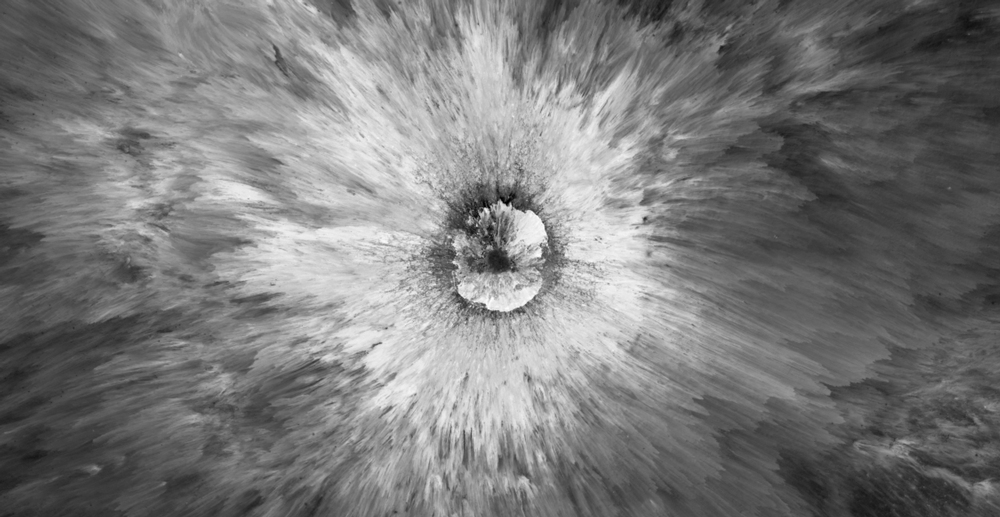
The image below shows “A Very Young Crater” with [spectacular] ejecta surround it. The crater is
about 1,400 meters (4,600 feet) across. Since there are no superimposed impact craters on the ejecta, and the delicate lacy impact spray is still preserved near the rim, this crater formed very recently, perhaps sometime in the past few thousand years.
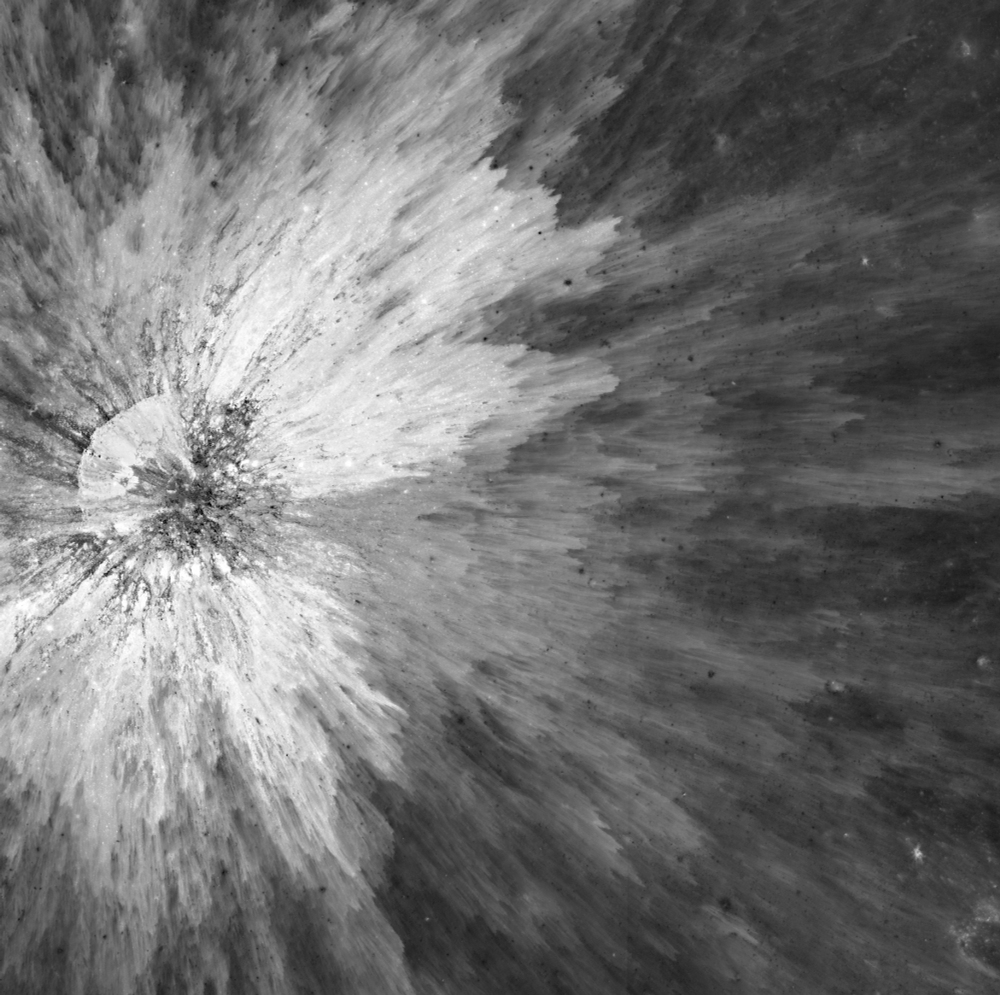
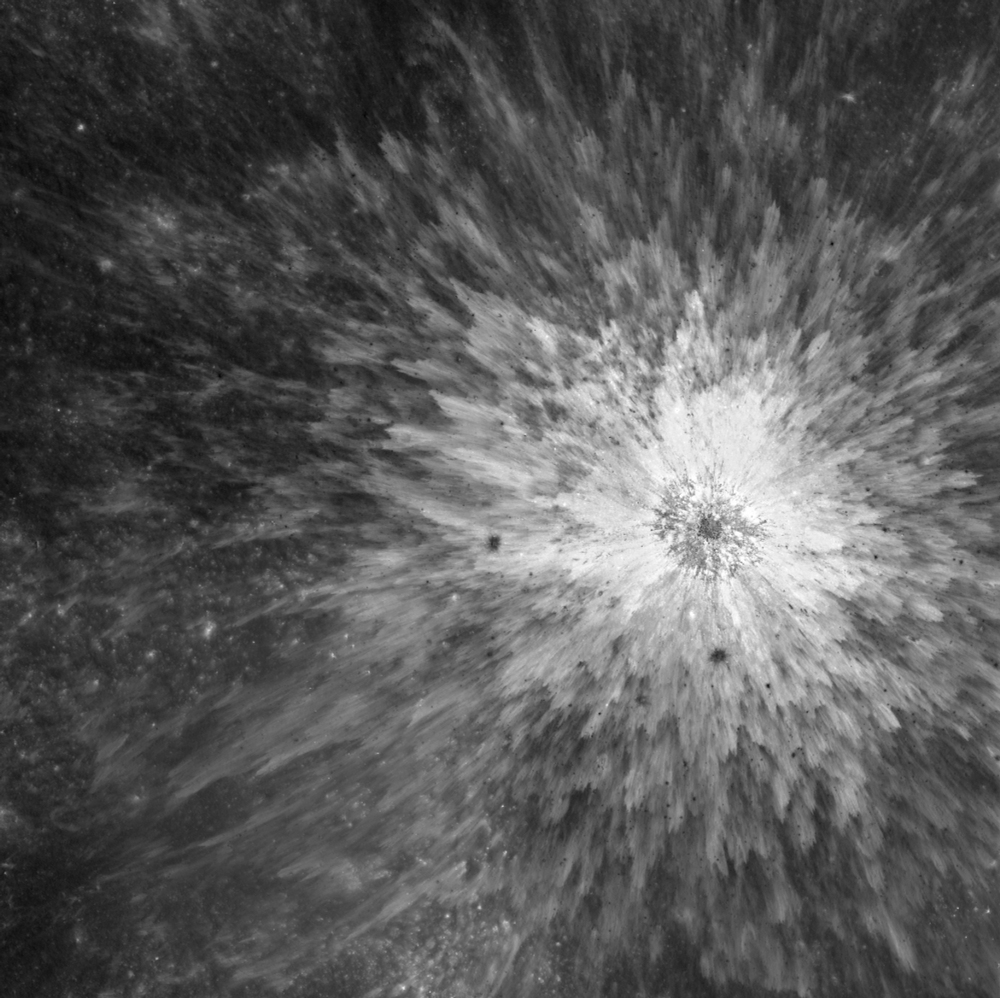
Below are two “Copernican Craters” that have
… large, spectacular ejecta patterns of bright material thrown across the Moon’s surface. These craters are no more than 1 billion years old—”Copernican age” in the lunar geologic timescale. Because they are so bright and have few impact craters on them, they may be as young as a few million years. Each is incredibly well preserved: crisp crater rims, steep crater walls, and delicate small-scale ejecta patterns. The overhead sunlight highlights the brightness variations.
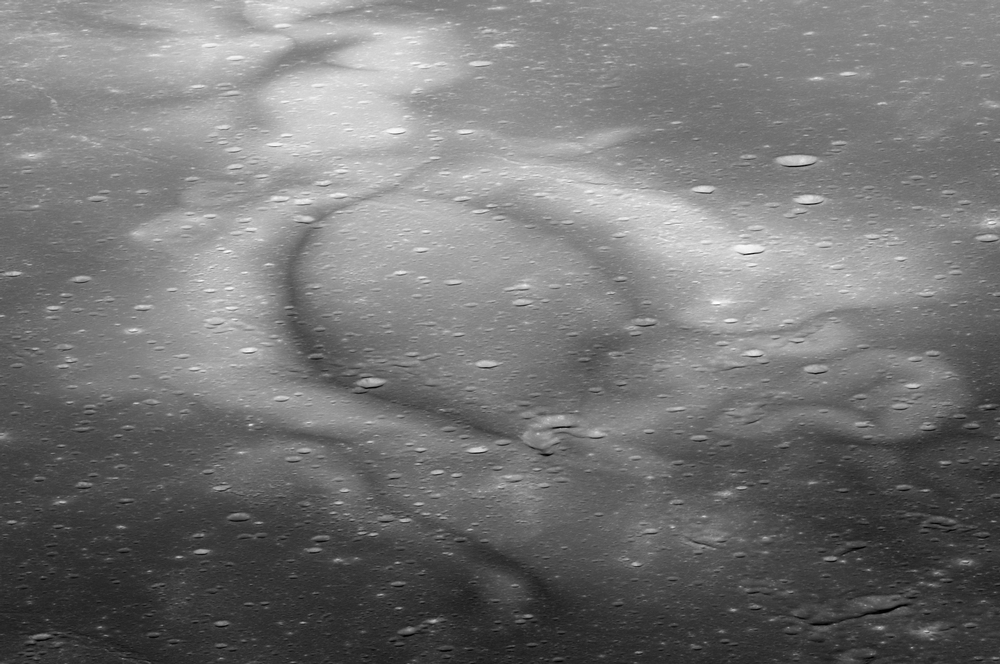
The lunar feature below is titled, “The Strangest of Swirls”
Reiner Gamma is one of the Moon’s most distinctive and mysterious features. This striking, tadpole-shaped swirl puzzles lunar scientists. Some think that its origin, as with other swirls, is somehow related to the shielding effects of localized magnetic field anomalies.
The images below
…, taken at different times, reveal that a cave extends at least 25 meters (82 feet) under the surface of the Moon. Collapse pits, where the near-surface lunar crust has caved in, can provide a window into the shallow subsurface. Image IDs: M126710873R, M155016845R, M152662021R
![11829p[1]](http://hobbyspace.com/Blog/wp-content/uploads/2016/03/11829p1.jpg)
—
Here is an entertaining video about how the LRO is operated:
Here is this week’s episode of NASA’s Space to Ground update on Int. Space Station related happenings:
Note that you can watch today’s Soyuz launch of three new crew members – NASA astronaut Jeff Williams and cosmonauts Oleg Skripochka and Alexey Ovchinin of Roscosmos – to the station via NASA TV. Liftoff from the Baikonur Cosmodrome in Kazakhstan is at 5:26 p.m. EDT Friday, March 18 (3:26 a.m. on March 19)is : Watch NASA TV for Launch of Next Crew – Space Station –