Satellite observation of earth has become an essential tool for monitoring and studying what is happening on our planet on the short and long term. Here is a good sampling of the amazing diversity of applications and benefits of earth observation satellites: 100 Earth Shattering Remote Sensing Applications & Uses – GIS Geography.
A sampling from the list:
5. Predicting retail earnings and market share by counting cars in parking lots
9. Searching for aircrafts and saving lives after fatal crashes
10. Detecting oil spills for marine life and environmental preservation
19. Extracting mineral deposits with hyperspectral remote sensing
38. Keeping tabs on the shift from rural to urban growth
59. Monitoring active volcanoes using thermal remote sensing
69. Understanding the human rights situation in North Korea
89. Improving efficiency and safety of air traffic control
BTW, on Wednesday the Indian space agency ISRO plans to launch a PSLV rocket to send 104 satellites into polar orbit.
The payload consists of one large Indian earth observation (EO) satellite – Cartosat -2 – and 103 smallsats, including 88 Doves for the earth observation company Planet, which will expand its constellation of small and large EO satellites to over 140. Once it has its full constellation in orbit, Planet will produce a complete image of the entire earth every day.
These videos give an overview of Planet’s plans and capabilities:
Planet has also had many Doves injected into lower inclination orbits via deployment from the International Space Station. This video shows a sampling of such deployments, which are arranged by the company NanoRacks;
This week, Lisa Stojanovski gives an update on how the Bigelow Expandable Activity Module (BEAM) is going on the International Space Station, and potential plans for its future.
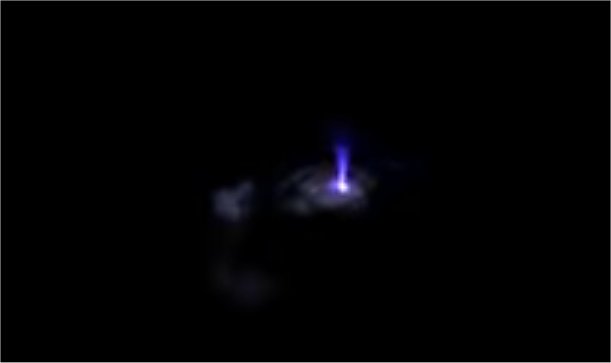
Screen capture from video of blue jet of lightning as seen from the ISS.
For years, their existence has been debated: elusive electrical discharges in the upper atmosphere that sport names such as red sprites, blue jets, pixies and elves. Reported by pilots, they are difficult to study as they occur above thunderstorms.
ESA astronaut Andreas Mogensen during his mission on the International Space Station in 2015 was asked to take pictures over thunderstorms with the most sensitive camera on the orbiting outpost to look for these brief features.
Denmark’s National Space Institute has now published the results, confirming many kilometre-wide blue flashes around 18 km altitude, including a pulsating blue jet reaching 40 km. A video recorded by Andreas as he flew over the Bay of Bengal at 28 800 km/h on the Station shows the electrical phenomena clearly – a first of its kind.
The Station’s low orbit makes it an ideal platform from which to observe and study these unusual electrical atmospheric phenomena. In the video below,
ESA astronaut Andreas Mogensen explains the phenomena he filmed over India from the International Space Station’s Cupola observatory in September 2015 during his postflight tour at ESA’s technical heart ESTEC in The Netherlands.
The film shows lightning illuminating clouds and recently discovered phenomena called blue jets and Red Sprites.
As part of his 10-day mission Andreas performed an experiment called Thor after the god of thunder, lightning and storms in Nordic mythology. Initiated by the Technical University of Denmark, Thor had Andreas test a new thundercloud imaging system that looks at the electrification of lighting.
Researchers are particularly interested in newly-discovered lights that occur in the upper atmosphere during thunderstorms called red sprites, blue jets and elves. Sprites last 20 milliseconds at most, and to capture them on camera is a real challenge. They received their name because of their elusive nature. Blue jets are found up to 50 km altitude with Red Sprites occurring between 60-80 km altitude.
Andreas received the coordinates of a few possible thunderstorms together with the times and instructions on which lens, filter and camera settings to use.
Some of the most violent electric discharges are very difficult to capture from the ground because the atmosphere blocks radiation. Apart from covering all the main thunderstorm regions, the International Space Station brings scientists as close as possible to the electric phenomena. Its great vantage point has the lowest orbit available for observation at around 400 km altitude – imaging satellites mostly operate at 800 km.
NASA’s Cassini probe at Saturn returns amazing views of the outer rings as it makes its final orbits before plunging into the planet’s atmosphere on September 15th :
Newly released images showcase the incredible closeness with which NASA’s Cassini spacecraft, now in its “Ring-Grazing” orbits phase, is observing Saturn’s dazzling rings of icy debris.
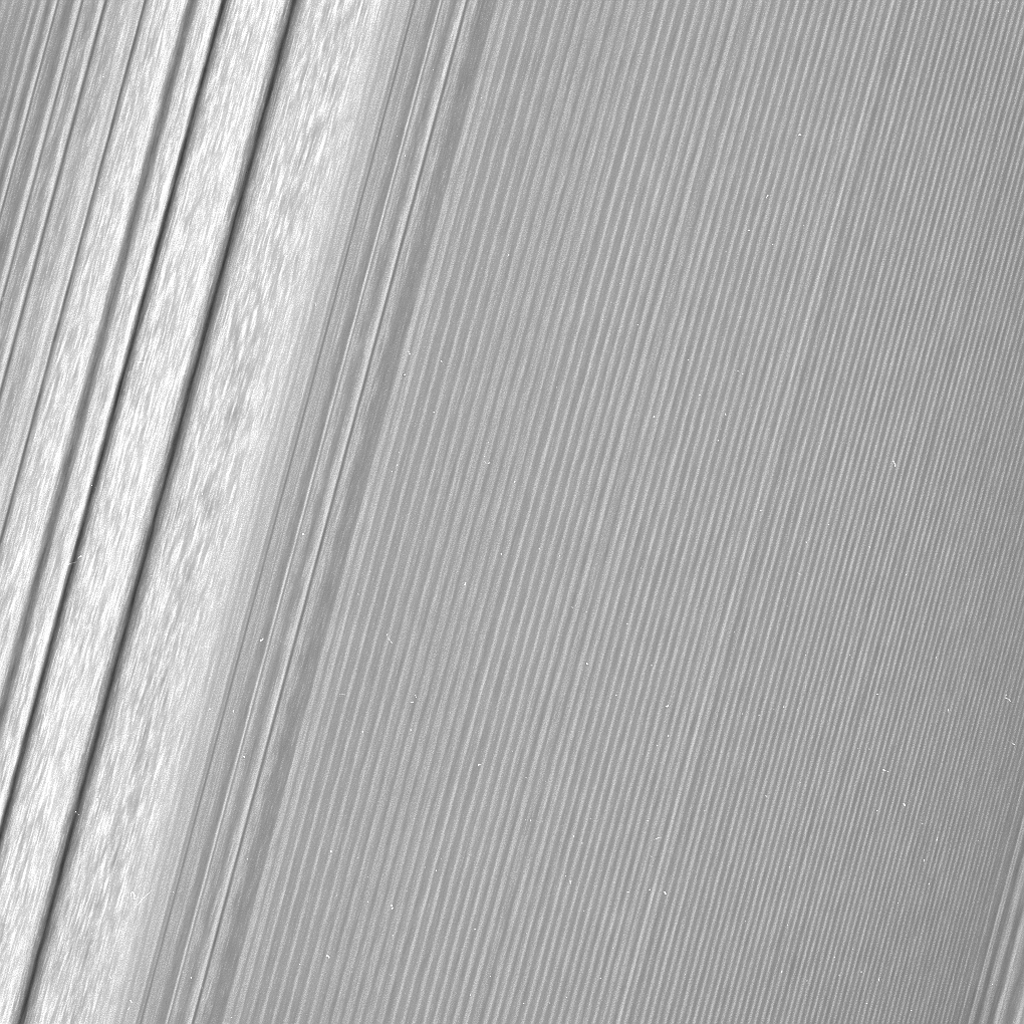
This Cassini image features a density wave in Saturn’s A ring (at left) that lies around 134,500 km from Saturn. Density waves are accumulations of particles at certain distances from the planet. This feature is filled with clumpy perturbations, which researchers informally refer to as “straw.” Image Credit: NASA/JPL-Caltech/Space Science Institute › Full image and caption
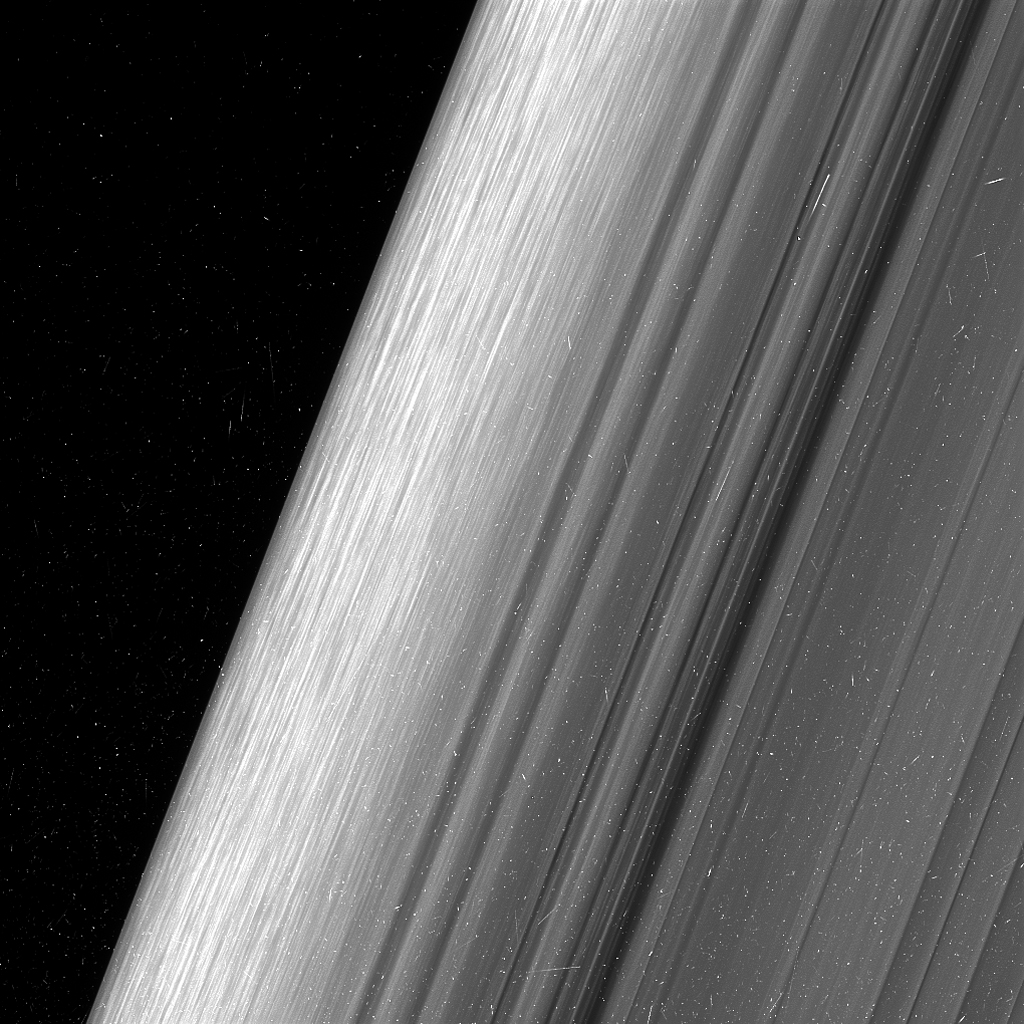
The views are some of the closest-ever images of the outer parts of the main rings, giving scientists an eagerly awaited opportunity to observe features with names like “straw” and “propellers.” Although Cassini saw these features earlier in the mission, the spacecraft’s current, special orbits are now providing opportunities to see them in greater detail. The new images resolve details as small as 0.3 miles (550 meters), which is on the scale of Earth’s tallest buildings.
Cassini is now about halfway through its penultimate mission phase — 20 orbits that dive past the outer edge of the main ring system. The ring-grazing orbits began last November, and will continue until late April, when Cassini begins its grand finale. During the 22 finale orbits, Cassini will repeatedly plunge through the gap between the rings and Saturn. The first finale plunge is scheduled for April 26.
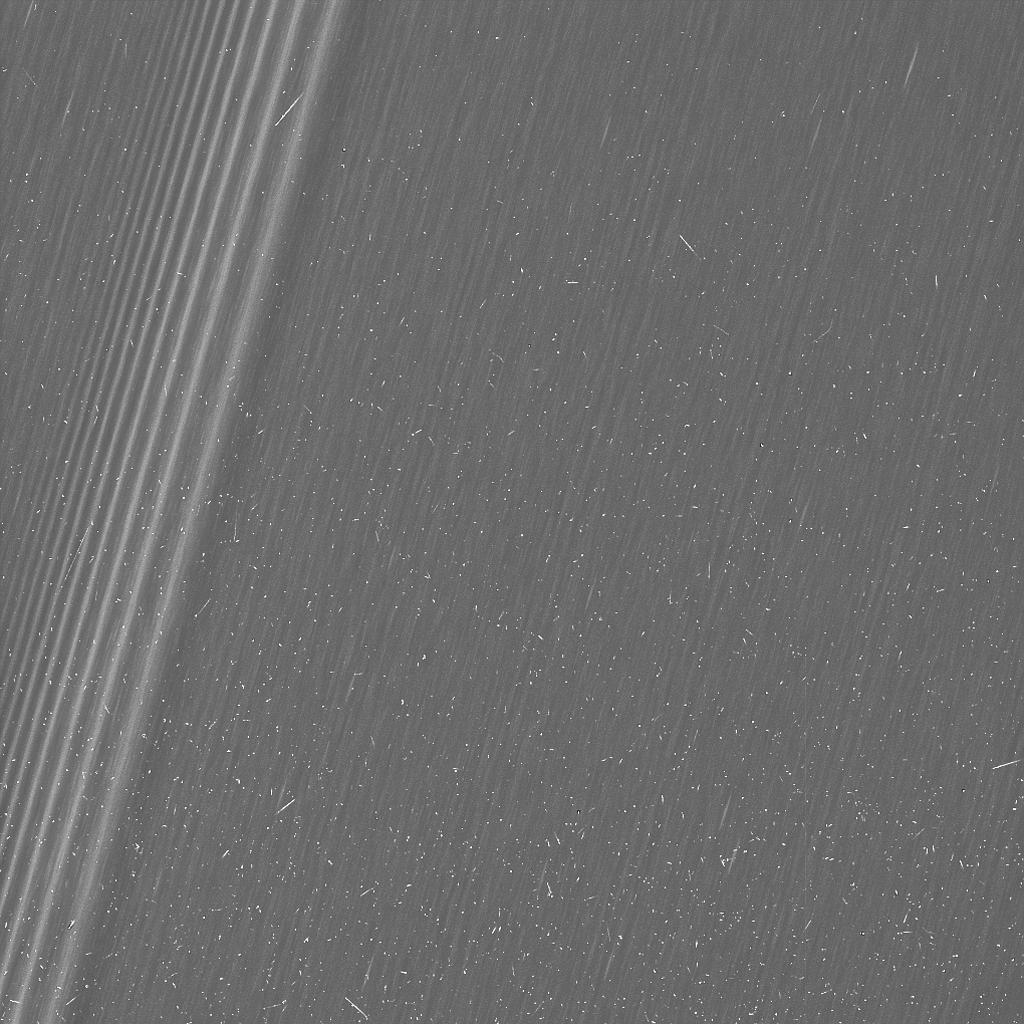
This image from NASA’s Cassini mission shows a region in Saturn’s A ring. The level of detail is twice as high as this part of the rings has ever been seen before. The view contains many small, bright blemishes due to cosmic rays and charged particle radiation near the planet. Image Credit: NASA/JPL-Caltech/Space Science Institute › Full image and caption
For now, the veteran spacecraft is shooting past the outer edges of the rings every week, gathering some of its best images of the rings and moons. Already Cassini has sent back the closest-ever views of small moons Daphnis and Pandora.
Some of the structures seen in recent Cassini images have not been visible at this level of detail since the spacecraft arrived at Saturn in mid-2004. At that time, fine details like straw and propellers — which are caused by clumping ring particles and small, embedded moonlets, respectively — had never been seen before. (Although propellers were present in Cassini’s arrival images, they were actually discovered in later analysis, the following year.)
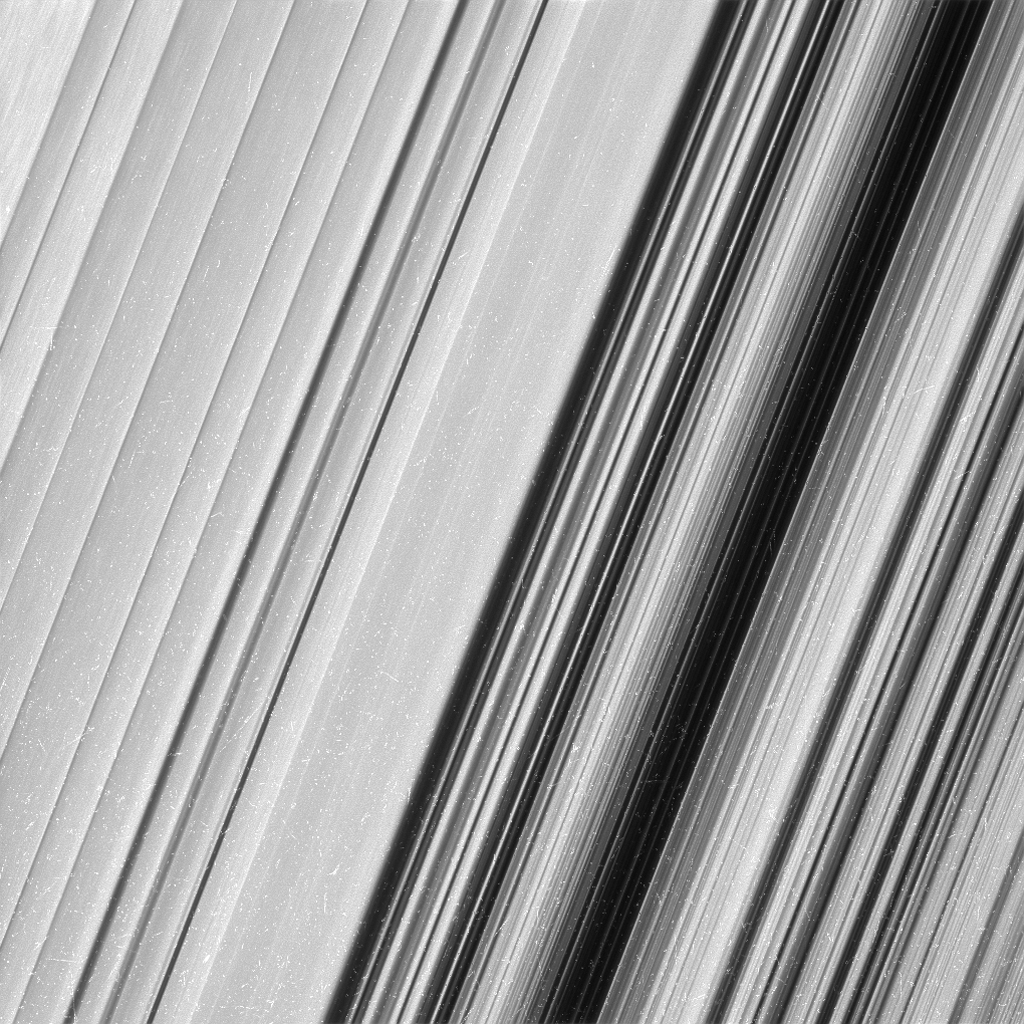
This image shows a region in Saturn’s outer B ring. NASA’s Cassini spacecraft viewed this area at a level of detail twice as high as it had ever been observed before. And from this view, it is clear that there are still finer details to uncover. Image Credit: NASA/JPL-Caltech/Space Science Institute › Full image and caption
Cassini came a bit closer to the rings during its arrival at Saturn, but the quality of those arrival images (examples: 1, 2, 3) was not as high as in the new views. Those precious few observations only looked out on the backlit side of the rings, and the team chose short exposure times to minimize smearing due to Cassini’s fast motion as it vaulted over the ring plane. This resulted in images that were scientifically stunning, but somewhat dark and noisy.
In contrast, the close views Cassini has begun capturing in its ring-grazing orbits (and soon will capture in its Grand Finale phase) are taking in both the backlit and sunlit side of the rings. Instead of just one brief pass lasting a few hours, Cassini is making several dozen passes during these final months.
“As the person who planned those initial orbit-insertion ring images — which remained our most detailed views of the rings for the past 13 years — I am taken aback by how vastly improved are the details in this new collection,” said Cassini Imaging Team Lead Carolyn Porco, of Space Science Institute, Boulder, Colorado. “How fitting it is that we should go out with the best views of Saturn’s rings we’ve ever collected.”
After nearly 13 years studying Saturn’s rings from orbit, the Cassini team has a deeper, richer understanding of what they’re seeing, but they still anticipate new surprises.
“These close views represent the opening of an entirely new window onto Saturn’s rings, and over the next few months we look forward to even more exciting data as we train our cameras on other parts of the rings closer to the planet,” said Matthew Tiscareno, a Cassini scientist who studies Saturn’s rings at the SETI Institute, Mountain View, California. Tiscareno planned the new images for the camera team.
Launched in 1997, Cassini has been touring the Saturn system since arriving in 2004 for an up-close study of the planet, its rings and moons, and its vast magnetosphere. Cassini has made numerous dramatic discoveries, including a global ocean with indications of hydrothermal activity within the moon Enceladus, and liquid methane seas on another moon, Titan.
This image shows a region in Saturn’s outer B ring. NASA’s Cassini spacecraft viewed this area at a level of detail twice as high as it had ever been observed before. Image Credit: NASA/JPL-Caltech/Space Science Institute › Full image and caption
The Cassini-Huygens mission is a cooperative project of NASA, ESA (European Space Agency) and the Italian Space Agency. NASA’s Jet Propulsion Laboratory in Pasadena, California, manages the mission for the agency’s Science Mission Directorate in Washington. JPL is a division of Caltech in Pasadena. The Cassini imaging operations center is based at Space Science Institute in Boulder, Colorado.