Here is a video of a Russian Soyuz blasting off on Thursday to take a Russian cosmonaut and a NASA astronaut to the station:
Just six hours later the Soyuz spacecraft docked to the ISS:
China also has a space station. On Thursday launched a Long March 7 rocket with the Tianzhou-1 cargo vehicle at the Wenchang Space Launch Center in south China’s Hainan Province. The spacecraft will dock with the unoccupied Tiangong-2 space station. It will transfer fuel to the station so that it can maintain its orbit.
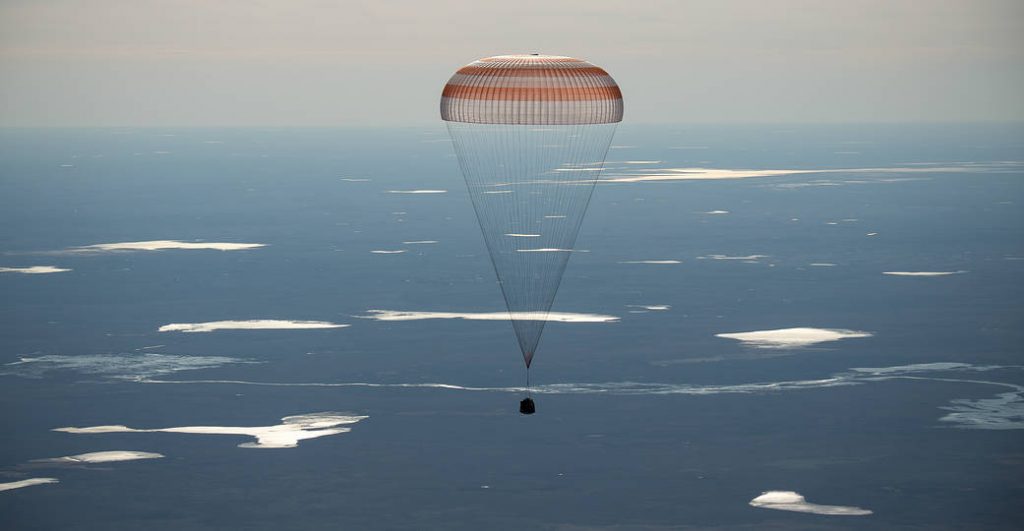
The Soyuz MS-02 spacecraft is seen as it lands with Expedition 50 Commander Shane Kimbrough of NASA and Flight Engineers Sergey Ryzhikov and Andrey Borisenko of Roscosmos near the town of Zhezkazgan, Kazakhstan on Monday, April 10, 2017 (Kazakh time). Kimbrough, Ryzhikov, and Borisenko are returning after 173 days in space where they served as members of the Expedition 49 and 50 crews onboard the International Space Station. Photo Credit: (NASA/Bill Ingalls)
On Monday, two Russian cosmonauts and a US astronaut returned to earth from the ISS in a Soyuz capsule:
Expedition 50 Commander Shane Kimbrough of NASA and Soyuz Commander Sergey Ryzhikov and Flight Engineer Andrey Borisenko of Roscosmos landed safely near the town of Dzhezkazgan, Kazakhstan April 10 after bidding farewell to their colleagues on the complex and undocking their Soyuz MS-02 spacecraft from the Poisk Module on the International Space Station. The trio spent 173 days in space conducting research and operational work in support of the station.
Here is a longer video with more scenes of the departure from the ISS and the descent and landing:
An earlier posting here described the “Grande Finale” of the Cassini spacecraft mission to Saturn. Here is a panel news conference held last week in which the panelists talked about the final activities of the spacecraft starting with a
final close flyby of Saturn’s moon Titan on April 22 [which] will reshape the Cassini spacecraft’s orbit so that it begins its final series of 22 weekly dives through the unexplored gap between the planet and its rings. The first of these dives is planned for April 26. Following these closer-than-ever encounters with the giant planet, Cassini will make a mission-ending plunge into Saturn’s upper atmosphere on Sept. 15.