This month marks 61 years since the launch of the Sputnik 1 satellite by the Soviet Union on October 4, 1957. Here are three documentaries (of increasing length) about Sputnik and the opening of the Space Age:
Small satellites, which typically refers to spacecraft in the kilogram to a few hundred kilograms range, have become in the past few years a large and growing part of what is happening in space. Smallsats have actually been around since the start of the Space Age. Just a few years after Sputnik reached orbit, the first amateur satellite reached orbit as well. (See A Brief History of AMSAT.) Note that “amateur” here refers primarily to the involvement of the amateur radio community and the use of amateur radio bands for communications with the satellites.
For decades, smallsats remained a niche activity carried out mostly by AMSAT and university student teams. Now companies like Planet and Spire operate hundreds of satellites in orbit for commercial purposes and constellations with thousands of satellites are set to be deployed during the coming years.
After referring to the 84 kg Sputnik, launched in 1957 as a “small satellite,” Dr. Patterson discusses the three keys to the growth of the small sat industry: affordability, responsiveness and shorter development cycles. And because the barrier to entry is so much lower for small satellites, more and more small companies begin to come online bringing a lot more competition, which brings a lot more good ideas to the table.
A mostly SpaceX episode as the ambitious company provides updated details regarding its huge new rocket and introduces its first astronauts. Mat Kaplan shares more from the company’s headquarters, while Planetary Society Digital Editor explains and explores the BFR. Jason also celebrates the successful landing of two asteroid “rovers” from Japan’s Hayabusa2 spacecraft. And we’ll tell you What’s Up in the night sky as we offer another space trivia contest.
** The Space Show | 02 Oct 2018 – Dr. Christopher Morrison talked about “new ideas for space nuclear power, new approaches and fuels being developed by his company, UltraSafe Nuclear Corporation (USNC) and multiple related nuclear space topics“.
** The Space Show | 01 Oct 2018 – Bjarke Gotfredsen from Cape Town, South Africa discussed “STEM in South Africa, global STEM learning with technology tools, astrobiology partnerships with the Carl Sagan Center at SETI, searching for Mars life via the Andes and much more“.
As we learned from our podcasts at the Small Satellite Conference in Utah this August, the small sat industry is simultaneously growing in so many directions…from new streamlined manufacturing techniques, to more launch options, a plethora of emerging applications and, of course the economic outlook for the industry Who better to discuss these issues than Carolyn Belle, Senior Analyst at NSR, who built their Small Satellite practice. Listen as Carolyn discusses the potential impact of SpaceX, One Web and other planned mega constellations on the GEO operators; the impact of new small sat propulsion systems and the emergence of in-orbit services including satellite refueling, life extension and salvage. Carolyn also addresses the hype that has surrounded the industry but believes that we’re only starting to scratch the surface of the value they might deliver moving forward.
Here is the latest Space to Ground report from NASA on activities related to the International Space Station:
Competitive tennis reaches orbit:
Fun Facts about a “Year of Education on Station:
Three ISS crew members returned to earth this week:
The Soyuz MS-08 spacecraft landed in Kazakhstan on 4 October 2018, at 11:45 UTC (07:45 EDT, 17:45 local time) with the International Space Station Expedition 56 crew members, Roscosmos cosmonaut Oleg Artemyev, NASA astronauts A.J. (Drew) Feustel and Ricky Arnold. The three crew members spent 197 days in space.
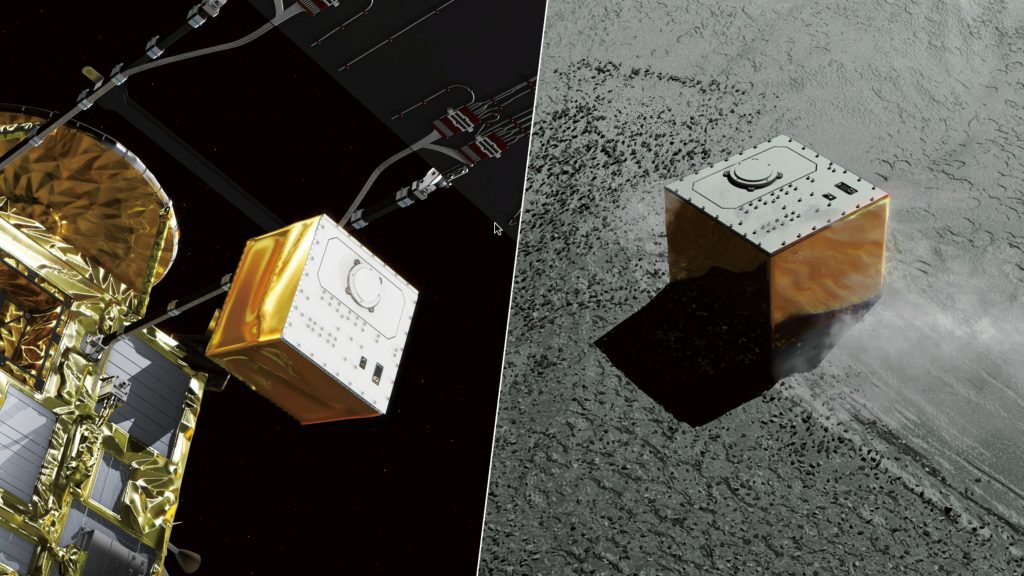
The Japanese Hayabusa-2 spacecraft continues its deployment of remote-control systems onto the asteroid Ryuga (see earlier posting here about deployment of two micro-rovers). On Wednesday the spacecraft released the MASCOT (Mobile Asteroid Surface Scout) lander, which was built by the German Aerospace Center (DLR) and the French Space Agency (CNES).
MicrOmega – a hyperspectral infrared microscope to analyze the mineralogical properties of the surface materials.
MASCAM – “a multispectral wide field camera to provide geological images of the asteroid”.
MARA – a radiometer “to determine the surface temperature and the thermal inertia of the asteroid”.
MASMAG – a magnetometer, which measures magnetic field strength.
This video previewed the MASCOT mission, which lasted about 17 hours before its batteries ran out:
Artist’s view of the deployment of MASCOT:
“Left: Illustration of MASCOT separating from Hayabusa2. Right: Illustration of MASCOT landing on the surface of Ryugu. (Image credit: JAXA)”
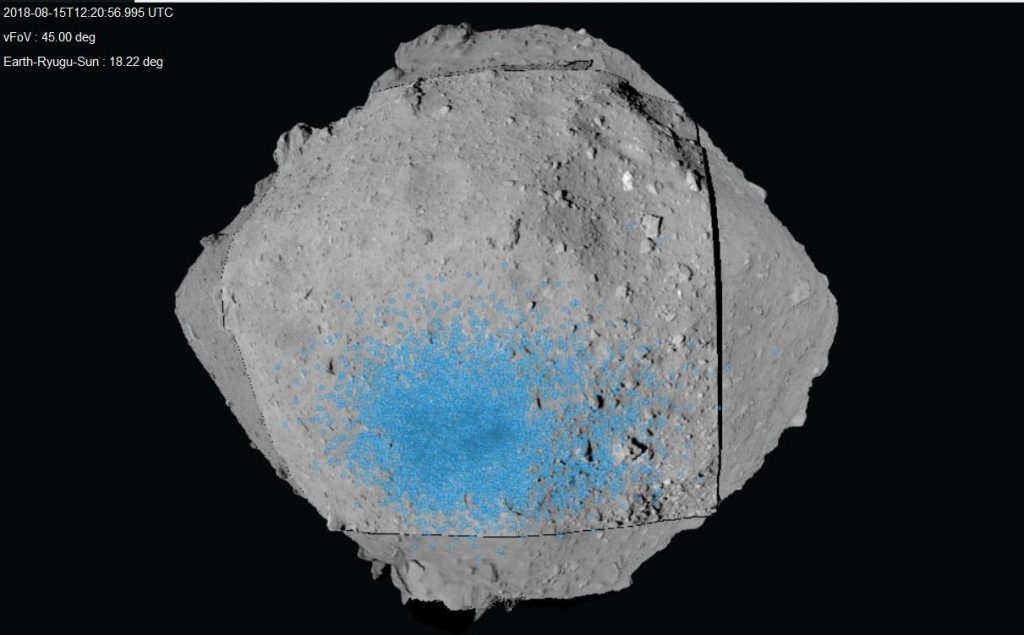
The target area for the MASCOT “landing”:
“MASCOT landing site candidate region (light blue area). Since MASCOT is expected to bounce several times after first touching down, a reasonably wide region is selected. (Image credit: JAXA, University of Tokyo, Kochi University, Rikkyo University, Nagoya University, Chiba Institute of Technology, Meiji University, University of Aizu, AIST, CNES, DLR). “