The SpaceX Falcon 9 launch of over 60 smallsats previously scheduled for launch on the same day as the PSLV was postponed to next Sunday due to high altitude winds. (See earlier posting about the two missions.)
Now targeting December 2 for launch of Spaceflight SSO-A: SmallSat Express from Vandenberg Air Force Base.
Meanwhile, South Korea successfully carried out a suborbital launch of a single-staged rocket. The goal of the flight was to test a domestically developed 75 ton thrust engine that will be used for the three-stage orbital Korea Space Launch Vehicle-2 (KSLV-2). The kerosene/liquid oxygen powered engine appears to have performed as planned:
Purdue University professor, David Spencer is leading an effort to send a CubeSat up for an attempted controlled solar sailing in Earth’s orbit. Solar sailing uses reflective sails to harness the momentum of sunlight for propulsion….
This project is sponsored by the citizen-funded Planetary Society, whose CEO is Bill Nye the Science Guy.
The CubeSat, LightSail 2, is one payload as part of the Air Force’s Space Test Program-2 (STP-2) mission that will launch on the SpaceX Falcon Heavy rocket in early 2019. Spencer’s research team will be tracking LightSail 2, receiving the signal from the spacecraft as well as commanding the spacecraft during operations, from the Space Flight Projects Lab at the Purdue Technology Center.https://engineering.purdue.edu/SFPL
“So the Marco is about double the size of RFTSat, but it’s really cool to see how NASA and JPL are also using cube sats and how NNU is using them too,” said Cox.
The Marcos being cube satellite’s used in conjunction with NASA’s InSight that landed on Mars Monday.
And engineering students at NNU are in the building stages of a satellite with similar features called RFTSat, which is also a version of a cube satellite.
An increasing number of interplanetary missions are aiming at visiting asteroids and other small bodies, since these may provide clues to understand the formation and evolution of our Solar System. CubeSats allow a low-cost solution to land on these objects, as opposed to risking a much more expensive mothership. The weak gravitational field on these small bodies may also enable the possibility of simply dropping a CubeSat from afar (i.e. ballistic landing).
However, ballistic landing of an unpowered spacecraft may be feasible solely within certain asteroid locations, and only if sufficient energy can be dissipated at touchdown. If such conditions are not met, the spacecraft will rebound off the surface. It is likely that the necessary energy dissipation may already occur naturally due to energy loss expected through the deformation of the regolith during touchdown. Indeed, previous low-velocity impact experiments in microgravity seem to indicate that this is exactly the case. However, data from past asteroid touchdowns, Hayabusa and Philae, indicate the contrary.
This paper describes the development of an experiment which aims to bridge the aforementioned disagreement between mission data and microgravity experiment; to understand the behaviour of CubeSat landing on asteroids. …
While Cal Poly’s ninth CubeSat tests a way to reduce vibrations aboard orbiting satellites, the softball-sized satellite also has been busy snapping photos of the Earth.
DAVE, or Damping and Vibrations Experiment, launched Sept. 15 from Vandenberg Air Force Base with three other small satellites, or CubeSats, as secondary payload on NASA’s ICESat-2 (Ice Cloud and Land Elevation Satellite-2) mission.
PolySat, the student-run research lab, released its first high-resolution image that was snapped just hours after the launch. The photo shows Svalbard, the Norwegian archipelago located between Norway and the North Pole.
“This is one of our better pictures,” said Grigory Heaton, a senior studying aerospace engineering and physics. “Our satellite is not controlled. It’s just spinning, so we have to get lucky with the pictures. This one, we were right overhead and got almost the entire archipelago.”
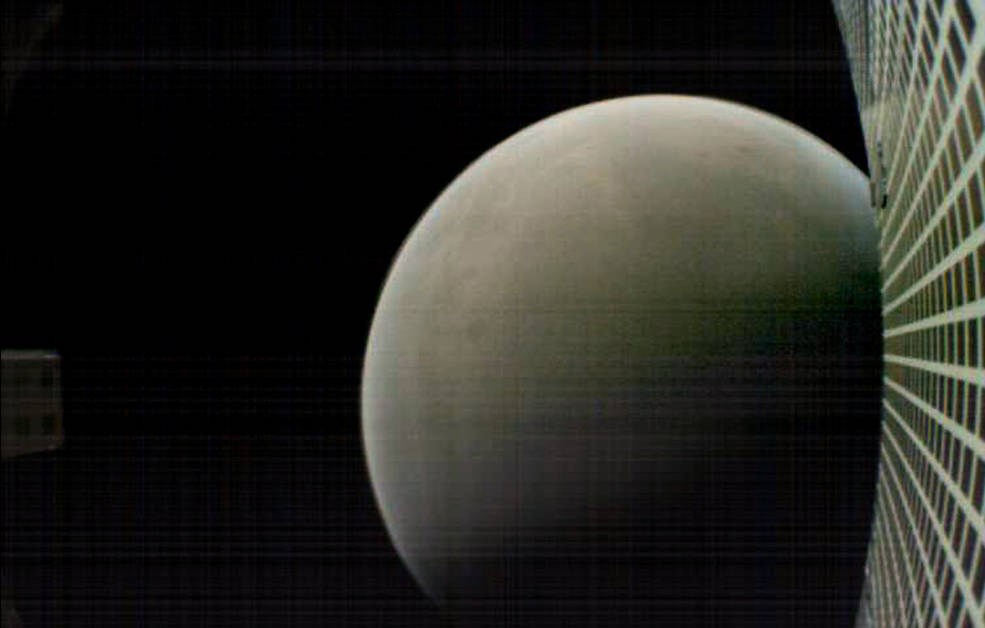
MarCO-B, one of the experimental Mars Cube One (MarCO) CubeSats, took this image of Mars from about 4,700 miles (7,600 kilometers) away during its flyby of the Red Planet on Nov. 26, 2018. MarCO-B was flying by Mars with its twin, MarCO-A, to attempt to serve as communications relays for NASA’s InSight spacecraft as it landed on Mars. Credits: NASA/JPL-Caltech. Full image and caption
iCubeSat – Interplanetary CubeSat Workshop – Milan, Italy – May 28-29, 2019.“iCubeSat 2019, the 8th Interplanetary CubeSat Workshop, will address the technical challenges, opportunities, and practicalities of interplanetary space exploration with CubeSats. The workshop provides a unique environment for open wide ranging practical collaboration between academic researchers, industry professionals, policy makers and students developing this new and rapidly growing field.”
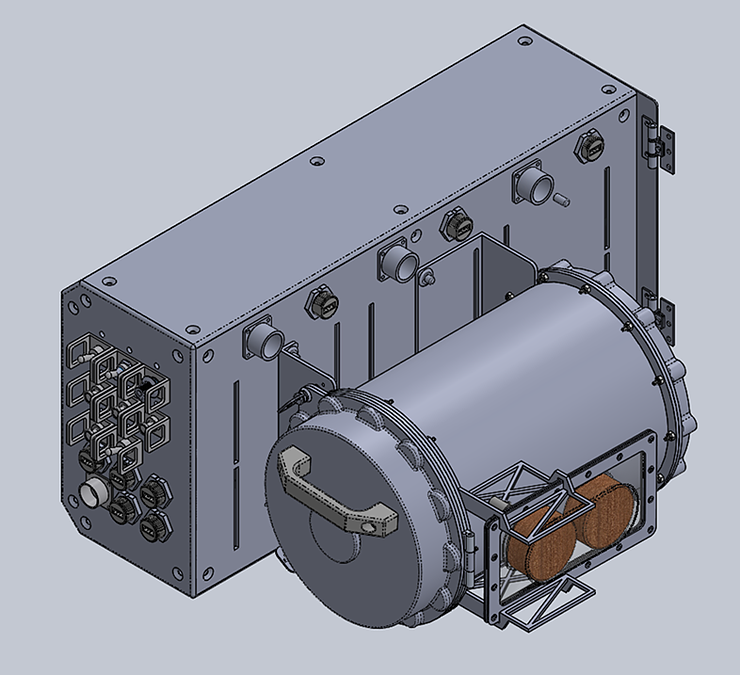
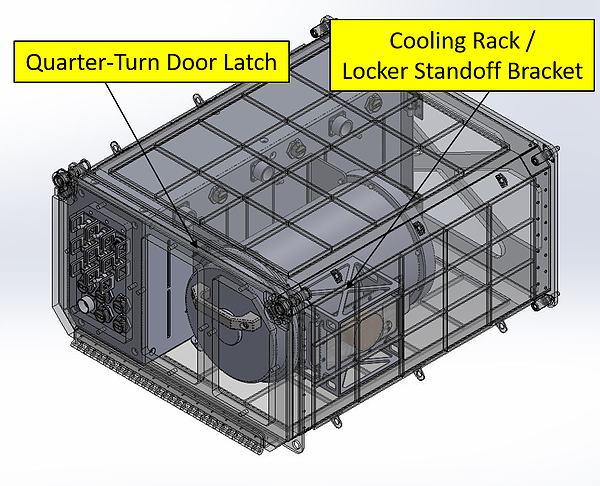
NEW YORK, NY – (November 15, 2018) – Zero G Kitchen LLC, a venture co-founded by Ian and Jordana Fichtenbaum, announced today the specifications and timing of the first appliance of its planned ‘kitchen in space,’ an open platform for food development in space and the zero gravity environment. The first appliance is an oven designed to freshly prepare small food items, such as rolls, cookies, patties, pockets and other basic foods for longer duration space travel.
The oven is built in partnership with NanoRacks, the leading commercial company operating on the International Space Station. NanoRacks is known for its rapid prototyping, plug-and-play interfaces and managing the NASA payload manifesting and safety processes.
“NanoRacks is committed to developing in-space platforms that are affordable and accessible to anyone with the dream to explore in space,” said Jeffrey Manber, CEO and founder, NanoRacks. “People have to eat when living and working in space, so Zero G Kitchen’s vision for hospitality and food preparation in space fits perfectly into NanoRacks’ long-term goal of populating the solar system with Outposts for everything from tourism and research to factories and more.”
The oven is the first in a series of space-adapted appliances built and operated under the direction of Zero G Kitchen. Following the oven, Zero G Kitchen plans to develop space-adapted versions of common household appliances, such as a refrigerator, blender, slow cooker and more. To achieve its goal of building a kitchen in space, Zero G Kitchen will work with a wide array of food companies, educators, researchers, appliance engineers and aerospace organizations.
“We have an incredibly exciting set of partners we are working with for our kitchen—and we always welcome more,” said Ian Fichtenbaum, co-chef and co-founder, Zero G Kitchen.
Zero G Kitchen expects to build and test the space oven before the end of 2018 with a targeted launch to the ISS in early 2019. Recently, Zero G Kitchen signed the first user of the space oven, and an announcement is expected in early 2019.
“Opening up the frontier of space to all means making it relatable to people’s everyday lives,” said Jordana Fichtenbaum, co-chef and co-founder, Zero G Kitchen. “What could be more relatable than a freshly cooked meal in your own kitchen? We’re not here to develop new technology or to build better ovens or kitchens, but rather to assist researchers, educators and companies to access space facilities and the excitement of space development in a relatable form.”
About Zero G Kitchen LLC (www.zerogk.space) – Based in New York City, Zero G Kitchen was founded with a goal of building a kitchen in space, piece-by-piece, and offering its use to a variety of food researchers, educators and companies with an interest in the future of food and household appliances in space. Funded by its founders, Ian and Jordana Fichtenbaum, it is leading the way with its first appliance, a small oven.
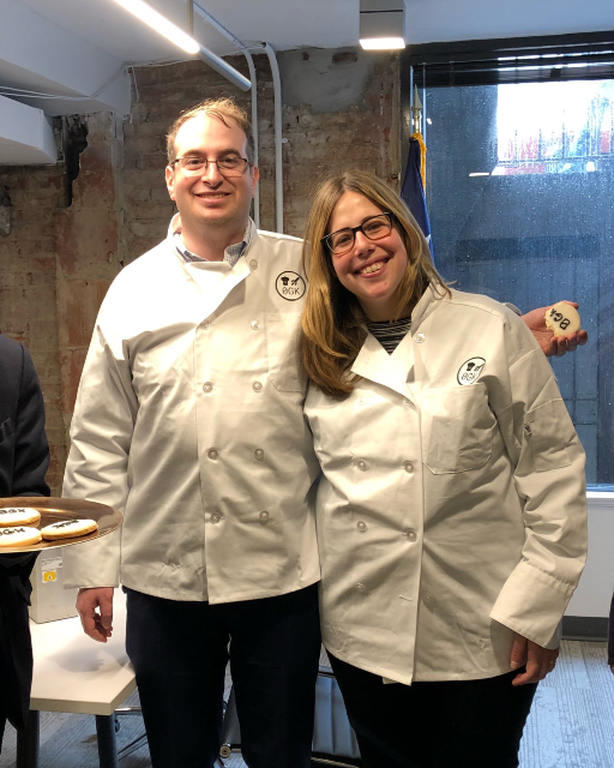
Ian and Jordana Fichtenbaum
About Ian and Jordana Fichtenbaum – Ian and Jordana are a married couple living in New York City and the co-Founders and co-Chefs of Zero G Kitchen. Bound together by their love of space and cooking, they determined to build a kitchen in space to pursue their mutual passions together.
Ian is a space entrepreneur, businessman, investor and director of space companies, including Bradford Space, a European space systems manufacturing group. He has devoted his work to commercializing space and to develop the use of space stations in low earth orbit. Originally from Montreal, Canada, he loves baked goods, especially Montreal bagels and chocolate chip cookies.
Jordana is social media expert and blogger serving restaurants and hotels, including a number of iconic chains. Earlier in her career, she served in the New York City Mayor’s Office working under Mayor Bloomberg, in the Community Affairs Unit. Aside from Zero G Kitchen, she runs a book Instagram account @whatsjordanareading
About NanoRacks (www.nanoracks.com) : NanoRacks LLC, an XO Markets company, is the world’s first commercial space station company with an existing customer base. The company offers low-cost, high-quality solutions to the most pressing needs for satellite deployment, basic and educational research, and more – both at home and in 30 nations worldwide. Since 2009, Texas-based NanoRacks has truly created new markets and ushered in a new era of in space-services, dedicated to making space just another place to do business.
In 2017, the Company announced their long-term plans via the NanoRacks Space Outpost Program. This program is dedicated to the repurposing of the upper stages of launch vehicles in-space and converting these structures into commercial habitats, both humanly and robotically tended, throughout the solar system.
** A video about biological research in microgravity on the ISS with “Tissue Chips”:
A small device that contains human cells in a 3D matrix represents a giant leap in the ability of scientists to test how those cells respond to stresses, drugs and genetic changes. About the size of a thumb drive, the devices are known as tissue chips or organs on chips.
We are in orbit ! Watch deployment of #IRVINE01 from Rocket Lab #ItsBusinessTime
Irvine Public Schools Foundation Irvine Unified School District Tustin Unified School District Ecuadorian Space Agency Kain Sosa https://t.co/n5oFG77OJ7
Jordanian history will be made on November 19, 2018, as the first local made nano-satellite, dubbed “JY1-SAT”, will launch into space to take pictures of Jordan’s historical and touristic places.
The ‘Masar’ (Path) initiative, was launched by the Crown Prince’s Foundation, Prince Hussein Bin Abdullah II, in partnership with NASA who trained 22 Jordanian engineering students from around the Kingdom, in scientific and practical research at the Ames Research Center in Silicon Valley, the United States.
The team of students explored satellite engineering and related knowledge, and developed their skills in aviation and space science through an intensive program over a period of 10 weeks, under the supervision of NASA experts. This partnership training aims to give Jordanian youth an opportunity to demonstrate capabilities and innovativeness in the field of space, and came to establish the CubeSat.
AMSAT is counting down to the launch of the next Fox-1 satellite, Fox-1Cliff. According to Spaceflight Now, the launch from Vandenberg Air Force Base of Spaceflight’s SSO-A SmallSat Express mission, on a SpaceX Falcon 9 vehicle, is currently scheduled for November 19 at 1832 UTC.
Fox-1Cliff carries the Fox-1 U/v FM repeater, AMSAT’s L-Band Downshifter, the flight spare of the AO-85 Vanderbilt University Low Energy Proton (LEP) radiation experiment, and the standard Fox-1 Penn State University-Erie MEMS gyroscope experiment. Virginia Tech provided a video graphics array camera that’s similar to the one on AO-92 but which will provide images at a higher 640 × 480 resolution.