Telerobotics, i.e. controlling a robot from a distance, could be useful in space for, say, asteroid sampling in which an astronaut in a nearby spacecraft controls a robot on the surface of the object. A mission to Mars might initially involve astronauts remaining in orbit while controlling robots on the surface. A demonstration of a telerobotic operation was carried out this week using the Int. Space Station:
8 August 2014: Looking down from orbit, ESA astronaut Alexander Gerst steered ESA’s Eurobot rover through a series of intricate manoeuvres on the ground yesterday, demonstrating a new space network that could connect astronauts to vehicles on alien worlds.
During an intense 90-minute live link on 7 August, Alex used a dedicated controller laptop on the International Space Station to operate Eurobot, relying on video and data feedback to feed commands from 400 km up, orbiting at 28 000 km/h.
The link was provided by a new network that stores commands when signals are interrupted if direct line of sight with Earth or the surface unit is lost, forwarding them once contact is re-established.
In the future, controlling robots on Mars or the Moon will require a sort of ‘space Internet’ to send telecommands and receive data. Such networks must also accommodate signal delays across vast distances, considering that astronauts and rovers on Mars will have to be linked with mission controllers on Earth.
Yesterday’s demonstration was the second in a series of experiments under the Meteron project, following the 2012 test by NASA astronaut Sunita Williams, who used an initial version of the network by steering a model rover at ESA’s ESOC operations centre in Darmstadt, Germany.
“This was the first time Eurobot was controlled from space as part of an experiment to validate communication and operations technologies that will ultimately be used for future human exploration missions,” noted Kim Nergaard, head of Advanced Mission Concepts at ESOC.
Rover driving license
During the session, which started at 16:35 GMT (18:35 CEST), Alexander Gerst commanded Eurobot to move and take pictures based on telemetry and pictures streaming to the Station from the rover.
Eurobot was inching around a test facility at ESA’s ESTEC technology centre in Noordwijk, the Netherlands, while ‘ground control’ was at ESOC and the disruption-tolerant network was routed via Belgium’s Station User Support and Operations Centre in Brussels, and NASA.
Ready to Rove
Simulations to prepare for yesterday’s link included live connections between Darmstadt, Noordwijk and Brussels to the Space Station throughout July.
“Today’s result is even better than the simulations we conducted,” said Daniela Taubert, Meteron’s operations coordinator. “The whole experiment ran extremely smoothly. Alex was faster and more efficient that we had expected.”
William Carey, ESA’s Meteron project engineer, agreed: “It is great to have a hands-on test of part of ESA’s long-term strategy to send humans and robots to explore our Solar System.”
Future space exploration will most likely involve sending robotic explorers to check out alien surfaces before landing humans. To prepare for this, ESA is running the Meteron human–robot exploration programme: Multi-Purpose End-To-End Robotic Operations Network.
Since my last post on the ISEE-3 Reboot Project, the team determined that it was impossible to restart the propulsion system due to the absence of the nitrogen pressurant gas needed to force fuel into the thrusters. They spacecraft therefore cannot be put into an orbit in the Earth-Moon system and will instead continue on its orbit around the sun.
The rest of the spacecraft system, including science instruments, are in good shape. So they plan to continue the project, focusing on carrying out citizen science activities with the data from the spacecraft:
While our original goal was to place ISEE-3 in a L-1 “halo” orbit, it will now do a flyby of the Moon and resume an orbit around the sun – an orbit nearly identical to Earth’s. We have begun the process of shutting down systems that are no longer needed and reconfiguring ISEE-3 to maximize science operations. We are also implementing plans that will allow us to listen to its science data no matter where it goes.
We will be beginning the “ISEE-3 Interplanetary Citizen Science Mission” on 10 August 2014 as the spacecraft flies by the Moon. We have a functional space craft that can do science and is already returning new data. All of our original citizen science objectives remain unchanged and are ready for implementation. In fact, we’ll be announcing some new partnerships shortly that will serve to turbocharge our efforts in this regard.
This will be the first citizen science, crowd funded, crowd sourced, interplanetary space science mission. A more detailed summary of recent activities and our partnership team will be posted at http://spacecollege.org/isee3
The European Space Agency’s Rosetta spacecraft after ten years has finally made its rendezvous this morning with Comet 67P/Churyumov–Gerasimenko. Below is the official announcement. (Note that unlike NASA, ESA has a policy of not releasing images in real time for its science missions. This is apparently to insure analysis of them by its researchers is not scooped by scientists elsewhere. So some of the images released this morning are not necessarily the latest from the spacecraft.)
6 August 2014 After a decade-long journey chasing its target, ESA’s Rosetta has today become the first spacecraft to rendezvous with a comet, opening a new chapter in Solar System exploration.
Comet 67P/Churyumov–Gerasimenko and Rosetta now lie 405 million kilometres from Earth, about half way between the orbits of Jupiter and Mars, rushing towards the inner Solar System at nearly 55 000 kilometres per hour.
Comet 67P/Churyumov–Gerasimenko as it appeared on August 3.
The comet is in an elliptical 6.5-year orbit that takes it from beyond Jupiter at its furthest point, to between the orbits of Mars and Earth at its closest to the Sun. Rosetta will accompany it for over a year as they swing around the Sun and back out towards Jupiter again.
Comets are considered to be primitive building blocks of the Solar System and may have helped to ‘seed’ Earth with water, perhaps even the ingredients for life. But many fundamental questions about these enigmatic objects remain, and through a comprehensive,in situstudy of the comet, Rosetta aims to unlock the secrets within.
The journey to the comet was not straightforward, however. Since its launch in 2004, Rosetta had to make three gravity-assist flybys of Earth and one of Mars to help it on course to its rendezvous with the comet. This complex course also allowed Rosetta to pass by asteroids Šteins and Lutetia, obtaining unprecedented views and scientific data on these two objects.
Sequence of images as Rosetta approached the comet.
“After ten years, five months and four days travelling towards our destination, looping around the Sun five times and clocking up 6.4 billion kilometres, we are delighted to announce finally ‘we are here’,” says Jean-Jacques Dordain, ESA’s Director General.
“Europe’s Rosetta is now the first spacecraft in history to rendezvous with a comet, a major highlight in exploring our origins. Discoveries can start.”
Today saw the last of a series of ten rendezvous manoeuvres that began in May to adjust Rosetta’s speed and trajectory gradually to match those of the comet. If any of these manoeuvres had failed, the mission would have been lost, and the spacecraft would simply have flown by the comet.
“Today’s achievement is a result of a huge international endeavour spanning several decades,” says Alvaro Giménez, ESA’s Director of Science and Robotic Exploration.
“We have come an extraordinarily long way since the mission concept was first discussed in the late 1970s and approved in 1993, and now we are ready to open a treasure chest of scientific discovery that is destined to rewrite the textbooks on comets for even more decades to come.”
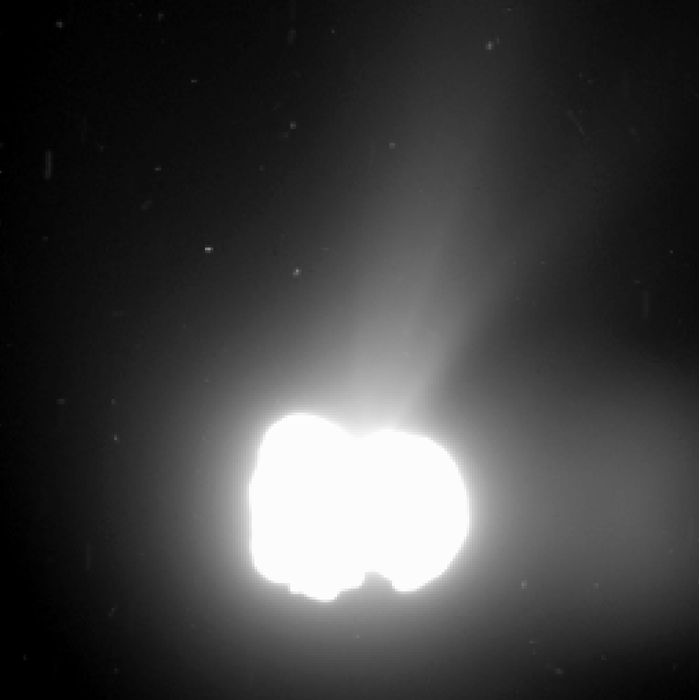
Comet 67P/Churyumov-Gerasimenko activity on 2 August 2014. The image
was taken by Rosetta’s OSIRIS wide-angle camera from a distance of 550 km.
The exposure time of the image was 330 seconds and the comet nucleus is
saturated to bring out the detail of the comet activity. Note there is a
ghost image to the right. The image resolution is 55 metres per pixel.
The comet began to reveal its personality while Rosetta was on its approach. Images taken by the OSIRIS camera between late April and early June showed that its activity was variable. The comet’s ‘coma’ – an extended envelope of gas and dust – became rapidly brighter and then died down again over the course of those six weeks.
In the same period, first measurements from the Microwave Instrument for the Rosetta Orbiter, MIRO, suggested that the comet was emitting water vapour into space at about 300 millilitres per second.
Meanwhile, the Visible and Infrared Thermal Imaging Spectrometer, VIRTIS, measured the comet’s average temperature to be about –70ºC, indicating that the surface is predominantly dark and dusty rather than clean and icy.
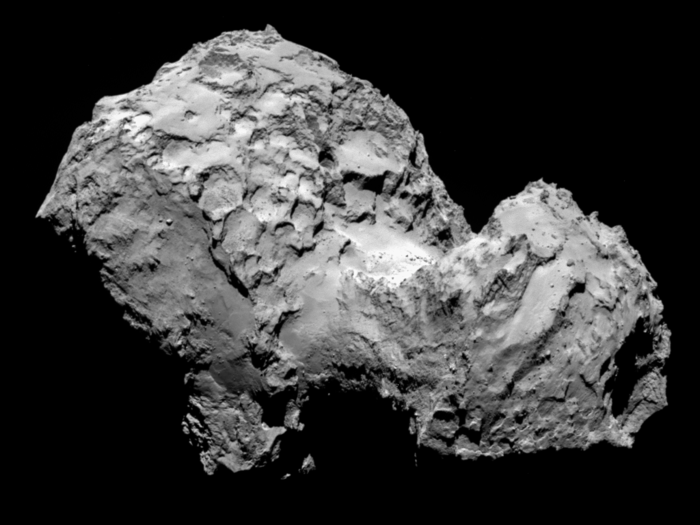
Then, stunning images taken from a distance of about 12 000 km began to reveal that the nucleus comprises two distinct segments joined by a ‘neck’, giving it a duck-like appearance. Subsequent images showed more and more detail – the most recent, highest-resolution image was downloaded from the spacecraft earlier today and will be available this afternoon.
“Our first clear views of the comet have given us plenty to think about,” says Matt Taylor, ESA’s Rosetta project scientist.
“Is this double-lobed structure built from two separate comets that came together in the Solar System’s history, or is it one comet that has eroded dramatically and asymmetrically over time? Rosetta, by design, is in the best place to study one of these unique objects.”
Today, Rosetta is just 100 km from the comet’s surface, but it will edge closer still. Over the next six weeks, it will describe two triangular-shaped trajectories in front of the comet, first at a distance of 100 km and then at 50 km.
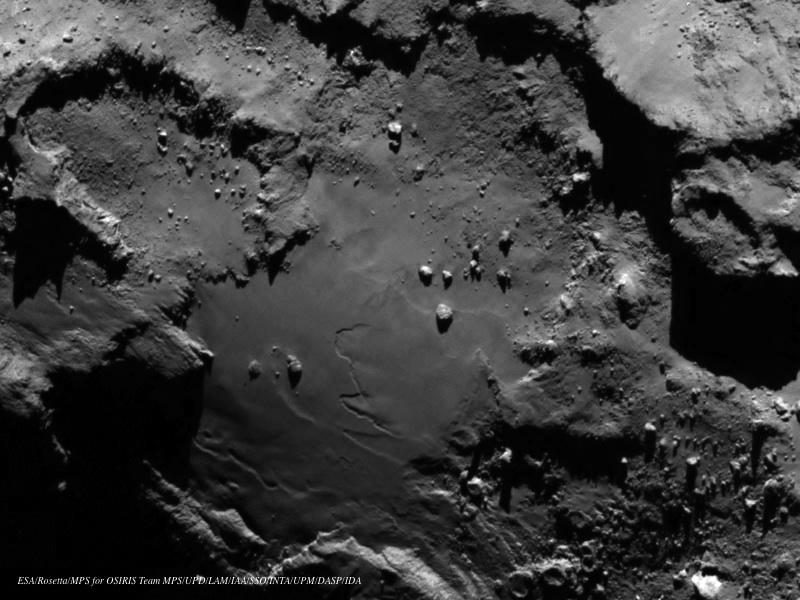
At the same time, more of the suite of instruments will provide a detailed scientific study of the comet, scrutinising the surface for a target site for the Philae lander.
Eventually, Rosetta will attempt a close, near-circular orbit at 30 km and, depending on the activity of the comet, perhaps come even closer.
“Arriving at the comet is really only just the beginning of an even bigger adventure, with greater challenges still to come as we learn how to operate in this unchartered environment, start to orbit and, eventually, land,” says Sylvain Lodiot, ESA’s Rosetta spacecraft operations manager.
As many as five possible landing sites will be identified by late August, before the primary site is identified in mid-September. The final timeline for the sequence of events for deploying Philae – currently expected for 11 November – will be confirmed by the middle of October.
“Over the next few months, in addition to characterising the comet nucleus and setting the bar for the rest of the mission, we will begin final preparations for another space history first: landing on a comet,” says Matt.
“After landing, Rosetta will continue to accompany the comet until its closest approach to the Sun in August 2015 and beyond, watching its behaviour from close quarters to give us a unique insight and realtime experience of how a comet works as it hurtles around the Sun.”
===
Rosetta will release a separate spacecraft called Philae to land on the comet:
From the caption;
Extended version of Philae touchdown animation to include visualisations of some of the science experiments on the lander.
The animation begins with the deployment of Philae from Rosetta at comet 67P/Churyumov–Gerasimenko in November 2014. Rosetta will come to within about 10 km of the nucleus to deploy Philae, which will take several hours to reach the surface. Because of the comet’s extremely low gravity, landing gear will absorb the small forces of landing while ice screws in the probe’s feet and a harpoon system will lock the probe to the surface. At the same time a thruster on top of the lander will push it down to counteract the impulse of the harpoon imparted in the opposite direction. Once it is anchored to the comet, the lander will begin its primary science mission, based on its 64-hour initial battery lifetime. The animation then shows five of Philae’s 10 instruments in action: CIVA, ROLIS, SD2, MUPUS and APXS.
Rosetta’s Philae lander is provided by a consortium led by DLR, MPS, CNES and ASI.
Here’s an animation showing the release and landing: