Category Archives: Education

Reach for the Stars: Rocketry contest winners to celebrate at Space Camp

An announcement from the Reach for the Stars program:

Reach for the Stars ~ National Rocket Competition Winners
to Celebrate at Space Camp

In response to the nations call for more interest in STEM (Science, Technology, Engineering & Math) activities – over 1000 kids across the nation participated in the ninth annual Reach for the Stars ~ National Rocket Competition. At the end of the competition those who had the “Right Stuff”* were victorious. The annual Competition, for ages ten to eighteen, runs continuously.

9th winners' collage sm b_topGirl Scouts of Connecticut – winner Maya Watson

With minds set on the task at hand, competitors prepared their rockets, aimed the launch rod and awaited the countdown. “Ready light – On!” 10…9…8…7… “All systems – Go.”  6…5…4… Everyone held their breath. 3…2…1…  With a whoosh, the small rocket leaped from the launch pad and soared hundreds of feet into the air. All eyes turned skyward. “Wait for it…Wait for it!” With a pop, the parachute opens and the rocket descends for a near perfect touch-down.

Contestants in the competition had to build and launch their own solid-fuel powered rocket. The competitions were held in their area by schools, scouts, youth groups and Challenger Learning Centers. The closest average landing by parachute to a target after two launches wins the local event. Local winner’s results were then submitted to the national competition headquarters. This produced four national winners.

The winners of the Reach for the Stars ~ National Rocket Competition; Alani Davidson, Kalli Riemer, Emily Schmidtlein and Maya Watson will celebrate with their families at Space Camp in “Rocket City” Huntsville, Alabama. All national winners will launch their rockets in celebration under an “October Sky” from Homer Hickam Field.** Most of the competitors and many of the family and friends have read his inspirational book, Rocket Boys or seen the movie, October Sky. Competition director, Jack Colpas says, “Getting the opportunity to launch their rockets from a exciting location is an important part of the celebration.”
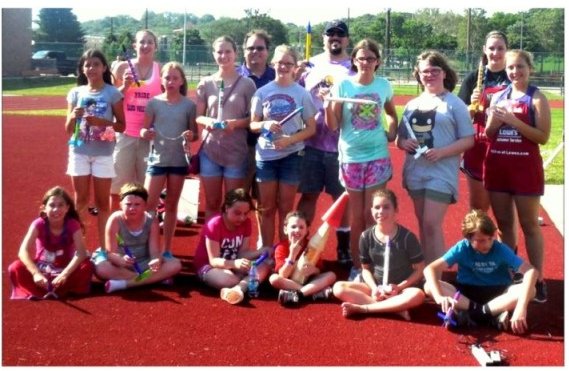
9th winners' collage sm b_botNorth Kansas City High School –
winner Emily Schmidtlein (2nd from left, top row)

In addition to the launch, the kids will be awarded a Space Shuttle Challenger commemorative coin and certificate that honor the memory of the first Teacher-in-Space, Christa McAuliffe and the crew of the Challenger. The certificates are signed by Captain Jon McBride, who piloted Challenger on one of its earliest missions.

Winners get to experience the Astronaut Training Simulators at Space Camp. They will take turns walking in the 1/6 gravity of the moon, move about mock space in a MMU (Manned Maneuvering Unit) and test their intestinal fortitude in the Spatial Disorientation Simulator.

Then they get to tour the US Space & Rocket Center with their friends and families. The group gets to visit the Space Shuttle Simulator – Pathfinder, see the amazing display at Rocket and Shuttle Parks, the Apollo Courtyard and the Saturn V Hall. “The U.S. Space & Rocket Center (USSRC) is a Smithsonian Affiliate and the Official Visitor Center for NASA’s Marshall Space Flight Center. The Center has one of the largest collections of rockets and space memorabilia anywhere in the world.” (rocketcenter.com/museum )

This is a fantastic opportunity for a young rocketeer. Reach for the Stars ~ National Rocket Competition directors Jack and Kathy Colpas boast, “National winners receive memories to last a lifetime – and bragging rights for generations to come.”

  • Alani Davidson won the honors with the Girl Scouts of Western Oklahoma with under Scout Leader, Chris Simon.
  • Kalli Riemer competed at Crystal River Primary School, in Crystal River, Florida under teacher, Christina Hackey.
  • Emily Schmidtlein joined in with her STEM Class at North Kansas City High School, N. Kansas City, Missouri in a competition run by Teacher, Dennis O’Connell.
  • Maya Watson launched during a STEM Summer Camp under the direction of Dr. Ellyn Savard of the Girl Scouts of Connecticut.

For the past 9 years – over 50 % of the national winners in the Reach for the Stars ~ National Rocket Competition have been girls!  Girl Scouts have taken an amazing seven national wins.

Model rocket manufacturer Estes, the world leader in educational rocketry, provided $200 in prize money to the top three national winners. The money is provided to any competitor who wins the national event using Estes rocket supplies. The prize money is provided to help with travel expenses. Three of the national winners will be traveling tothe US Space & Rocket Center in Huntsville, Alabama. Travel funding is crucial. These kids have earned the right to attend the national winners’ celebrations.

The U.S. Space & Rocket Center and Hampton Inn – Huntsville joined together to provide unforgettable memories for the national winners of the annual Reach for the Stars ~ National Rocket Competition. Tickets to Space Camp, plus discounted lodging and free breakfast are being provided for four winners and their families. Without the generosity of these companies, this winners’ celebration would not be possible.

Corporate sponsors are needed to ensure kids nationwide have the opportunity to enter the Reach for the Stars ~ National Rocket Competition. Sponsors receive national recognition and the satisfaction of Helping Kids Reach for the Stars. More information is available at www.TheRocketman.net .

Jack and Kathy Colpas, co-directors of the Reach for the Stars ~ National Rocket Competition are retired public school educators. “Our goal is to give kids the educational experience of building and launching a solid-fuel powered rocket. Our purpose is to foster an interest in model rocketry, STEM subjects and aeronautics. Our mission is to keep alive the memory of the first Teacher-in-Space, Christa McAuliffe.”

* Thomas Wolfe, The Right Stuff – (Farrar, Straus and Giroux) 1979

**Homer Hickam is the author of the memoire, Rocket Boys which became the inspirational movie October Sky.

Videos: TMRO Space Pods on Enceladus, Baby Universe, and the SpaceShipTwo accident

The latest TMRO.tv SpacePod short video reports:

* New Details Emerge Regarding Virgin Galactic Crash – Space Pod 08/04/15

This week Ariel Waldman talks about the beauty of Saturn’s moon Enceladus and how it may be the best place to find extraterrestrial life in our Solar System.

* Pictures of the Baby Universe – Space Pod 08/03/15

This week Ariel Waldman shares her baby pictures of the universe, also known as the Cosmic Microwave Background, from the space probes COBE, WMAP and Planck.

* New Details Emerge Regarding Virgin Galactic Crash – Space Pod 08/04/15

The National Transportation Safety Board has released their investigation into the SpaceShipTwo crash last year, and the results are worse than we thought.

TMRO Space Pods are crowd funded shows. If you like [these episodes] consider contributing to help us to continue to improve. Head over to www.patreon.com/spacepod for information, goals and reward levels. Don’t forget to check out our weekly live show campaign as well over at www.patreon.com/tmro

Video: Young students send “Blood and Fire” on a Near Space journey

Author Marcus Alexander helped students from The Baird Primary Academy in East Sussex, UK send one of his Puffin fantasy books on a near-space adventure. The goal was to promote literacy and creativity with the youngsters. This video shows the launch, flight, and retrieval at sea of the payload, which include a camera that captured scenes from the flight.

Here are miscellaneous facts and comments about the project and the flight:

The Goal:

To send ‘Blood & Fire’ into space via a weather balloon to further boost students interest in literacy, creativity and the power of imagination.

To record the project and capture footage of the book as it reaches peak altitude.

To tie the act of sending a book into space into a school project that spans multiple key subjects: English, Maths, Physics, Geography, Information Technology, Engineering and PSHE.

To show students that if they can overcome the obstacles of sending a book into space they can then apply this same drive and application of common sense to overcome all future hurdles and barriers they might encounter in quest of their own dreams and ambitions.

Katherin Weeks, Vice Principal:

At The Baird Primary Academy, we are willing to go ‘above and beyond’ to ensure that Every Child Succeeds.  Give us seven minutes of your time and we’ll show you an epic journey, including:  inspired students, a Puffin fantasy book that’s out of this world, an adventure across the channel to recover the payload before it sank and, most importantly, the impact of our determination in raising pupils’ progress rates in reading.”

Marcus Alexander’s role:

Acrobatic author Marcus Alexander has been supporting the Baird Primary Academy as a Patron of Reading. Upon hearing one of the students remark,  ‘When I read Keeper of the Realms I feel as though I’m taken out of this world…’ Marcus and the school Leadership Team thought this was the perfect opportunity to create a project that would tie students’ key subjects of Maths, Physics, Geography, Engineering and IT to the importance of literacy and creativity.

“Above all this project #CreativityTakesFlight is a drive for reading. By sending a book into space students have reinforced the importance of literacy and the principle that books can inspire dreams.”

The Baird Primary Principal, Ms Tenn:

‘3 out of 10 girls do not own a book at home, and 4 out of 10 boys do not own a book at home. This project is helping make reading exciting and highlight the importance of where literacy can take you – literally into outer space.’

The Reward:

As a ‘thank you’ for all the students’ hard work and diligence they signed pages of ‘Blood and Fire’ allowing them to say that their names have travelled to space.

The Event:

Students deployed a weather balloon containing ‘Blood & Fire’. The balloon reached an altitude of 35,000m before bursting. After 3 hours of total flight time the payload landed (splashed!) into the channel several miles off the Dover coastline. The project lead teacher, Roz Adie and Marcus Alexander raced to recover the payload before it sank and only managed to do so after hailing a speed launch from the Dover Sea Safari. Students were thrilled to find out that their names had successfully been to near-space and back.

The Project:

Students worked collaboratively to organise a working balloon kit that carried a 1,000 gram retrievable payload to an altitude of 30,000 to 40,000 metres. The payload contained book, camera, GPS systems and auto-deploy parachute.

Space & Aviation:

Space starts at the Karman line, 100 kilometres (62 miles) above the Earth’s sea level. We weren’t able to break that barrier but we did reach the stratosphere and ‘near-space’ altitudes of 35,000m. At this height we did manage to record ‘Blood & Fire’ floating beneath the balloon with the ‘black of space’ visible in the background. With students’ uptake in the engineering required for this project there has also been an increase of interest in aviation and aeronautics.

The Footage:

The day of the event was incredibly hot and unfortunately we picked up condensation on the camera at higher altitudes. To compensate for this we’ve combined footage from both the ‘official’ launch but also from the test launch that was done earlier in a central England location. (We were keen to test functionality and to avoid losing the cameras in a wet-landing.)

Results:

In conjunction with the Academy’s Improvement Plan, the project produced phenomenal results. Over the year literacy rates soared:

* 93% year 6 students made expected progress in reading

* 89% year 5 students made expected progress in reading

* Overall The Baird Primary Academy saw a 24% increase in reading compared to the previous year’s published figures.

 Web resources:

Full project details: http://whoischarliekeeper.com/creativity-takes-flight 

The Baird Academy: http://www.thebairdprimaryacademy.org.uk/

Keeper of the Realms: http://whoischarliekeeper.com/ 

Acrobatic and adrenaline author video: https://youtu.be/wkwOMeNS5yM

 Technical info:

It was a big project and although it was really nothing more sophisticated than releasing a balloon there was still an incredible amount of planning and organisation required!

We used a 12 metre diameter weather balloon that weighed 2,000 grams producing an ascent rate of 5.5-7mps allowing us to pack a 1000 gram payload.

The payload container was a polystyrene box that added a degree of insulation allowing camera and GPS systems to function at low temperatures. (We added two hand warmers for additional heat.)

Two GPS systems were used to increase recovery chances and overcome redundancy rates. (Allowing us to recover the payload even when it landed in the channel!)

Burst rate and flight predictions were mapped through these (very cool!) websites:

Burst rate: habhub.org/calc and sentintospace.com

Flight predictor: predict.habhub.org

(Although, in true British fashion weather forecasts were slightly off!)

Permissions were sought through the CAA (Civil Aviation Authority) more info here: caa.co.uk

Lightyear.fm – follow our music out into interstellar space

Check out the cool interactive lightyear.fm site to find out how far popular songs have traveled out into the universe: Stunning Sim Shows How Far Hit Songs Have Traveled in Space – WIRED

RocketSTEM Magazine – July 2015: “Kerbal, New Horizons, Al Worden, Lunar Rover & More”

Check out the latest issue of RocketSTEM‘s magazine: Issue #12 • July 2015 – RocketSTEM

7a18e1e2-3d7e-4bf5-ad02-bdcadb34a04a[1]

68 pages of inspiration await!
Kerbal, New Horizons, Al Worden, Lunar Rover & More

Space is hard. The past nine months have been difficult ones for rocketry. Multiple failures of Russian launch vehicles, the loss of SpaceShipOne during a test flight, the Antares rocket with the Orb-3 mission falling back to the launch pad in a fireball, and most recently, the disintegration of the SpaceX Falcon 9 rocket carrying a resupply mission to the International Space Station.

In this issue of RocketSTEM we bring you both success and failure. The success of the previously untested Lunar Rover sent to the Moon that carried the Apollo 15 astronauts further than any moonwalker before. And, of course, the failures of the above mentioned rocket launches.

But rather than tell you how hard it is to build and launch a spacecraft, we invite you to try for yourself. Kerbal Space Program is a game that is simple enough for a kid, yet advanced enough for engineers at NASA, JPL, and SpaceX to enjoy playing it too.

Download the game and run your own space agency. Just don’t be discouraged when your first rocket explodes upon launch.