Category Archives: Education

High school students design spacecraft in “Enterprise in Space” program sponsored by NSS and SpaceWorks

An announcement from the National Space Society (NSS):

High School Students Take on Challenge to Design World’s
First Science-Fiction Inspired Spacecraft

Enterprise In Space and SpaceWorks Partner to Provide
the Opportunity with ASTRO Program

(Washington, DC – June 28, 2017) SpaceWorks Enterprises, Inc. hosted a summer program specifically geared for high school students, challenging them to design the NSS Enterprise spacecraft envisioned by Enterprise In Space (EIS), a non-profit program of the National Space Society (NSS). The students had access to numerous resources, including the expertise of SpaceWorks and EIS staff. After completion of their project, the team presented their proposed design, budget, and methods of atmospheric re-entry to SpaceWorks, EIS, teachers, and parents.

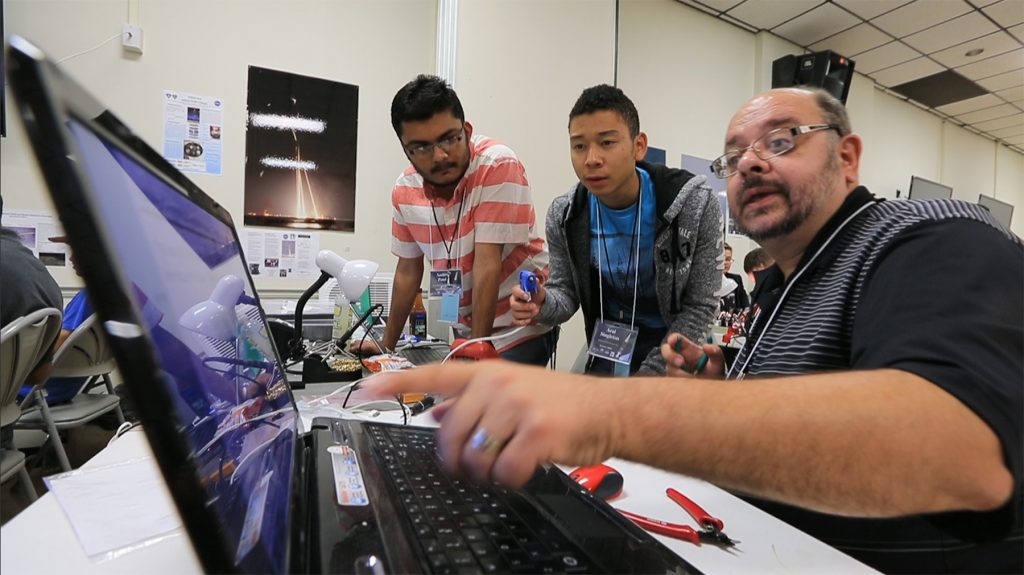
The SpaceWorks program is called ASTRO, or Aerospace Summer Training & Research Opportunity, a project-oriented experience during which participants work in teams to solve an aerospace engineering design problem. This was Team 8, consisting of six students, and their session started in early June.
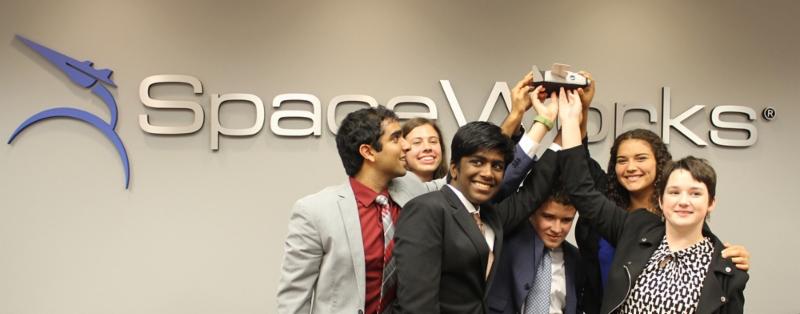
ASTRO Team 8 with their 3D printed version of NSS Enterprise

“ASTRO has been a wonderful way for SpaceWorks to see first-hand the potential that high school students in our community have to offer. We thoroughly enjoy working with the students and look forward each summer to the amazing ideas they come up with. Partnering with EIS for ASTRO this year has been a great experience for both us and the Team 8 students. Team 8 has been inspired by the work of EIS and they are genuinely honored to be part of the NSS Enterprise design process,” says Ashley Russ, Director of the ASTRO Program for SpaceWorks.

It was a tough challenge! The NSS Enterprise must be designed to carry a minimum of 100 student experiments, survive its launch into space aboard a rocket or space plane and its return to Earth. It must also be able to communicate results of some experiments from space as well as protect those experiments whose results can only be obtained once returned safely to Earth. Avionics, communications, structures, and all the engineering disciplines had to be considered.

Adding the liberal arts into the mix, some Team 8 members prepared artistic designs that can be used for promotion by the EIS team. EIS values the Arts portion of Science, Technology, Engineering, Art and Math (STEAM) education.

Bill Miller, the CEO of Deep Space Industries, another EIS partner, stopped by SpaceWorks to lend his expertise to help students to understand some of the NSS Enterprise systems. He discussed DSI’s Comet water-based thruster for possible use in orbital maneuvering of the NSS Enterprise. About the students, Bill said,

“I was incredibly impressed with the knowledge and enthusiasm of these students. They are entering the space industry at perhaps the most exciting time in our history, and will have the opportunity to make a significant difference in how humans move beyond the confines of our fragile planet.”

[Shawn Case, EIS founder, said, ]

“We are all thrilled that SpaceWorks has selected Enterprise In Space for the ASTRO program. It’s great to see the students take on the challenge and to see the interest and excitement they have shown in going into aerospace careers,” …”May they succeed in their future endeavors and become the aerospace engineers and astronauts that take us to the Moon, Mars, and beyond. I would also like to express my gratitude to SpaceWorks for all of the kind assistance they have donated to the Enterprise In Space program.”

SpaceWorks Enterprises has been a member of the EIS team since 2015 and looks forward to what the future will bring for the EIS orbiter.

“I am pleased to have the SpaceWorks ASTRO program among our partners and sponsors. EIS fundraising is underway and if you are interested in helping NSS/EIS carry out our mission of educating the workforce of tomorrow, we’d love to add you to our team,”

says Alice Hoffman, NSS President and EIS Program Manager.

About Enterprise In Space: The National Space Society’s Enterprise In Space (EIS) is the world’s first NewSpace education program. EIS is dedicated to providing access to STEAM education to all through the open online EIS Academy and with the help of an artificial intelligence tutor named Ali. The program’s first Academy-wide project is the design, launch, and retrieval of a 3D-printed spacecraft carrying 100+ active and passive experiments from K-postgrad student teams from all around the world. To join as a virtual crewmember, partner with, or sponsor the Enterprise In Space educational program, contact EIS via www.enterpriseinspace.org. EIS is also seeking a naming sponsor for the NSS Enterprise orbiter. Just imagine: NSS Enterprise sponsored by (Your Name or Company Name here).

About the National Space Society: NSS is an independent nonprofit educational membership organization dedicated to the creation of a spacefaring civilization. NSS is widely acknowledged as the preeminent citizen’s voice on space, with over 50 chapters in the United States and around the world. The Society publishes Ad Astra magazine, an award-winning periodical chronicling the most important developments in space. To learn more, visit www.nss.org.

About SpaceWorks Enterprises, Inc. (SEI): SpaceWorks Enterprises, Inc. (SEI), based in Atlanta, GA, specializes in independent technical concept development, economic analysis, market research, technology impact assessment, and systems analyses for future space systems and projects. SpaceWorks serves as the parent organization for Generation Orbit Launch Services, Inc. (GO)Terminal Velocity Aerospace, LLC (TVA), and Blink Astro, LLC (Blink). For more information please visit www.spaceworksenterprises.com.

Spaceport America Cup results + ULA Interns launch “Future Heavy”

The Spaceport America Cup college student rocket competition took place last week at the New Mexico spaceport.  (See earlier preview posting here.) Over 90 colleges were represented from around the world. The results are in:

Final launch on Friday:

==

Interns working at United Launch Alliance built a big one-stage sport rocket that was launched at the event:

Here is the ULA release about the project:

United Launch Alliance Interns, Ball Aerospace, and
Colorado Students Participate in Record-setting 

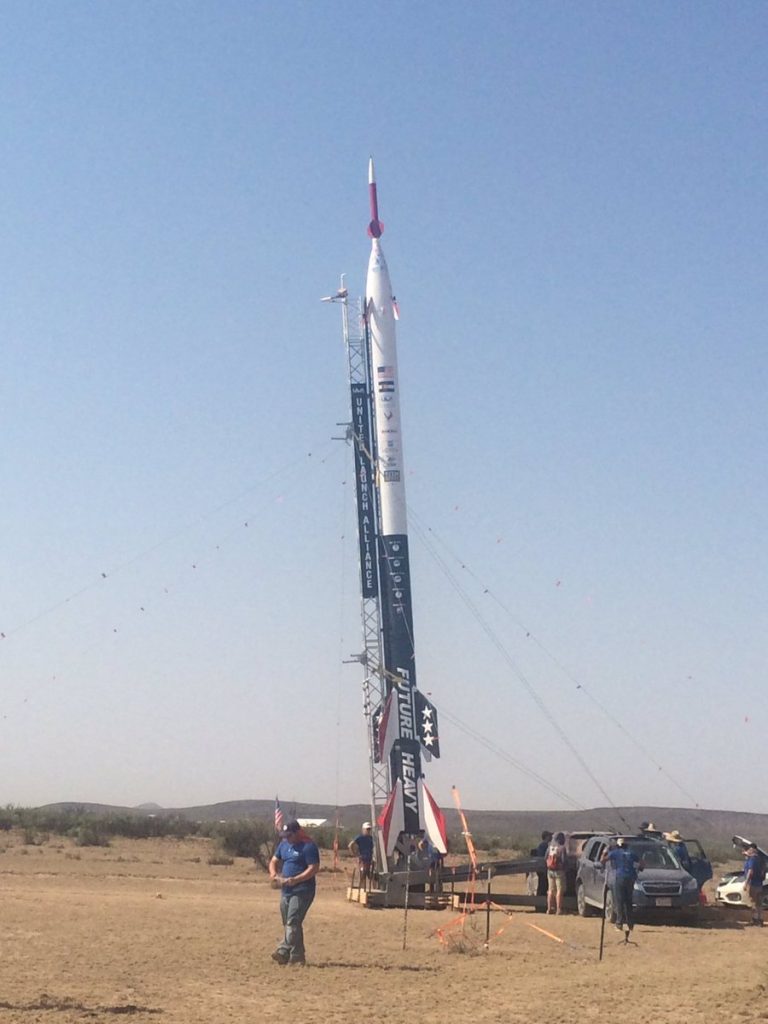
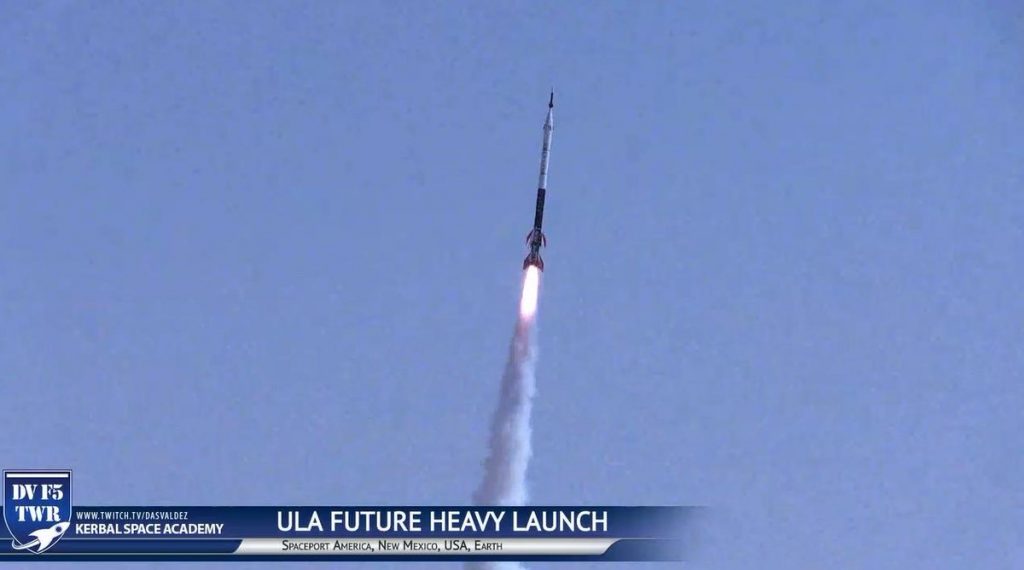
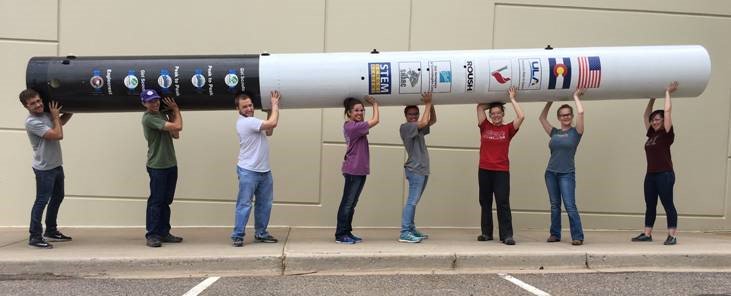
Spaceport America, N.M. (June 24, 2017) – A 53-foot-tall high-power sport rocket carried payloads thousands of feet above the New Mexico desert today at Spaceport America. United Launch Alliance (ULA) summer interns designed, built and launched the Future Heavy rocket, which carried 16 payloads (experiments and instruments) built by K-12 students, Ball Aerospace mentors and a combined ULA/Roush Industries team. The rocket launched at the Spaceport America Cup International Intercollegiate Rocket Engineering Competition in association with the Experimental Sounding Rocket Association (ESRA).

ULA Interns’ Future Heavy rocket vertical on its launch rail.

Future Heavy is the largest sport rocket to launch anywhere in the world, breaking the record set previously by ULA in 2016, when the rocket towered at 50 feet. The launch marked the culmination of an experience designed to simulate a real-life launch campaign and inspire students from kindergarten through graduate school to pursue careers in science, technology, engineering and math (STEM).


“The future of the space industry lies in the interns and students designing, building, and launching Future Heavy and the payloads it carried,” said Tory Bruno, ULA president and CEO. “United Launch Alliance continuously works to encourage the next generation of rocket scientists, astronauts, space entrepreneurs and enthusiasts. The sky (and physics) is the limit on the creativity and ingenuity at the Student Rocket Launch.”

Working on their own time, ULA interns designed, built and launched the rockets with the guidance of mentors, and Ball Aerospace mentors volunteered their time to create and test their payload. Altogether, more than 50 interns and 8 mentors from ULA along with Ball mentors participated in the 2017 event.

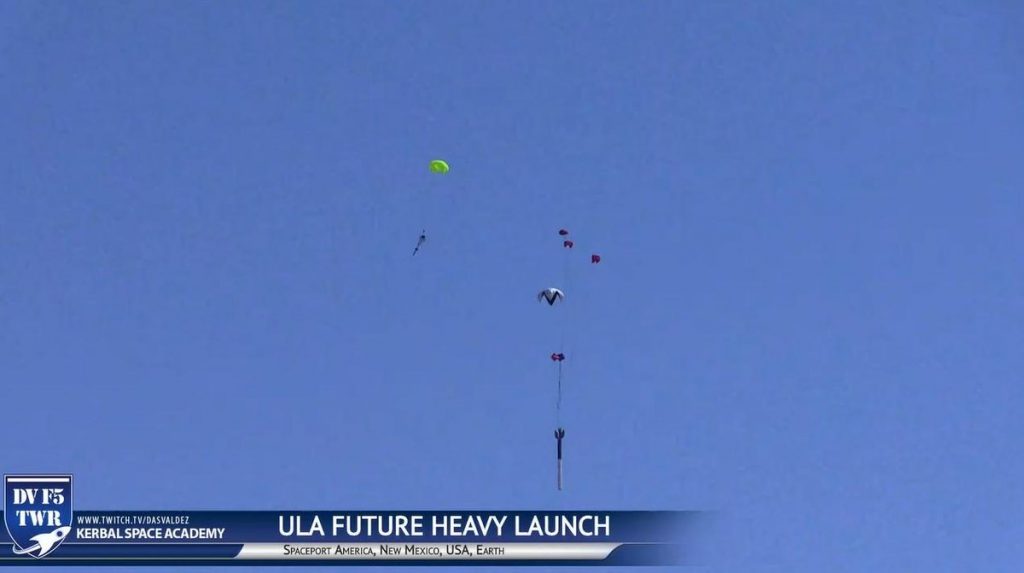
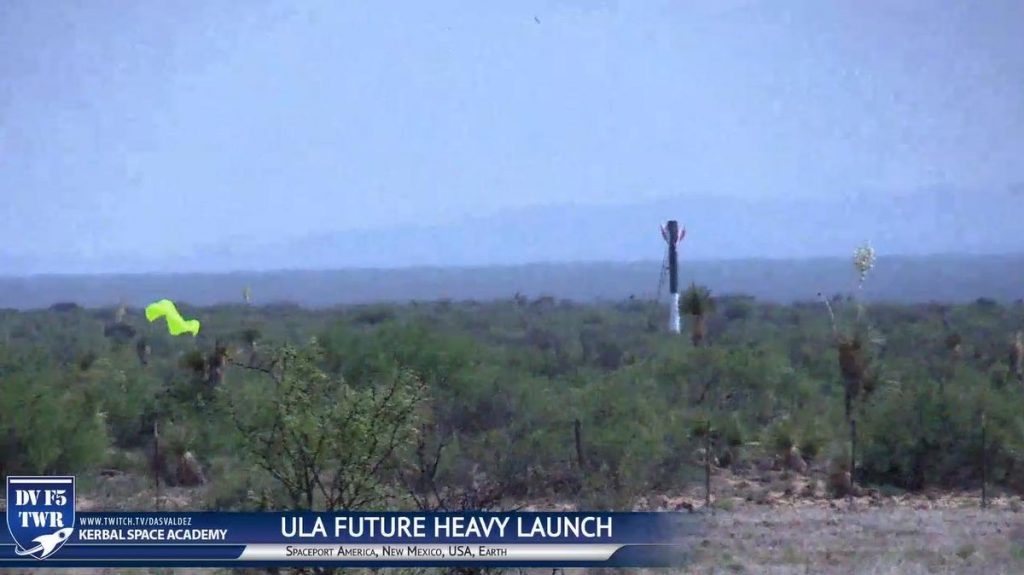
Parachutes deployed and returning to earth.

ULA and Roush Industries teamed up on a payload to test next-generation technology planned for use on future ULA rockets. The ULA and Roush payload will test a number of Integrated Vehicle Fluids (IVF) system components. IVF uses an internal combustion engine, manufactured by Roush Industries, that runs on propellant boil-off, otherwise vented to waste, to provide power to enable long-duration missions for the upper stage.

The Future Heavy and its payloads weighed in at more than 1,350 pounds and generated approximately 8,000 pounds of thrust off the launch pad. The K-12 payloads included a swarm of small gliders to gather atmospheric data, a test of various methods to harvest the energy of descent and a kindergarten parachute experiment.

“This program demonstrates a collaborative real-world aerospace industry partnership and experience,” said Rob Strain, president of Ball Aerospace. “We are proud to be supporting the next generation of space leaders.”

Ball designed, built and tested the largest payloads including: a black box data recorder; an environmental sensor suite with on-board data storage; accelerometer, pressure, temperature and humidity sensors; and a parafoil using ram-air inflation.

Earlier this year, ULA’s Greg Arend, who leads the Student Rocket Launch project, received the Distinguished Engineering Educator Award by the Engineers’ Council for his work on the program over the last five years. Over that time, hundreds of interns across all five of ULA’s sites participated in this unique, hands-on STEM activity and worked to build Future Heavy, the world’s largest high-powered sport rocket.

ULA interns lift the fuselage of the Future Heavy rocket that they built.

====

NASA Wallops hosts rocket training for students and educators

College students and high school educators participate next week in rocket programs hosted by NASA’s Wallops Island Space Flight Facility:

Students and Educators Become Rocket Scientists for a Week at Wallops 

A sounding rocket launches from Wallops Island in 2016. Credits: NASA

Have you wondered what it would be like to be a real rocket scientist?

Approximately 150 university and community college students and instructors and high school educators will get that chance during Rocket Week June 17 through 23 at NASA’s Wallops Flight Facility in Virginia.

Nearly 130 university and community college students and instructors from across the country will build and fly experiments on a NASA suborbital rocket through the RockOn! and RockSat-C programs. Another 20 high school educators from across the United States will examine how to apply rocketry basics into their curriculum through the Wallops Rocket Academy for Teachers (WRATs)

RockOn 2016 participants work to prepare their experiments for flight. Credits: NASA/Patrick Black

The week ends with the students launching their experiments on a NASA Terrier-Improved Orion suborbital sounding rocket at 6 a.m. EDT on June 22. The rocket is 36 feet long and the payload weighs 667 pounds.

The NASA Visitor Center at Wallops will open at 5 a.m. EDT on launch day for viewing the flight.  Live coverage of the mission is scheduled to begin at 5:30 a.m. on the Wallops Ustream site. Launch updates also are available via the Wallops Facebook and Twitter sites. Facebook Live coverage begins at 5:45 a.m. The rocket launch is expected to be seen from the eastern shore of Virginia and Maryland.

Smartphone users can download the “What’s Up at Wallops” app for information on the launch as well as a compass showing the precise direction for launch viewing.

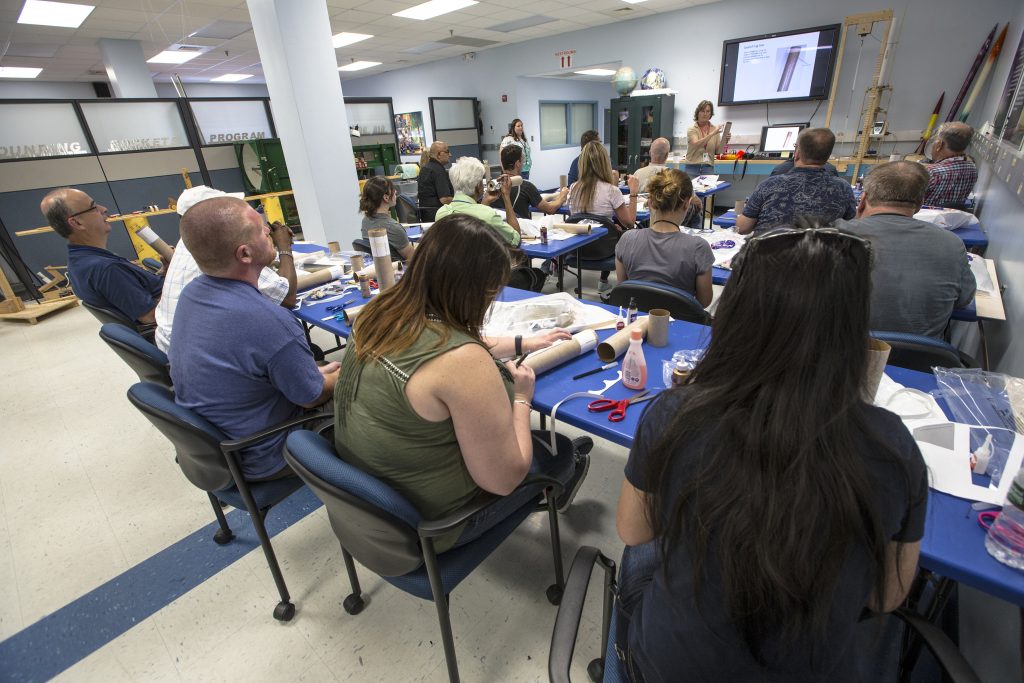
High school educators work on building model rockets during WRATS 2016. Credits: NASA/Patrick Black

The June rocket will carry 23 experiments (measuring acceleration, humidity, pressure, temperature and radiation counts) from the RockOn! program, nine experiments from the RockSat-C program and more than 80 small cubes with experiments developed by middle school students in 49 states as part of the Cubes in Space program, a partnership between idoodlelearning inc. and the Colorado Space Grant Consortium.

After flying to nearly 73 miles altitude, the payload will land via a parachute in the Atlantic Ocean where it will be recovered by boat. The participants should have their experiments returned to them later in the day to begin their data analysis.

Joyce Winterton, Wallops senior advisor for education and leadership development, said,

“We look forward each year to Rocket Week and the students and educators who come to Wallops with an enthusiasm to learn the skills to advance their careers and instruction to advance those of younger students.”

Conducted with the Colorado and Virginia Space Grant Consortia, RockOn! is in its tenth year, RockSat-C its ninth and WRATS is in its seventh year.

“The longevity of these programs shows the continued interest from students and educators, “said Phil Eberspeaker, chief of the NASA Sounding Rocket Program Office at Wallops. “Participants receive hands-on instruction, personal attention and the opportunity to work with career “rocket scientists” — engineers and technicians who work on rockets on a daily basis.”

In RockOn! the participants receive instruction on the basics required in building and developing a scientific payload for flight on a suborbital rocket. After learning the basics in RockOn!, students may then participate in RockSat-C, where they design and build an experiment for rocket flight during the school year.

Chris Koehler, director of the Colorado Space Grant Consortium, said,

“The partnership with NASA has led to excellent learning opportunities for the participants in the RockOn! and RockSat-C programs.  More than 500 students and instructors, including this years’ attendees, have participated in the 10-years RockOn! has been conducted.”

WRATS works with high school teachers to show them the basics of rocketry and how to take what they learn into the classroom. The 20 participants from Virginia, Maryland,  New York, New Jersey, Colorado, Kentucky, Tennessee, Delaware, and Oklahoma will receive instruction on the basics of rocketry including Newton’s Laws, fundamentals of electronics, drag and propulsion. This instruction will be applied to hands-on learning activities including building and launching model rockets.

The RockOn!, RockSat and WRATS programs are supported by the NASA Sounding Rocket Program. RockOn! also is supported by NASA’s Office of Education and NASA’s National Space Grant College and Fellowship Program in partnership with the Colorado and Virginia Space Grant Consortia, as well as the program participants.

NASA’s Sounding Rocket Program is conducted at the agency’s Wallops Flight Facility, which is managed by NASA’s Goddard Space Flight Center in Greenbelt, Maryland. Orbital ATK provides mission planning, engineering services and field operations for the NASA Sounding Rocket Operations Contract. NASA’s Heliophysics Division manages the sounding rocket program for the agency.

Keith Koehler
Wallops Flight Facility, Wallops Island, Va.

High school team sends experiment to the International Space Station

A SpaceX Dragon spacecraft recently berthed to the International Space Station and delivered over a ton of scientific experiments, including many student projects. (See NASA articles here and here.) Student groups can participate in ISS science via programs such as these:

Here is an example of a high school team in Singapore sending an experiment to the ISS:

Singapore American School (SAS) sends Singapore’s first experiment
to the International Space Station

SINGAPORE, June 5, 2017 — On Sunday, June 4, SpaceX’s Falcon 9 successfully lifted off from the Kennedy Space Center in Florida, United States, and sent the Dragon spacecraft into orbit. The spacecraft was carrying an experiment built by students at the Singapore American School (SAS) — the first ever experiment to be sent to space by high schoolers in Singapore.

The MicroLab — a container that encases a scientific experiment — is scheduled to arrive on the International Space Station (ISS) after two days of spaceflight. This is the first time a Singaporean experiment will be installed by astronauts on board the ISS.

For over a year, student leader Sunita Srivatsan and her team of five — Jaclyn Chan, Keshav Jagannath, Annie Kim, Madeline Smith, and Devansh Tandon, guided by SAS Robotics coaches Meredith White and Bart Millar — have been meticulously planning, collaborating, and researching to set up an experiment to study the effects of microgravity on mutations in bacteria.

As part of the Bhattacharya Space Enterprise program and under the mentorship of ex-National Aeronautics and Space Administration (NASA) scientist Dr. Bidushi Bhattacharya, CEO and founder of Bhattacharya Space Enterprises and Priyadarshini Majumdar, a National University of Singapore graduate, the students learned about both the research and commercial aspects of space technology.

“This is a very exciting time for commercial spacetech growth, thanks to companies such as SpaceX. Traditionally, space-related career paths were feasible for students from larger nations, but rapid privatization and miniaturization of electronics has made space accessible globally. I am really excited about this group of students in Singapore who are actually delivering something into orbit,” said Dr. Bhattacharya.

Dr. Chip Kimball, superintendent of SAS, who is a strong advocate of exploring interests and pursuing passions said,

“Backed by a culture of possibilities, students at SAS are offered every opportunity to dive deep into an area of interest while building competence and self-efficacy to engage and impact the world around them. It has to be one of the most exciting things in the world to be able to take the science they’re learning and applying it to a new frontier.”

The SAS Foundation, an organization that continues to strengthen the school for the future by funding educational programs, operations, and capital initiatives, has been a strong supporter of this project. The organization paid for mentor training in San Jose, biological and mechanical materials to create the experiment, orbital launch services on the Falcon 9 spacecraft, and leased space aboard the ISS.

Majumdar was instrumental in encouraging the team to focus on the various stages of the mission, formulate a plan and execute it. In six months time, the students went from finding it hard to visualize how everything would fit into a MicroLab to building the engineering model and constructing the flight model in about a week.

The MicroLab will test radiation levels in space using melanin genes implanted in E. coli bacteria. Once the rocket’s capsule docks at the ISS, astronauts will offload the MicroLab and plug it into a rack that provides the power needed to run the experiment in a microgravity environment. Driven by a circuit board and computer programme that the students designed, the experiment will run for one month.

Periodically, astronauts will download data and photos back to earth so the students can collect, analyze, and monitor their experiment. The students will also be conducting their ground truth (control) experiments here at the school after the experiment is returned to them post-flight. If the team’s hypothesis is proven true, NASA will genetically modify plants to produce more melanin to make growing plants in the conditions of space easier.

“The main purpose of this experiment is to make space technology development a tangible career option for students. Young people across Singapore see this project as something that has been built by kids their age, handed off to NASA and managed by astronauts for them. We are hoping to take this to other schools in Singapore in the coming years,” said Dr. Bhattacharya.

According to Sunita Srivatsan, SAS senior and team leader for the project,

“It’s not often that high schoolers get an opportunity of this magnitude, and we’re grateful to the SAS community, the SAS Foundation, and to our coaches and mentors. It wasn’t always smooth sailing, but the idea that our experiment could potentially impact the future of space research, kept us focused in the face of roadblocks and challenges.”

===

Here is a video about the science that went to the station:

=====

EarthKAM captures the Grand Canyon

EarthKAM is a camera aboard the International Space Station that is controlled by middle-school students participating in the Sally Ride Earth Knowledge Acquired by Middle School Students (i.e. Sally Ride EarthKAM) program. Students recently took this terrific image of the Grand Canyon:

Space Station’s EarthKAM Sees the Grand Canyon

View of the Grand Canyon with EarthKAM [Large image.]
On April 3, 2017, the student-controlled EarthKAM camera aboard the International Space Station captured this photograph of a favorite target — the Grand Canyon — from low Earth orbit. The camera has been aboard the orbiting outpost since the first space station expedition began in November 2000 and supports approximately four missions annually. Mission 58 begins in fall 2017, and interested middle school students and teachers can sign up at the EarthKAM website.

The Sally Ride Earth Knowledge Acquired by Middle School Students (Sally Ride EarthKAM) program provides a unique educational opportunity for thousands of students multiple times a year. EarthKAM is an international award-winning education program, allowing students to photograph and analyze our planet from the perspective of the International Space Station. Using the Internet, students control a special digital camera on the orbiting laboratory to photograph Earth’s coastlines, mountain ranges and other interesting geographical topography.

Image Credit: Sally Ride EarthKAM