Bean was the lunar pilot on the Apollo 12 mission and he and mission commander Pete Conrad explored the Moon’s Ocean of Storms in November 1969.
Bean became an accomplish artist after retiring from the astronaut corps. See galleries of his works at Alan Bean Art. He had been allowed to keep the name patch from his Apollo EVA suit and it turned out to be saturated with space dust. He would crush a tiny bit of the patch into the paints used for his lunar renderings.
The Artist Depiction Indiegogo crowdfunding campaign seeks support for a three part documentary series about the history of space art at NASA:
Artist Depiction is a documentary series about artists who have helped bring NASA projects to life. Their incredible artwork is ubiquitous, and yet these artists have been behind the scenes until now. We seek to give a voice to these artists: Don Davis, Charles Lindsay, and Rick Guidice. These oral histories will be lost to time without a series like this.
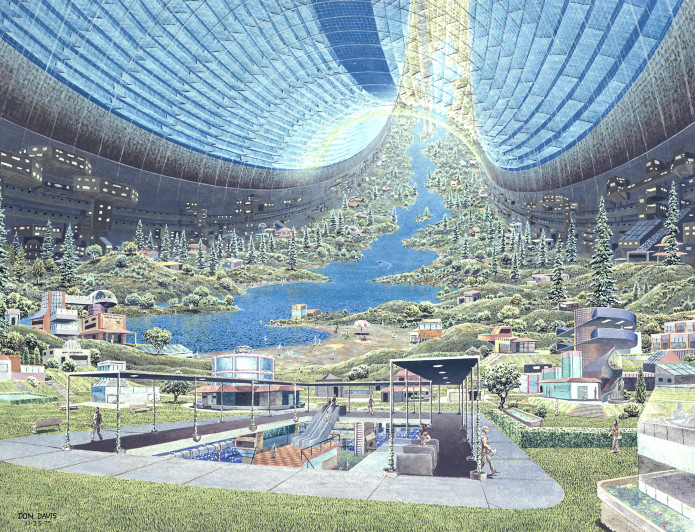
Inside of a toroidal space colony as envisioned by artist Don Davis
Why is the work of these NASA artists important in 2018? [Director Brett Ryan Bonowicz] explains that not only are these old space colony images still being used today to represent “the future,” they’ve also inspired so many of the designers that would come after them.
“Neill Blomkamp and Elysium. Christopher Nolan and Interstellar. Almost every day of our [crowdfunding] campaign someone mentions how ‘that artwork looks like Halo man.’” Bonowicz told me over email.
“It’s important to have these first-hand accounts from the artists that were depicting Gerard O’Neill’s original ideas about these colonies. Without these films those accounts are lost.”
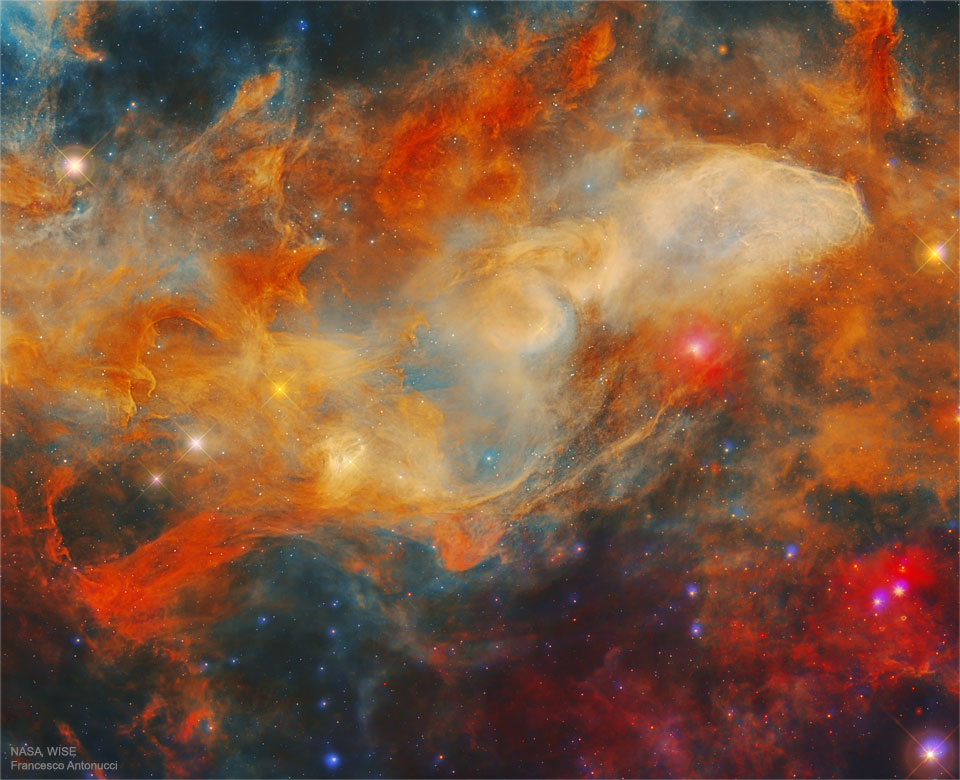
“The Blue Horsehead Nebula in Infrared”. Image Credit: WISE, IRSA, NASA; Processing & Copyright : Francesco Antonucci
Note that processing of an infrared image allows for considerable freedom in how the final rendering appears. In this case, it was rendered with great artistry by Mr. Antonucci.
From the caption:
The Blue Horsehead Nebula looks quite different in infrared light. In visible light, the reflecting dust of the nebula appears blue and shaped like a horse’s head. In infrared light, however, a complex labyrinth of filaments, caverns, and cocoons of glowing dust and gas emerges, making it hard to even identify the equine icon. The featured image of the nebula was created in three infrared colors (R=22, G=12, B=4.6 microns) from data taken by NASA’s orbiting Wide Field Infrared Survey Explorer (WISE) spacecraft. The nebula is cataloged as IC 4592 and spans about 40 light years, lying about 400 light years away toward the constellation Scorpius along the plane of our Milky Way Galaxy. IC 4592 is fainter but covers an angularly greater region than the better known Horsehead Nebula of Orion. The star that predominantly illuminates and heats the dust is Nu Scorpii, visible as the yellow star left of center.
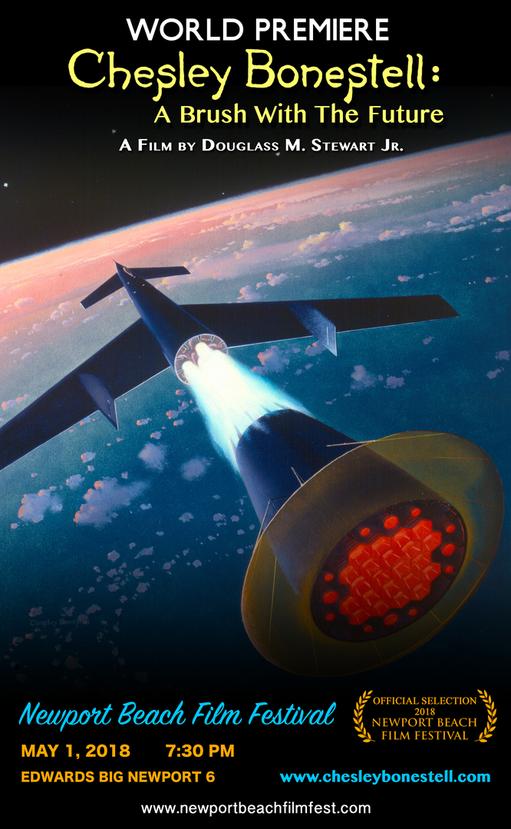
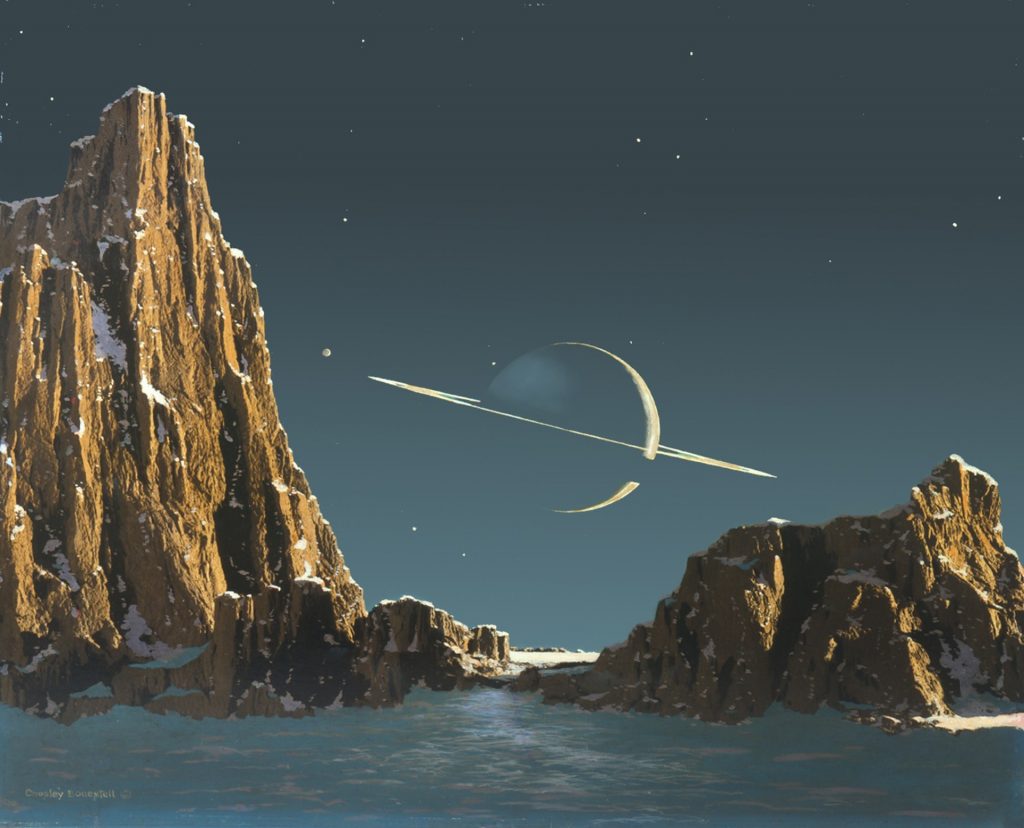
Behind every architect and builder is an artist who takes designs and ideas, morphing them into beautiful images for everyone to understand. Chesley Bonestell was this artist, yet very few know his name. He worked on the Golden Gate Bridge and the Chrysler Building, as a matte artist on famous movies like Citizen Kane, and his mesmerizing paintings of planets and star systems helped jumpstart America’s space program. His iconic “Saturn As Seen From Titan”, became known as “the painting that launched a thousand careers.” Discover the power of the forgotten man whose art inspired Americans to conquer “The Final Frontier”.
“Saturn As Seen From Titan” by Chesley Bonestell
Note that back in 2013 the AIAA Houston Section‘s Horizons Newsletter posted hi-res reproductions of the famous and influential series of articles on spaceflight by Wernher von Braun in Colliers Magazine in 1952-54, which included many illustrations by Bonestell. I wrote about this in these postings: