Outside the International Space Station, Expedition 51 Commander Peggy Whitson and Flight Engineer Jack Fischer of NASA conducted a spacewalk May 12 to replace an avionics box responsible for routing power and data commands to experiments on the orbital outpost. In addition to that work, the two spacewalkers installed a data cable for the Alpha Magnetic Spectrometer and a new high definition camera on the station’s truss. The spacewalk was the 200th in support of space station assembly and maintenance since 1998, the ninth for Whitson, who vaulted into third place on the all-time list for most spacewalking hours, and the first for Fischer.
Seven teams working on technology that could someday be used to create habitats from materials on other worlds have completed the first printing segment of NASA’s 3D-Printed Habitat Challenge. NASA has awarded $100,000 to the two top-scoring teams from this stage, the Phase 2: Level 1 Compression Test Competition. Point-based awards were made to Foster + Partners | Branch Technology of Chattanooga, Tennessee, who earned $85,930, and the University of Alaska, Fairbanks, earning $14,070.
This cone was 3D-printed by the Foster + Partners | Branch Technology team for the Level 2, Phase 1 Compression Test Competition of NASA’s 3D-Printed Habitat Competition. Foster + Partners scored the most points for this stage, and was awarded $85,930. Credits: Courtesy of Foster + Stearns | Branch Technology
The 3D-Printed Habitat Challenge is run through a partnership with NASA’s Centennial Challenges Program and Bradley University in Peoria, Illinois. The goal of the challenge is to foster the development of technologies to manufacture a habitat using local indigenous materials with, or without, recyclable materials. The vision is that autonomous machines will someday be deployed in deep space destinations, including Mars, to construct shelters for human habitation. On Earth, these same capabilities could be used to produce affordable housing wherever it is needed or where access to conventional building materials and skills are limited.
“Seeing tangible, 3D-printed objects for this phase makes the goals of this challenge more conceivable than ever,” said Monsi Roman, program manager of Centennial Challenges. “This is the first step toward building an entire habitat structure, and the potential to use this technology to aid human exploration to new worlds is thrilling.”
The Level 1 Compression Test Competition is the first of three sub-competitions within Phase 2. For this stage, teams were tasked with developing 3D-printable materials, using a 3-D printer, and printing two samples: a truncated cone and a cylinder. Judges evaluated results from lab tests performed on the samples to determine a score.
A 3D printer created by the University of Alaska team prints a cone for their entry in the Level 2, Phase 1 Compression Test Competition of NASA’s 3D-Printed Habitat Competition. The university was awarded $14,070 for this stage of the challenge. Credits: Courtesy of University of Alaska
“Innovation is a key focus of Bradley University which is one of the many reasons we are so very proud to be a part of the 3D-Printed Habitat Challenge with NASA,” said Bradley University President Gary Roberts. “The winners of Phase 1 and this first stage of Phase 2 are to be commended for their innovation in creating a solution that will fit not only in our world but beyond. I look forward to the next phase and seeing teams work to advance critical systems needed for human space exploration like never before.”
In addition to the two teams that earned prize money, the other teams participating were: Bubble Base of Winston-Salem, North Carolina; Pennsylvania State University of University Park; CTL Group Mars of Skokie, Illinois; ROBOCON of Singapore; and Moon X Construction of Seoul, South Korea. The teams showcased a variety of approaches, ranging from traditional cement to exotic cellular structures.
Teams will now work toward the Level 2 Beam Member Competition, where they must print a beam to be tested. New teams may enter the competition if they can meet minimum requirements.
The 3D-Printed Habitat Challenge comprises three phases: Phase 1, the Design Competition, was completed in 2015. Phase 2, the Structural Member Competition, which carries a $1.1 million prize purse and focuses on the material technologies needed to create structural components. Phase 3, the On-Site Habitat Competition, and has a $1.4 million prize purse and focuses on fabrication technologies.
NASA’s Centennial Challenges Program uses competitions to draw citizen inventors from diverse backgrounds and disciplines to push technology forward for the benefit of space exploration. The Centennial Challenges Program, managed at NASA’s Marshall Space Flight Center in Huntsville, Alabama, is part of the agency’s Space Technology Mission Directorate. Bradley University has partnered with sponsors Caterpillar, Bechtel and Brick & Mortar Ventures to run the competition.
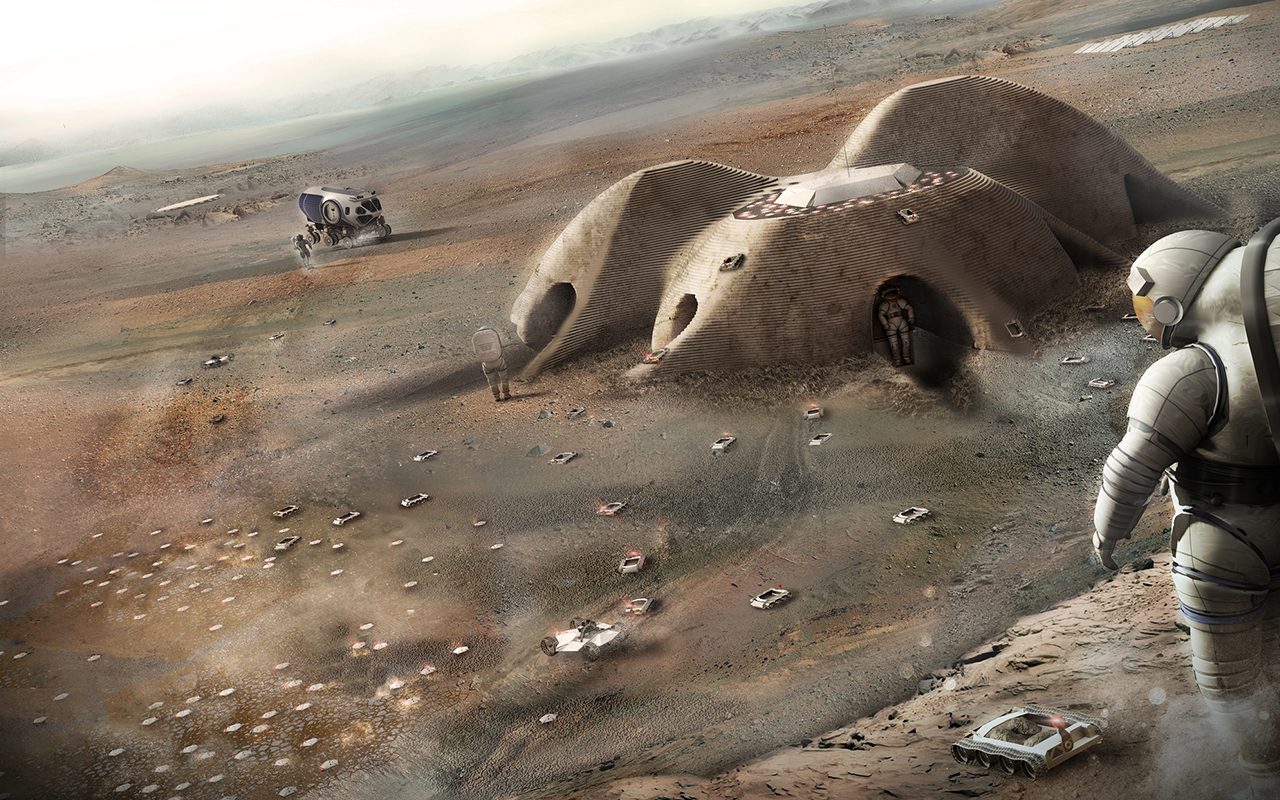
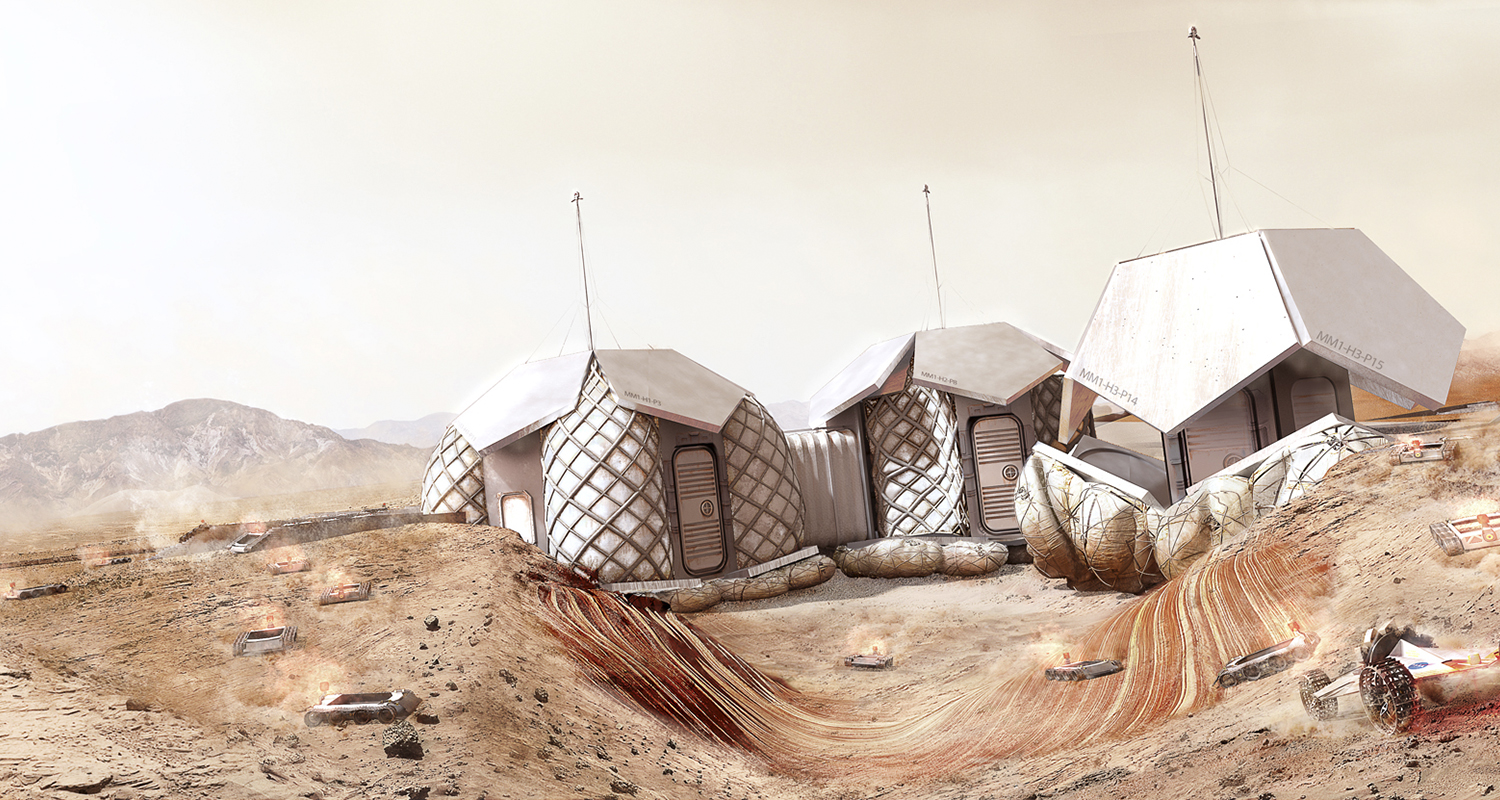
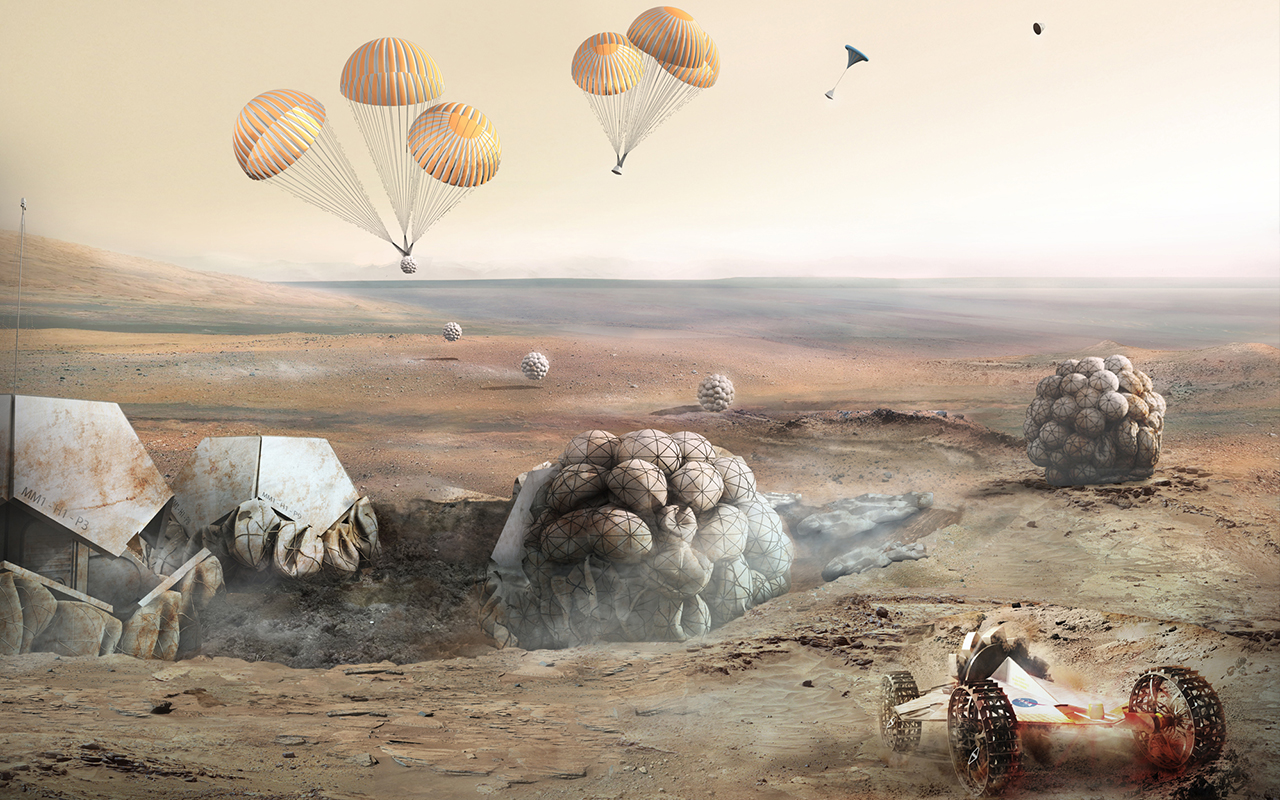
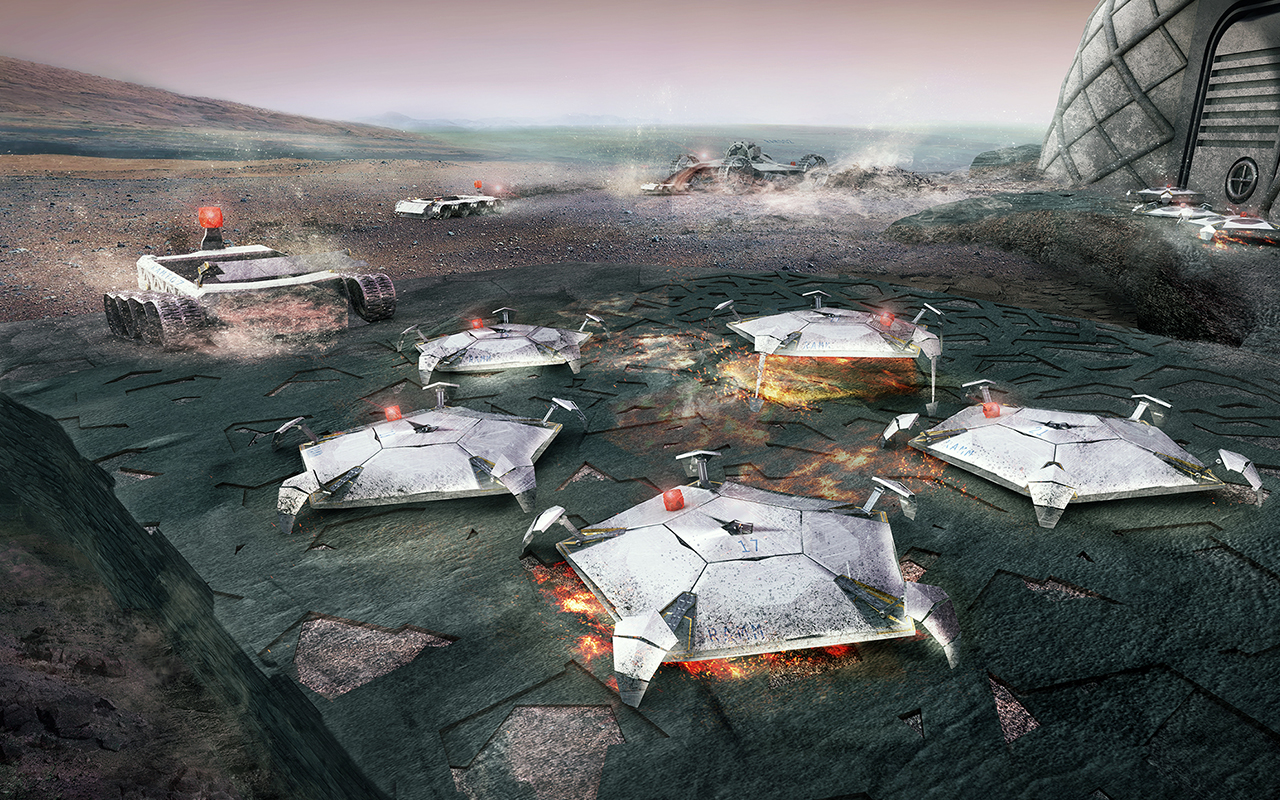
Foster + Partners California | Branch Technology has been awarded first-place in the NASA 3D-Printed Habitat Challenge, Phase 2: Level 1 Competition organized by NASA and Bradley University. The competition envisions a future where autonomous machines will help construct extra-terrestrial shelters for human habitation. This will also aid the development of technologies that advance fabrication capabilities on Earth.
While the final shelter will be a complex assembly of smaller building elements, the focus through the various stages of the challenge is to design and test individual prototypical building elements that can help demonstrate the suitability of the entire process from manufacture to construction and structural performance.
As part of this stage of the competition, teams were asked to use recycled mission materials and indigenous Martian regolith (soil) together to 3D-print a truncated cone and a cylinder, which were then subjected to compression testing to assess their suitability as structural components. Foster + Partners has been looking at the engineering geometry of the structures, while Branch Technology have brought their expertise with 3D-printing materials and methods to the project.
Developing optimized solutions that are specifically designed for the complexities of space travel, each of the proposals balances cost, weight, and structural performance against the stringent requirements of the long-term goal of extra-terrestrial habitation.
Having successfully completed Level 1, the team will now work toward the Level 2 Competition submission at the end of May, in which a beam will be printed to test spanning structures.
A video about a miniature DNA sequencer used by NASA on the ISS:
Thanks to work on the International Space Station, sequencing DNA is simple enough to do in your car…or whatever vehicle you drive. With the next generation of DNA research ready to get underway, NASA’s Dan Huot has a carpool conversation with the researchers at the Johnson Space Center in Houston about their work and watches as they sequence DNA in a portable handheld unit.
French astronaut Thomas Pesquet has worked on the International Space Station as an ESA member of the crew since last November. His six month mission will end in May. During his stay in space he has carried out multiple spacewalks and performed many science experiments. He also has taken lots of great snapshots and videos of the earth. Check out the sample below and the links to more: