Winners have been selected in the Guardians of the Galaxy Space Station Challenge student competition mentioned here back in January:
Guardians of the Galaxy Space Station Challenge Winning Projects Selected
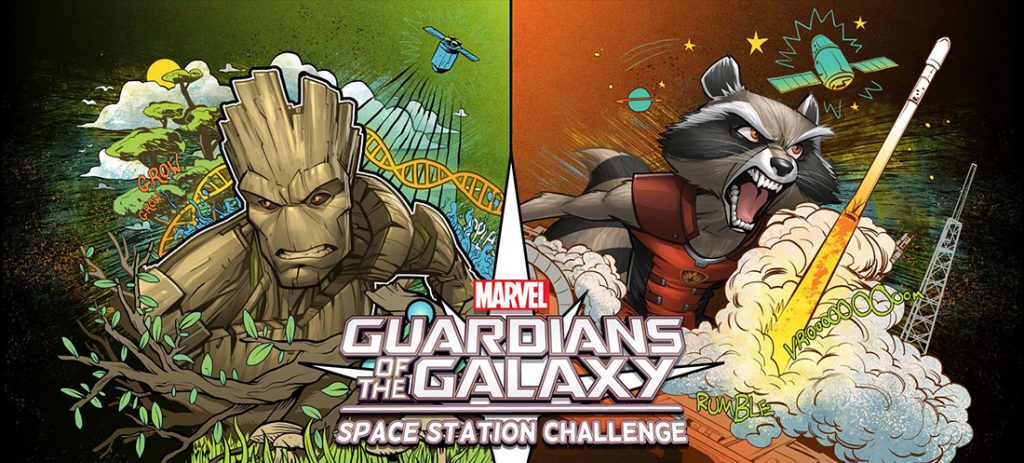
KENNEDY SPACE CENTER, FL. (May 22, 2018) – After a robust response from students around the country, the Center for the Advancement of Science in Space (CASIS) and Marvel Entertainment today announced two winning concepts from the recent Guardians of the Galaxy Space Station Challenge. The challenge was an opportunity for American students ages 13-18 to submit microgravity flight experiment concepts that could be conducted on the International Space Station (ISS) U.S. National Laboratory. The contest focused on Rocket and Groot, characters from the Guardians of the Galaxy comic book franchise. Students were encouraged to develop innovative concepts to be tested in space based on the attributes of these Super Heroes. The two selected flight concepts will become official ISS National Lab investigations, intending to launch to the space station in 2018.
Students with an interest in technology and engineering were encouraged to submit flight concepts through Team Rocket—a Super Hero with strong ties to technological innovation and engineering. Students interested in fundamental biological concepts were encouraged to submit flight proposals under Team Groot—a member of the Guardians of the Galaxy who is the embodiment of genetics and plant biology.
Below is an overview on the two research concepts selected through the challenge.
Team Groot:
Aeroponic Farming in Microgravity
Project Lead: Sarina Kopf
Golden, CO
This experiment seeks to explore an alternative method for watering plants in the absence of gravity. Aeroponic farming utilizes a misting device to deliver water to the plant roots and an air pump to blow excess water off of the roots. In space, aeroponic farming has advantages over other methods of watering plants that are gravity dependent. The project aims to test mister behavior in microgravity. Specifically, how the water behaves immediately after it is ejected from the head of the nozzle, and how moving air affects the water on the roots in the absence of gravity. Too much water is just as bad for plants as too little water, and root rot from over watering can be a problem when growing plants in space. Results from this experiment may have profound implications for both the future of spaceflight and for life on Earth by enabling humans to grow fruits and vegetables in microgravity and eliminate a major obstacle for long-term spaceflight.
Hardware Partner: Space Tango
Team Rocket:
Staying Healthy in Space
Project Lead: Adia Bulawa
Greeneville, TN
Staying healthy in space is extremely important. A broken tooth or a lost filling is painful on Earth, but in space it can be detrimental to an astronaut’s health. This experiment intends to analyze the effectiveness in microgravity of a dental glue that is activated by UV light. The team proposes to treat simulated, broken teeth with the dental glue, expose them to UV light, and observe them onboard the space station. Soldering in microgravity results in weaker bonds due to air bubbles, and the team wonders whether the same will happen with UV activated glue.
Hardware Partner: DreamUp (with hardware integration partner NanoRacks, LLC)
“This challenge created an incredible response from young researchers around our country, which is a testament to the reach and excitement of collaborating with an entity like Marvel Entertainment,” said CASIS Director of Operations and Education Initiatives, Ken Shields. “The two selected investigations provide diverse, fun, and important research concepts, and we thank our partners at Marvel for bringing further awareness to research opportunities available through the International Space Station.”
The winning students will work alongside partners DreamUp (with team member NanoRacks, LLC) and Space Tango, Inc. to help transform their ideas into research questions to be tested on the space station. In the coming months, students will work with these commercial partners and be exposed to space station facilities, hardware development, and the engineering required to ensure successful projects on the orbiting laboratory.
The Guardians of the Galaxy Space Station Challenge is a featured program of Space Station Explorers, a CASIS-led collaborative science, technology, engineering, and mathematics (STEM) consortium of partners who are committed to developing, promoting, and delivering ISS National Lab-themed educational curriculum, products, and outreach to student explorers. To learn more about Space Station Explorers’ broad range of student opportunities, please visit http://www.spacestationexplorers.org/
To learn more about the ISS U.S. National Laboratory, please visit: www.iss-casis.org
About CASIS: The Center for Advancement of Science in Space (CASIS) is the nonprofit organization selected to manage the ISS National Laboratory, with a focus on enabling a new era of space research to improve life on Earth. In this innovative role, CASIS promotes and brokers a diverse range of research in life sciences, physical sciences, remote sensing, technology development, and education.
Since 2011, the ISS National Lab portfolio has included hundreds of novel research projects spanning multiple scientific disciplines, all with the intention of benefitting life on Earth. Working together with NASA, CASIS aims to advance the nation’s leadership in commercial space, pursue groundbreaking science not possible on Earth, and leverage the space station to inspire the next generation.
About the ISS National Laboratory: In 2005, Congress designated the U.S. portion of the International Space Station as the nation’s newest national laboratory to maximize its use for improving life on Earth, promoting collaboration among diverse users, and advancing STEM education. This unique laboratory environment is available for use by other U.S. government agencies and by academic and private institutions, providing access to a permanent microgravity setting, a vantage point in low Earth orbit, and varied environments of space.
About Marvel Entertainment: Marvel, a wholly-owned subsidiary of The Walt Disney Company, is one of the world’s most prominent character-based entertainment companies, built on a proven library of more than 8,000 characters featured in a variety of media over seventy-five years. Marvel utilizes its character franchises in entertainment, licensing and publishing. For more information visit marvel.com. © 2018 MARVEL