Here is this week’s Space to Ground report form NASA on activities related to the International Space Station:
A report on medical research on the ISS:
And here is a report on other news from NASA:
====
Here is this week’s Space to Ground report form NASA on activities related to the International Space Station:
A report on medical research on the ISS:
And here is a report on other news from NASA:
====
An announcement from NASA:
Top 10 Teams Selected in Virtual Stage of 3D-Printed Habitat Challenge

NASA’s 3D-Printed Habitat Challenge is challenging teams of citizen inventors to push the state of the art of additive construction to design and build sustainable shelters for humans to live on Mars. Previous levels of the challenge have resulted in advanced habitat concepts, material compositions and printing technologies. The current stage (Phase 3: Level 1) of the multi-level contest challenges participants to prepare digital representations of physical and functional characteristics of a house on Mars using Building Information Modeling (BIM) software tools.

The habitat must comprise 1,000 square feet of living space to support four astronauts for one year and include plans for systems such as life support, mechanical and electrical, spacesuit and rover hatches, and plumbing.

“This stage of the competition asks the participants to design habitats that will combine shelter with critical survival systems,” said Monsi Roman, program manager for the Centennial Challenges Program. “We are asking them to look beyond the physical structure into the needs of our future explorers.”

Eighteen teams submitted their designs on May 16, and judges have selected the top 10 teams that will continue to compete for $100,000 in prize money that will be awarded to the top five teams in July. The teams will be evaluated by a panel of subject matter experts from NASA and industry.

The teams, listed in alphabetical order, are:
“There is a great breadth in use of technology and 3D-modeling skills among the judges that range from Building Information Modeling software developers to the most sophisticated applications of virtual design and construction,” said Pete Carrato, lead judge and corporate manager of Building Information Modeling at challenge sponsor Bechtel. “Each team’s submission is a view into the future of developing surface-based facilities on Mars.”

The goal of the 3D-Printed Habitat Challenge is to foster the development of technologies to manufacture a habitat using local indigenous materials with, or without, recyclable materials. The vision is that autonomous machines will someday be deployed in deep space destinations, including Mars, to construct shelters for human habitation. On Earth, these same capabilities could be used to produce affordable housing wherever it is needed or where access to conventional building materials and skills are limited.

The challenge, which began in 2014, is structured in phases:
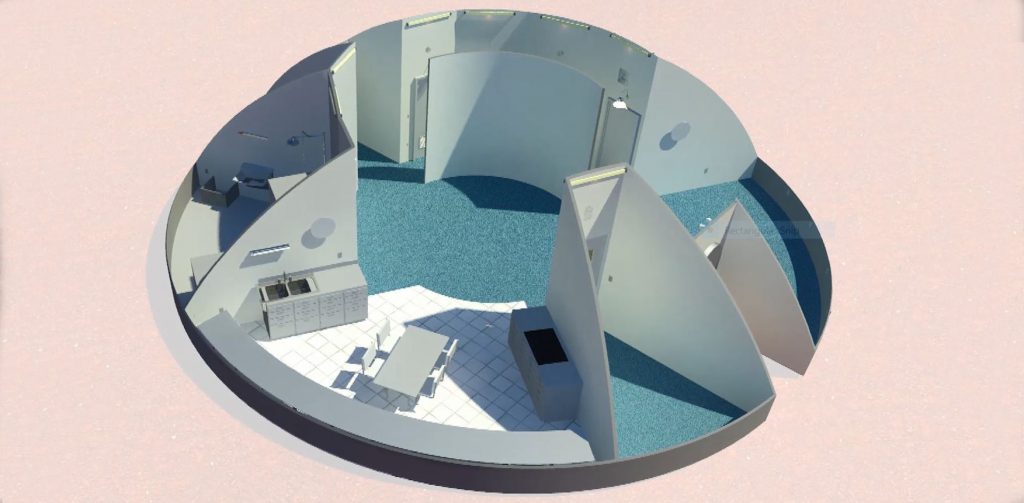
The 3D-Printed Habitat Challenge is managed through a partnership with NASA’s Centennial Challenges Program and Bradley University in Peoria, Illinois. Bradley University has partnered with sponsors Caterpillar, Bechtel and Brick & Mortar Ventures to administer the competition. NASA’s Centennial Challenges program is part of the agency’s Space Technology Mission Directorate, and is managed at NASA’s Marshall Space Flight Center in Huntsville, Alabama.

For information about the 3D-Printed Habitat Challenge, visit: http://www.nasa.gov/3DPHab
For information about NASA’s Centennial Challenges Program, visit: www.nasa.gov/winit

Here is the latest TMRO.tv program: Enjoying a cup of coffee in space – Orbit 11.26 – TMRO
Jeffrey Ayers of Death Wish Coffee joins us to talk about the caffeinated payload they just sent up to the International Space Station aboard SpaceX’s CRS-15.
TMRO has an incredible history with coffee. When we were Spacevidcast, the whole show was produced at the back of the Crow River Coffee Company, we had our own blast off blend coffee and Adam (Cafn8ed) directed the show. We are excited for a time when coffee is a regular part of a space journey. Along with many other creature comforts we take for granted today.
Recent launches and space news topics:
Launches:
Long March 2C Launches 2 Secret Demo Satellites
Falcon 9 Launches CRS-15
Space News:
Hayabusa in the sky with diamonds
Spacewalks and Falcons and Space Force, Oh My!
Stealth Comet
TMRO is a viewer supported program:
TMRO shows are crowd funded. If you like this episode consider contributing to help us to continue to improve. Head over to http://www.patreon.com/tmro for funding levels, goals and all of our different rewards!
Here is the latest Space to Ground report from NASA about activities related to the International Space Station:
These videos show more highlights of this morning’s SpaceX launch of a Cargo Dragon to the ISS on a Falcon 9 rocket:
A brief overview of science and technology payloads going to the ISS on the Dragon:
And a longer briefing held on Thursday about the science/tech payloads:
====
Here is the latest Space to Ground report from NASA on this week’s activities related to the International Space Station:
Here is a music video from NASA astronaut Scott Tingle’s son who
wrote, produced, and sent to him in space the song “To Touch the Stars” in honor of his family’s journey to reach his dreams.
Tingle played guitar at a professional level in a band as a young man. He returned to earth on June 3rd after 6 months on the ISS.
Here is a NASA video about eating in space:
Astronauts on the International Space Station get food that’s carefully chosen for its nutritional value and specially prepared and packaged to be easily accessible to them in a weightless world on orbit. Could the same food feed the needs of people stuck on planet Earth? We conducted an experiment to find out how well two regular people could get by eating only astronaut food for a full week—a week that included a holiday weekend feast, just to up the difficulty factor. Could they resist the lure of their favorite foods? Take a look at how they fared…
How to navigate in space by the stars: Deep Space Navigation: Tool Tested as Emergency Navigation Device | NASA
A tool that has helped guide sailors across oceans for centuries is now being tested aboard the International Space Station as a potential emergency navigation tool for guiding future spacecraft across the cosmos. The Sextant Navigation investigation tests use of a hand-held sextant aboard the space station.
Sextants have a telescope-like optical sight to take precise angle measurements between pairs of stars from land or sea, enabling navigation without computer assistance. NASA’s Gemini missions conducted the first sextant sightings from a spacecraft, and designers built a sextant into Apollo vehicles as a navigation backup in the event the crew lost communications from their spacecraft. Jim Lovell demonstrated on Apollo 8 that sextant navigation could return a space vehicle home. Astronauts conducted additional sextant experiments on Skylab.
====