Refabricator Installed on the ISS Tethers Unlimited Announces Successful Installation
of the First Recycler-3D Printer On-Board the ISS
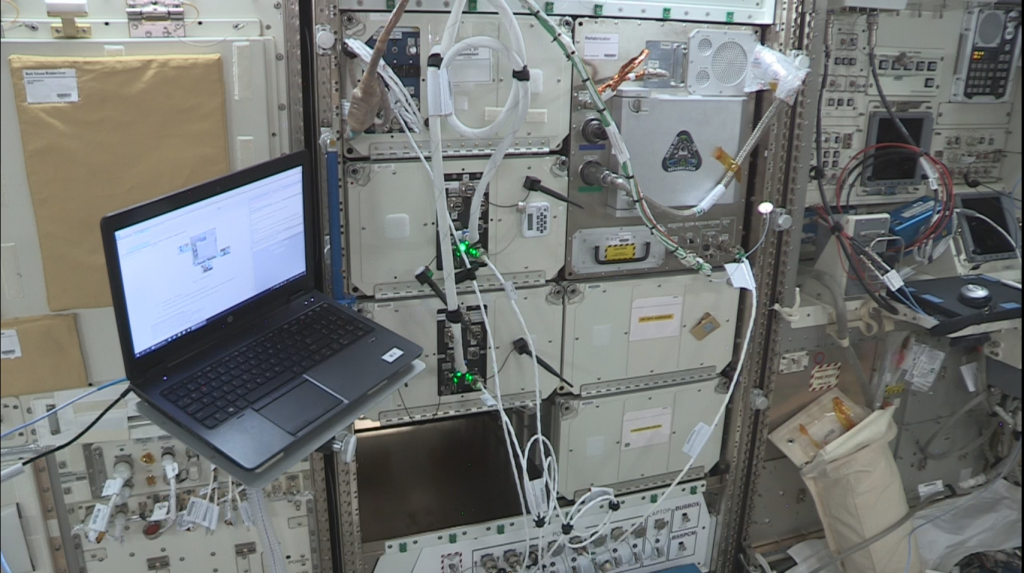
Astronaut Anne McClain installs Tethers Unlimited’s Refabricator™ recycling and 3D printing payload aboard the International Space Station.
Bothell, WA, 8 February 2019 – Astronauts aboard the International Space Station (ISS) have successfully installed the first integrated recycler and 3D printer into the station’s experiment racks. This technology demonstration, called the Refabricator, will perform repeated recycling and 3D printing of plastic materials to demonstrate capabilities for supporting long-duration crewed space missions with sustainable manufacturing.
The Refabricator was developed and built by Tethers Unlimited, Inc. for NASA’s In-Space Manufacturing Project under funding from NASA’s Small Business Innovation Research (SBIR) program. It combines the ability to recycle plastic items into high-quality 3D printer feedstock, and then use this feedstock to print new items. It is the first plastic recycler on the space station and the first combination of recycling and 3D printing capability in one unit.
“The Refabricator is key in demonstrating a sustainable model to fabricate, recycle and reuse parts and waste materials on extended space exploration missions,” said Niki Werkheiser, manager of In-Space Manufacturing at NASA’s Marshall Space Flight Center in Huntsville, Alabama.
Tethers Unlimited engineers in Bothell, Washington supported the space station operations team while astronaut Anne McClain, also from Washington state, installed the Refabricator into the equipment rack. With the installation complete, Tethers Unlimited eagerly looks forward to the opportunity to begin experiment operations within the next few weeks.
“I’m incredibly proud and thankful for the hard work put in by our team, the astronauts, and the NASA In Space Manufacturing Team to get the Refabricator all the way to installation aboard the space station,” said Dr. Rob Hoyt, Tethers Unlimited’s CEO. “The Refabricator is intended to demonstrate sustainable in-space manufacturing capabilities that are crucial to minimizing the costs and risks for long duration manned missions on the ISS, to the Moon, and someday to Mars. It will provide future astronauts the ability to manufacture tools, replacement parts, utensils, and medical implements when they need them and greatly reduce the logistics costs for manned space missions by re-using waste materials and minimizing the amount of replacement parts that must be launched from Earth.”
The Refabricator™ recycling and 3D printing payload has been successfully installed into the International Space Station’s EXPRESS rack.
About Tethers Unlimited, Inc.: Tethers Unlimited, Inc. develops transformative technologies for Space and Defense missions. Its technology portfolio includes programmable radios for small satellites, advanced space propulsion modules, and systems for in-space manufacturing of spacecraft components. To learn more about TUI and its products, please visit www.tethers.com.
A Northrop Grumman Cygnus cargo ship has been berthed to the ISS since it arrived on November 19th following the launch from NASA Wallops Island on November 17th aboard an Antares 230 rocket. Today the Cygnus left the station: Astronauts Release U.S. Spacecraft from Station – Space Station
The vehicle will maneuver to higher orbits for the release of several cubesats for NanoRacks. It will then de-orbit on Feb. 25th and burn up in the atmosphere over the Pacific Ocean.
The TMRO Science program recently had an interesting long-distance conversation with Paul Zaber, a scientist working with the EDEN-ISS project in Antarctica. The project involves operating a greenhouse in Antarctica to learn how foods can be grown more effectively in a closed-loop environment. This has applications for space habitation as well as for food production on Earth.
The goal of the EDEN ISS project is to advance controlled environment agriculture technologies beyond the state-of-the-art. It focuses on ground demonstration of plant cultivation technologies and their application in space. EDEN ISS develops safe food production for on-board the International Space Station (ISS) and for future human space exploration vehicles and planetary outposts.
====
Operating a greenhouse in Nebraska may seem to be a far less interesting challenge than doing so in Antarctica but growing tropical fruits and other warm climate plants in a region that often reaches -20°F (about -30°C) in winter is not a trivial accomplishment.
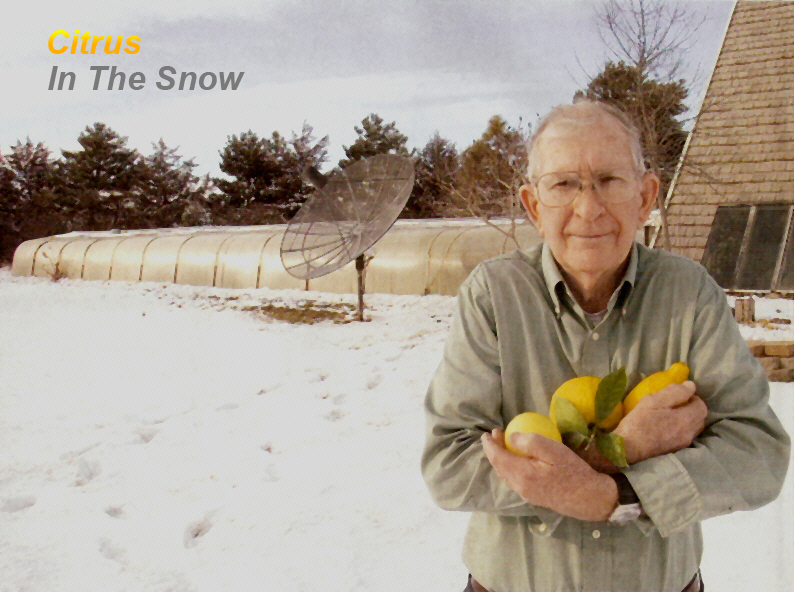
Retiree Russ Finch has developed a clever low-cost approach to keeping the inside of a northern latitude greenhouse temperate year round using underground warmth, i.e. geothermal heat. Rather than a complex and expensive system involving an anti-freeze fluid controlled with pumps and valves, he designed a simple low-cost system with fans blowing air through plastic tubes buried about 2 meters below the surface. The ground at that depth stays constant at about 50°F (10°C) year round. He grows oranges, lemons, and many other tropical fruits and vegetables in his greenhouse.
… retired mailman Russ Finch grows oranges in his backyard greenhouse without paying for heat. Instead, he draws on the earth’s stable temperature (around 52 degrees in his region) to grow warm weather produce- citrus, figs, pomegranates – in the snow.
Finch first discovered geothermal heating in 1979 when he and his wife built it into their 4400-square-foot dream home to cut energy costs. Eighteen years later they decided to add a 16’x80′ greenhouse in the backyard. The greenhouse resembles a pit greenhouse (walipini) in that the floor is dug down 4 feet below the surface and the roof is slanted to catch the southern sun.
To avoid using heaters for the cold Nebraska winter nights, Finch relies on the warm underground air fed into the greenhouse via plastic tubing under the yard and one fan.