Category Archives: Living in Space

Videos: “Space to Ground” ISS report – Mar.14.2020

Here is the latest episode in NASA’s Space to Ground weekly report on activities related to the International Space Station:

** Down to Earth – Tip Of The Iceberg

In this episode of “Down to Earth – Tip of the Iceberg,“ NASA astronaut Nick Hague shares how his time living and working in space changed his perception of life back on Earth. #SpaceStation20th

** Expedition 62 Inflight with Martin Van Buren High School – March 13, 2020

Aboard the International Space Station, Expedition 62 Flight Engineer Jessica Meir of NASA discussed life and research on the orbital outpost during an in-flight educational event March 13 with students at the Martin Van Buren High School in Queens Village, New York. Meir is in the final month of a six-and-a-half-month mission on the station, planning for a return to Earth in mid-April. During her mission, the crew in space has supported hundreds of research investigations, and she conducted three spacewalks with astronaut Christina Koch, including the first all-woman spacewalk Oct. 18, 2019.

** Expedition 63 Video File – Soyuz Qualification Training – March 13, 2020

Expedition 63 Space Station Crew Undergoes Final Training Outside Moscow Expedition 63 Soyuz Commander Anatoly Ivanishin of Roscosmos, Flight Engineers Ivan Vagner of Roscosmos and Chris Cassidy of NASA and their backups, Sergei Ryzhikov and Andrei Babkin of Roscosmos and Steve Bowen of NASA, conducted final qualification training for their upcoming International Space Station mission at the Gagarin Cosmonaut Training Center in Star City, Russia March 11 and 12. Ivanishin, Vagner and Cassidy are scheduled to launch on April 9 from the Baikonur Cosmodrome in Kazakhstan in the Soyuz MS-16 spacecraft for a six-month mission on the International Space Station.

** NASA Live: Earth Views from the Space Station – The ESA HDEV (High Definition Earth Viewing) camera originally used for the ISS live view streaming stopped working in July 2019.

Currently, live views from the ISS are streaming from an external camera mounted on the ISS module called Node 2. Node 2 is located on the forward part of the ISS. The camera is looking forward at an angle so that the International Docking Adapter 2 (IDA2) is visible. If the Node 2 camera is not available due to operational considerations for a longer period of time, a continuous loop of recorded HDEV imagery will be displayed. The loop will have “Previously Recorded” on the image to distinguish it from the live stream from the Node 2 camera.

=== Amazon Ad ===

Outpost in Orbit:
A Pictorial & Verbal History of the Space Station

=== Amazon Ad ===

Alcohol in Space:
Past, Present and Future

Videos: “Space to Ground” ISS report – March.6.2020

Here is the latest episode in NASA’s Space to Ground weekly report on activities related to the International Space Station:

** ISS National Lab Mission Overview: SpaceX CRS-20

The International Space Station (ISS) U.S. National Laboratory is sponsoring more than 20 payloads slated to launch onboard SpaceX’s 20th commercial resupply services (SpaceX CRS-20) mission. These payloads represent a diverse mix of research and development seeking to leverage the unique space-based environment of the orbiting laboratory to improve life on Earth. The SpaceX CRS-20 mission is slated for launch no earlier than March 6 at 11:50 p.m. ET from Cape Canaveral Air Force Station in Florida. This video highlights many of the ISS National Lab-sponsored investigations on this mission.

** “What’s on Board” Science Briefing – SpaceX CRS-20 Mission

This is NASA’s “What’s on Board” science briefing at held on Thursday, Feb. 20 at Kennedy Space Center, FL where the science investigations launching on the next SpaceX commercial resupply flight to the International Space Station are presented.]

** Jessica Meir speaks with students in Seattle

Aboard the International Space Station, Expedition 62 Flight Engineer Jessica Meir discussed life and research on the orbital laboratory during an in-flight education event March 2 with middle school students from the greater Seattle, Washington region preparing for a Microsoft Education-hosted design challenge at Seattle’s Museum of Flight. Meir has been in orbit since September and will return to Earth aboard a Russian Soyuz spacecraft in mid-April.

** Expedition 62: Live Interviews Jessica Watkins and Anne Roemer – next astronaut selection.

== Amazon Ad ==

Outpost in Orbit:
A Pictorial & Verbal History of the Space Station
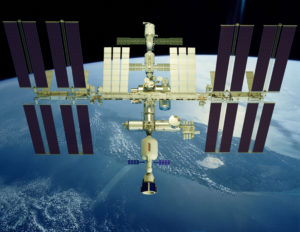
Axiom Space contracts SpaceX to take private astronauts to the ISS

SpaceX gets a second contract for a commercial human mission to low earth orbit on the Crew Dragon just a couple of weeks after the first one:

Axiom Space plans first-ever fully private human spaceflight mission
to International Space Station

HOUSTON – Today Axiom Space announced it is planning history’s first fully private human spaceflight mission to the International Space Station.

Axiom has signed a contract with SpaceX for a Crew Dragon flight which will transport a commander professionally trained by Axiom alongside three private astronauts to and from the International Space Station. The mission, set to launch as soon as the second half of 2021, will allow the crew to live aboard the ISS and experience at least eight days of microgravity and views of Earth that can only be fully appreciated in the large, venerable station.

“This history-making flight will represent a watershed moment in the march toward universal and routine access to space,”

Axiom CEO Michael Suffredini said.

“This will be just the first of many missions to ISS to be completely crewed and managed by Axiom Space – a first for a commercial entity. Procuring the transportation marks significant progress toward that goal, and we’re glad to be working with SpaceX in this effort.”

This is the first of Axiom’s proposed “precursor missions” to the ISS envisioned under its Space Act Agreement (SAA) with NASA. Discussions with NASA are underway to establish additional enabling agreements for the private astronaut missions to ISS.

Axiom plans to offer professional and private astronaut flights to ISS at a rate of up to two per year to align with flight opportunities as they are made available by NASA, while simultaneously constructing its own privately funded space station.

“Since 2012, SpaceX has been delivering cargo to the International Space Station in partnership with NASA and later this year, we will fly NASA astronauts for the first time,”

said SpaceX President and Chief Operating Officer Gwynne Shotwell.

“Now, thanks to Axiom and their support from NASA, privately crewed missions will have unprecedented access to the space station, furthering the commercialization of space and helping usher in a new era of human exploration.”

With its team’s vast experience in human spaceflight, Axiom serves as a one-stop shop overseeing all elements of its missions. In addition to contracting with SpaceX for a Crew Dragon vehicle to transport its crew to the ISS, Axiom’s turnkey service for the mission – two days in transit and at least eight days aboard the ISS – includes training, mission planning, hardware development, life support, medical support, crew provisions, hardware and safety certifications, on-orbit operations and overall mission management.

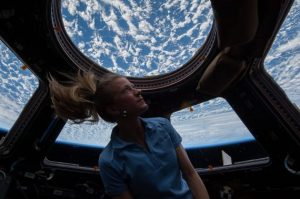
A phenomenal view – the world as seen by NASA astronaut Karen Nyberg from the Cupola of the International Space Station.

NASA recently selected Axiom’s proposal to attach its space station modules to the ISS beginning in the second half of 2024, ultimately creating a new ‘Axiom Segment’ which will expand the station’s usable and habitable volume. When the ISS reaches its retirement date, the Axiom complex will detach and operate as a free-flying commercial space station.

By serving the market for immediate access to space while building the future platform for a global user base, Axiom is leading the development and settlement of low Earth orbit now and into the future.

About Axiom Space: Axiom Space was founded in 2016 with the aim of creating humanity’s home in space to ensure a prosperous future for everyone, everywhere. While building and launching the Axiom Segment of the International Space Station to one day form the world’s first commercial space station, Axiom provides access to the ISS today by conducting crewed missions for professional and private astronauts. More information about Axiom can be found at www.axiomspace.com.

===

See also:

== Amazon Ad ==

See You In Orbit?:
Our Dream Of Spaceflight

Videos: “Space to Ground” ISS report – Feb.28.2020

Here is the latest episode in NASA’s Space to Ground weekly report on activities related to the International Space Station:

** “Down to Earth – A Work of Art

In this episode of “Down to Earth – A Work of Art,“ former NASA astronaut Nicole Stott recalls seeing home below during her time aboard the station. Stott explains how she experienced a shift in worldview known as “the Overview Effect,” a term coined by space philosopher Frank White.

** Jessica Meir speaks with students in Florida

In-flight event — Expedition 62 flight engineer Jessica Meir speaks with the Lee County School District in Florida.

** Space Station Crew Member Swears in Army Recruits

Aboard the International Space Station, Expedition 62 Flight Engineer Drew Morgan of NASA, a colonel in the U.S. Army, swore in new Army recruits gathered at the Space Center Houston visitors center in a ceremony conducted from orbit Feb. 26. Morgan, who launched to the orbital complex last July, is slated to return to Earth April 17 to complete a 272-day mission.

== Amazon Ad ==

Outpost in Orbit:
A Pictorial & Verbal History of the Space Station

Videos: “Space to Ground” ISS report – Feb.21.2020

Here is the latest episode in NASA’s Space to Ground weekly report on activities related to the International Space Station:

** NASA & Axiom Space Designing Commercial Expansion Of Space Station – Scott Manley

It’s been 4 years since NASA first seriously suggested the idea of commercial expansion of the International Space Station, and at the end of January they announced an agreement with Axiom Space to begin designing the extension with launches happening possibly as early as 2024. The specific details of the agreement are not clear at this time, however it’s known that the initial phase is a design study and business case analysis with reviews required before approving the next phase. https://www.nasa.gov/nextstep/issport

** NASA Astronaut Jessica Meir discusses the Zero-G Oven with Michigan students

Aboard the International Space Station, Expedition 62 Flight Engineer Jessica Meir of NASA discussed the revolutionary Zero-G oven recently used on the orbital outpost during an in-flight question and answer session Feb. 19 with students from the East Middle School in Grand Blanc, Michigan. The oven was launched on a Northrop Grumman Cygnus cargo ship last November, and, along with cookies baked in the oven, was returned to Earth in January on a SpaceX/Dragon resupply vehicle.

** OSCAR: NASA is developing tech for recycling in space

The Orbital Syngas Commodity Augmentation Reactor, or OSCAR, is an Early Career Initiative project funded by NASA’s Space Technology Mission Directorate in 2018. Work on OSCAR has demonstrated new ways to manage trash and waste in space by offering new options for safe disposal and the potential to transforming it into useful resources.

OSCAR has a reactor that uses heat, oxygen and steam to turn things like food packaging, old clothing and even human waste into water and a gas mixture. Industry calls this mixture synthetic gas or syngas, and it is primarily carbon dioxide with small amounts of hydrogen, carbon monoxide, and methane. Molecules from syngas can be used as building blocks for beneficial products like fuel for the spacecraft. The crew can also vent these gases for easy trash disposal.

On Dec. 11, 2019, OSCAR reached a major milestone when it launched on a Blue Origin New Shepard rocket. This suborbital flight added around three minutes of valuable microgravity performance data to OSCAR’s previous data from lab and drop tests. During the flight, OSCAR was able to autonomously inject trash into the high temperature reaction chamber and collect targeted product gases.

To learn more about NASA’s investments in space technology, visit: https://www.nasa.gov/spacetech

See also:

== Amazon Ad ==

Outpost in Orbit:
A Pictorial & Verbal History of the Space Station