Category Archives: Space participation

31 student teams to compete in Mars Society’s University Rover Challenge

The Mars Society gets a good response to their University Rover Challenge contest:

URC Registration Sets New Record with 31 Student Teams Set to Compete

The Mars Society is pleased to announce that 31 student teams from six countries and four continents have officially registered for the 2014 University Rover Challenge (URC), setting a new participation record for the annual international rover competition. Countries represented this year include the United States, India, Egypt, Poland, Canada and Bangladesh.

A sampling of some of the participating universities include: Cornell University, Warsaw University of Technology, Yale University, Cairo University, Częstochowa University of Technology, University of Michigan, Military Institute of Science & Technology and York University. To view the full list of schools involved in the URC, please click here.

Scheduled for May 29-31, 2014, the URC is the world’s premier robotics competition for college students.  Held annually in the desert of southern Utah, URC challenges student teams to design and build the next generation of Mars rovers that will one day work alongside astronauts exploring the Red Planet. Launched in 2006, the URC consistently draws an international field of the most talented and promising science, engineering and computer science students.

“In 2013, we shattered every previous URC milestone and had our winning team from Bialystok University of Technology score an almost unthinkable 493 points out of 500.  For 2014 our registered field has more than doubled over last year, and we are eager to welcome many new teams to the competition.  Everybody involved in the competition is getting excited. 2014 is going to be an incredible year for URC!”, said URC Director Kevin Sloan.

To view regular updates about the URC competition, please visit our web site or Facebook page.
Zooniverse passes one million citizen science volunteers

Congratulations to Zooniverse on gaining their one millionth volunteer for their many citizen science projects after starting seven years ago : One Million Volunteers – Zooniverse

This map shows the global distribution of volunteers.

Here’s a list of scientific publications resulting from Zooniverse activities:  Zooniverse Publications.

A posting on the Planet Hunters blog about the milestone : 15 percent of 1 million – Planet Hunters

This accomplishment is yours too. Our estimate is over 280,000 people world wide (unregistered and registered volunteers) have participated in Planet Hunters. 150,000 registered Zooniverse volunteers have classified at least one Planet Hunters light curve. Roughly 15% of the 1 million registered Zooniverse volunteers have contributed to Planet Hunters science. That’s a huge representation! 

JP Aerospace sale on flights of MiniCubes to NearSpace

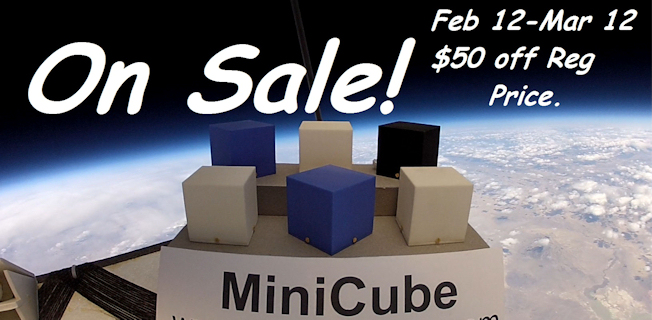
John Powell of JP Aerospace sends me a notice of their sale on flights of the Minicubes to high altitudes on their balloon and airship missions :  MiniCube Flights on Sale! – JP Aerospace Blog –

minicube_sale2mPhoto of MiniCubes in flight at 100,000 feet.

A MiniCube is a payload container for people to fly their projects on our high altitude balloons and airship missions.

MiniCubes can be used for research, commercial applications, art, inspiration or anything you can imagine.

Run your own space program!

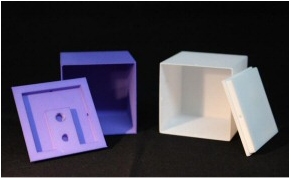
The MiniCube is small plastic box five cm on a side. On the base is a standard camera tripod mount. You put your project inside the cube and mail it to JP Aerospace. We carry it to the edge of space on a high altitude balloon then send it back to you.

MiniCube and flight all included price: regularly $320 now on sale for $270

Flights available April 26th and September 27, 2014

Sale ends March 12th 2014.

minicubes

When you purchase a MiniCube you will get a MiniCube and a flight. After the flight your MiniCube will be returned to you along with a data sheet about the mission and a CD with images and video from the flight.

  • MiniCube Home Page
  • MiniCube Store
  • JP Aerospace Home Page
  • MiniCube on facebook

The next MiniCube mission: High altitude balloon flight to 100,000 feet, April 26, 2014

Thank you,

John Powell
President
JP Aerospace, America’s OTHER Space Program

The Astronomy Legacy Project – digitizing more than a century of astronomical photos

The Astronomy Legacy Project, supported by the nonprofit Pisgah Astronomical Research Institute (PARI)has opened an Indiegogo crowdfunding campaign to raise $60,000 to finance their program of digitizing stellar photographic films and plates:

Before the invention of digital cameras in the 1990’s, and for more than 120 years before that, astronomers put in several million telescope hours photographing the night sky – measuring star brightnesses, detecting comets, planets, nebulae, mapping our Galaxy, and building the foundations of our understanding of our Universe!  All of this raw beauty, and secrets yet to be discovered, are held as largely unexplored photographic images on thin, fragile pieces of glass.  Imagine digitizing these hundreds of thousands of photographic images with such high precision that the images appearing on your screen replicates the original. This digitization process is the heart of the Astronomy Legacy Project.

The Astronomy Legacy Project (ALP) will digitize the extensive and diverse set of twentieth century analog (photographic) astronomical data housed at the Astronomical Photographic Data Archive and make it available to the twenty-first century digital world.  Funding will help us to purchase the OPTEK 463 VSM, a highly precise scanning machine that we have chosen to do the digitizing. A staff member will receive 10% of the funding who is responsible for administration of the scanning process with volunteers.

Your donation will honor and preserve the legacy of generations of astronomers and inspire the next generation of space science enthusiasts and people everywhere who are inspired by the mystery and beauty of the night sky!

Exploration. Discovery. Inspiration. from Michael Castelaz, Ph.D. on Vimeo.

Space tourism history + Video: Private Space Episode 1 – Space laws

Space historian Roger Launius recently posted two items about the history of space tourism:

===

Here’s is the first episode of the Private Space Web Series  from the photo/video production company LifeAssembled :