Category Archives: Space participation

Uwingu offers Dads a Farther’s Day gift on Mars

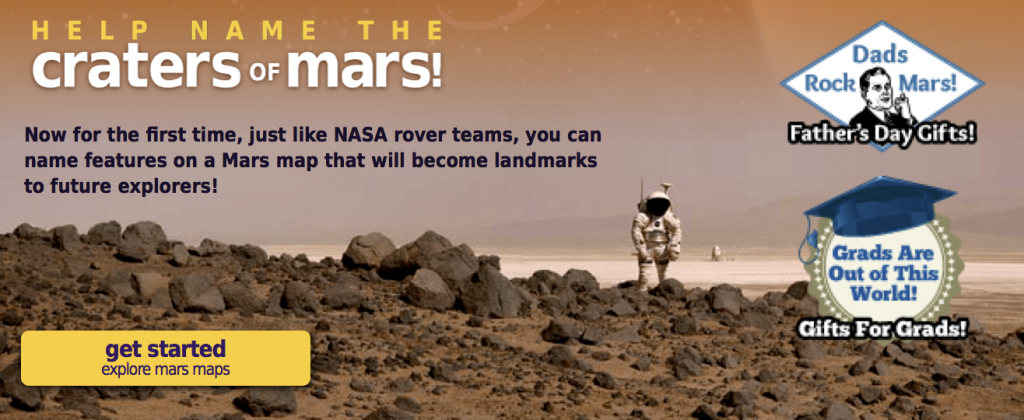
The Uwingu Mother’s Day effort attracted over 1200 people to name a crater on Mars for their Moms. Now comes their Dads’ turn. For Father’s Day, Uwingu has opened the Dad’s Rock Mars! campaign:

 Uwingu Offers Dads an Out of This World Father’s Day Gift

For_Dads_&_Grads

As a part of Uwingu’s “Dad’s Rock Mars” Father’s Day project, gift givers visiting Uwingu’s web site at www.uwingu.com have the first-ever opportunity to honor Dads for Father’s Day by naming a crater for him on Uwingu’s crowdsourced Mars map. The map will be carried to the surface of Mars on an upcoming space mission sponsored by Mars One.

Uwingu, a company helping people personally connect with space exploration and astronomy, announced today this unique gifting experience, which will last until Father’s Day, June 15. Each crater named for Father’s Day will be recognized with a handsome, official certificate of naming.

Half of the revenue Uwingu receives from the craters bought and named on Uwingu’s Mars map will go to fuel The Uwingu Fund, which provides grants to further space education, exploration and research. Prices range from $5 to $5,000 depending on crater size. There are almost 590,000 unnamed, scientifically cataloged craters on Uwingu’s crowdsourced Mars map.

“Dads of all ages will love this really unique, out this world Father’s Day gift for 2014. Dad may not be able to go to Mars himself this year, but his name can be put on the first ever public naming effort for Mars, and he’ll know that it’ll be going to Mars when Mars One launches its first lander mission in 2018,” said Alan Stern, Ph.D., planetary scientist, and founder and CEO of Uwingu; Stern formerly directed all science programs and missions at NASA.

Mars One partners with Endemol to broadcast crew selection and training

An announcement from Mars One:

Mars One Teams with Endemol for Worldwide TV Event 

  • Endemol-owned Darlow Smithson Productions (DSP) will exclusively follow the selection and training of the world’s first one way astronauts to Mars
  • Candidates chosen from over 200,000 applicants will be tested to the extreme in one of the most extraordinary and challenging job interviews ever seen
  • The winners will be the first to make the 300 million-mile journey to establish permanent human life on the red planet
  • DSP’s landmark production will be broadcast around the world and further announcements are due to follow soon

London / Amersfoort, 2nd of June 2014. Mars One and multi-award winning factual producer DSP (an Endemol company) today announced they have entered an international partnership to screen the mission to send the world’s first one way astronauts to Mars.

DSP becomes the exclusive worldwide production partner for the Mars One astronaut selection and training program, which will see people from all walks of life undergo one of the most extraordinary and challenging assessment processes ever seen.

705 highly motivated candidates, shortlisted from over 200,000 who applied to become future inhabitants of Mars, will be tested to the extreme as part of an elite training program run by a panel comprised of pre-eminent scientists, adventurers and astronauts.

In order to qualify for the mission, each individual must demonstrate that they have acquired the intricate knowledge and skills as well as the high levels of psychological and physical performance needed for the most long distance voyage humankind has ever embarked upon.

DSP will document the aspiring pioneers’ astonishing journeys every step of the way in the lead up to the mission, which will see the winners become the first to make the 300 million-mile, one way trip to establish permanent human life on the red planet.

Human settlement on Mars is possible today with existing technologies and Mars One’s mission plan integrates components that are well tested and readily available from industry leaders worldwide. However, no return trip can be made. Instead Mars One will send additional crews every two years to further build the pioneering colony.

With the astronaut selection process already underway, the first instalments of DSP’s landmark production are expected to begin broadcasting around the world in early 2015. Further details and announcements are due to follow soon.

Bas Lansdorp, Co-founder & CEO of Mars One said, “Bringing the story of our incredibly brave aspiring Martians to the world now officially begins with what we feel is a perfect partnership. Our team felt all along that we needed a partner whose strength lies in factual storytelling to an international audience. DSP will provide that to Mars One, while allowing our selection committee to maintain control of the astronaut selection process. This really is a perfect fit for both of us!”

Iain Riddick, DSP’s Head of Special Projects and Digital Media, comments: “It is a great privilege for DSP to be chosen to exclusively follow the incredible journeys of those who will make humankind’s first footprint on Mars. This has to be the world’s toughest job interview for what is without question a world-first opportunity and the human stories that emerge will captivate and inspire generations across the globe.”

About DSP

DSP has a long established reputation for producing world class television programmes and theatrical documentaries for UK, US and international broadcasters. The company has achieved global industry recognition for its ground breaking output and has received more than 40 industry awards, including accolades from BAFTA, The Peabody Awards, The Royal Television Society and the US Academy of Television, Arts and Sciences.

Credits include: The Mill (Channel 4), Richard III: The King in the Car Park (Channel 4); How to Build a Bionic Man (Channel 4 and Smithsonian Channel); Earth From Space (NOVA and Discovery Canada), ‘Hawking’ (PBS and Channel 4); Dead or Alive (National Geographic Channels International Wild); Nazi Megastructures (National Geographic Channel) and Neil Armstrong: First Man on the Moon (BBC Two).

DSP is part of Endemol, a world leading content creator with a global network of operations in over 30 countries including the USA, the UK, Spain, Italy, France, Germany and the Netherlands, as well as Latin America, India, Israel, South Africa and Australia.

For more information visit www.dsp.tv

About Mars One

Mars One is a not-for-profit foundation that will establish a permanent human settlement on Mars. Mars One has developed a realistic mission plan, built upon existing technologies available from proven aerospace suppliers worldwide. Several of these suppliers are already under contract of Mars One, including Lockheed Martin and Paragon Space Development. Work on the first unmanned mission, scheduled for launch in 2018, has already started.

Mars One plans to land the first crew on Mars by 2025. The ambitious schedule is possible because the crews departing to Mars go there to stay. Instead of trying to bring crews back to Earth, Mars One will send additional crews every two years, establishing the first human settlement outside of the Earth. Mars One will select and train crews of astronauts. The search for astronauts began in April 2013. More than 200,000 applied for this first call for future Mars inhabitants.

The first footprint on Mars and lives of the crew thereon, literally the Next Giant Leap for Mankind, will inspire generations to come and will be the world’s biggest media event.

For more information visit www.mars-one.com

About Endemol

Endemol is a world leading creator, producer and distributor of multiplatform entertainment. The company annually produces over 15,000 hours of programming across scripted and non-scripted genres, including drama, reality TV, comedy, game shows, entertainment, factual and kids programming.

Endemol comprises a global network of around 90 companies in more than 30 countries and works with over 300 broadcasters, digital platforms and licensees worldwide. The business covers development, production, marketing, distribution, franchise management and multi-platform initiatives including digital video, gaming and apps.

Endemol’s credits in non-scripted entertainment include worldwide hits such as Big Brother, Deal or No Deal, Wipeout, The Money Drop and Your Face Sounds Familiar. The company’s growing portfolio of award winning drama and comedy includes international titles such as Ripper Street, Peaky Blinders, Hell on Wheels, Hot in Cleveland, Kirstie, Leverage, Home and Away, Death Comes to Pemberley, Black Mirror, The Crimson Field and The Fall.

As one of the world’s largest independent content distributors, Endemol launches over 80 new entertainment formats a year on broadcast networks across the globe and distributes more than 33,000 hours of finished programming. The company’s creative teams around the world are continuously developing new ideas that are shared across the Endemol network.

Endemol is headquartered in Amsterdam, the Netherlands.

For more information visit www.endemol.com

– See more at: http://www.mars-one.com/news/press-releases/mars-one-teams-with-endemol-for-worldwide-tv-event#sthash.yu6xriyo.dpuf
Citizen science: The Milky Way Project classifies 1M images + New Kepler data for Planet Hunters

The Milky Way Project at the Zooniverse citizen science site has accomplished a lot in a short time: 1,000,000 Classifications and 7 Languages – The Milky Way Project

The Milky Way Project has now passed one million classifications since its relaunch a few months ago. The project is currently 75% complete, meaning there are still many, many images left to classify. Which is fine because in fact the project has become truly international lately – with citizen scientists around the world now able to participate in English, Spanish, German, French, Indonesian, Polish and Danish. There are more languages on the way too!

===

The Kepler Observatory was severely crippled last year due to the failure of a reaction wheel needed to maintain the pointing precision of the space telescope. The Kepler K2 recovery plan will return the observatory to planet finding by taking advantage of solar radiation pressure to maintain the pointing alignment.

This is good news for the Planet Hunters citizen science program, which will now get a stream of new data from the space observatory: Welcome to the Era of K2 – Planet Hunters

ISEE-3 Reboot Project takes command of the spacecraft

The ISEE-3 Reboot Project (see earlier post) is now talking with the spacecraft :

We Are Now In Command of the ISEE-3 Spacecraft

The ISEE-3 Reboot Project is pleased to announce that our team has established two-way communication with the ISEE-3 spacecraft and has begun commanding it to perform specific functions. Over the coming days and weeks our team will make an assessment of the spacecraft’s overall health and refine the techniques required to fire its engines and bring it back to an orbit near Earth.

First Contact with ISEE-3 was achieved at the Arecibo Radio Observatory in Puerto Rico. We would not have been able to achieve this effort without the gracious assistance provided by the entire staff at Arecibo. In addition to the staff at Arecibo, our team included simultaneous listening and analysis support by AMSAT-DL at the Bochum Observatory in Germany, the Space Science Center at Morehead State University in Kentucky, and the SETI Institute’s Allen Telescope Array in California.

Of course this effort would not have been possible without the assistance of NASA and the Space Act Agreement crafted by NASA Headquarters, NASA Ames Research center, and the System Solar System Exploration Research Virtual Institute (SSERVI).

For further information on the ISEE-3 Reboot Project please visit our website at http://spacecollege.org/isee3 A much more detailed description of our First Contact efforts and future plans will be published on our website next week.


NASA green-lights citizen science group’s effort to contact & redirect ISEE-3 spacecraft

I’ve written about the ISEE-3 Reboot Project effort by a private non-profit group to reconnect with NASA’s 35 year old International Sun-Earth Explorers (ISSE) spacecraft and direct it back to its original solar science mission. The group recently carried out a successful crowd-funding campaign to pay for the initial phase of the project. NASA has now given them the green-light to communicate with and take control of the spacecraft:

NASA Signs Agreement with Citizen Scientists Attempting
to Communicate with Old Spacecraft

NASA has given a green light to a group of citizen scientists attempting to breathe new scientific life into a more than 35-year old agency spacecraft.

The agency has signed a Non-Reimbursable Space Act Agreement (NRSAA) with Skycorp, Inc., in Los Gatos, California, allowing the company to attempt to contact, and possibly command and control, NASA’s International Sun-Earth Explorer-3 (ISEE-3) spacecraft as part of the company’s ISEE-3 Reboot Project. This is the first time NASA has worked such an agreement for use of a spacecraft the agency is no longer using or ever planned to use again.

international_cometary_explorer_isee3_art[1]International Sun-Earth Explorer-3 (ISEE-3)

The NRSAA details the technical, safety, legal and proprietary issues that will be addressed before any attempts are made to communicate with or control the 1970’s-era spacecraft as it nears the Earth in August.

“The intrepid ISEE-3 spacecraft was sent away from its primary mission to study the physics of the solar wind extending its mission of discovery to study two comets.” said John Grunsfeld, astronaut and associate administrator for the Science Mission Directorate at NASA headquarters in Washington. “We have a chance to engage a new generation of citizen scientists through this creative effort to recapture the ISEE-3 spacecraft as it zips by the Earth this summer.”

Launched in 1978 to study the constant flow of solar wind streaming toward Earth, ISEE-3 successfully completed its prime mission in 1981. With remaining fuel and functioning instruments, it then was redirected to observe two comets. Following the completion of that mission, the spacecraft continued in orbit around the sun. It is now making its closest approach to Earth in more than 30 years.

The goal of the ISEE-3 Reboot Project is to put the spacecraft into an orbit at   a gravitationally stable point between Earth and the sun known as Lagrangian 1 (L1). Once safely back in orbit, the next step would be to return the spacecraft to operations and use its instruments as they were originally designed. ISEE-3’s close approach in the coming weeks provides optimal conditions to attempt communication. If communications are unsuccessful, the spacecraft will swing by the moon and continue to orbit the sun.

NASA has shared technical data with these citizen scientists to help them communicate with and return data from ISEE-3. The contributions of any citizen science provided by the spacecraft, if it is successfully recovered, depend on the current condition of its instruments. New data resulting from the project will be shared with the science community and the public, providing a unique tool for teaching students and the public about spacecraft operations and data gathering. The data also will provide valuable information about the effects of the space environment on the 36-year old spacecraft.

The ISEE-3 mission opened new pathways for scientific exploration, helping scientists better understand the sun-Earth system, which at its most turbulent can affect satellites around Earth and disrupt our technological infrastructure.

To learn more about the ISEE-3 Reboot Project, visit: http://spacecollege.org/isee3

To learn more about ISEE-3, visit: http://go.nasa.gov/1mSskQs