Category Archives: Space participation

Program sends educators to Space Camp

The Honeywell Educators @ Space Academy project sends teachers to Space Camp in Huntsville, Alabama:

this professional development program is designed to help middle school math and science teachers from around the world become more effective educators in science, technology, engineering, and math. Educators are empowered with supplemental teaching techniques through simulated astronaut training and innovative educational tools that help bring science to life in the classroom.

Here’s are article about teachers in Illinois who participated in the program: At Space Academy, teachers learn to help students reach for the stars – Chicago Sun-Times.

Universe Awareness: introducing kids to astronomy

UNAWE or Universe Awareness is a program started in Europe that seeks

to educate children aged 4-10 years (especially those from underprivileged communities) about astronomy because it embodies a unique combination of scientific and cultural aspects:

  • Our awe-inspiring Universe captures the imagination of children, making it a great stepping-stone to introduce youngsters to science and technology. Indeed, many scientists can trace their interest in science to a moment as a young child when they were first introduced to the wonders of the cosmos.
  • Considering the vastness and beauty of the Universe and our place within it provides a special perspective that can help broaden the mind and stimulate a sense of global citizenship and tolerance.

The organization now has projects in 47 countries. Their website has a lot of information and resources about the program, how to get involved, and about amateur astronomy.

Here’s an article about programs like UNAWE to attract young and old to astronomy: Starstruck: Welcome to the universe of amateur astronomers – the Poughkeepsie Journal.

Students and educators to experience rocket week at NASA Wallops

NASA’s Wallops Flight Facility on the Eastern Shore in Virginia will host the seventh RockOn! workshop, which starts this Saturday with over 60 student and faculty rocketeers participating. It will finish with a sounding rocket launch on Thursday,  June 26th :  Students and educators visit Virginia’s Eastern Shore to launch rocket – DCNewsRoom.

On Monday there will also start the week long Wallops Rocket Academy for Teachers (WRATs). Here is a NASA posting about both programs:

Rocket Week Launches June 21 at
NASA’s Wallops Flight Facility

Students and educators from across the United States will become “rocket scientists” during two workshops at NASA’s Wallops Flight Facility in Virginia this month.

RockOn Launch from June 20, 2013 with students looking on.
Image Credit: NASA

The seventh annual RockOn! workshop, conducted in partnership with the Colorado and Virginia Space Grant Consortia, will provide 61 community college and university students and instructors the opportunity to learn how to build a scientific payload for a suborbital rocket flight.  This workshop is June 21–26.

During the fourth annual Wallops Rocket Academy for Teachers (WRATs), June 23–27, 20 high school educators will receive instruction on the physics and math behind rocket flight and how to incorporate what they learn into classroom curriculum.

“These two workshops provide students and faculty the opportunity to expand their education,” said Joyce Winterton, Wallops senior advisor for education and leadership development. “It’s a hands-on learning experience that will prepare participating students for their future careers in science, technology, engineering, and math (STEM) and provide the educators with information to expand opportunities for students in the classroom.”

During RockOn!, participants will learn the basics of experiment design including programming and electronics.  The students will construct experiments to measure acceleration, spin rate, radiation, humidity, pressure and temperature during a rocket flight.

Their experiments, built in only three days, will then be incorporated into a rocket payload for launch on a Terrier-Improved Orion suborbital sounding rocket at 5:30 a.m. EDT Thursday, June 26. After flying to nearly 70 miles in altitude, the payload carrying the experiments will land in the Atlantic Ocean where it will be recovered. The participants are expected to have their experiments in hand later in the day to begin data analysis.

In addition to the RockOn! experiments, a group of more complex experiments from the RockSat-C program also will be flying on the sounding rocket. These experiments are developed by students, many of whom have participated in a previous RockOn! workshop, from Mitchell Community College, Statesville, North Carolina; West Virginia University, Morgantown; Carthage College, Kenosha, Wisconsin; Temple University, Philadelphia; and Howard University in Washington.

About 50 students and instructors participating in RockSat-C will come to Wallops on Friday, June 20 to begin their final experiment integration and to witness the launch.

“The RockOn! and RockSat-C programs are part of an effort to expand students’ skills in developing experiments for spaceflight,” said Chris Koehler, director of the Colorado Space Grant Consortium.” These two programs, coupled with RockSat-X, which requires an even more advanced skillset, will help prepare these students for future careers in the aerospace industry and at NASA.”

In addition, more than 100 small cubes carrying experiments developed by pre-college students will launch with RockSat-C as part of the Cubes in Space program. Experiments vary from measuring changes in the electromagnetic field as the experiment moves through the ionosphere to determine whether the nano-computers would survive spaceflight, to observing the changes to the properties of a marshmallow as a result of the intense g-force of the launch. Cubes in Space is a partnership between Rubik Learning Initiative, idoodlesoftware inc. and the Colorado Space Grant Consortium.

During WRATS, participants will receive instruction from Wallops engineers on the basics of rocketry, including Newton’s Laws, electronic fundamentals, drag and propulsion. This instruction will be applied to hands-on learning activities, including building and launching model rockets. The WRATS participants also will attend the RockOn! launch on June 26.

“Rocket Week is designed to inspire and increase the participants’ interest in STEM and prepare the students for their careers,” said Phil Eberspeaker, chief of the NASA Sounding Rocket Programs Office at Wallops.  “Through these programs, the participants will experience what it takes to be a rocket scientist.”

The RockOn! and WRATS workshops are supported by the NASA Sounding Rocket Program. RockOn! also is supported by NASA’s Office of Education and the National Space Grant College and Fellowship Program.

The June 26 launch will be shown live on Ustream beginning at 4:30 a.m. at  www.ustream.tv/channel/nasa-tv-wallops

The NASA Visitor Center at Wallops will open at 4:30 a.m. for viewing the launch, which is predicted to be visible only in the Wallops area.

For more information about the WRATS programs, visit: education.wff.nasa.gov

For more information on RockOn! and RockSat, visit:  spacegrant.colorado.edu/national-programs/rockon-2014-home

For more information about NASA’s education programs visit:  www.nasa.gov/education

Zooniverse news: Sunspotters wanted, an oddball in the Radio Galaxy Zoo, and more

A scan of  news and blog posts at Zooniverse citizen science projects:

The Sunspotter project was introduced quietly earlier in the year and the first round of classifications  has been declared a success and a new one is underway:

The goal

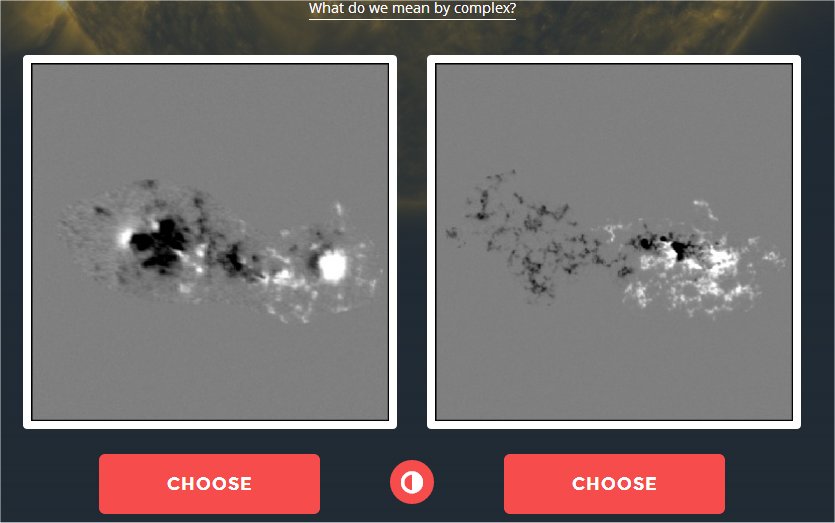
 is to determine the complexity of sunspot groups. It is well known (to solar physicists) that more complicated looking sunspot groups produce more solar flares than simple looking ones. But so far, scientists have not found a good way to quantify sunspot group complexity. This is not a task easily accomplished by a computer. Humans, on the other hand, can easily point to the more complex in a pair of objects, ideas, images, and so on.

The task is to judge relative complexity of sunspot groups:

SunspotComplexity

The Sunspotter blog has a several interesting posts about the sun, sun spots, solar weather and more

===
The Radio Galaxy Zoo project has turned up a pair of galaxies that seem to be connected despite measured at vastly different distances and velocities: Remarkable Discoveries Underway – Citizen Scientists fire up Radio Galaxy Zoo – Galaxy Zoo.

arg00025v9_lab[1]

===

Participants in the Planet Hunters project will look for exoplanets in data from the new K2 phase of the Kepler space observatory: Welcome to the Era of K2- Planet Hunters

Milky Way with 9 K2 field locations shown

“This is a photograph of the Milky Way with the approximate locations
of the 9 proposed Kepler K2 campaign target fields. The line shows
the ecliptic (Earth’s orbit plane) along which the Kepler Space
Telescope can maintain precision pointing. That line intersects the
galactic plane in two locations.
Credit: ESO/S. Brunier/NASA Kepler Mission.”
Click for higher resolution version.

===

The Milky Way Project finds “a wonderful synergy that can exist between citizen scientists, professional scientists, and machine learning”  :  New MWP paper outlines the powerful synergy between citizens scientists, professional scientists, and machine learning – The Milky Way Project

A new Milky Way Project paper was published to the arXiv last week. The paper presents Brut, an algorithm trained to identify bubbles in infrared images of the Galaxy.

Brut uses the catalogue of bubbles identified by more 35,000 citizen scientists from the original Milky Way Project. These bubbles are used as a training set to allow Brut to discover the characteristics of bubbles in images from the Spitzer Space Telescope. This training data gives Brut the ability to identify bubbles just as well as expert astronomers!

The paper then shows how Brut can be used to re-assess the bubbles in the Milky Way Project catalog itself, and it finds that more than 10% of the objects in this catalog are really non-bubble interlopers. Furthermore, Brut is able to discover bubbles missed by previous searches too, usually ones that were hard to see because they are near bright sources.

[…]

At first it might seem that Brut removes the need for the Milky Way Project –  but the ruth is exactly the opposite. This new paper demonstrates a wonderful synergy that can exist between citizen scientists, professional scientists, and machine learning. The example outlined with the Milky Way Project is that citizens can identify patterns that machines cannot detect without training, machine learning algorithms can use citizen science projects as input training sets, creating amazing new opportunities to speed-up the pace of discovery. A hybrid model of machine learning combined with crowdsourced training data from citizen scientists can not only classify large quantities of data, but also address the weakness of each approach if deployed alone.

===

A lot more data arrives for participants in the Disk Detective project to look for stars with disks of matter around them where planets could be forming: Good News Everyone! 272,000 More Subjects – Disk Detective.

World View Experience opens emblem design contest

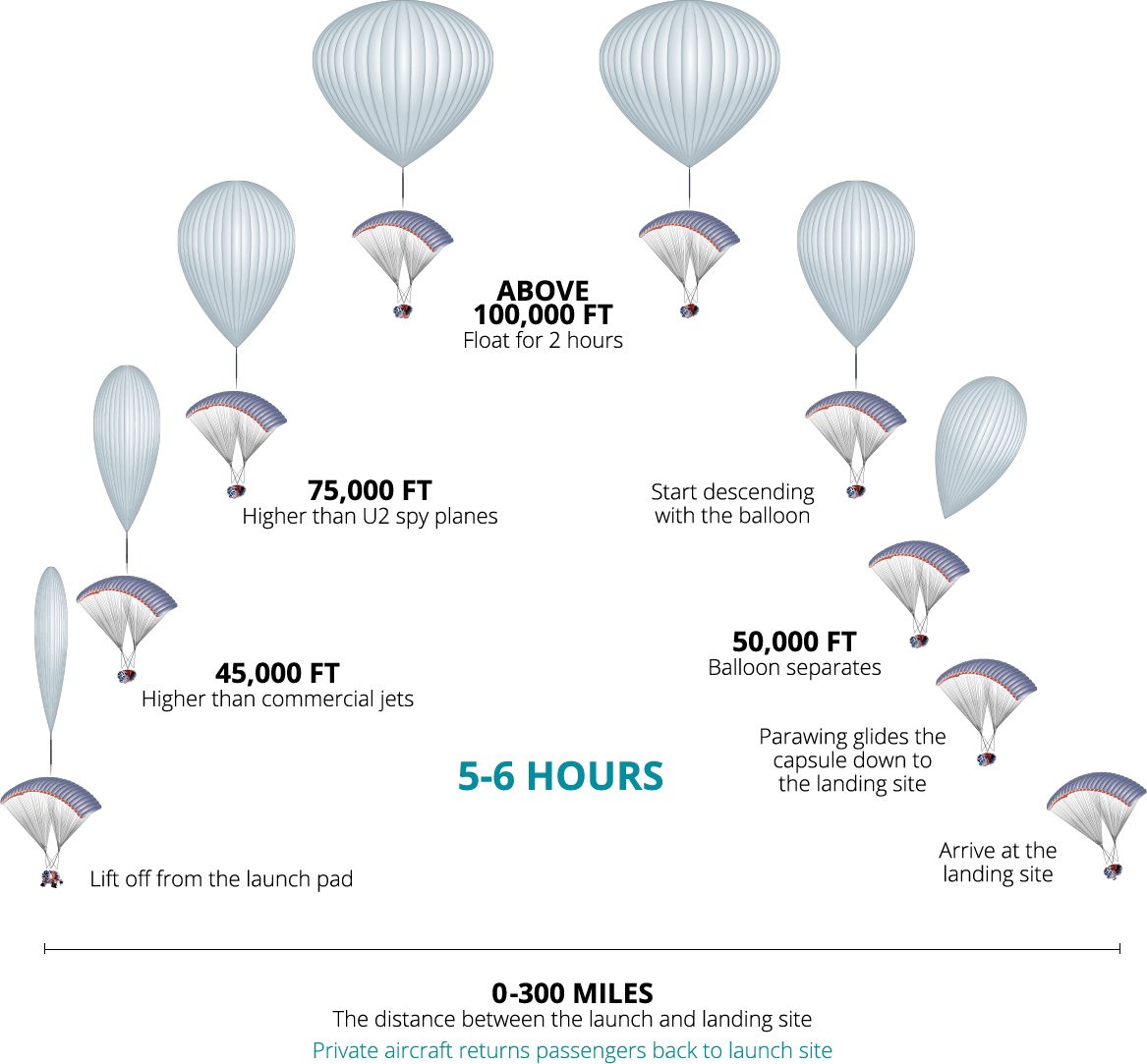
The World View Experience high altitude balloon travel venture has opened a contest to design their Voyager emblem:

Leave Your Mark On Spaceflight – Design Contest 

PassengerModule

 Enter and Submit Your Design

The Details:

Design the World View Voyager emblem; an iconic mark that will represent our group of spaceflight passengers, which we call “Voyagers,” for decades to come. Our community of Voyagers is comprised of people from all over the world that have reserved a flight with World View. Like any club, alumni organization, or society that has a logo, our Voyagers need one as well. Something separate from the World View logo itself, but a mark that they would be proud to wear on a flight uniform or display in a home.

This is your chance to leave a mark – on the industry that captivates our dreams.

The Prize: 

One designer will win $500 cash and an all expenses paid trip for themselves and one guest to our Inaugural Voyager Gala at the end of this year, where they’ll have the chance to witness the unveiling of part of the World View space capsule and rub elbows with NASA astronauts, celebrities, and leaders from industries the world over.

How to Enter:

Click on the “Enter and Submit Your Design” link above and submit your design through our online competition website. That’s also where you can find submission guidelines, official rules, and a link to our brand elements for use in your design.

The Deadline:

All designs must be submitted via the link above by 11:59 p.m. on June 23rd, 2014. Save the date! Bookmark this page. Set a reminder. Though we’d love to be flexible, our legal team won’t let us. So make sure your design hits our submission portal before time expires.

===

Enter your design at Contest registration

Graph-of-flight